Within Blue Book
Did Wichita Radar Reports Undermine Blue Book Explanations?
Radar reports from Wichita became part of a wider dispute over whether Blue Book relied too heavily on astronomical explanations.
On this page
- John Shockley and the Wichita radar claims
- Why Blue Book blamed stars and planets
- How the 1965 flap shaped Kansas UFO debate
Page outline Jump by section
Introduction
In the autumn of 1965, Wichita became part of a national argument about how the United States Air Force handled UFO reports. The dispute was not driven by a dramatic crash story or a single famous photograph. Instead, it centred on radar claims, witness reports across the Midwest, and growing criticism that Project Blue Book had become too quick to explain sightings away as stars or planets. Wichita weather observer John Shockley became one of the most quoted Kansas figures in that controversy after saying that unusual aerial targets had appeared on radar near the city during the wider 1965 UFO flap.[Wikipedia]WikipediaProject Blue BookProject Blue Book
 What made the Wichita episode important was not simply the sightings themselves, but the reaction to them. Blue Book’s explanations were increasingly challenged not only by civilian UFO groups, but also by scientists, journalists, radar personnel and some police officers involved in other Midwestern cases. Kansas therefore entered a broader national debate about whether Blue Book was conducting careful investigations or protecting the Air Force from embarrassment by forcing ordinary explanations onto difficult cases.[Wikipedia]WikipediaProject Blue BookProject Blue Book
John Shockley and the Wichita radar claims
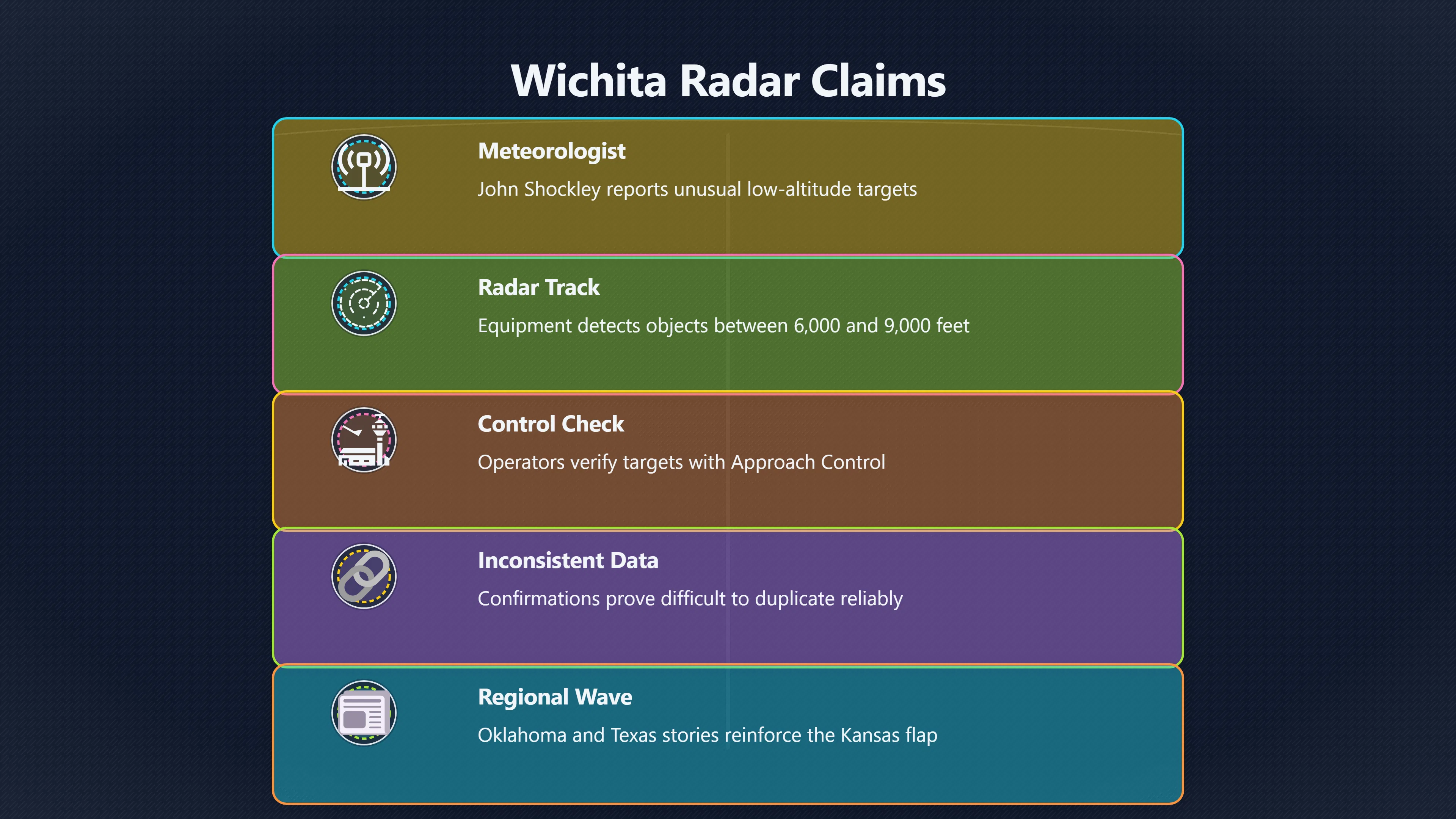
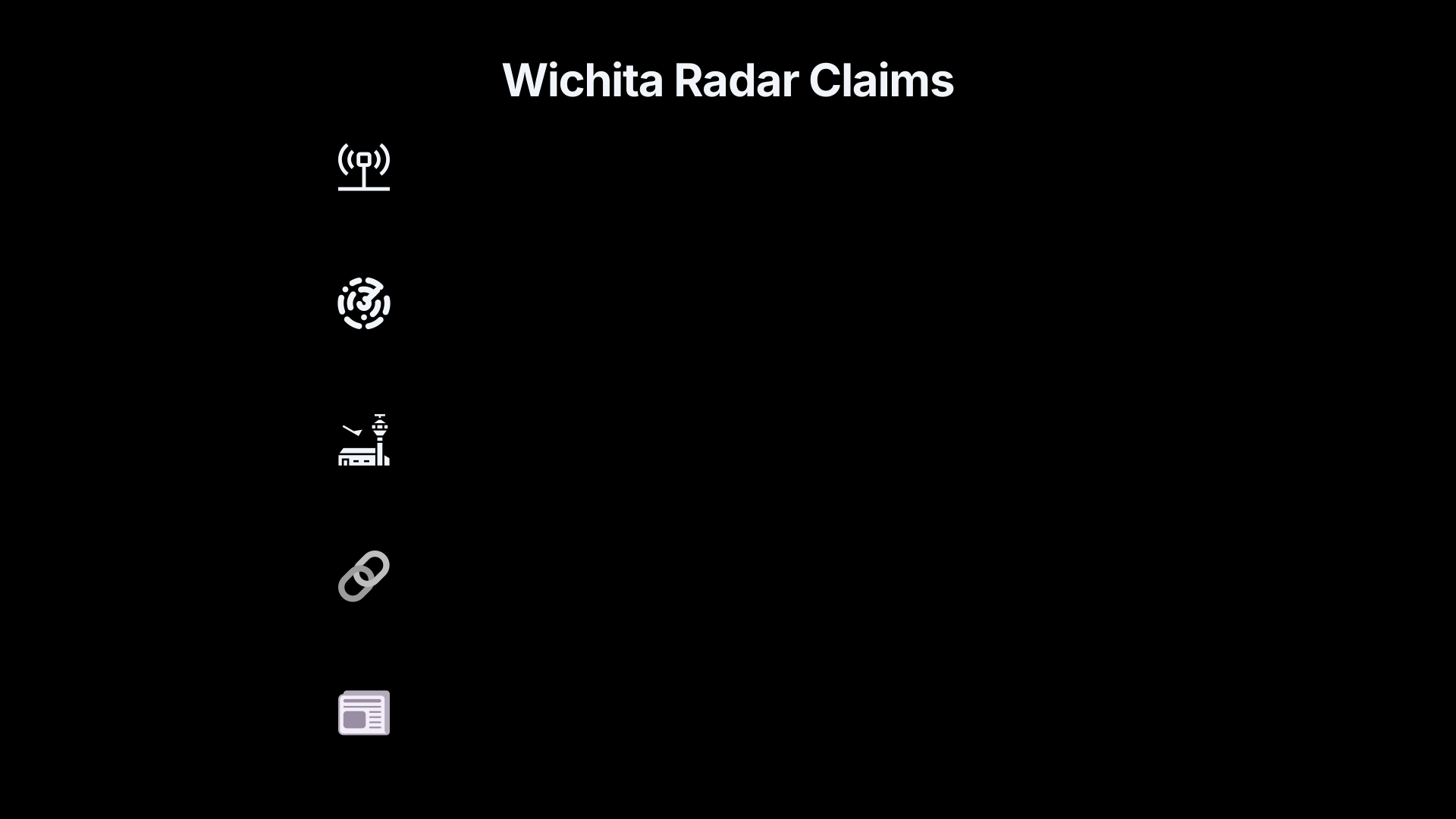
The central Kansas figure in the 1965 controversy was John Shockley, a Wichita meteorologist associated with the Weather Bureau. During the major Midwest UFO wave of August and September 1965, Shockley said radar equipment in the Wichita area detected unusual targets moving at relatively low altitudes. Accounts linked to Project Blue Book criticism later described these objects as appearing between roughly 6,000 and 9,000 feet.[Wikipedia]WikipediaProject Blue BookProject Blue Book
The reports mattered because radar claims carried a different weight from ordinary visual sightings. A bright light in the night sky could be dismissed as a star, aircraft light or atmospheric effect. Radar returns suggested that at least some observers believed there was a measurable object in the airspace. Shockley reportedly checked with Wichita Radar Approach Control, although surviving accounts suggest the radar confirmations were inconsistent and difficult to duplicate.[Internet Archive]archive.orgInternet Archive Full text of "Scientific Study Of Unidentified Flying ObjectsShockley checked with the Wichita Radar Approach Control, however they were notable to observe a target simultaneously, with the exceptio…
That uncertainty became part of the later debate. Supporters of the sightings argued that radar detections strengthened the credibility of witnesses across Kansas and neighbouring states. Sceptics countered that 1960s radar systems were vulnerable to false returns, temperature inversions, anomalous propagation and operator interpretation errors. The surviving evidence does not clearly establish that the Wichita targets represented structured craft, but it also shows why some investigators thought the cases deserved more than a quick astronomical explanation.
The Wichita claims were never isolated from the wider Midwestern flap. Reports were simultaneously emerging from Oklahoma, Texas and other states. In Oklahoma, law-enforcement officers described radar-tracked objects performing rapid descents far beyond the capabilities of known aircraft. These regional stories reinforced each other in newspaper coverage and created the impression of a connected wave rather than scattered local misunderstandings.[Wikipedia]WikipediaProject Blue BookProject Blue Book
Why Blue Book blamed stars and planets
Project Blue Book’s official responses to the 1965 sightings became one of the most criticised parts of its history. Air Force investigators frequently argued that witnesses had misidentified astronomical objects such as Jupiter, Venus or bright stars including Rigel and Betelgeuse. Blue Book documentation from the period openly stated that astronomical misidentifications were among the most common causes of UFO reports.[ESD]esd.whs.milESDProject Blue BookSeptember 25, 2012 — There are various types of UFO sightings. Most common are reports of astronomical sightings, which include bright st…
In principle, that was not unreasonable. Venus in particular has long generated UFO reports because of its brightness, low position near the horizon and apparent movement under changing atmospheric conditions. Blue Book investigators therefore saw many night-time reports as familiar patterns rather than evidence of unknown craft.
The problem was that the explanations often appeared disconnected from the details of the reports themselves. Critics argued that the Air Force was applying stock answers too broadly. The Wichita radar claims became especially awkward because radar operators were not simply describing lights in the sky. Journalists quickly pointed out the obvious weakness in applying astronomical explanations to radar returns. One widely quoted remark from the period noted that ordinary radar does not detect planets or stars.[Wikipedia]WikipediaProject Blue BookProject Blue Book
Scientists also entered the dispute. Robert Riser, director of the Oklahoma Science and Art Foundation Planetarium, sharply criticised Blue Book’s astronomical explanations for the regional sightings, arguing that some cited celestial objects were not even positioned correctly in the sky for the reported observations. His criticism circulated widely in newspapers and helped turn what might have remained a niche UFO story into a broader credibility problem for the Air Force.[Wikipedia]WikipediaProject Blue BookProject Blue Book
For many observers, the controversy was no longer about whether UFOs were alien spacecraft. It became a question of whether Blue Book was conducting serious investigations at all.
How the 1965 flap changed the Kansas debate
Kansas had seen earlier UFO reports, especially around military aviation facilities such as McConnell Air Force Base, but the 1965 flap gave the subject a different public profile. Wichita’s involvement linked the state directly to national criticism of Blue Book during one of the most intense UFO reporting periods of the decade.
The timing mattered. By the mid-1960s, Blue Book was already under pressure from civilian researchers and some scientists who believed the project had become defensive and dismissive. The Wichita radar stories fed into a growing perception that the Air Force was more interested in calming public concern than resolving difficult cases.[Wikipedia]WikipediaProject Blue BookProject Blue Book
This atmosphere shaped later reactions to Kansas UFO reports. Once Blue Book acquired a reputation for overusing astronomical explanations, even reasonable conclusions risked public distrust. Every subsequent Kansas case involving pilots, radar, or military witnesses was increasingly viewed through the lens of that earlier controversy.
The flap also helped elevate astronomer J. Allen Hynek’s public importance. Hynek had originally served as Blue Book’s scientific consultant and often supported conventional explanations. Over time, however, he became increasingly critical of the project’s investigative standards. His later complaints about poor statistical methods, inadequate field investigation and premature dismissals echoed many criticisms first sharpened during the 1965 controversy.[Wikipedia]WikipediaProject Blue BookProject Blue Book
Did the Wichita reports actually undermine Blue Book?
The strongest historical answer is more limited than either believers or debunkers sometimes claim.
The Wichita radar reports did not prove the existence of extraterrestrial craft. The surviving evidence is fragmentary, and there is no confirmed technical record showing extraordinary manoeuvres beyond all conventional explanation. Radar anomalies, interpretation problems and ordinary air traffic remain plausible possibilities. Wichita’s crowded airspace and military activity complicated every attempt at certainty.
At the same time, the controversy exposed real weaknesses in Blue Book’s public handling of cases. Critics were often responding less to the existence of ordinary explanations than to the speed and confidence with which those explanations were announced. The Air Force sometimes appeared to offer conclusions before fully addressing witness testimony, radar data or local astronomical conditions.[Wikipedia]WikipediaProject Blue BookProject Blue Book
That distinction is important for understanding Kansas UFO history. Wichita’s role in the 1965 flap was not mainly about producing an undeniable “unknown”. Instead, it highlighted a credibility crisis inside Blue Book itself. The debate became a test of institutional trust: whether official investigators were carefully weighing evidence, or simply managing public perception.
In that sense, the Wichita controversy had a lasting effect even without a definitive UFO answer. It helped shift public discussion from “What was seen?” to “Can the official investigation be trusted?” That question would continue to shape UFO debates in Kansas and across the United States long after Project Blue Book closed in 1969.
Amazon book picks
Further Reading
Books and field guides related to Did Wichita Radar Reports Undermine Blue Book Explanations?. Use these as the next step if you want deeper reading beyond the article.
The Report on Unidentified Flying Objects
Provides historical context for official explanations and disputes.
eBay marketplace picks
Marketplace Samples
Example marketplace items related to this page. Use the search link to explore similar finds on eBay.


Endnotes
1.
Source: Wikipedia
Title: Project Blue Book
Link:https://en.wikipedia.org/wiki/Project_Blue_Book
2.
Source: archive.org
Title: Internet Archive Full text of “Scientific Study Of Unidentified Flying Objects
Link:https://archive.org/stream/pdfy-4vyHjooOJagoGAwN/Scientific%2BStudy%2BOf%2BUnidentified%2BFlying%2BObjects_djvu.txt
Source snippet
Shockley checked with the Wichita Radar Approach Control, however they were notable to observe a target simultaneously, with the exceptio...
3.
Source: esd.whs.mil
Title: ESDProject Blue Book
Link:https://www.esd.whs.mil/Portals/54/Documents/FOID/Reading%20Room/UFOsandUAPs/proj_b1.pdf?ver=2017-05-22-113513-837
Source snippet
September 25, 2012 — There are various types of UFO sightings. Most common are reports of astronomical sightings, which include bright st...
Published: September 25, 2012
4.
Source: public.ukp.informatik.tu-darmstadt.de
Title: wikipedia word frequencies.txt
Link:https://public.ukp.informatik.tu-darmstadt.de/reimers/embeddings/wikipedia_word_frequencies.txt
Source snippet
tu-darmstadt.dewikipedia_word_frequencies.txt... john 781672 $ 778031 end 771626 west 770291 place 766566 began 759347... claims 141138...
Additional References
5.
Source: af.mil
Link:https://www.af.mil/About-Us/Fact-Sheets/Display/Article/104590/unidentified-flying-objects-and-air-force-project-blue-book/
Source snippet
Unidentified Flying Objects and Air Force Project Blue BookWith the termination of Project Blue Book, the Air Force regulation establishi...
6.
Source: worksheets.codalab.org
Link:https://worksheets.codalab.org/rest/bundles/0xadf98bb30a99476ab56ebff3e462d4fa/contents/blob/glove.6B.100d.txt-vocab.txt
Source snippet
codalab.orgglove.6B.100d.txt-vocab.txt... john support series play office following me meeting expected late washington games european le...
7.
Source: facebook.com
Title: tbt in 1965 police departments took the possible presence of ufos seriously as d
Link:https://www.facebook.com/paramuspolice/posts/tbt-in-1965-police-departments-took-the-possible-presence-of-ufos-seriously-as-d/3546626512043941/
Source snippet
TBT: In 1965, Police Departments took the possible...Interesting 1965 UFO sighting from Old Base from an aircraft commander. Project Blu...
8.
Source: archives.gov
Title: project blue book 50th anniversary
Link:https://www.archives.gov/news/articles/project-blue-book-50th-anniversary
Source snippet
Public Interest in UFOs Persists 50 Years After Project Blue...5 Dec 2019 — The Air Force's follow-on project, Grudge, evaluated 244 rep...
9.
Source: hybrid-analysis.com
Link:https://hybrid-analysis.com/sample/7792234cdbf56c80195333ada1c77a9ca069ae34aa046f51a405e01d368dfe66/5bec95197ca3e1543127aca3
Source snippet
Hybrid Analysis develops and licenses analysis tools to fight malware...
10.
Source: iheart.com
Title: How Project Blue Book Worked, Pt II
Link:https://www.iheart.com/podcast/1119-stuff-you-should-know-26940277/episode/how-project-blue-book-worked-pt-51294396/
Source snippet
Stuff You Should KnowA rash of UFO sightings kicks off a new spike in America's UFO fever and new headaches for the Air Force, which cont...
11.
Source: tustinhistory.com
Title: Reanalysis of the 1965 Heflin UFO Photos Society for Scientific
Link:https://tustinhistory.com/wp-content/uploads/2019/01/Reanalysis-of-the-1965-Heflin-UFO-Photos-Society-for-Scientific-.pdf
Source snippet
“Photo Analysis Report” describes a comparison photo, made by other Air. Force officials...
12.
Source: jasoncolavito.com
Link:https://www.jasoncolavito.com/blog/review-of-historys-project-blue-book-ufo-propaganda-as-turgid-drama
Source snippet
Review of History's "Project Blue Book": UFO Propaganda...6 Jan 2019 — The study ended by concluding that there was no evidence that UFO...
13.
Source: govinfo.gov
Title: CHRG 89hhrg50066O
Link:https://www.govinfo.gov/content/pkg/CHRG-89hhrg50066O/pdf/CHRG-89hhrg50066O.pdf
Source snippet
•1W,The objectives of the Project Blue Book are twofold: first, to determine whether UFO's pose a threat to the security of the United St...
14.
Source: youtube.com
Title: Stuff They Don’t Want You To Know
Link:http://www.youtube.com/watch?v=t8Rl6hC2ZFw
Source snippet
Lt Col Lawrence J. Tacker & Maj Hector Quintanilla, Jr. - Project Blue Book Interview...
Topic Tree