Within NC UFOs
Are the Brown Mountain Lights Really Unexplained?
The Brown Mountain Lights are North Carolina's best-known mystery-light tradition, but their evidence is mixed and contested.
On this page
- Early reports and official investigation
- Headlights, fires and other prosaic explanations
- Modern cameras and why the debate continues
Page outline Jump by section
Introduction
The Brown Mountain Lights are North Carolina’s most famous “mystery light” tradition, but the strongest lesson they offer is not that the case is solved or unsolved in one neat stroke. It is that the evidence is uneven. Some early reports describe striking red orbs appearing above or beyond Brown Mountain; some official investigation found ordinary sources such as train headlights, car headlights, fixed lights and brush fires; and some modern camera work has kept the subject alive without producing a definitive explanation for every claimed sighting. The result is a classic North Carolina UFO-adjacent case: culturally powerful, visually intriguing, but difficult to turn into firm evidence for anything extraordinary.
For readers interested in UFO history, Brown Mountain matters because it shows how a local mountain-light story can move between folklore, journalism, official science, tourism, paranormal media and UFO interpretation. It also shows why “unexplained” is not the same as “unexplainable”. The hard question is not whether people have seen lights near Brown Mountain. They have. The harder question is whether any well-documented lights remain after ordinary lights, weather, distance, expectation and weak reporting are taken seriously.
Why Brown Mountain became North Carolina’s mystery-light landmark
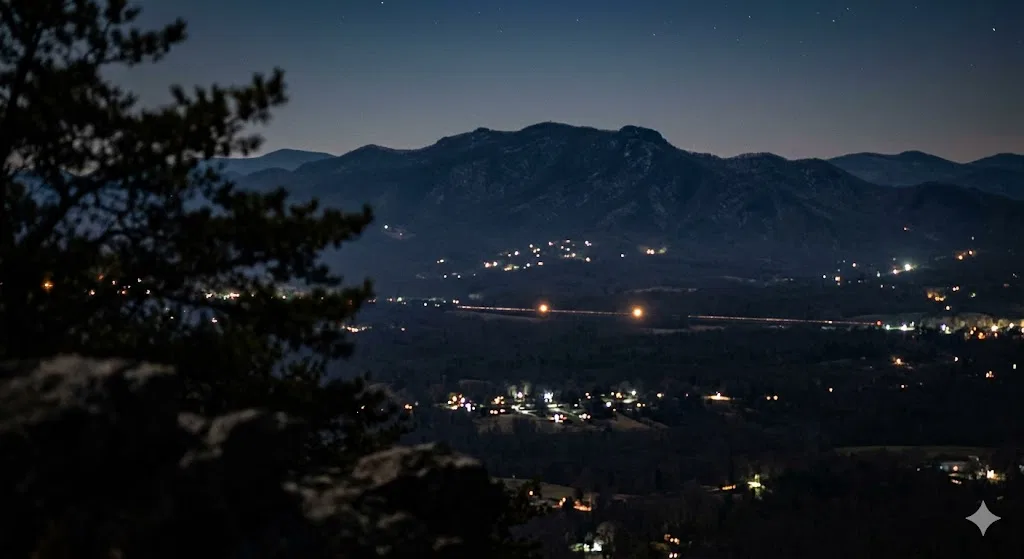
Brown Mountain lies in the Blue Ridge region of western North Carolina, near Burke County, Linville Gorge and the viewpoints from which people have long watched the night horizon. Modern tourism pages still point visitors to clear-night viewing locations along NC Highway 181 and Wiseman’s View in the Linville Gorge Wilderness, which helps explain why the story has stayed visible rather than fading into an old newspaper curiosity.[Visit North Carolina]visitnc.comVisit North CarolinaBrown Mountain Lights | Visit North…The Brown Mountain Lights are typically visible on clear nights from vantage p…
The classic description is simple but memorable: small lights, often described as star-like or orb-like, appearing near or above the mountain, sometimes seeming to brighten, move, hover, rise or vanish. Appalachian State’s Brown Mountain Lights research site describes the reports as “small, star-like dots of light” with motion varying by witness, from slow movement to more dramatic action.[Daniel B. Caton]dancaton.physics.appstate.eduDaniel B. Caton The Brown Mountain LightsDaniel B. Caton The Brown Mountain Lights That range of descriptions is part of the evidence problem. A distant fixed light shimmering in unstable air, a vehicle headlamp seen through gaps, an aircraft light, a fire, a prank, and an unusual natural glow can all produce reports that sound similar once retold as “the Brown Mountain Lights”.
The story entered wider public record in the early twentieth century. A reproduced Charlotte Observer account from September 1913 described a mysterious light seen near Rattlesnake Knob, appearing with “punctual regularity”, fiery red, larger than a star but smaller than the full moon, rising briefly and then going out. The article treated the case as a genuine puzzle and quoted Anderson Loven as a reliable local witness.[dsoftp.appstate.edu]dsoftp.appstate.eduCharlotte Observer 1924 Article on the Brown Mountain Lights… This matters because the Brown Mountain Lights are not just a late internet legend. They had already become a public mystery before the UFO era began in 1947.
The modern UFO connection came later. Once flying saucers became part of American culture, older mystery-light traditions could be reinterpreted through that lens. Brown Mountain’s lights have since been folded into alien, paranormal and “energy vortex” claims, as well as into television and horror entertainment. But the early record is better understood as a local observation-and-explanation problem: people saw puzzling lights across a mountain landscape at night, and investigators tried to work out what sources could be visible from those viewpoints.
Early reports and official investigation
The best-known official source is George R. Mansfield’s US Geological Survey report, later published as Origin of the Brown Mountain Light in North Carolina. The USGS catalogue identifies it as Circular 646 by George Rogers Mansfield, published by the U.S. Geological Survey and carrying the DOI 10.3133/cir646.[U.S. Geological Survey]pubs.usgs.govU.S. Geological Survey Origin of the Brown Mountain light in North CarolinaU.S. Geological Survey Origin of the Brown Mountain light in North Carolina The report remains central because it did what much UFO and mystery-light lore rarely does: it tried to match observations to geography, instruments, bearings and known light sources.
The USGS itself summarises the case as one in which public interest and congressional pressure led the Survey to send Mansfield, a research geologist, to investigate. According to the agency’s later account, Mansfield reviewed earlier work, interviewed local people and used a plane table, alidade, compass, camera, barometer and flashlight while trying to observe the lights.[USGS]pubs.usgs.govU.S. Geological Survey Origin of the Brown Mountain light in North CarolinaU.S. Geological Survey Origin of the Brown Mountain light in North Carolina This is important: Mansfield was not simply dismissing witness accounts from an office. He was testing lines of sight in the landscape where the claims were being made.
Mansfield’s conclusion was sceptical. The USGS summary states that he found the lights were “clearly not of unusual nature or origin” and attributed them to a combination of natural and human conditions, including automobile headlights, train headlights and fog in the valley.[USGS]usgs.govScience or Superstition? | U.S. Geological SurveyScience or Superstition? | U.S. Geological Survey… A later sceptical review gives the more detailed breakdown from the investigation: about 47 per cent of the lights studied instrumentally were attributed to automobile headlights, 33 per cent to locomotive headlights, and 10 per cent each to stationary lights and brush fires.[Skeptical Inquirer]skepticalinquirer.orgSource details in endnotes.
That finding does not automatically explain every Brown Mountain Lights story ever told. It does, however, seriously weakens the claim that the early mystery was untouched by ordinary causes. Mansfield’s work suggests that at least many of the famous observations were not lights over the mountain at all, but distant lights seen across a complex valley-and-ridge landscape. In a dark mountain setting, a headlamp or fire can seem detached from the ground, especially when the viewer has no clear depth cues.
There was also an earlier official explanation. The same sceptical review notes that a USGS geologist in 1913 attributed the lights to locomotive headlights, while a 1919 U.S. Weather Bureau report suggested an electrical-discharge explanation even though its writer had not visited the site.[Skeptical Inquirer]skepticalinquirer.orgSource details in endnotes. That contrast is useful. The locomotive-headlight explanation was grounded in a local line-of-sight claim; the weather-bureau theory sounds more speculative. Brown Mountain’s history is full of this tension between field checking and imaginative explanation.
Headlights, fires and other ordinary explanations
The most persistent prosaic explanation is that many sightings are distant human lights seen under misleading conditions. Trains, cars, town lights, towers, aircraft, fires, off-road vehicles and deliberate light displays are all plausible in a region where viewers look across long distances, broken ridgelines and atmospheric layers. The key issue is not whether each source is exciting. It is whether it can look exciting from a dark overlook.
This is where Brown Mountain differs from a one-off UFO report. The viewing geography is repeatable. People often watch from known overlooks, looking towards known valleys, roads, towns and ridges. That makes testing possible, but it also means a viewer may repeatedly encounter ordinary light sources under conditions that make them seem strange. Mansfield’s investigation took this seriously by plotting directions and comparing appearances with known sources rather than relying only on how odd a light looked to the naked eye.[USGS]pubs.usgs.govOpen source on usgs.gov.
Atmosphere complicates the problem. Even if the original source is ordinary, the seen effect may not be. Mist, temperature layers, refraction, haze and changing density can bend, dim, scatter or colour light. The sceptical review of Mansfield’s work notes his attention to the basin-like geography and unstable atmospheric conditions around the area, including fog, dust and mist that can affect brightness and colour.[Skeptical Inquirer]skepticalinquirer.orgSource details in endnotes. In plain terms, a car headlight does not always look like a car headlight when viewed from miles away through mountain air.
Later observers have made similar arguments. In a Blue Ridge Country interview, geologist and author Ed Speer argued that most baffling lights seen by visitors were manmade: town and city lights, planes, trains, helicopters and similar sources. He also pointed to less obvious contributors, including blue ghost fireflies and pranksters.[Blue Ridge Country]blueridgecountry.comSource details in endnotes. That does not make every witness foolish. It shows how many different things can enter the same category once the category is simply “strange light near Brown Mountain”.
The 1916 flood is often raised as a challenge to the train-headlight explanation. If rail traffic stopped but lights were still reported, the argument goes, then trains cannot explain the phenomenon. That point deserves attention, but it is not decisive. It may undermine a single-source explanation, especially one based only on locomotives, but it does not eliminate car lights, fixed lights, fires, atmospheric effects, observer error or the possibility that different sightings had different causes. Brown Mountain is best treated as a family of light reports, not one repeated object with one necessary explanation.
Why the evidence remains difficult to judge
The Brown Mountain Lights are hard to evaluate because the evidence often arrives in the wrong form. Many reports are sincere but imprecise. A witness may remember a colour, movement or emotional impression, but not the exact time, bearing, duration, weather, comparison stars, camera settings or possible ground sources. That is normal for human observation, but it is a problem if the claim is that a light was physically anomalous.
The strongest evidence would include several features at once: a precise observation point, exact time, compass bearing, duration, weather conditions, simultaneous views from different locations, a camera record with metadata, and a serious attempt to rule out roads, aircraft, towers, towns and fires. Much of the Brown Mountain tradition lacks that full package. Instead, the case is carried by a mixture of old journalism, local memory, official reports, visitor anecdotes, folklore and occasional modern images.
That mix creates three recurring traps.
First, “seen for a century” can hide changing evidence. A 1913 newspaper account, a 1960s UFO claim, a 2016 camera anomaly and a tourist’s phone video are not the same kind of evidence. They may all be grouped under one label, but they do not all support the same conclusion.
Second, “unexplained to me” can become “unexplained by anyone”. A visitor who sees a light from Wiseman’s View may not recognise a distant tower or aircraft track. An investigator with maps, bearings and repeated observations may reach a different conclusion.
Third, folklore can backfill history. Once a place becomes famous for mysterious lights, older legends, ghost stories and alien claims can attach themselves to it. That does not mean all folklore is worthless; it means folklore is evidence of cultural meaning, not automatically evidence of a physical anomaly.
For North Carolina UFO history, this distinction is essential. Brown Mountain is relevant to UFO study because it shaped how people in the state talk about anomalous lights. But its value as evidence for non-human craft is weak. The better reading is that it is a long-running case study in perception, landscape, local identity and the difficulty of documenting transient lights.
Modern cameras and why the debate continues
Modern cameras should, in theory, make the Brown Mountain Lights easier to settle. In practice, they have made the debate more interesting rather than closed. Appalachian State researchers have operated cameras looking at Brown Mountain and Linville Gorge, with one camera generally running from dusk to dawn and another operating during a narrower overnight window because of satellite internet costs.[Daniel B. Caton]dancaton.physics.appstate.eduDaniel B. Caton The Brown Mountain LightsDaniel B. Caton The Brown Mountain Lights This is a more disciplined approach than casual skywatching, because repeated monitoring can catch lights when no witness is standing at an overlook.
The most discussed modern episode came in 2016, when researchers Daniel Caton and Lee Hawkins of Appalachian State were reported to have captured an unexplained ball of light on more than one camera after about three years of monitoring. WFAE reported that the light appeared above Brown Mountain and apart from the lights of Lenoir, and that the researchers could not explain that particular capture.[wfae.org]wfae.orgSource details in endnotes. That is a meaningful data point, but it is not the same as proof of an extraordinary origin. A recorded anomaly asks for analysis; it does not, by itself, choose an answer.
The careful wording matters. “Unexplained” in a camera project usually means the researchers did not identify the source from the available data. It does not mean the light was impossible, intelligent, extraterrestrial or paranormal. Without triangulation from widely separated sites, spectral data, a clear track, high-resolution imagery and complete exclusion of aircraft, reflections, insects, camera artefacts or ground sources, the result remains an anomaly rather than a conclusion.
Still, the modern work is valuable because it improves the conversation. It moves Brown Mountain away from pure legend and towards repeatable observation. It also shows why the case persists. If cameras run for years and capture little or nothing, sceptics point to the rarity and ambiguity of the phenomenon. If a camera captures a puzzling light, believers point to a surviving mystery. Both reactions can be too quick. The more responsible answer is that modern evidence has not restored the old legend in full, but neither has it made every reported light vanish into an easy explanation.
What Brown Mountain adds to North Carolina UFO history
Brown Mountain is not North Carolina’s strongest UFO case in the sense of aviation data, radar records, military files or named pilot testimony. Its importance is different. It is the state’s best-known example of a recurring anomalous-light tradition, and it shows how a local mystery can become a flexible container for whatever explanation a period finds most compelling: trains, marsh gas, electrical discharges, ghosts, UFOs, energy fields, camera anomalies or misidentified modern lights.
That flexibility is exactly why the evidence problem matters. If the same lights can be explained as ghosts in one decade, flying saucers in another and atmospheric optics in another, the label alone is not doing much evidential work. The real work comes from disciplined observation: where was the viewer, what was the bearing, what sources lay along that line, what was the weather, what did instruments record, and could the sighting be repeated?
For a state-level UFO project, Brown Mountain also offers a useful warning about famous cases. Fame does not equal evidential strength. A case can be historically important, locally beloved and genuinely interesting while still being weak support for extraordinary claims. Brown Mountain’s strongest evidence supports a narrower conclusion: people have long reported unusual-looking lights in a mountain landscape where ordinary lights can behave deceptively, and official and later investigators have explained many such observations without eliminating every modern anomaly.
So are the Brown Mountain Lights really unexplained?
The fairest answer is: some individual reports remain unidentified, but the Brown Mountain Lights as a tradition are not a single unsolved object or event. The early public mystery was substantially weakened by official investigation, especially Mansfield’s USGS work linking many observations to headlights, trains, stationary lights, brush fires and atmospheric effects.[USGS]usgs.govOpen source on usgs.gov. Later field observers and writers have likewise argued that most sightings can be traced to manmade or natural sources once the night landscape is checked carefully.[Blue Ridge Country]blueridgecountry.comSource details in endnotes.
At the same time, it would be too strong to say that every claimed Brown Mountain light has been explained. Some reports are too vague to test. Some may involve unusual atmospheric effects. A few modern camera captures have been treated by researchers as unexplained from the available information.[wfae.org]wfae.orgSource details in endnotes. The honest category is therefore “mixed”: many prosaically explained, many too poorly documented to evaluate, a smaller number still unresolved.
That makes Brown Mountain a valuable North Carolina case precisely because it resists the two easiest answers. It is not good evidence for alien visitation. It is also not merely a silly legend with no observational basis. It is a long-running evidence problem: a place where real witnesses, difficult terrain, ordinary lights, atmospheric distortion, local storytelling and modern cameras all meet on the same dark horizon.
Amazon book picks
Further Reading
Books and field guides related to Are the Brown Mountain Lights Really Unexplained?. Use these as the next step if you want deeper reading beyond the article.
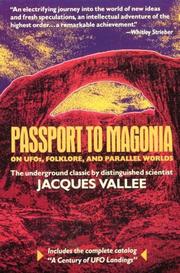
Passport to Magonia: from folklore to flying saucers
First published 1969. Subjects: Unidentified flying objects.
eBay marketplace picks
Marketplace Samples
Example marketplace items related to this page. Use the search link to explore similar finds on eBay.



Endnotes
1.
Source: dancaton.physics.appstate.edu
Title: Daniel B. Caton The Brown Mountain Lights
Link:https://www.dancaton.physics.appstate.edu/BML/index.htm
2.
Source: dsoftp.appstate.edu
Link:https://dsoftp.appstate.edu/web/BML/CharObs092413.htm
Source snippet
Charlotte Observer 1924 Article on the Brown Mountain Lights...
3.
Source: pubs.usgs.gov
Title: U.S. Geological Survey Origin of the Brown Mountain light in North Carolina
Link:https://pubs.usgs.gov/publication/cir646
4.
Source: usgs.gov
Title: Science or Superstition? | U.S. Geological Survey
Link:https://www.usgs.gov/news/featured-story/science-or-superstition
Source snippet
Science or Superstition? | U.S. Geological Survey...
5.
Source: wfae.org
Link:https://www.wfae.org/local-news/2016-08-05/app-state-researchers-capture-image-of-unexplained-light-at-brown-mountain
6.
Source: pubs.usgs.gov
Link:https://pubs.usgs.gov/circ/1971/0646/report.pdf
7.
Source: usgs.gov
Link:https://www.usgs.gov/
8.
Source: pubs.usgs.gov
Link:https://pubs.usgs.gov/of/1990/0276/report.pdf
9.
Source: usgs.gov
Title: map brown mountain and occurrences brown mountain lights
Link:https://www.usgs.gov/media/images/map-brown-mountain-and-occurrences-brown-mountain-lights
10.
Source: pubs.usgs.gov
Link:https://pubs.usgs.gov/bul/0444/report.pdf
11.
Source: dancaton.physics.appstate.edu
Title: USGS p01
Link:https://dancaton.physics.appstate.edu/BML/USGSreport/USGS-p01.htm
12.
Source: visitnc.com
Link:https://www.visitnc.com/brown-mountain-lights
Source snippet
Visit North CarolinaBrown Mountain Lights | Visit North...The Brown Mountain Lights are typically visible on clear nights from vantage p...
13.
Source: skepticalinquirer.org
Link:https://skepticalinquirer.org/2016/04/the-brown-mountain-lights-solved-again/
14.
Source: blueridgecountry.com
Link:https://blueridgecountry.com/travel/brown-mountain-lights-revisited/
15.
Source: kids.kiddle.co
Title: Brown Mountain Lights
Link:https://kids.kiddle.co/Brown_Mountain_Lights
16.
Source: Wikipedia
Title: Brown Mountain lights
Link:https://en.wikipedia.org/wiki/Brown_Mountain_lights
17.
Source: youtube.com
Link:https://www.youtube.com/watch?v=f3CN6e_gH3s&vl=id
18.
Source: youtube.com
Link:https://www.youtube.com/watch?v=vCzmzVkCIJo
19.
Source: foothillsdigest.com
Title: brown mountain lights
Link:https://foothillsdigest.com/brown-mountain-lights/
20.
Source: usa.gov
Link:https://www.usa.gov/agencies/u-s-geological-survey
21.
Source: tripadvisor.co.uk
Title: Brown mountain lights
Link:https://www.tripadvisor.co.uk/ShowTopic-g60742-i251-k10995864-Brown_mountain_lights-Asheville_North_Carolina.html
22.
Source: wherethedogwoodblooms.com
Title: brown mountain lights
Link:https://www.wherethedogwoodblooms.com/brown-mountain-lights/
Additional References
23.
Source: youtube.com
Link:https://www.youtube.com/watch?v=8TDcY9ecMlY
Source snippet
What We Captured at Brown Mountain Shouldn't Be Possible...
24.
Source: youtube.com
Title: What We Captured at Brown Mountain Shouldn’t Be Possible
Link:https://www.youtube.com/watch?v=lUdj-ypVn7k
Source snippet
I Can't Explain It - The Brown Mountain Ghost Lights Camping Adventure...
25.
Source: youtube.com
Title: Mysterious Dancing Orbs: The Mystery of the Brown Mountain Lights
Link:https://www.youtube.com/watch?v=fYgHvB3psjU
Source snippet
The Mystery of the Brown Mountain Lights Episode...
26.
Source: youtube.com
Title: The Mystery of the Brown Mountain Lights Episode
Link:https://www.youtube.com/watch?v=Zq6_Fxv_8RY
Source snippet
Mysterious Brown Mountain Lights captured in 1999 | From TV Archives...
27.
Source: reddit.com
Link:https://www.reddit.com/r/Appalachia/comments/17x4cg3/anyone_here_seen_the_brown_mountain_lights_in/
28.
Source: facebook.com
Link:https://www.facebook.com/groups/mountainviewmotorcyclecampground/posts/7783500931778216/
29.
Source: discoverburkecounty.com
Link:https://www.discoverburkecounty.com/all-attractions/brown-mountain-lights/
30.
Source: romanticasheville.com
Link:https://www.romanticasheville.com/brown_mountain_lights.htm
31.
Source: facebook.com
Link:https://www.facebook.com/AppStateCAS/posts/dr-daniel-caton-professor-in-the-appalachian-state-university-department-of-phys/1586066010191563/
32.
Source: instagram.com
Link:https://www.instagram.com/reel/DQkk8KEksi1/?hl=en-gb
Topic Tree