Within Fort Monmouth
When radar made a UFO seem faster
The Navesink radar episode looked dramatic on screen, but investigators argued that atmosphere and expectation may have distorted the return.
On this page
- What operators saw on the Navesink radar return
- Why anomalous propagation became the official answer
- What the case shows about radar evidence
Page outline Jump by section
Introduction
The Navesink radar episode became one of the most discussed parts of the 1951 Fort Monmouth UFO reports because it seemed to offer something stronger than a witness description: a radar target apparently performing impossible manoeuvres. In the tense early Cold War atmosphere, radar was widely viewed as an objective instrument. A strange return on a military radar screen could appear more convincing than a report of lights in the sky.
 Yet the Navesink case also became an early lesson in the limits of radar evidence. Air Force investigators eventually argued that the dramatic movements may not have represented a solid object at all. Instead, they pointed to anomalous propagation, a condition in which unusual atmospheric layers bend radar beams and create misleading returns. The dispute matters because it shows how a radar-backed UFO report could look compelling in real time while later analysis suggested a far more ordinary explanation.[Wikisource]en.wikisource.orgPage:Project Blue Book, complete status reportsPage:Project Blue Book, complete status reports.pdf/28On 10 September 1951, 1515 hours, an SCR 584, serial number 433, tracked…
What operators saw on the Navesink radar return
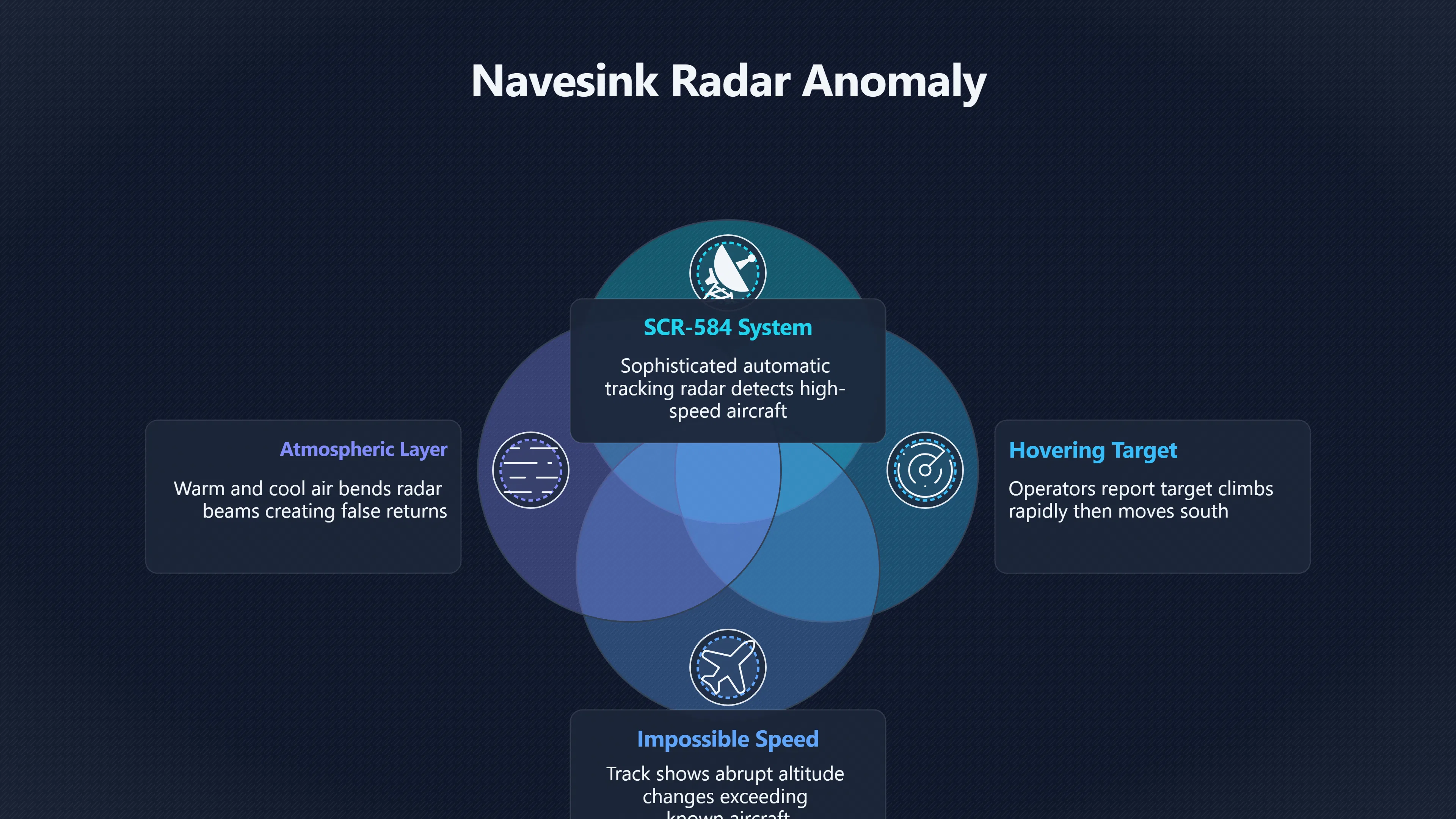
The Navesink report emerged during the wider cluster of Fort Monmouth incidents on 10 and 11 September 1951. Radar operators using SCR-584 tracking radar systems reported unusual targets northeast of Fort Monmouth and near the Navesink area overlooking Sandy Hook Bay and the Atlantic coast. The SCR-584 was not a primitive device. It was one of the most sophisticated radar systems of its era, designed for automatic tracking and capable of following high-speed aircraft.[ll.mit.edu]ll.mit.eduCommemorating the SCR-584 radar, a historical pioneerThe SCR-584 was a marvel of its time, able to detect an aircraft out to a distance o…
According to Project Blue Book records, one of the most puzzling returns appeared on 11 September. Operators reported a target that seemed to hover, climb rapidly and then move south at extraordinary speed. Such behaviour naturally attracted attention because it did not resemble the smooth track expected from an aircraft or weather balloon. The return appeared to show abrupt changes in altitude and velocity that would have exceeded the performance of known aircraft available in 1951.[Wikisource]en.wikisource.orgPage:Project Blue Book, complete status reportsPage:Project Blue Book, complete status reports.pdf/28On 10 September 1951, 1515 hours, an SCR 584, serial number 433, tracked…[wikimedia]upload.wikimedia.orgProject Blue Book, BBA PBSR1 300Wikimedia CommonsThe Project Blue Book ArchiveThe ~133Q EDST radar sighting on 11 September 1951 rer-ains unknown but it was very possibl… Part of the reason the report gained traction was the setting. Fort Monmouth housed Army Signal Corps personnel whose work centred on communications and radar technology. To outside observers, reports from trained operators seemed more credible than reports from casual witnesses. The impression was that experienced technicians had watched an unknown object behave in a way that could not easily be explained away.[infoage.org]infoage.orgWorld War II & RadarDeveloped at Fort Monmouth's Camp Evans, the SCR-584 radar leapfrogged German radar-jamming technology, giving allied…
The difficulty is that radar operators do not directly see aircraft. They see electronic representations created from reflected radio energy. A striking radar display can therefore result either from an unusual object or from unusual radar behaviour.
Why anomalous propagation became the official answer
The official explanation focused on anomalous propagation, often shortened by radar specialists to “AP”. In simple terms, radar beams normally travel through the atmosphere in predictable ways. Under certain weather conditions, however, layers of warm and cool air can bend those beams. The radar may then detect reflections from distant terrain, ships, atmospheric layers or other objects that would normally be outside its expected coverage area. The resulting display can make stationary or ordinary targets appear to move strangely.[Wikimedia Commons]upload.wikimedia.orgProject Blue Book, BBA PBSR1 300Wikimedia CommonsThe Project Blue Book ArchiveThe ~133Q EDST radar sighting on 11 September 1951 rer-ains unknown but it was very possibl…
Project Blue Book’s own assessment eventually stated that the approximately 1:30 p.m. radar sighting on 11 September remained technically unidentified but was “very possible” to explain through anomalous propagation. The report also suggested that operator expectations may have contributed to the interpretation of what appeared on the screen. Investigators noted that personnel were already alert to unusual activity because of the previous reports connected with Fort Monmouth.[Wikimedia Commons]upload.wikimedia.orgProject Blue Book, BBA PBSR1 300Wikimedia CommonsThe Project Blue Book ArchiveThe ~133Q EDST radar sighting on 11 September 1951 rer-ains unknown but it was very possibl…
That detail is important. Investigators were not merely arguing that the radar malfunctioned. They were proposing a combination of factors:
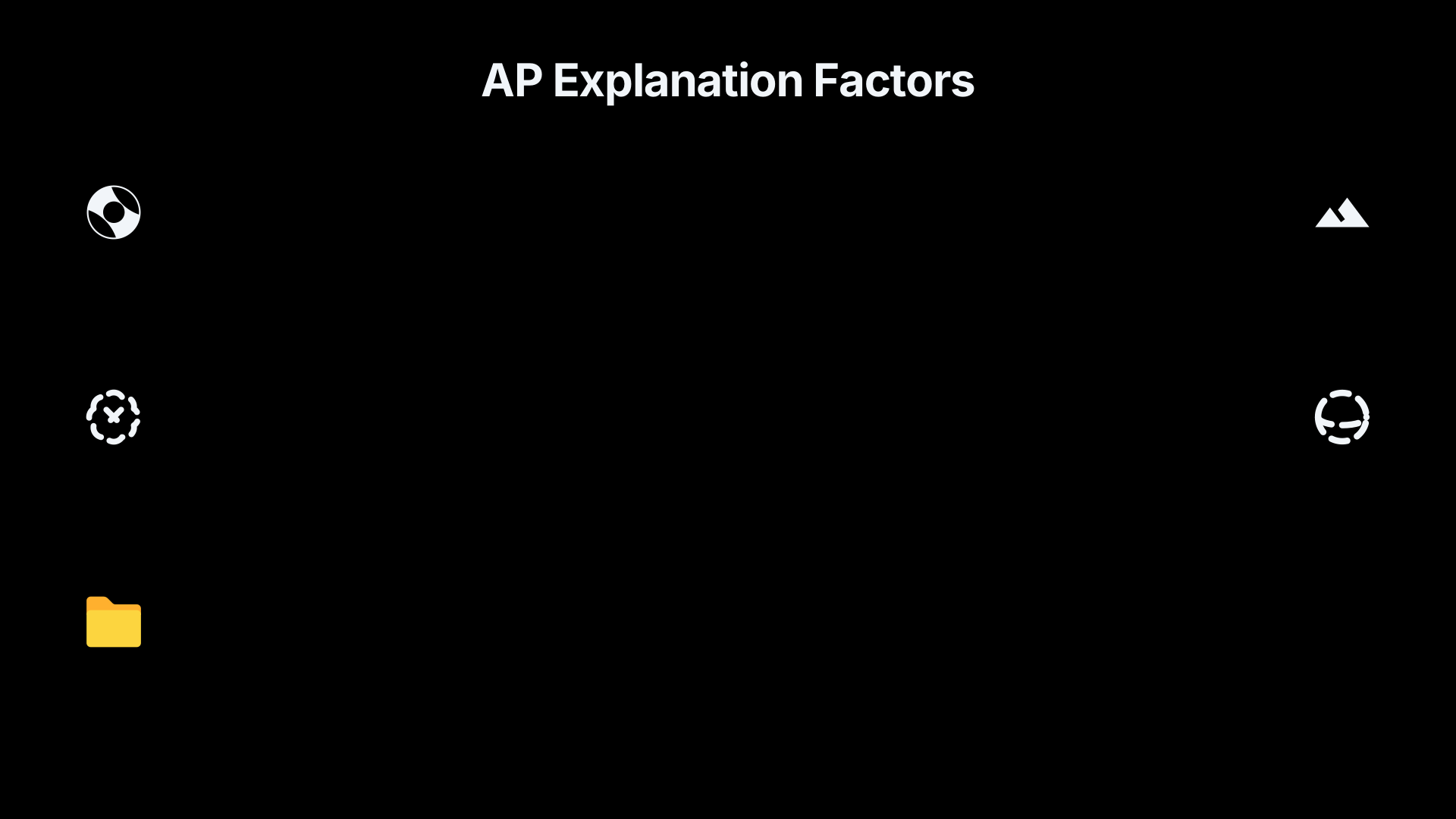
- Unusual atmospheric conditions may have produced misleading returns.
- Operators were already primed by earlier sightings and discussions.
- Ambiguous radar information may have been interpreted as extraordinary movement.
- The apparent performance of the target could have been an artefact of the display rather than a real flight path.[Wikimedia Commons]upload.wikimedia.orgProject Blue Book, BBA PBSR1 300Wikimedia CommonsThe Project Blue Book ArchiveThe ~133Q EDST radar sighting on 11 September 1951 rer-ains unknown but it was very possibl…
The same Blue Book records classified another radar event from the period as a weather balloon and treated several other returns as less mysterious after closer examination. This reinforced the Air Force view that extraordinary radar tracks did not automatically indicate unknown craft.[Wikisource]en.wikisource.orgPage:Project Blue Book, complete status reportsPage:Project Blue Book, complete status reports.pdf/28On 10 September 1951, 1515 hours, an SCR 584, serial number 433, tracked…[Wikimedia]upload.wikimedia.orgProject Blue Book, BBA PBSR1 300Wikimedia CommonsThe Project Blue Book ArchiveThe ~133Q EDST radar sighting on 11 September 1951 rer-ains unknown but it was very possibl…
Why the explanation remained controversial
The anomalous propagation explanation never completely satisfied UFO researchers. Critics argued that trained military operators should have recognised common radar artefacts. Some also pointed out that the Fort Monmouth incidents involved multiple reports over two days rather than a single isolated radar blip. To them, the accumulation of radar returns, visual sightings and military interest suggested that something unusual had occurred.[Wasabi Technologies]s3.us-west-1.wasabisys.comWasabi Technologies The only book about FLYING SAUCERS basedRup- pelt was chief of the United States Air For e's Project Blue. Book, an operation of the Air Technical…
Supporters of the official explanation countered that precisely because the events occurred during a period of heightened attention, ordinary ambiguities could acquire greater significance. Once a radar room begins discussing strange targets, operators may scrutinise displays more intensely and connect unrelated events into a single narrative. The Blue Book analysis specifically raised the possibility that expectations influenced interpretation.[Wikimedia Commons]upload.wikimedia.orgProject Blue Book, BBA PBSR1 300Wikimedia CommonsThe Project Blue Book ArchiveThe ~133Q EDST radar sighting on 11 September 1951 rer-ains unknown but it was very possibl…
Another complication is that surviving records do not provide enough technical data to reconstruct every radar return in detail. Modern analysts therefore work largely from summaries, reports and later recollections rather than complete raw radar recordings. That limits how confidently anyone can settle the matter decades later.[Wikisource]en.wikisource.orgPage:Project Blue Book, complete status reportsPage:Project Blue Book, complete status reports.pdf/28On 10 September 1951, 1515 hours, an SCR 584, serial number 433, tracked…
What the case shows about radar evidence
The Navesink episode remains valuable because it illustrates a recurring problem in UFO investigations: radar evidence sounds objective, but interpreting radar can be surprisingly difficult.
Several lessons emerge from the case:
Radar is not a camera. Operators interpret electronic signals rather than directly observing physical objects. Strange returns do not automatically mean strange craft.
Context matters. The reports occurred during a period of Cold War anxiety, military alertness and intense interest in unidentified aerial phenomena. Expectations can influence how ambiguous information is understood.
Technical expertise does not eliminate uncertainty. Fort Monmouth personnel were trained specialists, yet investigators still disagreed about what the radar displays meant.
Official explanations can be partial rather than absolute. The Air Force did not claim every detail was fully resolved. Instead, it argued that anomalous propagation offered the most plausible explanation for the most dramatic radar behaviour.[Wikimedia Commons]upload.wikimedia.orgProject Blue Book, BBA PBSR1 300Wikimedia CommonsThe Project Blue Book ArchiveThe ~133Q EDST radar sighting on 11 September 1951 rer-ains unknown but it was very possibl…
Within New Jersey UFO history, the Navesink radar return is therefore less important as evidence for an unknown craft than as a case study in how radar reports gain authority. The episode helped shape later debates around Fort Monmouth and Project Blue Book. It demonstrated that a radar target could appear to show impossible speed and manoeuvrability while still leaving investigators asking whether the real mystery lay in the sky or in the atmosphere between the radar and its target.[Wikisource]en.wikisource.orgPage:Project Blue Book, complete status reportsPage:Project Blue Book, complete status reports.pdf/28On 10 September 1951, 1515 hours, an SCR 584, serial number 433, tracked…[Wikimedia]upload.wikimedia.orgProject Blue Book, BBA PBSR1 300Wikimedia CommonsThe Project Blue Book ArchiveThe ~133Q EDST radar sighting on 11 September 1951 rer-ains unknown but it was very possibl…

Amazon book picks
Further Reading
Books and field guides related to When radar made a UFO seem faster. Use these as the next step if you want deeper reading beyond the article.
The Report on Unidentified Flying Objects
Directly relevant to radar evidence and official analysis.
eBay marketplace picks
Marketplace Samples
Example marketplace items related to this page. Use the search link to explore similar finds on eBay.


Endnotes
1.
Source: en.wikisource.org
Title: Page:Project Blue Book, complete status reports
Link:https://en.wikisource.org/wiki/Page%3AProject_Blue_Book%2C_complete_status_reports.pdf/28
Source snippet
Page:Project Blue Book, complete status reports.pdf/28On 10 September 1951, 1515 hours, an SCR 584, serial number 433, tracked...
Published: September 1951
2.
Source: upload.wikimedia.org
Title: Project Blue Book, BBA PBSR1 300
Link:https://upload.wikimedia.org/wikipedia/commons/3/3b/Project_Blue_Book%2C_BBA-PBSR1-300.pdf
Source snippet
Wikimedia CommonsThe Project Blue Book ArchiveThe ~133Q EDST radar sighting on 11 September 1951 rer-ains unknown but it was very possibl...
Published: September 1951
3.
Source: ll.mit.edu
Link:https://www.ll.mit.edu/impact/commemorating-scr-584-radar-historical-pioneer
Source snippet
Commemorating the SCR-584 radar, a historical pioneerThe SCR-584 was a marvel of its time, able to detect an aircraft out to a distance o...
4.
Source: war.gov
Title: 65 hs1 834228961 62 hq 83894 section 6
Link:https://www.war.gov/medialink/ufo/release_1/65_hs1-834228961_62-hq-83894_section_6.pdf
5.
Source: infoage.org
Link:https://www.infoage.org/history-ia/world-war-ii-radar/
Source snippet
World War II & RadarDeveloped at Fort Monmouth's Camp Evans, the SCR-584 radar leapfrogged German radar-jamming technology, giving allied...
6.
Source: army.mil
Title: history mystery from the archives
Link:https://www.army.mil/article/227612/history_mystery_from_the_archives
Source snippet
Article24 Sept 2019 — The radar anomaly was attributed to user error. The records of "Project Blue Book" have been declassified, and many...
7.
Source: history.army.mil
Link:https://history.army.mil/portals/143/Images/Publications/catalog/10-16.pdf
Source snippet
Signal Corps: The EmergencyThe reader can here follow from birth the history of Army radar and mobile radio, the first steps taken in the...
8.
Source: infoage.org
Link:https://www.infoage.org/history-ia/world-war-ii-radar/camp-evans-developed-radar-key-at-anzio-italy/
Source snippet
Camp Evans-developed radar key at Anzio, ItalyDeveloped at Fort Monmouth's Camp Evans, the SCR-584 radar leapfrogged German radar-jamming...
9.
Source: Wikipedia
Title: SCR-584 radar
Link:https://en.wikipedia.org/wiki/SCR-584_radar
Source snippet
SCR-584 radarThe SCR-584 (short for Set, Complete, Radio # 584) was an automatic-tracking microwave radar developed by the MIT Radiati...
10.
Source: s3.us-west-1.wasabisys.com
Title: Wasabi Technologies The only book about FLYING SAUCERS based
Link:https://s3.us-west-1.wasabisys.com/luminist/EB/R/Ruppelt%20-%20The%20Report%20on%20UFOs.pdf
Source snippet
Rup- pelt was chief of the United States Air For e's Project Blue. Book, an operation of the Air Technical...
11.
Source: britannica.com
Title: Project Blue Book
Link:https://www.britannica.com/topic/Project-Blue-Book
Source snippet
Definition, History, Aliens, UFOs, & Facts16 May 2026 — Project Blue Book, code name for the United States' longest-running Air Force pro...
Published: May 2026
Additional References
12.
Source: govinfo.gov
Link:https://www.govinfo.gov/content/pkg/GOVPUB-D114-PURL-gpo87330/pdf/GOVPUB-D114-PURL-gpo87330.pdf
Source snippet
The Signal Corps: The EmergencyThe reader can here follow from birth the history of Army radar and mobile radio, the first steps taken in...
13.
Source: Wikipedia
Link:https://en.wikipedia.org/wiki/Project_Blue_Book
Source snippet
Project Blue BookProject Blue Book was the code name for the systematic study of unidentified flying objects (UFOs) by the United Stat...
14.
Source: websail-fe.cs.northwestern.edu
Title: edubiennials Feijo BSDs Villalon woodi woods spiders
Link:https://websail-fe.cs.northwestern.edu/downloads/OTyper_data_aaai18/FIGER_data/word_list.txt
Source snippet
anomalous officeholders S26 LANCER Vipiteno Necrophagia Jwaneng pre-tax marshall honeymoon nongovernmental reticuloendothelial Sitka gash...
15.
Source: Wikipedia
Title: The Report on Unidentified Flying Objects
Link:https://en.wikipedia.org/wiki/The_Report_on_Unidentified_Flying_Objects
Source snippet
The Report on Unidentified Flying ObjectsThe Report on Unidentified Flying Objects is a 1956 book by then-retired Air Force UFO invest...
16.
Source: osi.af.mil
Title: project blue book part 1 ufo reports
Link:https://www.osi.af.mil/News/Features/Display/Article/2302429/project-blue-book-part-1-ufo-reports/
Source snippet
Blue Book Part 1 (UFO Reports)6 Aug 2020 — In 1951, UFO investigations continued under the newly named Project Blue Book. The parameters...
17.
Source: antiquewireless.org
Title: 1995 AWA Review Vol 09 1
Link:https://www.antiquewireless.org/wp-content/uploads/1995-AWA-Review-Vol-09-1.pdf
Source snippet
Volume 9 1995Signal Corps' SCR-584 10-cm wavelength radar, developed by the. Radiation Lab and the Signal Corps. This radar was specifica...
18.
Source: reddit.com
Link:https://www.reddit.com/r/UFOs/comments/rlwdrs/original_photo_from_project_blue_book_taken_in/
Source snippet
And even our objective systems for observation (cameras, radar, etc) record anomalous...Read more...
19.
Source: youtube.com
Title: Project Blue Book: Declassified
Link:https://www.youtube.com/watch?v=UKzI3uu_oTQ
Source snippet
HISTORY's upcoming new drama series 'Project Blue Book' is based on the true, top-secret investigations into Unidentified Flying Objects...
20.
Source: archives.gov
Title: National Archives Project BLUE BOOK
Link:https://www.archives.gov/research/military/air-force/ufos
Source snippet
The project closed in 1969 and we have no...Read more...
21.
Source: Wikipedia
Title: Edward J. Ruppelt
Link:https://en.wikipedia.org/wiki/Edward_J._Ruppelt
Source snippet
Edward J. RuppeltEdward James Ruppelt (July 17, 1923 – September 15, 1960) was a United States Air Force officer probably best known f...
Published: July 17, 1923
Topic Tree