Within Nebraska UFOs
What Nebraska's UFO Archives Can Still Reveal
Nebraska's local UFO files matter because they preserve ordinary reports that never became famous national cases.
On this page
- E. A. Kral's investigation files
- Why local records change the evidence picture
- How archives help separate folklore from documentation
Page outline Jump by section
Introduction
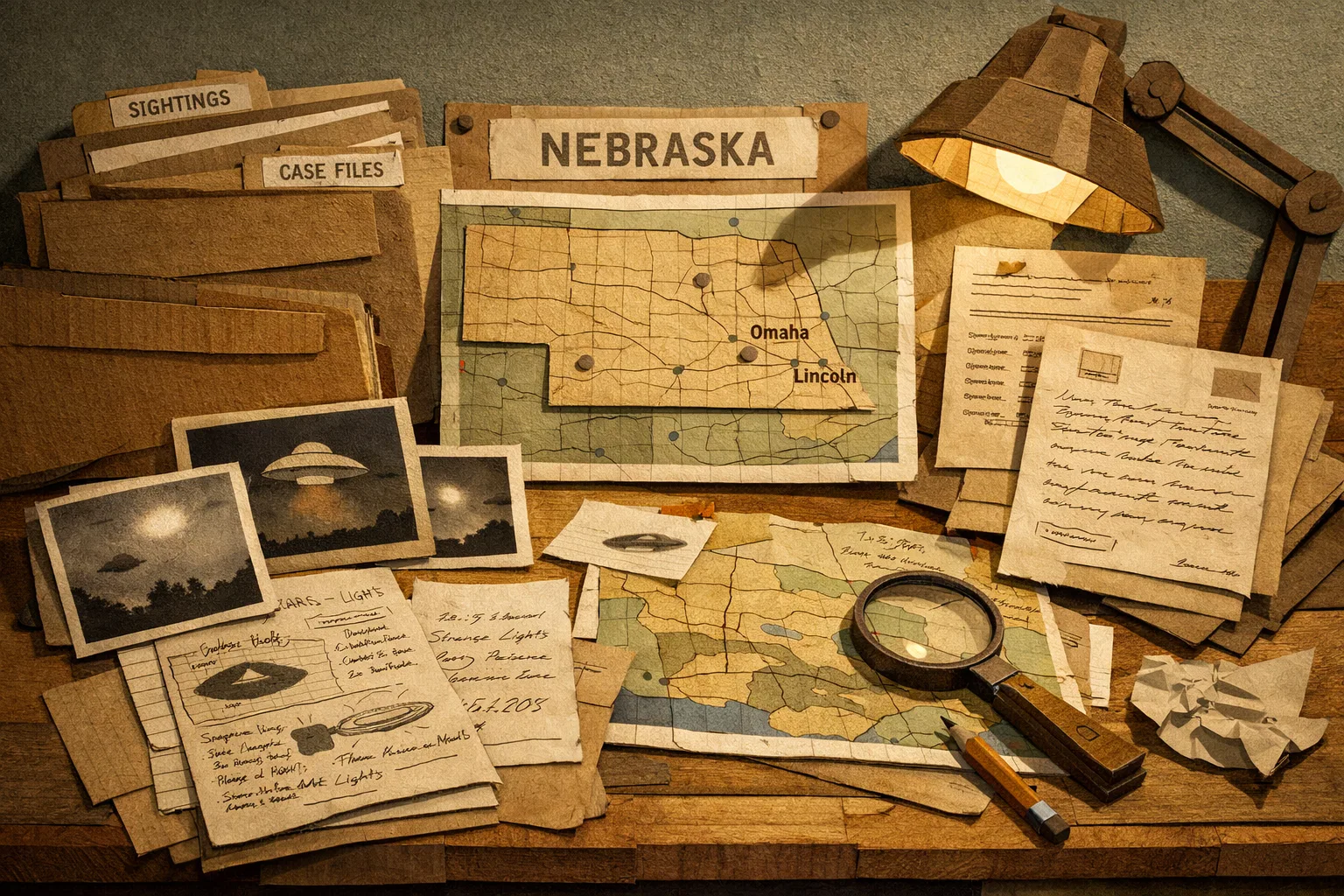
Nebraska’s local UFO archives matter because they preserve the reports that usually disappear from state-level history: the sheriff’s call, the teenager’s photographs, the farmer’s remembered lights, the investigator’s form, and the follow-up letter explaining why a case was probably Venus, a balloon or a helicopter. The key collection is E. A. “Earl” Kral’s paranormal and UFO material at the University of Nebraska-Lincoln, a set of organised files that includes dozens of Nebraska UFO investigations and was opened to public access after a privacy restriction expired in 2025.[Nebraska Public Media]nebraskapublicmedia.orgSource details in endnotes.
That makes the archive valuable in a very specific way. It does not prove that Nebraska was visited by extraterrestrial craft, and the strongest reporting on the Kral files says only three or four of the investigated objects remained unidentified, with none shown to be extraterrestrial.[Nebraska Public Media]nebraskapublicmedia.orgSource details in endnotes. What it does provide is something rarer and more useful for readers of Nebraska UFO history: a local record of how ordinary sightings were gathered, tested, explained, protected and remembered outside the better-known federal UFO programmes.
E. A. Kral’s Investigation Files
E. A. Kral was not simply a collector of odd stories. He was a Nebraska educator, researcher and writer who taught for 30 years, including at Grand Island Senior High, and later published extensively on Nebraska biography and history. A University of Nebraska-Lincoln finding aid for one of his other collections describes his background as a teacher, researcher and author with a long interest in documentation, local history and critical reasoning.[archivespec.unl.edu]archivespec.unl.eduUN L | Libraries | Archives & Special Collections | Finding AidsUN L | Libraries | Archives & Special Collections | Finding Aids That matters because the UFO files are not just loose folklore. They come from someone whose habits were archival: clipping, filing, corresponding, comparing sources and trying to reach a conclusion.
Nebraska Public Media’s review of the collection describes 16 organised boxes at UNL containing hundreds of original documents, newspaper and magazine articles, scholarly material and investigation reports, with folder subjects ranging from visitors from outer space to cattle mutilations, ghosts, extrasensory perception and conspiracy theories. Mary Ellen Ducey, UNL’s special collections librarian, described it as the university archive’s only paranormal collection.[Nebraska Public Media]nebraskapublicmedia.orgSource details in endnotes. For UFO researchers, the important point is not that the collection is “paranormal” in a broad sense, but that UFO reports sit inside a larger working archive of claims that Kral and others tried to test.
Kral’s strongest Nebraska UFO legacy appears to be his role in organised civilian investigation. Nebraska Public Media reports that he was the first Nebraska state director of the Mutual UFO Network, or MUFON, and that he recruited a team of 40 people with scientific backgrounds to collect and analyse reports.[Nebraska Public Media]nebraskapublicmedia.orgSource details in endnotes. MUFON itself began in 1969 as the Midwest UFO Network before changing its name to the Mutual UFO Network as it expanded beyond the Midwest, so Nebraska’s local files belong to a wider late-1960s and 1970s civilian-investigator movement rather than to a one-person hobby alone.[MUFON]mufon.comThrough the AgesThrough the Ages
The files also show how Kral worked. Each case was documented on a standardised form, and many reports were followed by hand-typed letters to witnesses explaining what the investigators had concluded.[Nebraska Public Media]nebraskapublicmedia.orgSource details in endnotes. That is one of the archive’s most important features. A UFO sighting remembered in conversation may preserve drama; a filed investigation can preserve date, place, weather, direction, duration, witness description, photographs, local newspaper context and the investigator’s reasoning.
Why Local Records Change the Evidence Picture
A state UFO history built only from famous incidents gives a distorted picture. Nebraska’s best-known case, the 1967 Ashland police sighting involving officer Herbert Schirmer, became nationally significant because it entered the orbit of the University of Colorado UFO project and later UFO literature. Local archives such as Kral’s do something different: they show the much larger background layer of reports that never became landmark cases but still shaped how Nebraskans understood strange lights and objects in the sky.
The examples reviewed in the Kral material are ordinary in the best historical sense. Nebraska Public Media notes reports such as Ernest Dahlke calling the Hamilton County sheriff about a bright white light outside his bedroom window; Grand Island teenager Kevin Aldridge photographing an oblong object crossing the sky for nearly four minutes; and L. J. Garrison and his wife asking MUFON to investigate a 1953 Sandhills sighting near Burwell in which they described two bright objects connected by a beam of light.[Nebraska Public Media]nebraskapublicmedia.orgSource details in endnotes. These are not famous national legends. They are the sort of cases that reveal how UFO reporting actually operated in Nebraska communities: through families, local law enforcement, local newspapers, and volunteer investigators.
The archive also changes the balance between mystery and explanation. In one 1973 central Nebraska case, a science teacher reportedly saw a hovering object in his backyard, took notes and provided photographs; Kral’s team checked possible ordinary explanations and analysed the photographs for trickery before labelling the case “unexplained”. But the same account stresses that “unexplained” meant “we don’t know”, not “alien spacecraft”.[Nebraska Public Media]nebraskapublicmedia.orgSource details in endnotes. That distinction is essential. Local files can preserve genuinely unresolved cases while also stopping unresolved from being inflated into confirmed extraordinary events.
Just as importantly, the Kral files show the large number of cases that did receive mundane explanations. Investigators checked weather reports, star charts and aviation records; Kral’s letters then explained to witnesses why a sighting appeared to match bright planets, a weather balloon or a visiting helicopter.[Nebraska Public Media]nebraskapublicmedia.orgSource details in endnotes. For Nebraska UFO history, that is not a debunking footnote. It is part of the evidence picture. If most investigated reports turned out to be ordinary objects seen under unusual conditions, then the remaining unresolved cases should be understood against that background rather than treated as isolated marvels.
The Human Side of the Archive
The Kral collection also preserves the social reality of UFO reporting. The files were not immediately open to the public because the University Archives was bound by an agreement requiring the reports to remain closed until 2025 to protect people who had reported UFO sightings. Jack Kasher, a former Nebraska MUFON president who worked with Kral, supported that restriction because of the stigma around saying that something strange had happened.[Nebraska Public Media]nebraskapublicmedia.orgSource details in endnotes.
That privacy issue is more than an archival detail. UFO records often depend on witnesses being willing to describe something they fear will make them look foolish, dishonest or unstable. If investigators ridicule witnesses, fewer people report. If investigators accept every claim too readily, the files become unreliable. Kral’s Nebraska material sits in that tension: it records unusual claims, but it also records attempts to check them and sometimes to disappoint witnesses with ordinary explanations.
Kral’s own views appear to have shifted. Nebraska Public Media reports that after leaving MUFON, he told the Omaha World-Herald that investigating UFO sightings had taught him about “the unreliability of eyewitnesses”.[Nebraska Public Media]nebraskapublicmedia.orgSource details in endnotes. That is one of the most revealing details in the archive story. The files were created by someone interested enough to investigate reports seriously, but his experience seems to have pushed him towards caution rather than certainty.
This makes Kral a useful figure for a balanced Nebraska UFO page. He was neither a simple believer nor a dismissive outsider. He helped organise investigations, preserved witness material, recruited technically minded volunteers and then increasingly recognised how fragile eyewitness evidence can be. In a field often split between credulity and ridicule, that mixture is historically valuable.
How Archives Help Separate Folklore From Documentation
Nebraska has a long record of aerial mystery stories, but archives help separate stories that are merely repeated from stories that can be checked. The difference is clear when older Nebraska cases are compared with Kral’s investigation files.
The 1897 Nebraska airship wave is a good example of how local records can preserve a mass sighting tradition. Roger L. Welsch’s Nebraska History article found nearly 200 newspaper reports of airship sightings, beginning in Nebraska in February 1897, with descriptions of fast-moving night objects, multiple lights and sometimes wings.[nebraska]history.nebraska.govState Historical Society Microsoft WordState Historical Society Microsoft Word State Historical Society Those newspaper accounts are not proof of a real unknown aircraft, but they are excellent evidence of what people reported, how newspapers framed the claims, which communities were involved and how quickly aerial mystery could spread through local media.
The 1884 Dundy County “Celestial Visitor” shows the opposite lesson. History Nebraska describes the newspaper story of a blazing object near Benkelman that supposedly left machinery scattered across the prairie, but also explains that the tale later became known as a newspaper hoax.[nebraska]history.nebraska.govState Historical Society Microsoft WordState Historical Society Microsoft Word State Historical Society The case is useful precisely because it warns readers not to confuse vivid old detail with reliable evidence. A report can have names, places, dramatic injuries and mechanical debris and still be fabricated.
Kral’s files sit between those two older examples. They are not merely newspaper retellings, but they are also not laboratory proof. Their value lies in the layers: witness statements, investigator forms, photographs in some cases, correspondence, local press coverage and recorded attempts at explanation. That structure allows readers to ask better questions: Was there more than one witness? Was the direction of travel recorded? Were weather and astronomy checked? Did the investigator consider aircraft? Was the case labelled unexplained only after alternatives were tested?
Local Files Versus Federal Records
Nebraska UFO history cannot be understood only through federal records. Project Blue Book, the US Air Force’s best-known UFO investigation programme, collected 12,618 reports between 1947 and 1969, of which 701 remained unidentified; the Air Force concluded that no investigated UFO represented a national-security threat, advanced technology beyond scientific knowledge, or extraterrestrial vehicles.[National Archives]nationalarchives.gov.ukSource details in endnotes. The National Archives notes that Blue Book’s textual records are held on 94 rolls of microfilm, with additional photographs, motion-picture film, sound recordings and still images held through relevant branches.[National Archives]nationalarchives.gov.ukSource details in endnotes.
Those federal records are vital for cases that reached official channels, especially military, aviation or national-security contexts. But they can miss the local life of a report. A sheriff’s call, a high-school student’s photograph, a farmer’s account from the Sandhills, or a MUFON follow-up letter may be more visible in a local archive than in a federal index. The Kral files therefore complement, rather than replace, Project Blue Book and National Archives material.
The same is true of modern online databases. The National UFO Reporting Center maintains a public state index for Nebraska reports, which is useful for browsing modern and older submitted sightings.[nuforc.org]nuforc.orgNUFOR C Reports for State NENUFOR C Reports for State NE But a database entry is usually only the starting point. It may record a report, but it does not always show the local investigation behind it. Kral’s material is valuable because it preserves the investigative middle layer between raw witness claim and public conclusion.
MUFON’s continuing Nebraska presence also shows that local reporting has not vanished. MUFON’s current chapter list identifies Nebraska leadership roles including state director, assistant state director and chief investigator.[MUFON]mufon.comFind a ChapterFind a Chapter That continuity matters, but modern case databases and current investigator networks should still be treated carefully. They can help locate reports, patterns and witnesses; they do not automatically validate extraordinary interpretations.
What Researchers Can Learn From Nebraska’s Local UFO Files
The strongest use of Nebraska’s local UFO archives is not to count sightings and announce a hotspot. It is to study how reports are made and filtered. Kral’s files show that Nebraska sightings often passed through practical local channels: a sheriff’s office, a newspaper, a teacher, a farm family, a MUFON investigator, or a university archive. That pathway affects what survives.
A good local file can reveal several things that a short UFO anecdote cannot:
- The original claim: what the witness said before later retellings added drama.
- The setting: time, place, weather, sky conditions, nearby roads, farms, airports or towns.
- The witness context: whether the report came from a lone observer, a family, a police officer, a student, a teacher or another identifiable source.
- The investigation: whether anyone checked star charts, aircraft activity, weather balloons, helicopters, photographs or possible hoaxes.
- The conclusion: whether the case was explained, insufficiently documented, unresolved, or actively considered unusual after checks.
This is where the Kral material is most useful for public-facing Nebraska UFO history. It helps readers move away from the blunt question “was it aliens?” and towards better questions: What was actually reported? What was checked? What explanation was offered? What evidence survived? What changed between the first report and later memory?
The Limits of the Archive
The Kral files are important, but they should not be treated as a hidden proof vault. Nebraska Public Media’s review is clear that only three or four of the MUFON-investigated flying objects remained unidentified, and none could be considered extraterrestrial.[Nebraska Public Media]nebraskapublicmedia.orgSource details in endnotes. That does not make the archive unimportant. It makes it more credible as a historical source, because the collection records both mystery and explanation.
Several limits remain. First, the archive reflects the reports that reached Kral, MUFON or related channels, not every strange sighting in Nebraska. Rural witnesses may never have reported what they saw. Others may have spoken only to family, police or local newspapers. Second, the survival of a report can depend on private decisions: whether a witness wrote back, whether photographs were kept, whether local press clippings were saved, and whether an investigator filed the case carefully.
Third, local archives can still contain mistakes. A form does not guarantee accuracy; a witness may misjudge distance, size, speed or direction. Kral’s later comment about eyewitness unreliability is therefore not a dismissal of witnesses, but a reminder that sincere people can misinterpret what they see.[Nebraska Public Media]nebraskapublicmedia.orgSource details in endnotes. In UFO history, that is often the central problem: the witness may be honest, the experience may be real to them, and the explanation may still be ordinary.
Finally, the archive’s broader paranormal scope requires discipline. Because the Kral collection includes ghosts, cattle mutilations, cults, extrasensory perception and other subjects as well as UFOs, readers need to keep Nebraska UFO evidence separate from adjacent folklore.[Nebraska Public Media]nebraskapublicmedia.orgSource details in endnotes. The fact that material shares a box or collector does not mean it shares evidential value.
Why This Matters for Nebraska UFO History
Nebraska’s UFO story is often told through a few memorable episodes: the 1897 airship wave, the 1884 Dundy County hoax, the 1967 Ashland police case, and scattered later sightings. Local archives make that story less sensational but more interesting. They show the ordinary machinery of UFO history: people see something, report it, investigators ask questions, explanations are tested, and only a small residue remains difficult to classify.
The Kral files are especially important because they document Nebraska’s civilian-investigator culture at ground level. They preserve a period when local MUFON investigators tried to apply forms, correspondence and technical checks to reports from farms, towns and small cities.[Nebraska Public Media]nebraskapublicmedia.orgSource details in endnotes. The result is not a catalogue of confirmed extraordinary events. It is a rare record of method, doubt and witness experience.
For readers, that is the main takeaway. Nebraska’s local UFO archives can still reveal where sightings clustered, how investigators worked, what explanations were most common, which cases resisted easy answers, and how stigma shaped what people were willing to report. They also show why unresolved should remain a careful word. In Nebraska’s best local files, “unexplained” means the evidence did not settle the matter. It does not mean the mystery has been solved in favour of the most dramatic possibility.
Amazon book picks
Further Reading
Books and field guides related to What Nebraska's UFO Archives Can Still Reveal. Use these as the next step if you want deeper reading beyond the article.
The Ufo Encyclopedia
Matches the page's focus on documentation, records and case files.
eBay marketplace picks
Marketplace Samples
Example marketplace items related to this page. Use the search link to explore similar finds on eBay.



Endnotes
1.
Source: archivespec.unl.edu
Title: UN L | Libraries | Archives & Special Collections | Finding Aids
Link:https://archivespec.unl.edu/findingaids/ms0352-kral-unl.html
2.
Source: mufon.com
Title: Through the Ages
Link:https://mufon.com/history/
3.
Source: history.nebraska.gov
Title: State Historical Society Microsoft Word
Link:https://history.nebraska.gov/wp-content/uploads/2017/12/doc_publications_NH1979UFOs.pdf
4.
Source: history.nebraska.gov
Link:https://history.nebraska.gov/flashback-friday-a-celestial-visitor-revisited-a-nebraska-newspaper-hoax-from-1884-patricia-c-gaster/
5.
Source: archives.gov
Title: National Archives Project BLUE BOOK
Link:https://www.archives.gov/research/military/air-force/ufos
6.
Source: nuforc.org
Title: NUFOR C Reports for State NE
Link:https://nuforc.org/subndx/?id=lNE
7.
Source: mufon.com
Title: Find a Chapter
Link:https://mufon.com/find-a-chapter/
8.
Source: history.nebraska.gov
Title: doc publications NH2013Hoax
Link:https://history.nebraska.gov/wp-content/uploads/2018/01/doc_publications_NH2013Hoax.pdf
9.
Source: history.nebraska.gov
Title: e a kral
Link:https://history.nebraska.gov/document-author/e-a-kral/
10.
Source: archives.gov
Link:https://www.archives.gov/research/topics/uaps
11.
Source: mufon.com
Link:https://mufon.com/ertbio/
12.
Source: mufon.com
Link:https://mufon.com/functional-directors/
13.
Source: mufon.com
Link:https://mufon.com/cms-ifo-info/
14.
Source: archive.org
Title: obituariesfromke05clan djvu.txt
Link:https://archive.org/stream/obituariesfromke05clan/obituariesfromke05clan_djvu.txt
15.
Source: ia600600.us.archive.org
Title: 492780987 The UFO Book Encyclopedia of the Extraterrestrial PDFDrive
Link:https://ia600600.us.archive.org/32/items/492780987-the-ufo-book-encyclopedia-of-the-extraterrestrial-pdfdrive/492780987-The-UFO-Book-Encyclopedia-of-the-Extraterrestrial-PDFDrive.pdf
16.
Source: ia903102.us.archive.org
Link:https://ia903102.us.archive.org/21/items/MUFON_Massachusetts_Annual_Report_1982-1983/MUFON_Massachusetts_Annual_Report_1982-1983.pdf
17.
Source: nuforc.org
Title: NUFOR C Reports by Location USA
Link:https://nuforc.org/ndx/?id=loc
18.
Source: nuforc.org
Link:https://nuforc.org/sighting/?id=196810
19.
Source: nuforc.org
Link:https://nuforc.org/sighting/?id=37668
20.
Source: nuforc.org
Link:https://nuforc.org/sighting/?id=96446
21.
Source: newspapers.com
Title: lincoln journal star the 1967 schirmer u
Link:https://www.newspapers.com/article/lincoln-journal-star-the-1967-schirmer-u/53351592/
22.
Source: youtube.com
Link:https://www.youtube.com/watch?v=7d5fpbVzgVs
Source snippet
Exploring Nebraska's Weird Folklore: Myths and Legends of the United States...
23.
Source: nebraskapublicmedia.org
Link:https://nebraskapublicmedia.org/en/news/news-articles/flying-saucers-over-the-sandhills-ufo-investigations-now-public-in-university-of-nebraska-archives/
24.
Source: reddit.com
Link:https://www.reddit.com/r/Nebraska/comments/1t7upsr/nebraska_ufo_investigations_made_public_through/
25.
Source: Wikipedia
Title: Project Blue Book
Link:https://en.wikipedia.org/wiki/Project_Blue_Book
26.
Source: Wikipedia
Title: Mutual UFO Network
Link:https://en.wikipedia.org/wiki/Mutual_UFO_Network
27.
Source: nationalarchives.gov.uk
Link:https://www.nationalarchives.gov.uk/help-with-your-research/research-guides/ufos/
28.
Source: nebraskalife.com
Title: is there anybody out there
Link:https://www.nebraskalife.com/blog/post/is-there-anybody-out-there?srsltid=AfmBOorAmlExje1Yjqa5T_GZym6Fw9BZq4a9xDBENE3hRTKJbM3IkROn
29.
Source: nebraskalife.com
Link:https://www.nebraskalife.com/printpage/post/index/id/371?srsltid=AfmBOorItCr_MWxHgAwXrYpgG4KpLEy-djo3q7-xFpsY10Q2zLqcUVSK
30.
Source: music.amazon.com
Title: nebraska history podcast
Link:https://music.amazon.com/podcasts/a21a8804-ef4f-4fb1-8c2b-de970c3413fc/nebraska-history-podcast
31.
Source: britannica.com
Title: Project Blue Book
Link:https://www.britannica.com/topic/Project-Blue-Book
Additional References
32.
Source: youtube.com
Title: Exploring Nebraska’s Weird Folklore: Myths and Legends of the United States
Link:https://www.youtube.com/watch?v=8OzqxxSyMjI
Source snippet
BrainScratch: Herbert Schirmer's Alien Story...
33.
Source: nsa.gov
Link:https://www.nsa.gov/portals/75/documents/news-features/declassified-documents/ufo/usaf_fact_sheet_95_03.pdf
34.
Source: archivesfoundation.org
Link:https://archivesfoundation.org/documents/50-years-ago-government-stops-investigating-ufos/
35.
Source: reddit.com
Link:https://www.reddit.com/r/UFOs/comments/vwm47k/accounts_of_airship_sightings_in_nebraska_125/
36.
Source: governmentattic.org
Link:https://www.governmentattic.org/13docs/UFOsRelatedSubjBiblio_Catoe_1969.pdf
37.
Source: facebook.com
Link:https://www.facebook.com/groups/241634282627903/posts/9806774392780463/
38.
Source: facebook.com
Link:https://www.facebook.com/WIONews/posts/declassified-documents-raise-intrigueus-air-force-document-cites-12618-ufo-sight/1335121142060390/
39.
Source: european-accreditation.org
Link:https://european-accreditation.org/ea-members/directory-of-ea-members-and-mla-signatories/
40.
Source: facebook.com
Link:https://www.facebook.com/FRVPLD/videos/join-us-for-an-out-of-this-world-presentation-by-state-director-of-mutual-ufo-ne/2268032973610950/
41.
Source: ufoevidence.org
Link:https://www.ufoevidence.org/cases/case659.htm
Topic Tree