Within Haynesville
Why Experts Debate the Cause of Haynesville Burned Traces
Sceptics question whether the 1966 burn marks were caused by a UFO or ordinary natural or human factors.
On this page
- Official scepticism and Condon Committee assessments
- Natural and human explanations for tree damage and cleared areas
- Challenges from missing contemporaneous documentation and evidence
Page outline Jump by section
Introduction
The most disputed part of the 1966 Haynesville UFO incident is not the sighting itself but the meaning of the alleged physical traces found afterwards. Supporters of the case point to blackened tree bark, a circular clearing and later laboratory analysis as evidence that an unusually intense energy source affected the site. Sceptics argue that the traces were discovered too late, documented too poorly and interpreted too selectively to support extraordinary conclusions. The debate matters because Haynesville is often presented as one of Louisianas strongest “physical evidence” UFO cases rather than a simple eyewitness report. Yet the same features that make it famous also expose its weaknesses: uncertain timelines, incomplete records and disagreement over whether the damage was even unusual.[ScienceDirect]sciencedirect.comThey are often noted to impact both human health and physical devices in…[Wikipedia]WikipediaCondon CommitteeCondon Committee

Official scepticism and the Condon Committee view
The Haynesville case emerged during the era of the University of Colorado UFO study, commonly called the Condon Committee. That project was funded by the US Air Force to examine UFO reports scientifically, but its overall conclusion was deeply sceptical of the value of further UFO investigation.[University of Colorado Boulder]colorado.educondon report cu boulders historic ufo studyUniversity of Colorado BoulderThe Condon Report: CU Boulder's Historic UFO StudyNov 5, 2021 — Very few official UFO studies have been con…[Wikipedia]WikipediaInvestigation of UFO reports by the United States governmentInvestigation of UFO reports by the United States government
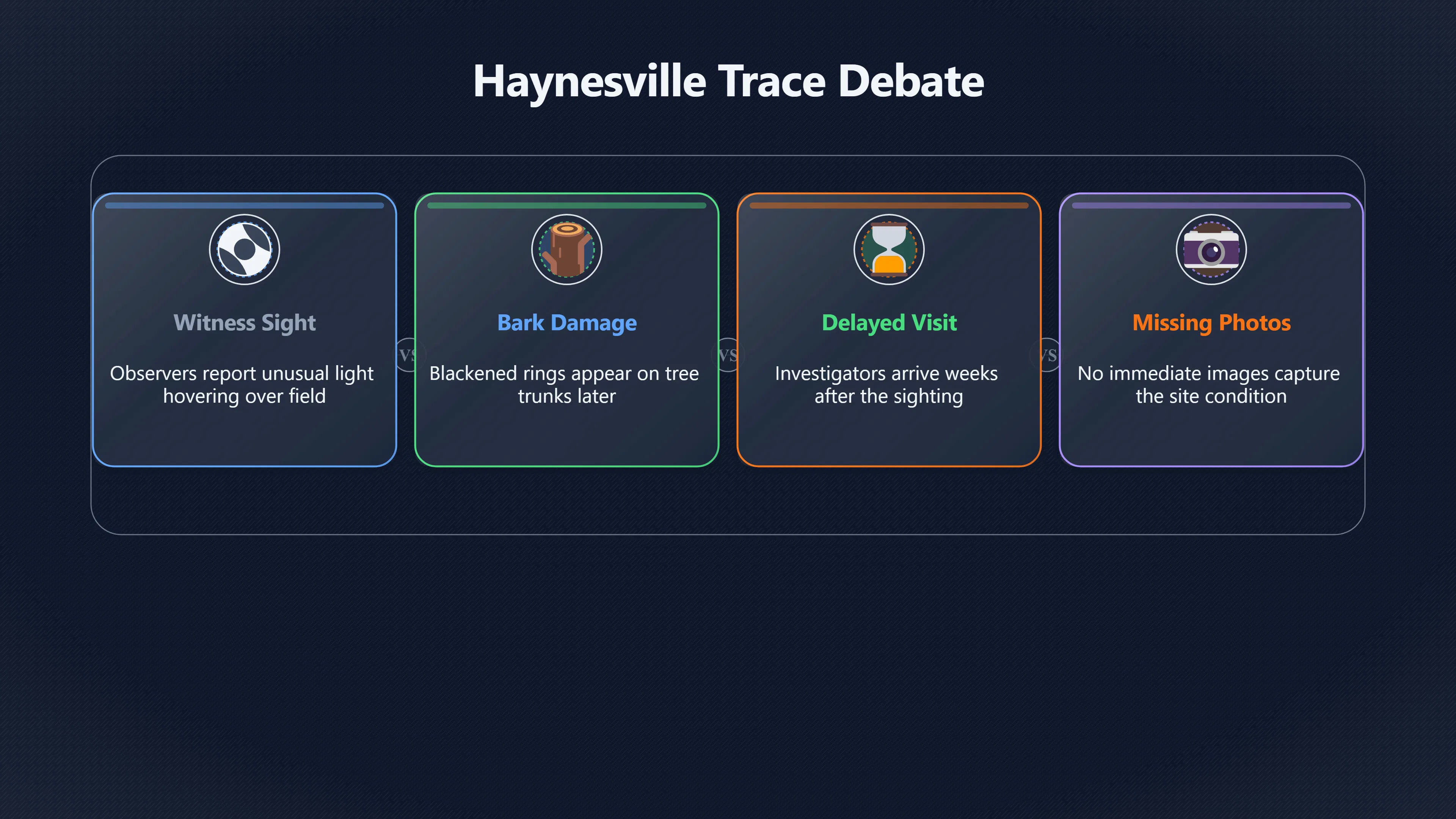
In Haynesville, investigators accepted that witnesses saw an unusual light source, but they were much more cautious about the claimed environmental effects. One major problem was that the physical traces were not documented immediately after the event. The better-known claims about burned bark and a distinct clearing only became prominent after later visits to the site. Modern supporters describe the area as roughly nine metres across with blackened bark facing inward towards the supposed source.[ScienceDirect]sciencedirect.comThey are often noted to impact both human health and physical devices in…
For sceptics, that delay is crucial. Physical evidence collected long after an incident is difficult to separate from ordinary environmental change. Forested areas naturally experience bark damage, fungus, insect activity, lightning strikes, controlled burning and decay. Without careful contemporaneous measurements, photographs or chain-of-custody procedures, later observers may unintentionally reinterpret ordinary damage through the lens of an already famous UFO story.
The Condon-era investigators also appear not to have treated the Haynesville traces as conclusive physical proof. Although the case was logged and discussed, the report did not elevate it into a decisive scientific breakthrough. Critics of UFO claims often point to this restraint as significant: even investigators willing to catalogue unexplained reports did not conclude that the site damage demonstrated advanced technology or extraterrestrial machinery.[Wikipedia]WikipediaJames E. Mc DonaldJames E. Mc Donald
At the same time, UFO researchers later accused the Condon project itself of institutional bias. Critics argued that the committee was predisposed towards dismissive interpretations before investigations were complete. Controversies surrounding internal memoranda and sceptical attitudes within the project became part of wider arguments over whether some UFO evidence was prematurely discounted.[Center for Inquiry]centerforinquiry.s3.amazonaws.comCenter for InquiryThe Condon UFO Study: A Trick or a Conspiracy?by PJ Klass · Cited by 3 — Roush's very one-sided UFO symposium provided…
That dispute complicates the Haynesville debate. Believers see the cautious treatment of the traces as evidence of excessive scepticism, while critics see the same caution as appropriate scientific restraint.
Could ordinary causes explain the tree damage?
The core argument revolves around whether the bark damage really required an exotic explanation.
Later technical papers sympathetic to the case have argued that the inward-facing blackening pattern suggests exposure to intense radiant energy rather than a conventional forest fire. Some researchers used thermal modelling to estimate very large energy outputs from the alleged source.[Astrophysics Data System]ui.adsabs.harvard.eduThe case, which centered on a well…Read more…
However, those conclusions depend heavily on assumptions that sceptics dispute.
Natural explanations
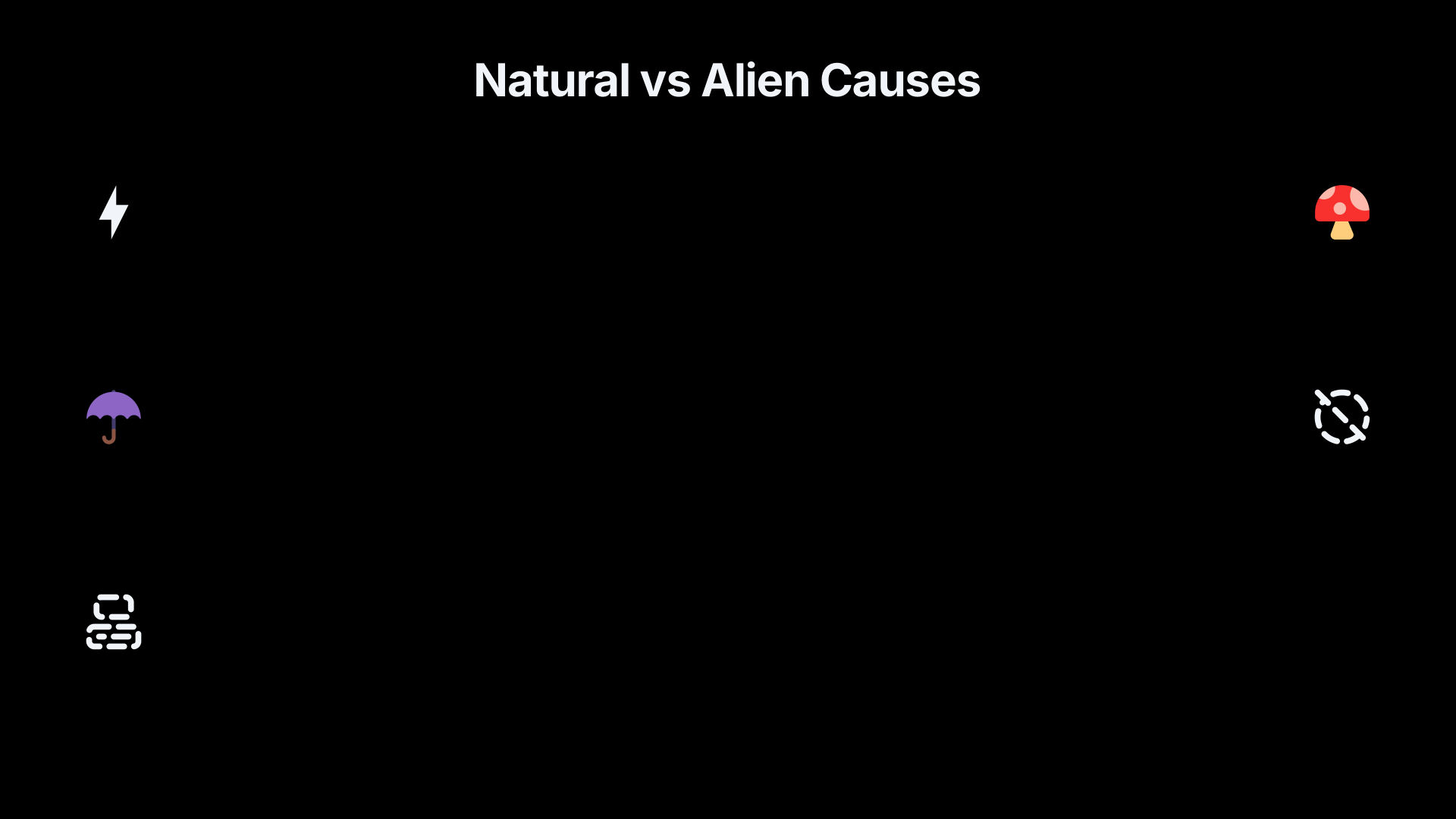
Several ordinary environmental processes could potentially produce confusing or misleading damage patterns:
- Lightning effects: Lightning can scar or blacken bark unevenly and may affect clusters of trees differently depending on moisture and conductivity.
- Fungal or insect damage: Disease and decay sometimes darken bark in irregular patches that can later appear “burned”.
- Weather exposure: Wet winter conditions, rot and natural dieback may alter bark texture and colour over time.
- Small ground fires or human burning: Localised fires, discarded materials or agricultural activity can leave circular or patchy damage without creating a major wildfire record.
Because the site was not preserved immediately after the incident, sceptics argue there is no reliable baseline showing what the trees looked like before the sighting or in the weeks immediately afterwards.
Human interpretation and expectation
Another sceptical argument concerns observer expectation. Once witnesses and investigators believed a UFO had landed or hovered in the area, they may have unconsciously searched for confirming evidence. A roughly circular clearing or discoloured bark could then acquire significance that might otherwise have gone unnoticed.
This criticism is common in disputed UFO trace cases. Environmental features are often interpreted after the fact rather than documented in real time under controlled conditions. Critics therefore argue that pattern recognition and suggestion can play a major role in how physical evidence is perceived.

Problems with the “burn pattern” argument
Supporters of the Haynesville case emphasise that the bark damage allegedly faced inward towards the centre of the clearing. Yet sceptics note that this description itself comes largely from retrospective accounts rather than detailed measurements published at the time.
There is also uncertainty about the exact tree species involved, their condition before the incident and whether all trees in the area showed similar effects. Even the later technical reassessments acknowledge that important biological details were unavailable.[ScienceDirect]sciencedirect.comThey are often noted to impact both human health and physical devices in…
Without controlled comparisons from 1966, critics argue that later energy calculations may rest on fragile assumptions about how much heat or radiation the trees actually absorbed.
The missing-documentation problem
One of the strongest sceptical criticisms is simply that the evidence trail is incomplete.
Modern discussions of Haynesville often describe laboratory studies of bark fragments and advanced modelling work, but the original field documentation from the 1960s appears limited compared with what modern forensic investigators would require. The gap between the event and later evidence collection creates several problems:
- uncertain location accuracy
- uncertain timing of the damage
- limited photographic documentation
- unclear handling of samples
- incomplete environmental controls
- lack of independent replication
This matters because extraordinary physical claims require unusually strong documentation. If a site truly experienced radiation levels or energy outputs comparable to industrial-scale systems, sceptics argue there should ideally be broader and more rigorously preserved evidence.
The absence of such records does not prove the traces were mundane, but it weakens confidence in later interpretations.
Why later reanalysis did not settle the argument
The Haynesville traces gained renewed attention through recent technical papers associated with Jacques Vallée and collaborators. These studies attempted to revisit the case with modern analytical methods, including thermal diffusion modelling and examination of preserved bark samples.[Astrophysics Data System]ui.adsabs.harvard.eduThe case, which centered on a well…Read more…
For supporters, this work strengthened the case by treating it as a measurable physical event rather than folklore. The research argued that the traces deserved scientific attention because they involved quantifiable environmental effects.
Yet sceptics responded that sophisticated modelling cannot compensate for uncertain original evidence. If the underlying assumptions about the bark damage or source geometry are wrong, then the resulting energy estimates may also be unreliable. Critics further note that modelling can produce dramatic outputs even when the starting evidence is fragmentary.
Another source of disagreement concerns sample preservation. Bark collected years after the event may not cleanly preserve signatures from a single moment in 1966. Environmental contamination, ageing and storage conditions can all complicate later laboratory interpretation.
As a result, the reanalysis revived interest in Haynesville without ending the debate.
Why the Haynesville traces remain controversial in Louisiana UFO history
Haynesville occupies an unusual place in Louisiana UFO history because it sits between two categories. It is stronger than many simple “light in the sky” reports because it involves trained witnesses, official investigations and alleged physical effects. But it is weaker than a truly documented forensic case because the evidence chain contains major gaps.
That tension explains why the incident continues to divide opinion decades later.
For UFO researchers, Haynesville represents a rare attempt to connect eyewitness testimony with measurable environmental traces. For sceptics, it demonstrates how ambiguous physical marks can become magnified into extraordinary claims once attached to a dramatic story.
The central dispute is therefore not whether something unusual was reported near Haynesville in December 1966. It is whether the later interpretation of burned bark and damaged trees genuinely points to an unknown high-energy phenomenon, or whether ordinary environmental effects were transformed into apparent UFO evidence through incomplete documentation and retrospective interpretation.
Amazon book picks
Further Reading
Books and field guides related to Why Experts Debate the Cause of Haynesville Burned Traces. Use these as the next step if you want deeper reading beyond the article.
Dimensions
Directly aligns with debates over environmental evidence and trace effects.
The UFO Experience
Provides scientific and investigative frameworks for disputed evidence.
Passport to Magonia
Explores alternative interpretations of unusual reports and claims.
eBay marketplace picks
Marketplace Samples
Example marketplace items related to this page. Use the search link to explore similar finds on eBay.





Endnotes
1.
Source: sciencedirect.com
Link:https://www.sciencedirect.com/science/article/abs/pii/S0376042125000247
Source snippet
They are often noted to impact both human health and physical devices in...
2.
Source: Wikipedia
Title: Condon Committee
Link:https://en.wikipedia.org/wiki/Condon_Committee
3.
Source: colorado.edu
Title: condon report cu boulders historic ufo study
Link:https://www.colorado.edu/coloradan/2021/11/05/condon-report-cu-boulders-historic-ufo-study
Source snippet
University of Colorado BoulderThe Condon Report: CU Boulder's Historic UFO StudyNov 5, 2021 — Very few official UFO studies have been con...
4.
Source: Wikipedia
Title: Investigation of UFO reports by the United States government
Link:https://en.wikipedia.org/wiki/Investigation_of_UFO_reports_by_the_United_States_government
5.
Source: Wikipedia
Title: James E. Mc Donald
Link:https://en.wikipedia.org/wiki/James_E._McDonald
6.
Source: centerforinquiry.s3.amazonaws.com
Link:https://centerforinquiry.s3.amazonaws.com/wp-content/uploads/sites/29/1986/07/22165324/p42.pdf
Source snippet
Center for InquiryThe Condon UFO Study: A Trick or a Conspiracy?by PJ Klass · Cited by 3 — Roush's very one-sided UFO symposium provided...
7.
Source: ui.adsabs.harvard.edu
Link:https://ui.adsabs.harvard.edu/abs/2025PrAeS.15601098V/abstract
Source snippet
The case, which centered on a well...Read more...
Additional References
8.
Source: cia.gov
Link:https://www.cia.gov/readingroom/docs/CIA-RDP81R00560R000100010010-0.pdf
9.
Source: files.ncas.org
Link:https://files.ncas.org/condon/text/s3chap01.htm
Source snippet
Report Section III, Chapter 1: Field StudiesAccording to the account of the UFO sighting, the photographer was at the base ball park to p...
10.
Source: facebook.com
Link:https://www.facebook.com/groups/641270671133568/posts/1402992438294717/
Source snippet
Scientist examines ufo evidence for extraterrestrial lifeAllen Hynek was the scientific consultant for the U.S. Air Force's three UFO inv...
11.
Source: scribd.com
Link:https://www.scribd.com/document/367857927/Physical-Traces-Associated-With-UFO-Sightings-Ted-Phillips
Source snippet
Physical Traces Associated With UFO Sightings - Ted PhillipsUFO landed, bark on tree trunks damaged, trees spread outward...
12.
Source: 3af.fr
Link:https://www.3af.fr/docs/2025110701_1328693110_2025-estimates-of-radiative-energy-values-in-ground-level-observations-of-an-0aunidentified-aerial-phenomenon-new-physical-data.pdf
Source snippet
They are often noted to impact both human health and physical devices in consistent ways.Read more...
13.
Source: archive.org
Title: Full text of “Scientific Study Of Unidentified Flying Objects
Link:https://archive.org/stream/pdfy-4vyHjooOJagoGAwN/Scientific%2BStudy%2BOf%2BUnidentified%2BFlying%2BObjects_djvu.txt
Source snippet
One publication (Hall, 1964) lists 106 UFO cases in which electromagnetic effects are a significant feature of the UFO report. Forty-five...
14.
Source: pod.wave.co
Link:https://pod.wave.co/podcast/danny-jones-podcast/324-nasa-physicist-comes-clean-on-ufos-why-we-cant-go-back-to-the-moon-kevin-knu-b4c3d904
Source snippet
wave.co#324 - NASA Physicist Comes Clean on UFOs & Why We Can...18 Aug 2025 — There were UFO reports that night, many UFO reports to the...
15.
Source: olivieromannucci.substack.com
Title: uap breakthrough in progress in aerospace
Link:https://olivieromannucci.substack.com/p/uap-breakthrough-in-progress-in-aerospace
Source snippet
Breakthrough in Progress in Aerospace SciencesThe lack of transparency—names and qualifications hidden—fuels doubts they were super scien...
16.
Source: medium.com
Link:https://medium.com/%40kyeq1/the-forgotten-uap-case-jacques-vall%C3%A9e-calls-one-of-the-most-important-in-history-5f5f44f2d88c
Source snippet
long-running program to evaluate UFO reports. It did not...
17.
Source: knuthlab.org
Title: knuth+etal 2025 new science UAP
Link:https://knuthlab.org/papers/knuth%2Betal—2025–new-science-UAP.pdf
Source snippet
knuth+etal---2025--new-science-UAP.pdfto see if he could find any physical evidence of the UFO's presence. The field was covered with sno...
Topic Tree