Within NC UFOs
What Did Project Blue Book Record in North Carolina?
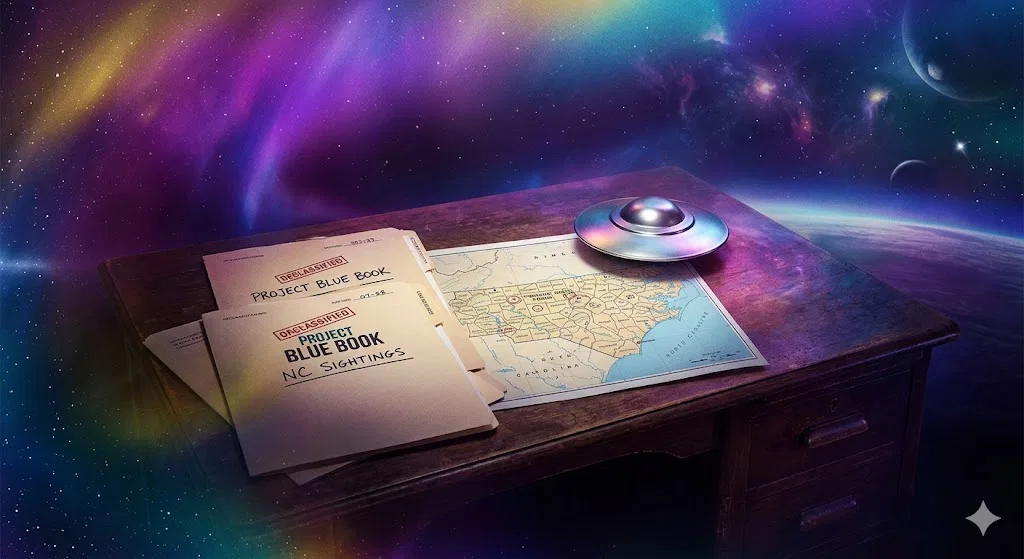
Cold War Air Force files give North Carolina sightings a documented place in the classic UFO era.
On this page
- North Carolina cases in the Air Force archive
- Pope, Bonlee, Southern Pines and Fort Bragg
- What 'unidentified' did and did not mean
Page outline Jump by section
Introduction
Project Blue Book gives North Carolina a documented place in the classic Cold War UFO era, but the files do not tell a simple “aliens visited the state” story. They show something more useful: a chain of Air Force-recorded reports from pilots, military personnel, civilians and base observers, some marked as “unidentified”, many thinly documented, and several clustered around the state’s military aviation landscape. The strongest North Carolina entries include the 1950 Pope AFB and Bonlee reports, the 1952 Southern Pines case, and later Fort Bragg and Pope AFB incidents in 1958. These cases matter because they sit at the overlap of witness testimony, Cold War air defence concerns, and imperfect official investigation. They are historically significant, but “unidentified” meant the Air Force had not found a satisfactory explanation from the available data, not that it had proved an extraordinary origin.[National Archives]archives.govNational Archives Project BLUE BOOKNational Archives Project BLUE BOOK
North Carolina cases in the Air Force archive
Project Blue Book was the best-known Air Force UFO investigation, but the public archive also folds in earlier material from the related Air Force programmes Project Sign and Project Grudge. That matters for North Carolina because some of the state’s important entries pre-date Blue Book’s formal start in 1952 but appear in the Blue Book case lists and later “unknown” catalogues. The National Archives describes Project Blue Book as covering Air Force UFO records from 1947 to 1969, with 12,618 reported sightings and 701 remaining “Unidentified” when the programme closed.[National Archives]archives.govNational Archives Project BLUE BOOKNational Archives Project BLUE BOOK
North Carolina appears repeatedly in those lists, though not always in the same way. Some cases are in Air Force “unidentified” lists; some are later researcher catalogues of Blue Book-related unknowns; some are specific case files where the final label may be “insufficient data” rather than a strong unknown. For readers, this distinction is crucial. A case in the Blue Book archive is not automatically a strong case. It may be an official record of a report, an unresolved evaluation, or a report too incomplete to judge.
The North Carolina entries also show the variety of the state’s Cold War UFO record. They include daylight sightings by pilots, brief night-light reports, military-base observations, possible radar-adjacent cases, and rural visual sightings. A later comprehensive catalogue of Blue Book “unknowns” includes North Carolina entries at Wilmington in 1948, Wilson and Hamlet-Greenwood in 1949, Pope AFB and Bonlee in 1950, Southern Pines, Laurinburg-Maxton AFB and Greensboro in 1952, Henderson and Highland in 1956, Fort Bragg and Pope AFB in 1958, and several 1960s reports including Burnsville-Mt. Mitchell and Vanceboro.[Center for UFO Studies]cufos.orgCenter for UFO Studies Microsoft WordCenter for UFO Studies Microsoft Word[Center for UFO Studies]cufos.orgCenter for UFO Studies Microsoft WordCenter for UFO Studies Microsoft Word[Center for UFO Studies]cufos.orgCenter for UFO Studies Microsoft WordCenter for UFO Studies Microsoft Word
The pattern is not a single statewide “flap” in the way that some UFO histories describe Washington, D.C. in 1952 or Michigan in 1966. Instead, the North Carolina record looks like a scattered sequence of high-strangeness reports, many connected to aviation corridors or military settings, with a few rural cases that became notable because trained or apparently credible witnesses were involved.
Pope, Bonlee, Southern Pines and Fort Bragg
Pope AFB, October 1950: pilots, pursuit and a base-area setting
One of the most important early North Carolina entries is the 15 October 1950 Pope AFB case, listed as case 821 in an Air Force “unknown” list reproduced by UFO historian Patrick Gross from Blue Book material. The case appears beside Bonlee in the 1950 section, which immediately marks this period as one of the state’s most concentrated early Blue Book-era clusters.[ufologie.patrickgross.org]ufologie.patrickgross.orgOpen source on patrickgross.org.
Brad Sparks’s later catalogue gives a more detailed summary. It places the report near Pope AFB at 4:20 p.m. and describes a Miami Airlines DC-4 pilot, Captain George A. Woodward, and copilot Williams Bradsley or Bardsley, flying from Raleigh to Miami. They reportedly saw four round, shiny, domed-disc objects about five miles away, roughly 100 feet in size and spaced in a line. The objects were said to descend slowly, back away as the aircraft pursued, and then leave in a “burst of speed”. A possible ground observation from retired Army Captain Harvey W. Daniel in Chapel Hill was also noted, though the relationship between the observations is not certain.[Center for UFO Studies]cufos.orgCenter for UFO Studies Microsoft WordCenter for UFO Studies Microsoft Word
Why does this case matter for North Carolina? First, it involves aviation witnesses rather than only casual ground observers. Second, it happened near Pope AFB, next to Fort Bragg, placing it in a major military aviation environment. Third, its description is more elaborate than many one-light night sightings: multiple objects, estimated distance, aircraft pursuit and a possible independent ground report.
The doubts are just as important. Distance, size and speed estimates from moving aircraft are notoriously difficult. “Domed disc” descriptions can sound persuasive, but without photographs, radar confirmation, reliable triangulation or surviving detailed interview material, the case remains historically interesting rather than decisive. The Air Force “unknown” label means it resisted the available explanation process; it does not mean the physical nature of the objects was established.

Bonlee, October 1950: a rural daylight report by an ex-USAF pilot
Eight days after the Pope AFB report, another North Carolina case entered the “unknown” lists: Bonlee, in Chatham County, on 23 October 1950. In the Air Force list, it is case 824, immediately following the Pope AFB entry.[ufologie.patrickgross.org]ufologie.patrickgross.orgOpen source on patrickgross.org.
The fuller catalogue summary identifies the witness as ex-USAF pilot Frank M. Risher, driving southeast on Highway 421, about two miles west of Bonlee, at 12:42 p.m. He reportedly saw an aluminium-coloured object about two miles away, below overcast clouds at an estimated altitude of 600 to 800 feet. The object was described as dirigible-shaped, roughly the size of a B-36 “stacked double thickness”, with three or four dark portholes. It reportedly hovered for about 35 seconds, then flew away to the south-southeast and disappeared into the overcast.[Center for UFO Studies]cufos.orgCenter for UFO Studies Microsoft WordCenter for UFO Studies Microsoft Word
The Bonlee case is memorable because it is daylight, rural and detailed. It also has the kind of witness profile that Blue Book reviewers often treated as more valuable than an anonymous night-light report: a former Air Force pilot giving a structured observation with distance, height, colour, shape and motion.
Yet it also shows the limits of a witness-only case. The reported object was seen for less than a minute. There is no cited radar track, photograph, recovered material or confirmed second observer in the catalogue summary. The shape could invite ordinary hypotheses — aircraft seen at an odd angle, a balloon, a small airship-like object, or a cloud-shadow illusion — but the specific “hover then depart into overcast” description is why it remained difficult to close from the information available.
Southern Pines, September 1952: a short but striking military-witness report
Southern Pines appears in the 1952 “unknown” sequence, a year famous nationally for a surge of UFO reports. The Air Force list gives it as case 2140 on 29 September 1952.[ufologie.patrickgross.org]ufologie.patrickgross.orgOpen source on patrickgross.org.
The Blue Book summary is brief but vivid: at 8:15 p.m., U.S. Army Reserve First Lieutenant C. H. Stevens and two others reportedly saw “one green ellipse with a long tail” orbiting for 15 minutes.[ufologie.patrickgross.org]ufologie.patrickgross.orgOpen source on patrickgross.org.
That description makes the case useful but also awkward. “Green ellipse with a long tail” is the sort of phrase that can suggest a meteor to a modern reader, but the reported duration and “orbiting” motion do not fit a typical meteor. It might suggest an aircraft light, flare, searchlight effect, advertising light, or atmospheric phenomenon, but the short summary does not provide enough geometry, sky position, weather, altitude estimate or comparison stars to test those possibilities properly.
Southern Pines also matters geographically. It lies near the Fort Bragg/Pope military region, making it part of a broader central North Carolina cluster rather than an isolated local curiosity. The case does not prove anything exotic, but it does show how military-linked observers and unusual night-light descriptions entered the official record during the peak 1952 reporting wave.
Fort Bragg, 1958: two reports in a military setting
Fort Bragg appears in the later 1950s Blue Book-related record in two notable ways. One report, dated 15 May 1958, involved a military pilot named Beck and two civilian airline pilots who reportedly saw an orange round object heading north at high speed for about five minutes. Another, dated 20 June 1958 and listed as Blue Book case 5857, involved Battalion Communication Chief Sergeant First Class A. Parsley, who reportedly saw a silver circular object, partly through a green haze, hover, oscillate slightly and then move away at great speed.[Center for UFO Studies]cufos.orgCenter for UFO Studies Microsoft WordCenter for UFO Studies Microsoft Word
The June 1958 Fort Bragg report is the stronger archival anchor because it appears in the official “unknown” list as case 5857.[ufologie.patrickgross.org]ufologie.patrickgross.orgOpen source on patrickgross.org. Its value is not that it contains spectacular proof, but that it ties an unresolved report to one of the most important military installations in North Carolina. Fort Bragg was not just a backdrop; it was a place where trained military personnel, communications staff, pilots and air defence systems could plausibly become involved in reporting aerial anomalies.
The limitations are familiar. The 20 June case summary has one named witness and no clear radar confirmation in the brief catalogue entry. The description — a silver circular object, green haze, hovering, slight oscillation and rapid departure — is striking, but without stronger instrumental data it remains a report of an observation, not a resolved physical event.
Pope AFB, November 1958: the collision-course report
The 4 November 1958 Pope AFB case is one of the more dramatic North Carolina entries because it involves an aircraft on approach, tower personnel and a reported safety concern. According to Sparks’s catalogue, a USAF pilot of a landing KB-50 tanker and Pope AFB tower personnel saw an object with strange lights on a collision course. The pilot aborted the landing, climbed away, and circled to observe it. Tower personnel reportedly watched the object hovering above the base through binoculars for about 20 minutes.[Center for UFO Studies]cufos.orgCenter for UFO Studies Microsoft WordCenter for UFO Studies Microsoft Word
For a North Carolina UFO history page, this is a key case because it is not simply “someone saw a light”. It involves operational aviation behaviour: an aborted landing and tower observation. Even if the object eventually had a conventional explanation, the report shows why the Air Force treated at least some UFO reports as air-safety and intelligence matters rather than only public curiosity.
The case also illustrates the archive’s frustrating unevenness. The summary is compelling, but it leaves major questions unanswered: what did the tower staff actually see through binoculars, what was the weather, was there radar, what aircraft were nearby, and how did investigators treat the “strange lights” seen inside the cockpit? Without the complete file and careful reconstruction, the case should be treated as important but not conclusive.
What the North Carolina pattern shows
The North Carolina Blue Book record is most interesting when the cases are read together. The state’s entries do not form one neat story, but several patterns stand out.
First, many of the strongest cases are tied to trained observers. Pope AFB in 1950 involved airline pilots; Bonlee involved an ex-USAF pilot; Southern Pines involved an Army Reserve lieutenant and other witnesses; Greensboro in 1952 involved USAF pilots in RF-80 aircraft; Fort Bragg and Pope AFB in 1958 involved military or aviation personnel. That does not make the reports automatically correct, but it makes them harder to dismiss as simple unfamiliarity with aircraft or sky objects.[Center for UFO Studies]cufos.orgCenter for UFO Studies Microsoft WordCenter for UFO Studies Microsoft Word[Center for UFO Studies]cufos.orgCenter for UFO Studies Microsoft WordCenter for UFO Studies Microsoft Word[Center for UFO Studies]cufos.orgCenter for UFO Studies Microsoft WordCenter for UFO Studies Microsoft Word
Second, the state’s military geography matters. Fort Bragg, Pope AFB, Laurinburg-Maxton AFB and nearby air routes placed central and eastern North Carolina inside a busy aviation environment. This increases the chance of both genuine misidentifications and meaningful safety reports. In other words, military aviation can produce more UFO reports because there is more to see, but it can also produce better reports because trained observers and formal channels are present.
Third, the North Carolina entries show how varied “UFO” meant in the archive. The reports include shiny domed discs, aluminium dirigible-like objects, green elliptical lights, silver circular objects, orange round lights, football-shaped objects with red and green lights, and bright silvery objects seen from aircraft. That variety weakens any single explanation, but it also weakens any single extraordinary narrative. A mixed set of reports is more likely to contain a mixed set of causes.
Finally, the cases show the difference between historical significance and evidential strength. Pope AFB, Bonlee, Southern Pines and Fort Bragg are historically significant because they are documented in Blue Book-related records and later unknown catalogues. Their evidential strength varies because the surviving summaries often lack the details needed for modern reconstruction.
What “unidentified” did and did not mean
The word “unidentified” is the most misunderstood part of Project Blue Book. In Air Force language, it did not mean “extraterrestrial”. It meant that investigators did not settle on a conventional explanation from the evidence they had. The Air Force’s own public summary stated that none of the investigated and evaluated UFO reports indicated a threat to national security, none showed technological principles beyond modern scientific knowledge, and none provided evidence of extraterrestrial vehicles.[U.S. Air Force]af.milUnidentified Flying Objects and Air Force Project Blue Book > Air Force > Fact Sheet Display…
At the same time, “unidentified” was not meaningless. The Condon Report’s summary defined a UFO as the stimulus for a report made by someone who could not identify what they saw and found it puzzling enough to report; it also stressed that many ordinary objects, including Venus, could become UFOs when not recognised by the observer.[files.ncas.org]files.ncas.orgCondon Report, Section IICondon Report, Section II That is a sober definition, but it does not make every unresolved case trivial. Some reports involved trained witnesses, multiple observers, aircraft operations or military settings.
This is the best way to read North Carolina’s Blue Book cases:
- Unidentified means unresolved in the record, not confirmed extraordinary. A case may remain open because the sighting was genuinely puzzling, because data were missing, or because the investigation was incomplete.
- Witness quality helps, but does not settle the cause. Pilots and military personnel are often better observers of aircraft than the general public, but they are still vulnerable to distance errors, lighting effects, fatigue, expectation and unusual viewing geometry.
- Short summaries are not full case files. Many public lists compress a complicated file into one or two sentences. That can preserve the outline while stripping away the weather, interviews, sketches, radar checks and investigator reasoning needed for a confident judgement.
- “Insufficient data” is weaker than “unknown”. Some Blue Book files record reports that could not be evaluated properly. Those should not be upgraded into strong mysteries simply because no answer was reached.
The Air Force’s 1969 termination announcement sharpened this distinction. It said Project Blue Book was being closed partly because the University of Colorado study and National Academy of Sciences review did not justify continued investigation as a scientific or national-security priority. It also repeated the Air Force’s position that “unidentified” cases had not shown evidence of extraterrestrial vehicles.[esd.whs.mil]esd.whs.milSource details in endnotes.
Why these cases still matter in North Carolina UFO history
North Carolina’s Project Blue Book cases matter because they give the state’s UFO history a documentary backbone. Brown Mountain may be the state’s best-known mystery-light tradition, and modern civilian databases may contain far more reports, but Blue Book is different: it preserves an official Cold War record, however imperfect, of what people reported and how the Air Force classified some of those reports.
The cases also help separate folklore from archive-based history. A dramatic local UFO story can grow in retelling, but a Blue Book case has dates, places, witnesses or witness categories, and a place in a federal record system. That does not make it true in every detail. It does mean it can be checked, compared and placed in context.
For North Carolina, the central interpretive point is that the Blue Book cases are strongest as evidence of uncertainty, not as evidence of a single answer. They show that trained observers sometimes reported puzzling aerial events over or near North Carolina. They show that the Air Force sometimes could not match those reports to aircraft, balloons, astronomical objects, meteors or other common explanations. They also show that the official conclusion remained cautious: unresolved cases did not amount to proof of advanced technology, hostile threat or extraterrestrial visitation.
That balanced reading makes the North Carolina cases more interesting, not less. Pope AFB and Fort Bragg connect UFO history with military aviation. Bonlee shows how a rural daylight report by a former pilot could enter the official unknown record. Southern Pines captures the strangeness of the 1952 wave in a compact local incident. Together, they make North Carolina part of the classic Blue Book story: not as a solved mystery, and not as a confirmed extraordinary event, but as a state where Cold War skies, trained witnesses, incomplete records and unresolved observations all crossed paths.
Amazon book picks
Further Reading
Books and field guides related to What Did Project Blue Book Record in North Carolina?. Use these as the next step if you want deeper reading beyond the article.
The Report on Unidentified Flying Objects
Directly addresses the program discussed on the page.
UFOs and Government
Explains government handling of cases like those from North Carolina.
Project "Blue Book"
Covers cases and records associated with Air Force investigations.
eBay marketplace picks
Marketplace Samples
Example marketplace items related to this page. Use the search link to explore similar finds on eBay.






Endnotes
1.
Source: archives.gov
Title: National Archives Project BLUE BOOK
Link:https://www.archives.gov/research/military/air-force/ufos
2.
Source: esd.whs.mil
Link:https://www.esd.whs.mil/Portals/54/Documents/FOID/Reading%20Room/UFOsandUAPs/asdpa1.pdf?ver=2017-05-22-113454-807
3.
Source: ufologie.patrickgross.org
Link:https://ufologie.patrickgross.org/htm/blulst.htm
4.
Source: ufologie.patrickgross.org
Link:https://ufologie.patrickgross.org/htm/bluebooku52.htm
5.
Source: af.mil
Title: U.S. Air Force
Link:https://www.af.mil/About-Us/Fact-Sheets/Display/Article/104590/unidentified-flying-objects-and-air-force-project-blue-book/
Source snippet
Unidentified Flying Objects and Air Force Project Blue Book > Air Force > Fact Sheet Display...
6.
Source: files.ncas.org
Title: Condon Report, Section II
Link:https://files.ncas.org/condon/text/sec-ii.htm
7.
Source: ufologie.patrickgross.org
Link:https://ufologie.patrickgross.org/htm/bluebooku50.htm
8.
Source: archive.org
Link:https://archive.org/stream/ProjectBlueBookSpecialReport14/pbbsr14_djvu.txt
9.
Source: archive.org
Title: Brad Sparks Comprehensive Catalog of 1,600 Project Blue Book UFO Unknowns
Link:https://archive.org/download/BernardSieglerTechnicsAndTime1TheFaultOfEpimetheus/Brad%20Sparks%20-%20Comprehensive%20Catalog%20of%201%2C600%20Project%20Blue%20Book%20UFO%20Unknowns.pdf
10.
Source: archive.org
Title: 1957 11 6781964 Ft Bragg NCar
Link:https://archive.org/details/1957-11-6781964-Ft-Bragg-NCar
11.
Source: cufos.org
Title: Center for UFO Studies Microsoft Word
Link:https://cufos.org/PDFs/pdfs/BB_Unknowns.pdf
12.
Source: dictionary.cambridge.org
Link:https://dictionary.cambridge.org/zht/%E8%A9%9E%E5%85%B8/%E8%8B%B1%E8%AA%9E-%E6%BC%A2%E8%AA%9E-%E7%B9%81%E9%AB%94/project
13.
Source: Wikipedia
Title: Project Blue Book
Link:https://en.wikipedia.org/wiki/Project_Blue_Book
14.
Source: Wikipedia
Link:https://en.wikipedia.org/wiki/Project
15.
Source: britannica.com
Title: Project Blue Book
Link:https://www.britannica.com/topic/Project-Blue-Book
16.
Source: pinestrawmag.com
Link:https://pinestrawmag.com/category/march-2019/page/2/
17.
Source: vocal.media
Title: Project Blue Book | Futurism
Link:https://vocal.media/futurism/project-blue-book
18.
Source: vocabulary.com
Link:https://www.vocabulary.com/dictionary/project
19.
Source: junyiacademy.org
Link:https://www.junyiacademy.org/videos/nFcdbY-56w0?topic=junyi-english%2Fenglish-high%2Feng-senior10%2Fv1283-new-topic-231%2Fenglish-vocabulary1%2Fdragon-book2-lesson5-new
Additional References
20.
Source: youtube.com
Title: Asheville Included in Project Blue Book UFO Sightings Report
Link:https://www.youtube.com/watch?v=7YNAWs9w_88
Source snippet
'Project Blue Book' Ep. 1 Official Clip | UFO | SHOWTIME Documentary Series...
21.
Source: youtube.com
Title: ‘Project Blue Book’ Ep. 1 Official Clip | UFO | SHOWTIME Documentary Series
Link:https://www.youtube.com/watch?v=W89jh2C2Ry8
Source snippet
Project Blue Book: America's Obsession with UFOs...
22.
Source: cia.gov
Link:https://www.cia.gov/readingroom/docs/CIA-RDP81R00560R000100060001-5.pdf
23.
Source: cia.gov
Link:https://www.cia.gov/readingroom/document/cia-rdp81r00560r000100060001-5
24.
Source: youtube.com
Title: 10 Cases From Project Blue Book: The CIA’s Hunt For UFOs
Link:https://www.youtube.com/watch?v=OoKm417zKOA
Source snippet
Project Blue Book Exposed (2020) [Documentary]...
25.
Source: youtube.com
Title: Project Blue Book: America’s Obsession with UFOs
Link:https://www.youtube.com/watch?v=Xu4oTBBI5UE
Source snippet
10 Cases From Project Blue Book: The CIA's Hunt For UFOs...
26.
Source: facebook.com
Link:https://www.facebook.com/WCBDNews2/posts/8-firsthand-accounts-of-ufo-sightings-in-horry-county/4894966030514786/
27.
Source: scribd.com
Link:https://www.scribd.com/document/51179838/UFOlogy-The-Book-NICAP-Database
28.
Source: facebook.com
Link:https://www.facebook.com/HISTORY/posts/during-the-cold-war-as-project-blue-book-investigated-potential-ufo-threats-a-sh/1473622884330683/
29.
Source: amazon.co.uk
Link:https://www.amazon.co.uk/Flying-saucers-analysis-project-special/dp/B0006BNMN0
Topic Tree