Within South Dakota UFOs
How Official Were South Dakota's UFO Explanations?
South Dakota's Blue Book files show how sightings could be classified, explained, dismissed or left uncertain on limited evidence.
On this page
- What Blue Book counted and preserved
- South Dakota cases marked solved or insufficient
- Why an official answer was not always a strong answer
Page outline Jump by section
Introduction
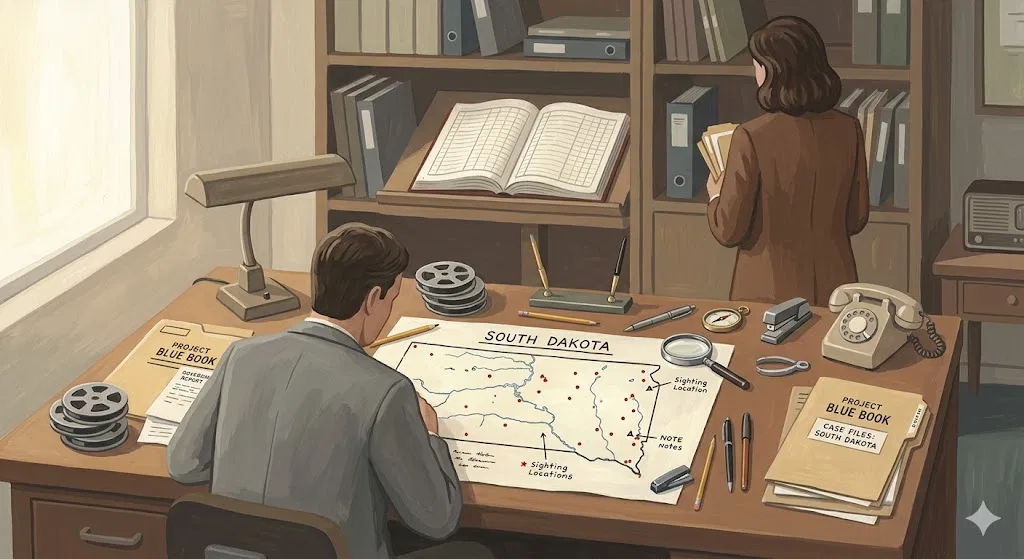
Project Blue Book matters to South Dakota’s UFO history because it turned scattered sightings into official categories: aircraft, balloon, meteor, astronomical object, insufficient data, or unidentified. Those labels shaped how the state’s cases were remembered, but they did not always mean the evidence had been deeply tested. The clearest lesson from the South Dakota files is that an “official explanation” could range from a reasonable identification to a thin judgement made from incomplete witness forms, while an “unidentified” label meant only that the Air Force could not match the report to a known cause from the information it had. Nationally, Blue Book recorded 12,618 sightings from 1947 to 1969, of which 701 remained “Unidentified”; South Dakota’s surviving record is much smaller, but it shows the same strengths and weaknesses in miniature.[National Archives]archives.govNational Archives Project BLUE BOOKNational ArchivesProject BLUE BOOK - Unidentified Flying Objects | National Archives…
What Blue Book counted and preserved
Project Blue Book was the United States Air Force’s long-running UFO investigation, based at Wright-Patterson Air Force Base in Ohio. Its stated task was not to prove or disprove every extraordinary claim, but to receive, investigate, document and evaluate reports, especially where they might involve national security, unusual technology, or public concern. Air Force material described the process as three stages: a local base investigation, more intensive review at the Blue Book office if no clear explanation emerged, and public release of evaluations and statistics through Air Force information channels.[Defense Acquisition University]esd.whs.milDefense Acquisition University
For South Dakota, that meant reports could enter the federal system through nearby air bases, military observers, law enforcement, radar stations, pilots, weather observers, civilians, or Ground Observer Corps posts. The records were not a single polished narrative. They were case cards, teletype summaries, witness statements, status reports, consultant notes and later administrative material. The National Archives says the textual Blue Book records are held on 94 rolls of 35 mm microfilm, with photographs filmed separately on the final two rolls; South Dakota historian Lawrence H. Larsen noted that researchers had to work through chronological microfilm rolls and sometimes poor-quality filming to locate individual Great Plains cases.[National Archives]archives.govNational Archives Project BLUE BOOKNational ArchivesProject BLUE BOOK - Unidentified Flying Objects | National Archives…
That archival structure matters. A Blue Book record can prove that a report was received, logged and evaluated, but it does not automatically prove that the event itself was unusual. In many South Dakota cases, the official paper trail is stronger than the underlying evidence: the reader may see that an airman, student, ranger, controller or observer made a report, and that the Air Force assigned a conclusion, but not always enough raw data to judge the conclusion independently.
Blue Book’s own categories also need careful reading. Air Force explanatory material grouped evaluations under three broad headings: “identified”, “insufficient data” and “unidentified”. “Identified” meant the Air Force believed it had enough specific information for a positive explanation. “Insufficient data” meant key details such as date, duration, location, sky position, weather, appearance or disappearance were missing. “Unidentified” was supposed to be a narrower category: a report containing enough information to form a valid hypothesis, yet still not matching a known object or phenomenon.[Defense Acquisition University]esd.whs.milDefense Acquisition University
That distinction is central to South Dakota. A weakly documented sighting could be dismissed as “insufficient data”, while a better-documented case could remain “unidentified”. But the line between those outcomes was not always clean. Larsen’s review of Great Plains files found that the quality of evidence in some “identified” South Dakota sightings was not obviously better than the evidence in cases where Blue Book said no definite judgement could be made.[South Dakota Historical Society Press]sdhspress.comSouth Dakota Historical Society Press
South Dakota cases marked solved or insufficient
The South Dakota files are useful because they show the ordinary machinery of official explanation. Most cases were not dramatic chases or famous mysteries. They were brief lights, discs, streaks, flashes, apparent formations, radar returns, or distant objects whose explanation depended on witness position, weather, timing, military traffic and astronomical checks.
Some identifications look plausible. Larsen listed a high-altitude sphere seen over Hecla on 30 June 1948 as a balloon released from Camp Ripley, Minnesota, for cosmic-ray research. A 7 July 1954 Ellsworth-related sighting near Whitewood, initially serious enough for fighters to be scrambled, was later identified as a permanent beacon seen through haze. A 12 December 1957 Rapid City white-ball report was treated as part of a meteor display, and a 7 August 1958 Rapid City night-sky report was identified as a star.[South Dakota Historical Society Press]sdhspress.comSouth Dakota Historical Society Press
Other official answers were less secure. Larsen highlighted an August 1947 report from Weaver, where an Air Force intelligence officer saw twelve yellow-and-white objects moving south in a tight diamond formation at an estimated 6,000 to 10,000 feet; Blue Book’s consultant called them migrating birds. On 4 August 1958, several Rapid City witnesses described a round or disc-shaped object, apparently basketball-sized to the naked eye, travelling straight and level before vanishing south; the official explanation was an aircraft turning in sunlight. Near Deadwood on 15 January 1959, a forest ranger’s flickering object was closed with the suggestion that clouds could create an illusion of movement.[South Dakota Historical Society Press]sdhspress.comSouth Dakota Historical Society Press
The problem is not that those explanations are impossible. Birds, aircraft, haze, stars, meteors and balloons really do account for many UFO reports. Blue Book’s own public material emphasised exactly those sources, including aircraft seen at distance, jet exhaust, condensation trails, balloons reflecting sunlight, satellites, meteors, planets, mirages, searchlights, birds, kites, hoaxes and spurious radar indications.[Defense Acquisition University]esd.whs.milDefense Acquisition University
The problem is that a plausible category was sometimes treated as if it were a demonstrated answer. In the Rapid City aircraft-in-sunlight case, for example, the official conclusion may be reasonable, but the surviving summary does not show the full reconstruction a modern reader would want: aircraft track, sun angle, witness geometry and timing. In the Deadwood cloud-illusion case, the explanation could fit some observations, yet it reads more like a possibility than a strongly proven identification.
“Insufficient data” cases tell a different story. On 2 September 1952, two B-36 flight engineers stationed at Ellsworth Air Force Base reported UFOs moving slowly in a circular pattern; Blue Book decided there was not enough information to evaluate the occurrence. On 3 March 1957, two airmen at Rapid City reported coloured rays slanting outward in a circular pattern; the file was also considered insufficient, although a note speculated that they may have seen northern lights. Near Lead on 24 June 1960, an airman watched a large multicoloured object for about half an hour, but a consultant said no identification could be made because key position details were missing, even though an astronomical object under atmospheric conditions was considered likely.[South Dakota Historical Society Press]sdhspress.comSouth Dakota Historical Society Press
Those examples show why “insufficient data” should not be read as either a debunking or a mystery endorsement. It is often a record-management outcome. The Air Force could not prove a conventional answer, but it also did not have enough information to justify a stronger unknown classification.
The unresolved label was narrower than many readers assume
In popular UFO culture, “unexplained” often becomes the most exciting word in a case file. In Blue Book practice, it was more technical and more limited. Former Blue Book head Edward J. Ruppelt wrote that a good “unknown” report needed a competent observer and a reasonable amount of data, while reports lacking such data were stamped “Insufficient Data for Evaluation” and became statistics rather than strong cases.[Project Gutenberg]gutenberg.orgSource details in endnotes.
That matters for South Dakota because the state’s most discussed official cases do not all sit neatly in one bucket. Larsen wrote that Blue Book experts listed only one South Dakota UFO as unidentified: a 14 August 1952 White Lake report in which a Ground Observer Corps member saw what looked like a “stick” or “cigar” that intermittently emitted smoke or vapour before moving rapidly west. Larsen noted that the file was labelled “Secret” and that a stray missile was one possible explanation, though the evidence was not enough to settle the question.[South Dakota Historical Society Press]sdhspress.comSouth Dakota Historical Society Press
At the same time, the Rapid City/Ellsworth radar-visual episode remains the state’s best-known Blue Book-related case. A Project Blue Book status-report text preserved in archival mirrors describes a combined ground-visual, air-visual, ground-radar and air-radar report at Rapid City, with a Ground Observer Corps call from Black Hawk, radar activity at Ellsworth, airmen sent outside to look, and an F-84 vectored towards a target.[Ufologie]ufologie.patrickgross.orgSource details in endnotes. Ruppelt later presented the Rapid City/Ellsworth event as an unusually strong official case because it involved multiple reporting channels rather than a single witness.[Internet Sacred Text Archive]sacred-texts.comSource details in endnotes.
The safest reading is cautious. Rapid City/Ellsworth is important because it shows the Air Force taking a South Dakota sighting seriously enough to investigate through radar, ground observers and fighter interception. It is not, by itself, proof of an extraordinary craft. White Lake is important because it appears in Larsen’s review as the state’s one officially listed “unidentified” case. The contrast between them is a useful warning: later fame, official attention and final Blue Book classification are not always the same thing.
Why an official answer was not always a strong answer
An Air Force conclusion carried institutional authority, but its strength depended on the quality of the incoming report. South Dakota’s files show three recurring limits.
First, many reports were too brief. A light seen for seconds, without precise direction, elevation, weather or comparison objects, gave evaluators little to work with. Blue Book’s own definition of “insufficient data” recognised that missing elements such as duration, location, sky position and manner of disappearance could prevent any firm conclusion.[Defense Acquisition University]esd.whs.milDefense Acquisition University
Second, some explanations were based on pattern matching rather than full reconstruction. A streaking light might become a meteor; a distant bright object might become Venus or a star; a disc-like object might become an aircraft seen in unusual lighting. Those answers may often have been right, but in several South Dakota summaries the surviving evidence does not show enough detail to prove them beyond reasonable doubt. Larsen’s judgement was blunt: conclusions in many cases seemed to depend more on the evaluator than on the weight of evidence, and the Air Force could have said “not enough was known” in many more instances.[South Dakota Historical Society Press]sdhspress.comSouth Dakota Historical Society Press
Third, the official process had public-pressure and national-security aims as well as scientific aims. Air Force material said Blue Book’s objectives included determining whether UFOs posed a threat to the United States and whether they displayed unique scientific or technological information.[The Black Vault]documents.theblackvault.comThe Black Vault That is not the same as running an open-ended scientific inquiry into every puzzling light. The programme was built to triage reports, reduce uncertainty where possible and reassure officials and the public when no threat appeared.
The national closure of Blue Book reinforces this point. The Air Force ended the programme after the University of Colorado’s Condon study, a National Academy of Sciences review, earlier UFO studies and Air Force experience. Its final public conclusions were that no investigated and evaluated UFO had indicated a national-security threat, no evidence showed technology beyond modern scientific knowledge, and no evidence indicated extraterrestrial vehicles.[National Archives]archives.govNational Archives Project BLUE BOOKNational ArchivesProject BLUE BOOK - Unidentified Flying Objects | National Archives… The Condon Report itself argued that UFO studies had not proved a fruitful path for scientific advance, while still allowing that scientists with clear, specific research proposals should not be barred from pursuing them.[NCAS PDF Directory]files.ncas.orgPDF DirectoryCondon Report, Section I: Conclusions & Recommendations…
For South Dakota readers, the implication is modest but important. Blue Book’s closure did not mean every South Dakota sighting had been conclusively solved. It meant the Air Force judged the overall programme no longer justified for national security or scientific purposes.

What the South Dakota files are best used for
The Blue Book record is strongest as a map of official handling, not as a final court verdict on every sighting. It helps answer practical historical questions: which South Dakota reports reached the Air Force, which explanations were favoured, which cases were left weak or uncertain, and how Ellsworth Air Force Base, Rapid City and Ground Observer Corps channels entered the federal UFO system.
The records also help separate three kinds of case that are often blurred together:
- Reasonably solved cases, where the explanation fits the available facts well enough, such as balloons, stars, meteors, aircraft lights or known beacons.
- Weak or insufficient cases, where a witness may have seen something real but the preserved record lacks enough detail for a confident judgement.
- Officially unresolved cases, where the Air Force retained an “unidentified” or unsolved status despite considering the report meaningful enough to evaluate.
South Dakota’s Blue Book legacy sits mostly in the second category, with a smaller number of solved cases and a still smaller number of unresolved ones. That does not make the state unimportant. It makes it a useful example of how official UFO history actually worked: most files were not spectacular secrets, but messy records of human observation, military procedure, incomplete data and sometimes overconfident explanation.
How to read the official explanations today
A careful reader should treat a South Dakota Blue Book entry as the beginning of interpretation, not the end. The most useful question is not “Did the Air Force solve it?” but “How well does the explanation follow from the evidence in the file?”
A strong official explanation should show the relevant timing, direction, weather, object behaviour, witness reliability and comparison with known traffic or astronomical conditions. A weaker one may simply attach a label that is possible but under-supported. An “insufficient data” conclusion may be intellectually honest, because it admits that the evidence is too thin. An “unidentified” conclusion is more interesting, but still limited: it means the case resisted identification within the Air Force process, not that an extraordinary origin has been established.
That is the balanced value of Project Blue Book for South Dakota. It preserves a state-level record of sightings around open skies, military facilities and ordinary communities, while also showing the limits of federal UFO investigation. Its files can weaken exaggerated claims by revealing likely mundane causes. They can also weaken overconfident dismissals by showing how little evidence sometimes stood behind an official answer.
Amazon book picks
Further Reading
Books and field guides related to How Official Were South Dakota's UFO Explanations?. Use these as the next step if you want deeper reading beyond the article.
The Report on Unidentified Flying Objects
Directly connected to Project Blue Book and official investigations.
eBay marketplace picks
Marketplace Samples
Example marketplace items related to this page. Use the search link to explore similar finds on eBay.


Endnotes
1.
Source: archives.gov
Title: National Archives Project BLUE BOOK
Link:https://www.archives.gov/research/military/air-force/ufos
Source snippet
National ArchivesProject BLUE BOOK - Unidentified Flying Objects | National Archives...
2.
Source: esd.whs.mil
Title: Defense Acquisition University
Link:https://www.esd.whs.mil/Portals/54/Documents/FOID/Reading%20Room/UFOsandUAPs/proj_b1.pdf?ver=2017-05-22-113513-837
3.
Source: documents.theblackvault.com
Title: The Black Vault
Link:https://documents.theblackvault.com/bluebookdesk/pbb-locufo.pdf
4.
Source: sdhspress.com
Title: South Dakota Historical Society Press
Link:https://www.sdhspress.com/journal/south-dakota-history-12-1/united-states-air-force-efforts-to-investigate-ufos-great-plains-encounters/vol-12-no-1-united-states-air-force-efforts-to-investigate-ufos.pdf
5.
Source: gutenberg.org
Link:https://www.gutenberg.org/cache/epub/17346/pg17346-images.html
6.
Source: files.ncas.org
Title: PDF Directory
Link:https://files.ncas.org/condon/text/sec-i.htm
Source snippet
Condon Report, Section I: Conclusions & Recommendations...
7.
Source: archive.org
Title: Brad Sparks Comprehensive Catalog of 1,600 Project Blue Book UFO Unknowns
Link:https://archive.org/download/BernardSieglerTechnicsAndTime1TheFaultOfEpimetheus/Brad%20Sparks%20-%20Comprehensive%20Catalog%20of%201%2C600%20Project%20Blue%20Book%20UFO%20Unknowns.pdf
8.
Source: ia600600.us.archive.org
Title: 492780987 The UFO Book Encyclopedia of the Extraterrestrial PDFDrive
Link:https://ia600600.us.archive.org/32/items/492780987-the-ufo-book-encyclopedia-of-the-extraterrestrial-pdfdrive/492780987-The-UFO-Book-Encyclopedia-of-the-Extraterrestrial-PDFDrive.pdf
9.
Source: ia800501.us.archive.org
Title: Edward J Ruppelt The Report on Unidentified Flying Objects
Link:https://ia800501.us.archive.org/20/items/FritjofCapraTheTurningPoint/Edward%20J%20Ruppelt%20-%20The%20Report%20on%20Unidentified%20Flying%20Objects.pdf
10.
Source: archive.org
Link:https://archive.org/stream/DavidJacobsTheUFOControversyInAmerica/C.D.B.%20Bryan%20-%20Close%20Encounters%20of%20the%20Fourth%20Kind_djvu.txt
11.
Source: dn721804.ca.archive.org
Title: Bad UFOs critical thinking about UFO claims
Link:https://dn721804.ca.archive.org/0/items/bad-ufos/Bad%20UFOs%20-%20critical%20thinking%20about%20UFO%20claims.pdf
12.
Source: archive.org
Link:https://archive.org/stream/secret-journey-to-planet-serpo-pdfdrive/Secret%20Journey%20to%20Planet%20Serpo%20%28%20PDFDrive%20%29_djvu.txt
13.
Source: archive.org
Link:https://archive.org/stream/PassportToMagonia–UFOsFolkloreAndParallelWorldsJacquesVallee1993/Passport%20to%20Magonia%E2%80%94UFOs%2C%20Folklore%2C%20and%20Parallel%20Worlds%2C%20Jacques%20Vall%C3%A9e%20%281993%29_djvu.txt
14.
Source: archive.org
Title: Nuforc Directory
Link:https://archive.org/download/NationalUfoReportingCenterRecordings/NuforcDirectory.pdf
15.
Source: archive.org
Title: Flying Saucer Mind Control Mkultra Technology djvu.txt
Link:https://archive.org/stream/FlyingSaucerMindControlMkultraTechnology/Flying%20Saucer%20Mind%20Control%20Mkultra%20Technology_djvu.txt
16.
Source: ia801305.us.archive.org
Link:https://ia801305.us.archive.org/25/items/aeronauticsastro61unit/aeronauticsastro61unit.pdf
17.
Source: archive.org
Link:https://archive.org/stream/pdfy-4vyHjooOJagoGAwN/Scientific%2BStudy%2BOf%2BUnidentified%2BFlying%2BObjects_djvu.txt
18.
Source: archives.gov
Link:https://www.archives.gov/research/alic/periodicals/nara-citations/judicial.html
19.
Source: gutenberg.org
Link:https://www.gutenberg.org/cache/epub/17346/pg17346.html
20.
Source: youtube.com
Title: Project Blue Book
Link:https://www.youtube.com/watch?v=_xyesq1k3Ns
Source snippet
'Project Blue Book' Ep. 1 Official Clip | UFO | SHOWTIME Documentary Series...
Published: December 2021
21.
Source: ufologie.patrickgross.org
Link:https://www.ufologie.patrickgross.org/htm/ellsworth53bluebook.htm
22.
Source: sacred-texts.com
Link:https://sacred-texts.com/ufo/rufo/rufo19.htm
23.
Source: documents.theblackvault.com
Title: projectbluebook report8
Link:https://documents.theblackvault.com/documents/ufos/projectbluebook-report8.pdf
24.
Source: documents2.theblackvault.com
Link:https://documents2.theblackvault.com/documents/ntis/CondonReport-Complete.pdf
25.
Source: bahaistudies.net
Title: project blue book
Link:https://www.bahaistudies.net/asma/project_blue_book.pdf
26.
Source: Wikipedia
Title: Project Blue Book
Link:https://en.wikipedia.org/wiki/Project_Blue_Book
27.
Source: britannica.com
Link:https://www.britannica.com/topic/Project-Blue-Book
Additional References
28.
Source: youtube.com
Link:https://www.youtube.com/watch?v=GcOCIabFnLE
Source snippet
17th December 1969: Project Blue Book, the United States' study of UFOs, officially terminated...
Published: December 1969
29.
Source: academia.edu
Link:https://www.academia.edu/7482584/Project_Blue_Book_Archive
30.
Source: locallifesc.com
Link:https://www.locallifesc.com/ufo-sightings-in-southern-skies/
31.
Source: archivesfoundation.org
Link:https://archivesfoundation.org/documents/50-years-ago-government-stops-investigating-ufos/
32.
Source: blaze.tv
Link:https://www.blaze.tv/series/quick-history-us-governments-secret-ufo-project-blue-book
33.
Source: cufos.org
Link:https://cufos.org/PDFs/pdfs/BB_Unknowns.pdf
34.
Source: instagram.com
Link:https://www.instagram.com/p/DM2sXraOcxz/
35.
Source: facebook.com
Link:https://www.facebook.com/HISTORY/posts/during-the-cold-war-as-project-blue-book-investigated-potential-ufo-threats-a-sh/1473622884330683/
36.
Source: facebook.com
Link:https://www.facebook.com/news.now.go/posts/long-discussed-uap-related-files-including-unidentified-flying-objects-and-flyin/1353704246860361/
37.
Source: academia.edu
Link:https://www.academia.edu/69518005/Proceedings_of_the_Sign_Historical_Group_UFO_History_Workshop
Topic Tree