Within Origins
How Pendleton coined the saucer age
Pendleton's East Oregonian turned Arnold's aviation account into the phrase that reshaped American UFO reporting.
On this page
- Arnold's interview with the East Oregonian
- From skipped saucer motion to flying disc image
- How wire service wording changed public memory
Page outline Jump by section
Introduction
The phrase “flying saucer” did not begin as a carefully planned label for alien spacecraft. It emerged from a fast-moving chain of newspaper reporting centred on Pendleton, Oregon, in June 1947. When private pilot Kenneth Arnold stopped in Pendleton after reporting a strange aerial sighting near Mount Rainier, he spoke with staff at the East Oregonian. Within roughly a day, a regional aviation story had become a national media phenomenon. The wording used in Pendleton, and then reshaped by wire services and headline writers, changed how Americans imagined unexplained objects in the sky for decades.[Wikipedia]WikipediaKenneth Arnold UFO sightingKenneth Arnold UFO sighting[HistoryLink]historylink.orgFlying saucers, first in world, reported near Mount Rainier…1 Mar 2003 — Kenneth Arnold (1915-1984) spots nine mysterious, high-speed…
 That transformation matters to Oregon UFO history because it shows that the state’s role was not simply hosting a witness interview. Pendleton became the place where an ambiguous description of movement hardened into a visual image. The result was a powerful piece of public vocabulary that influenced later reports, newspaper illustrations, films and popular culture long after the original sighting itself became disputed and reinterpreted. National Air and Space Museum[East Oregonian]eastoregonian.comthe sighting16 Jun 2017 — Bill Bequette holds the copy of June 25, 1947, East Oregonian in which he broke the story that began the UFO craze. Boise b…
Arnold’s interview with the East Oregonian
Kenneth Arnold’s sighting occurred near Mount Rainier in Washington on 24 June 1947, but the crucial media stage happened after he reached Pendleton. There he spoke with East Oregonian editor Nolan Skiff and reporter Bill Bequette. Their newspaper became the first outlet to give broad public circulation to Arnold’s account.[Wikipedia]WikipediaFlying saucerFlying saucer
At the time, Arnold was not presenting himself as a UFO celebrity. He was a businessman and experienced pilot describing something he believed he had seen during a flight. The story gained attention partly because he appeared to be a credible aviation witness rather than a sensationalist figure. That credibility encouraged reporters to treat the account as news rather than a joke, at least in the earliest coverage.[Wikipedia]Wikipedia1947 flying disc craze1947 flying disc craze
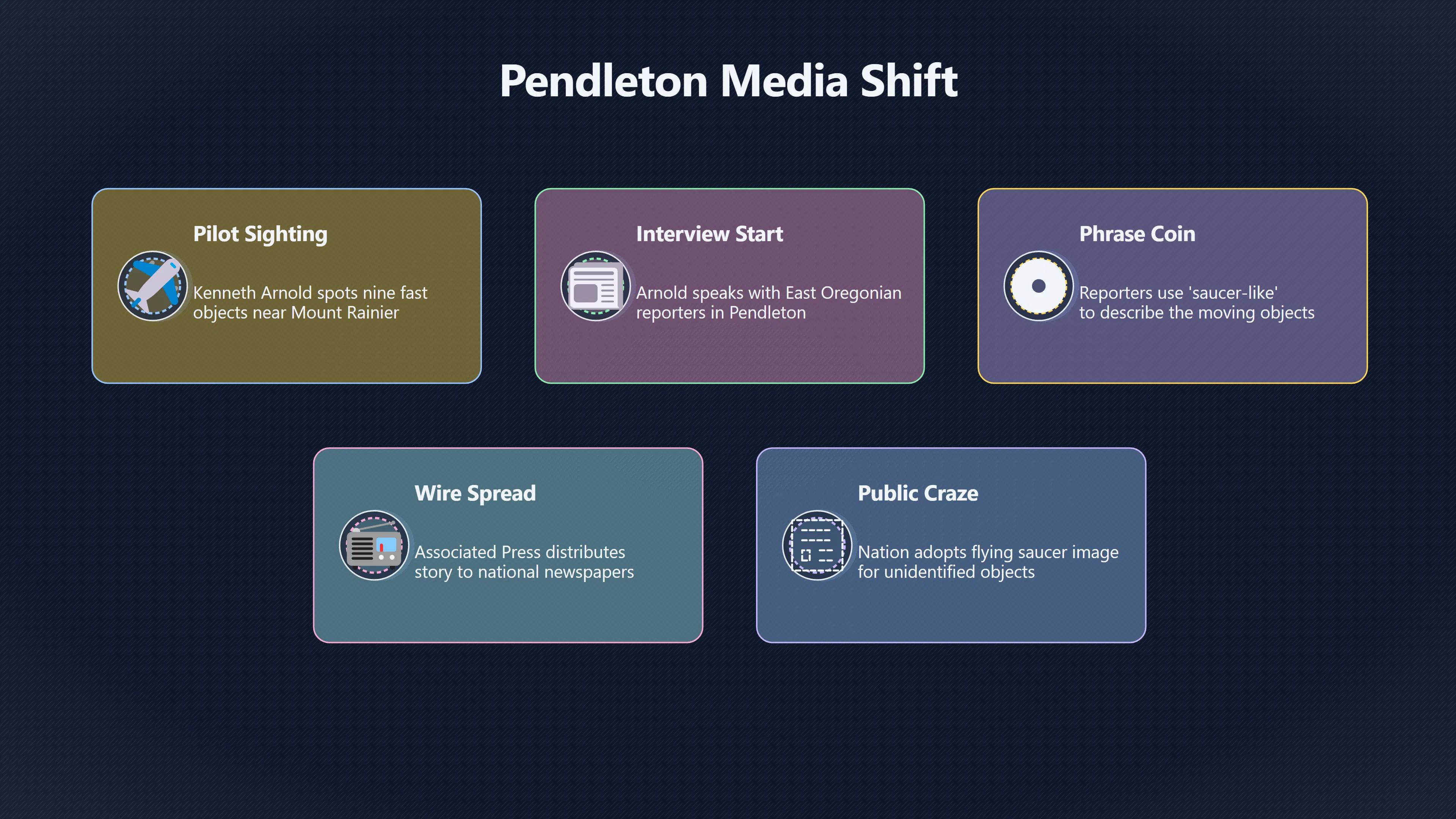
The first East Oregonian reports described nine bright objects moving at extraordinary speed. Bequette’s dispatch referred to “saucer-like” objects, language that soon proved far more influential than anyone involved could have expected. Once the Associated Press distributed the story beyond Oregon, newspapers across North America began reproducing and adapting the description.[Wikipedia]WikipediaKenneth Arnold UFO sightingKenneth Arnold UFO sighting
What makes Pendleton important is that the newspaper interview acted as a translation point between witness testimony and mass communication. Arnold provided observations; reporters converted those observations into publishable language; wire services then compressed that language further for national audiences. Each stage slightly altered how readers understood the event.[Wikipedia]WikipediaFlying saucerFlying saucer
From skipped-saucer motion to flying-disc image
One of the most persistent arguments in UFO history concerns what Arnold actually meant when he compared the objects to a saucer.
According to later accounts, Arnold said the objects moved “like a saucer would if you skipped it across the water”. In this version, the comparison referred primarily to motion: a skipping, weaving or undulating flight path. The image was meant to help listeners visualise how the objects travelled, not necessarily what shape they were.[HistoryLink]historylink.orgFlying saucers, first in world, reported near Mount Rainier…1 Mar 2003 — Kenneth Arnold (1915-1984) spots nine mysterious, high-speed…
The distinction became important because many readers interpreted the phrase differently. Instead of imagining a movement pattern, they pictured literal flying plates or discs. Once newspapers began describing the objects as “saucer-like”, the public increasingly focused on shape rather than motion.[Wikipedia]Wikipedia1947 flying disc craze1947 flying disc craze
The situation was complicated further because Arnold’s own descriptions were not entirely uniform. Some early reports quoted him describing flat or disc-like forms, while other statements emphasised crescent or boomerang characteristics. Surviving interviews indicate that he described objects that were thin, reflective and unusual in outline, rather than perfect circular plates.[Wikipedia]Wikipedia1947 flying disc craze1947 flying disc craze[Wikipedia]Wikipedia1947 flying disc craze1947 flying disc craze
As a result, historians and UFO researchers continue to debate whether the later claim that Arnold was completely misunderstood oversimplifies the record. The evidence suggests a more complicated picture: he appears to have used both shape-based and motion-based comparisons, but the motion comparison became the most famous because it generated the memorable saucer metaphor.[Wikipedia]Wikipedia1947 flying disc craze1947 flying disc craze
How wire-service wording changed public memory
The decisive step was not the original interview itself but what happened after it entered the wire-service system.
Bequette’s reporting reached Associated Press channels, allowing newspapers far beyond Oregon to run shortened versions of the story. During that process, editors and headline writers searched for language that would instantly attract attention and fit limited newspaper space. Terms such as “flying saucer”, “flying disc” and “saucer-like objects” spread rapidly. Wikipedia HowStuffWorks Researchers who have reviewed early newspaper coverage note that the famous phrase may have become established partly through headlines rathe[science.howstuffworks.com]science.howstuffworks.comArrival of Flying SaucersThe day after his sighting, Kenneth Arnold told his story to two reporters for Pendleton's East Oregonian. One o… r than through Arnold’s exact spoken words. A headline writer’s need for a vivid image proved more influential than the technical details of the witness statement.[Wikipedia]Wikipedia1947 flying disc craze1947 flying disc craze
This process changed public memory almost immediately. Readers who never saw Arnold’s original descriptions encountered a simplified image: mysterious discs racing through the sky. The phrase was easy to remember, easy to repeat and easy to illustrate. Within days, newspapers were reporting additional “flying saucer” sightings across the United States, often using the new label before careful comparisons with Arnold’s account had even been made.[Wikipedia]Wikipedia1947 flying disc craze1947 flying disc craze
The linguistic shift mattered because it created a template. Witnesses, journalists and readers now shared a common image for unidentified aerial reports. Future sightings were often described in relation to that image, whether the objects reportedly resembled discs, crescents, lights or something else entirely.[Wikipedia]Wikipedia1947 flying disc craze1947 flying disc craze
Why Pendleton’s reporting became an Oregon milestone
Many states can point to famous sightings, military investigations or alleged crash stories. Oregon’s distinctive contribution to early UFO history is different. Pendleton became the place where a witness report was transformed into a cultural category.
Without the East Oregonian interview, Arnold’s account might have remained a regional aviation curiosity. Instead, Pendleton served as the gateway through which the story entered national circulation. The newspaper’s wording, and the wire-service adaptations that followed, helped create the language through which the modern UFO era was understood.[Wikipedia]Wikipedia1947 flying disc craze1947 flying disc craze[HistoryLink]historylink.orgFlying Saucers in Washington6 Feb 1999 — The modern phenomena of UFOs and “flying saucers” began in Washington state on June 2…
That does not mean the newspaper deliberately invented a myth. Rather, it demonstrates how media framing can shape public understanding of ambiguous events. A phrase intended to explain movement became a description of appearance. A local report became a national sensation. A Washington sighting became an Oregon landmark because the decisive act was not seeing the objects but naming them.[HistoryLink]historylink.orgFlying saucers, first in world, reported near Mount Rainier…1 Mar 2003 — Kenneth Arnold (1915-1984) spots nine mysterious, high-speed…[Wikipedia]Wikipedia1947 flying disc craze1947 flying disc craze
In the history of UFOs, few journalistic choices have had a larger cultural impact than the wording that emerged from Pendleton in June 1947. The enduring image of the flying saucer owes as much to newspaper language as it does to whatever Kenneth Arnold actually saw in the skies over the Pacific Northwest.[National Air and Space Museum]airandspace.si.edu1947 year flying saucerNational Air and Space Museum1947: Year of the Flying Saucer24 Jun 2022 — What Kenneth Arnold saw while flying past Mt. Rainier on June 2…[Wikipedia]Wikipedia1947 flying disc craze1947 flying disc craze
Amazon book picks
Further Reading
Books and field guides related to How Pendleton coined the saucer age. Use these as the next step if you want deeper reading beyond the article.
The Report on Unidentified Flying Objects
Covers the early flying saucer era and how terminology and reporting shaped UFO culture.
The UFO Experience
Explains how reports and classifications evolved during the flying saucer era.
The Mammoth Encyclopedia of Extraterrestrial Encounters
Includes discussion of foundational cases and the growth of UFO terminology.
eBay marketplace picks
Marketplace Samples
Example marketplace items related to this page. Use the search link to explore similar finds on eBay.


Endnotes
1.
Source: Wikipedia
Title: Kenneth Arnold UFO sighting
Link:https://en.wikipedia.org/wiki/Kenneth_Arnold_UFO_sighting
2.
Source: historylink.org
Link:https://www.historylink.org/File/5336
Source snippet
Flying saucers, first in world, reported near Mount Rainier...1 Mar 2003 — Kenneth Arnold (1915-1984) spots nine mysterious, high-speed...
3.
Source: science.howstuffworks.com
Link:https://science.howstuffworks.com/space/aliens-ufos/ufo-history1.htm
Source snippet
Arrival of Flying SaucersThe day after his sighting, Kenneth Arnold told his story to two reporters for Pendleton's East Oregonian. One o...
4.
Source: historylink.org
Link:https://www.historylink.org/file/2067
Source snippet
Flying Saucers in Washington6 Feb 1999 — The modern phenomena of UFOs and “flying saucers” began in Washington state on June 2...
5.
Source: Wikipedia
Title: Flying saucer
Link:https://en.wikipedia.org/wiki/Flying_saucer
6.
Source: history.com
Title: Kenneth Arnold
Link:https://www.history.com/articles/kenneth-arnold
Source snippet
UFO, 1947 & Flying Saucer22 Feb 2010 — He estimated the objects' flight speed at 1700 mph and compared their motion to “a saucer if you s...
7.
Source: Wikipedia
Title: 1947 flying disc craze
Link:https://en.wikipedia.org/wiki/1947_flying_disc_craze
8.
Source: airandspace.si.edu
Title: 1947 year flying saucer
Link:https://airandspace.si.edu/stories/editorial/1947-year-flying-saucer
Source snippet
National Air and Space Museum1947: Year of the Flying Saucer24 Jun 2022 — What Kenneth Arnold saw while flying past Mt. Rainier on June 2...
9.
Source: eastoregonian.com
Title: the sighting
Link:https://eastoregonian.com/2017/06/16/the-sighting/
Source snippet
16 Jun 2017 — Bill Bequette holds the copy of June 25, 1947, East Oregonian in which he broke the story that began the UFO craze. Boise b...
Published: June 25, 1947
Additional References
10.
Source: scottbakal.com
Link:https://www.scottbakal.com/kennetharnoldsighting
Source snippet
Kenneth Arnold SightingThe very first public sighting of a flying 'disc' was on June 25, 1947. · Shortly before 3:00 p.m., as Arnold circ...
Published: June 25, 1947
11.
Source: spokesman.com
Title: flying saucers still evasive 70 years after pilots
Link:https://www.spokesman.com/stories/2017/jun/25/flying-saucers-still-evasive-70-years-after-pilots/
Source snippet
Flying saucers still evasive 70 years after pilot's report25 Jun 2017 — Boise businessman Ken Arnold had no idea he would change the worl...
12.
Source: scribd.com
Link:https://www.scribd.com/document/941265524/A-Moment-in-History-an-Interview-With-B
Source snippet
estigation of the Ken- neth Arnold story moze than 10 years ago...Read more...
13.
Source: americanghostwalks.com
Title: kenneth arnold and the origin of flying saucers
Link:https://www.americanghostwalks.com/kenneth-arnold-and-the-origin-of-flying-saucers
Source snippet
Kenneth Arnold and the Origin of the Modern UFO Movement24 Jun 2025 — On June 24, 1947, Kenneth Arnold's UFO sighting near Mount Rainier...
Published: June 24, 1947
14.
Source: reddit.com
Title: Kenneth Arnold and his description of UFOs
Link:https://www.reddit.com/r/UFOs/comments/zrowqo/kenneth_arnold_and_his_description_of_ufos/
Source snippet
June 24, 1947 - Pilot Kenneth Arnold sights a series of unidentified flying objects near Washington's Mount Rainier. It's the first widel...
Published: June 24, 1947
15.
Source: offbeatoregon.com
Title: 1807b.flying saucer UFO stories started in pendleton 503
Link:https://offbeatoregon.com/1807b.flying-saucer-UFO-stories-started-in-pendleton-503.html
Source snippet
Here's how that happened: ON JUNE 24, 1947, Kenneth Arnold, owner of Great Western Fire Control...Read more...
Published: June 24, 1947
16.
Source: pierrelagrangesociologie.files.wordpress.com
Title: lagrange arnoldbequette eo 1997
Link:https://pierrelagrangesociologie.files.wordpress.com/2014/02/lagrange-arnoldbequette-eo-1997.pdf
Source snippet
camps warm andBill Bequette helped coin the phrase "flying saucers" after inter- viewing pilot Kenneth Arnold in. June of 1947. A young j...
17.
Source: facebook.com
Link:https://www.facebook.com/idahoptv/posts/some-may-describe-these-objects-as-boomerang-looking-but-to-idaho-pilot-ken-arno/10158301321966307/
Source snippet
Idaho Public TelevisionOn June 24, 1947, Kenneth Arnold was flying past Mount Rainier National Park when he noticed nine shiny objects fl...
Published: June 24, 1947
18.
Source: facebook.com
Link:https://www.facebook.com/libraryofcongress/posts/on-this-day-in-1947-what-many-consider-to-be-the-first-modern-ufo-sighting-took-/1150298620475987/
Source snippet
The Library of CongressOn June 24, 1947, private pilot Kenneth Arnold took off from Chehalis, Washington, on what he thought would be a r...
Published: June 24, 1947
19.
Source: discoveryuk.com
Link:https://www.discoveryuk.com/mysteries/legendary-flying-saucer-re-examining-the-kenneth-arnold-ufo-sighting/
Source snippet
Re-examining the Kenneth Arnold UFO Sighting8 Oct 2025 — By the summer of 1947, Kenneth Arnold is believed to have accumulated around 4,0...
Topic Tree