Within Rutledge Study
What did Rutledge's instruments really prove?
Rutledge's equipment raised the evidential bar, but it could not turn unidentified lights into a secure origin story.
On this page
- What equipment the field team used
- How instruments improved on witness testimony
- Why the readings still fell short of identification
Page outline Jump by section
Introduction
Harley Rutledge’s Project Identification became one of the most unusual episodes in Missouri’s UFO history because it tried to move beyond stories and into measurement. During the 1973 Piedmont-area sightings, Rutledge and his team did not simply interview witnesses after the fact. They brought telescopes, cameras, optical instruments and electronic sensors into the field and attempted to observe reported objects in real time. That approach raised the evidential standard compared with ordinary UFO reports. It also exposed a harder truth: instruments could document unusual lights and movements, but they could not automatically reveal what those lights actually were.[Wikipedia]WikipediaHarley RutledgeHarley Rutledge
 The lasting importance of Project Identification is therefore not that it proved alien craft or some exotic technology. It showed that some Missouri sightings were persistent enough to attract sustained observation by trained investigators, and that at least some observations resisted easy dismissal. At the same time, the measurements never reached the level needed for a secure identification. The equipment produced data, but not a definitive origin story.[Wikipedia]WikipediaHarley RutledgeHarley Rutledge
What equipment the field team used
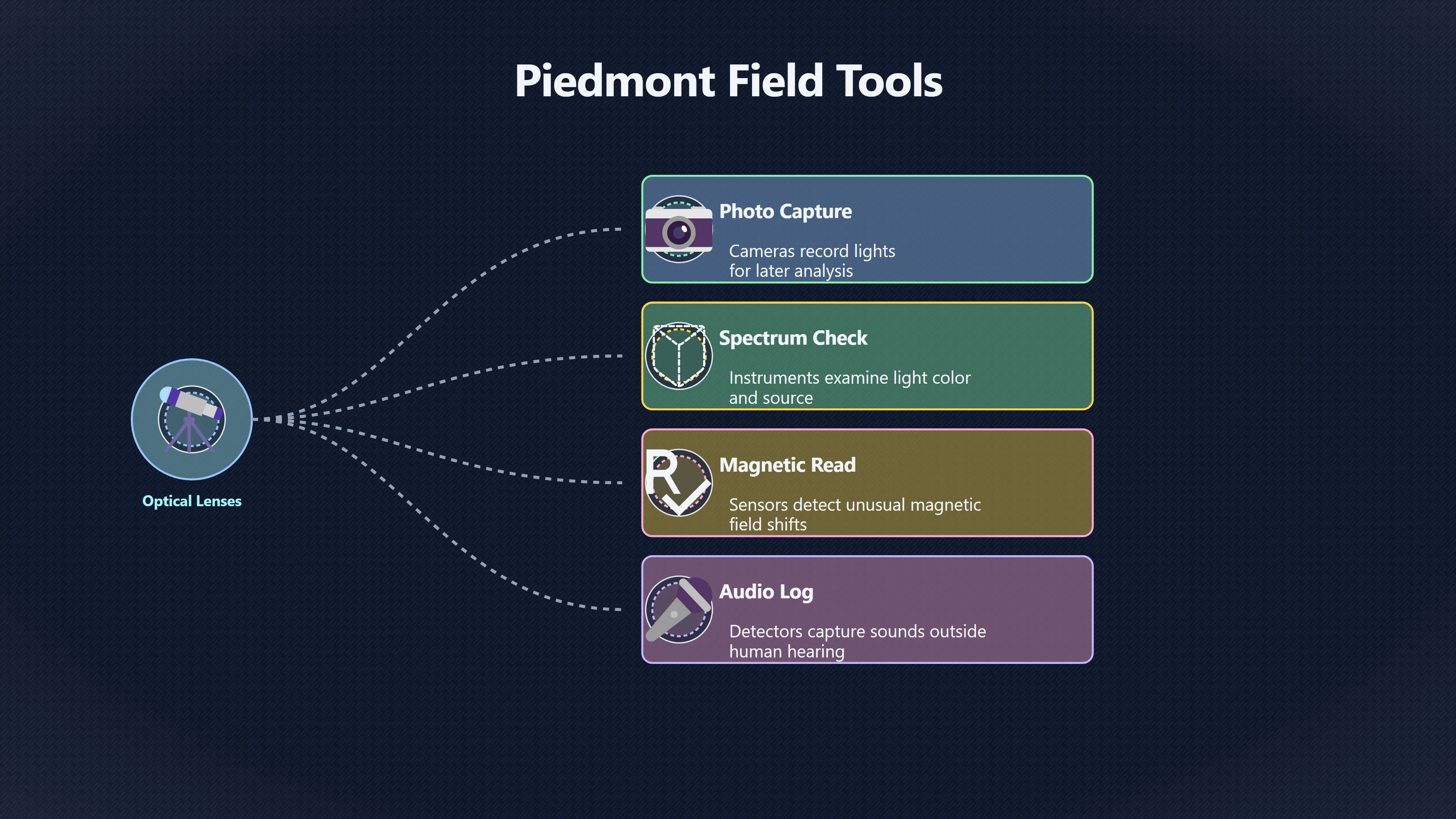
Rutledge assembled a field operation that looked very different from the typical UFO investigation of the period. Accounts of Project Identification describe the use of Questar telescopes, binoculars, camera systems, spectrum-analysis equipment, audio detectors and electromagnetic measuring devices. Later summaries of the project also refer to magnetometers and optical or radio spectrometers being used during observation campaigns.[arXiv]arxiv.orgarXiv The New Science of Unidentified Aerospace-UnderseaReview 20 (1) (1974) 12–16, July 1974. [418] H. D. Rutledge, Project Identification: the first scientific field study of UFO phenomena, P…[Vatican Observatory]vaticanobservatory.orgVatican Observatory MO UFOsand Miracles - Vatican…11 Oct 2025 — Harley Rutledge — head of the Physics Department at a nearby university — decided to subject thes…[wikipedia]WikipediaHarley RutledgeHarley Rutledge The equipment served different purposes:
- Telescopes and binoculars helped observers determine whether a light behaved like a star, planet, aircraft or something apparently different.
- Photographic equipment allowed sightings to be recorded rather than relying solely on memory.
- Spectrum-analysis instruments were intended to examine the light itself, looking for clues about its source.
- Electromagnetic and magnetic sensors were used in the hope that unusual aerial objects might produce measurable physical effects.
- Audio equipment was intended to detect sounds outside normal human hearing or capture timing information during observations.[Vatican Observatory]vaticanobservatory.orgVatican Observatory MO UFOsand Miracles - Vatican…11 Oct 2025 — Harley Rutledge — head of the Physics Department at a nearby university — decided to subject thes…[wikipedia]WikipediaHarley RutledgeHarley Rutledge The choice of equipment reflected Rutledge’s background as a physicist. Instead of treating UFO reports purely as witness testimony, he tried to treat them as observable events that might leave measurable traces. That was unusual enough in the 1970s that later reviews of instrument-based UFO research still cite Project Identification as an early example of a structured field study.[ResearchGate]researchgate.netResearch Gate Historical Insights, Current Challenges, and Future DirectionsHistorical Insights, Current Challenges, and Future DirectionsJanuary 31, 2024 — We provide an overview of some past and curr…
How instruments improved on witness testimony
The strongest contribution of the equipment was not that it solved the mystery. It reduced some of the weaknesses that normally affect UFO reports.
Human observers are often poor judges of distance, altitude and speed at night. A bright light against a dark sky can appear much larger, faster or closer than it really is. Witnesses can also influence one another when discussing what they think they saw. By placing trained observers at known locations and using optical equipment, Rutledge attempted to create a more controlled record.[Wikipedia]WikipediaHarley RutledgeHarley Rutledge
This allowed investigators to do things that ordinary eyewitnesses could not easily do:
- Compare observations from multiple locations.
- Estimate angular movement against known stars.
- Record photographs for later analysis.
- Check whether a reported object remained fixed, drifted or manoeuvred.
- Compare sightings with aircraft routes, astronomical objects or known atmospheric effects.[Google Books]books.google.rwGoogle BooksThe First Scientific Field Study of UFO PhenomenaProject Identification: The First Scientific Field Study of UFO Phenomena…
Rutledge argued that repeated observations by trained teams made it possible to estimate an object’s position, course, apparent speed and size more rigorously than witness recollections alone. Whether those estimates were always reliable is debated, but the attempt itself distinguished the Missouri study from many contemporary UFO investigations.[Wikipedia]WikipediaHarley RutledgeHarley Rutledge
A useful example is the project’s attention to what Rutledge called “pseudostars” — lights that appeared stationary and blended into familiar star patterns. Such observations highlighted how easily ordinary sky objects could be misperceived and why telescopic observation mattered. Instruments did not merely support extraordinary claims; they also exposed potential errors in perception.[Vatican Observatory]vaticanobservatory.orgVatican Observatory MO UFOsand Miracles - Vatican…11 Oct 2025 — Harley Rutledge — head of the Physics Department at a nearby university — decided to subject thes…

What the photographs actually showed
Photographs became some of the most discussed pieces of Project Identification evidence, but they illustrate both the value and the limits of instrumentation.
A camera can demonstrate that a light was present at a particular time and place. It can preserve details that witnesses may forget. However, a photograph of a bright light against a dark sky rarely reveals distance, physical structure or true size. Exposure settings, lens effects and motion can create ambiguous images that are difficult to interpret.[Vatican Observatory]vaticanobservatory.orgVatican Observatory MO UFOsand Miracles - Vatican…11 Oct 2025 — Harley Rutledge — head of the Physics Department at a nearby university — decided to subject thes…
Rutledge reported cases in which lights appeared differently in photographs than they did to observers. One frequently cited example involved a light that seemed singular to the eye but produced multiple trails in photographs. Such results were intriguing because they suggested that something measurable had occurred, yet they also complicated interpretation rather than settling it.[Vatican Observatory]vaticanobservatory.orgVatican Observatory MO UFOsand Miracles - Vatican…11 Oct 2025 — Harley Rutledge — head of the Physics Department at a nearby university — decided to subject thes…
For sceptics, photographs of lights were often evidence of the limitations of night photography. For supporters of the project, they were evidence that the events were not purely invented or remembered incorrectly. Neither side could use the images alone to identify the source of the lights.[Vatican Observatory]vaticanobservatory.orgVatican Observatory MO UFOsand Miracles - Vatican…11 Oct 2025 — Harley Rutledge — head of the Physics Department at a nearby university — decided to subject thes…
Why the readings still fell short of identification
The central problem facing Rutledge’s equipment was that measuring a phenomenon is not the same thing as explaining it.
Even if observers could establish that a light moved unusually, appeared unexpectedly or produced an unusual photographic result, several critical questions often remained unanswered:
- How far away was it?
- Was it a single object or an optical effect?
- Was it atmospheric, astronomical or man-made?
- Could the observation be reproduced?
- Did multiple instruments independently confirm the same event?[ResearchGate]researchgate.netResearch Gate Historical Insights, Current Challenges, and Future DirectionsHistorical Insights, Current Challenges, and Future DirectionsJanuary 31, 2024 — We provide an overview of some past and curr…
Modern discussions of instrumented UFO research frequently emphasise that convincing identification usually requires several independent forms of evidence operating together, such as calibrated optical data, radar information, infrared imaging and precise positional tracking. Project Identification did not possess that level of coverage. Its equipment was advanced for a civilian field project of the 1970s, but it remained limited compared with military or professional astronomical observation networks.[ResearchGate]researchgate.netResearch Gate Historical Insights, Current Challenges, and Future DirectionsHistorical Insights, Current Challenges, and Future DirectionsJanuary 31, 2024 — We provide an overview of some past and curr…
The electromagnetic and magnetic instruments faced a similar challenge. A sensor might record a fluctuation, but proving that the fluctuation was caused by a specific aerial object is much harder. Correlation is not automatically causation. Without precise tracking and independent confirmation, unusual readings remain suggestive rather than conclusive.[ResearchGate]researchgate.netResearch Gate Historical Insights, Current Challenges, and Future DirectionsHistorical Insights, Current Challenges, and Future DirectionsJanuary 31, 2024 — We provide an overview of some past and curr…
The strongest claim the instruments supported
The most defensible conclusion from Rutledge’s equipment was relatively modest.
The instruments supported the argument that some reported Missouri sightings deserved more attention than ordinary rumour or folklore. Project Identification documented repeated observations, gathered photographs, maintained logs and attempted physical measurements. That body of work made the Piedmont flap harder to dismiss as nothing more than mass imagination or media hysteria.[Wikipedia]WikipediaHarley RutledgeHarley Rutledge
What the instruments did not prove was equally important. They did not establish extraterrestrial visitors. They did not demonstrate advanced secret aircraft. They did not produce a universally accepted physical explanation for the lights. Even Rutledge repeatedly stressed that he did not possess evidence proving an extraterrestrial origin and resisted being labelled a believer in that interpretation. His position remained tied to the data he believed he had collected rather than to a grand theory about what the objects were.[Wikipedia]WikipediaHarley RutledgeHarley Rutledge
That restraint is one reason Project Identification still occupies a distinctive place in Missouri’s UFO history. The equipment raised the quality of observation, but it also revealed how difficult identification can be. The instruments could show that something unusual had been seen and recorded. They could not bridge the final gap between an unidentified light and a verified explanation.[Wikipedia]WikipediaHarley RutledgeHarley Rutledge[Vatican]vaticanobservatory.orgVatican Observatory MO UFOsand Miracles - Vatican…11 Oct 2025 — Harley Rutledge — head of the Physics Department at a nearby university — decided to subject thes…
Amazon book picks
Further Reading
Books and field guides related to What did Rutledge's instruments really prove?. Use these as the next step if you want deeper reading beyond the article.
UFOs and Government
Provides context for scientific investigations and evidence claims.
Project Identification
Directly describes the equipment, measurements and observations.
eBay marketplace picks
Marketplace Samples
Example marketplace items related to this page. Use the search link to explore similar finds on eBay.


Endnotes
1.
Source: Wikipedia
Title: Harley Rutledge
Link:https://en.wikipedia.org/wiki/Harley_Rutledge
2.
Source: books.google.rw
Link:https://books.google.rw/books?id=3claAAAAYAAJ&source=gbs_navlinks_s
Source snippet
Google BooksThe First Scientific Field Study of UFO PhenomenaProject Identification: The First Scientific Field Study of UFO Phenomena...
3.
Source: arxiv.org
Title: arXiv The New Science of Unidentified Aerospace-Undersea
Link:https://arxiv.org/html/2502.06794v1
Source snippet
Review 20 (1) (1974) 12–16, July 1974. [418] H. D. Rutledge, Project Identification: the first scientific field study of UFO phenomena, P...
Published: July 1974
4.
Source: researchgate.net
Title: Research Gate Historical Insights, Current Challenges, and Future Directions
Link:https://www.researchgate.net/publication/377871814_Exploring_Unidentified_Aerospace_Phenomena_through_Instrumented_Field_Studies_Historical_Insights_Current_Challenges_and_Future_Directions
Source snippet
Historical Insights, Current Challenges, and Future DirectionsJanuary 31, 2024 — We provide an overview of some past and curr...
Published: January 31, 2024
5.
Source: vaticanobservatory.org
Title: Vatican Observatory MO UFOs
Link:https://www.vaticanobservatory.org/sacred-space-astronomy/mo-ufos-and-miracles/
Source snippet
and Miracles - Vatican...11 Oct 2025 — Harley Rutledge — head of the Physics Department at a nearby university — decided to subject thes...
6.
Source: vaticanobservatory.org
Title: ufos in mo
Link:https://www.vaticanobservatory.org/sacred-space-astronomy/ufos-in-mo/
Source snippet
4 Oct 2025 — He issued a public paper in 1973, which he later turned into a book called Project Identification: The First Scientific Fiel...
Additional References
7.
Source: cia.gov
Link:https://www.cia.gov/readingroom/docs/CIA-RDP81R00560R000100010012-8.pdf
Source snippet
DAILY NEWSIt said that 90 percent of all UFO sightings prove to be plausibly relat- ed to planes, space satellites, bal- loons and variou...
8.
Source: sos.mo.gov
Link:https://www.sos.mo.gov/symbol/ufo
Source snippet
State UFO Capitals of MissouriRutledge, Harley D. Project Identification: The First Scientific Field Study of UFO Phenomena. Englewood Cl...
9.
Source: amazon.co.uk
Link:https://www.amazon.co.uk/Project-Identification-Harley-D-Rutledge/dp/0137307136
Source snippet
Project IdentificationThis book is the result of an investigation headed by the author (who has a Ph.D. in Physics) who used many scienti...
10.
Source: facebook.com
Link:https://www.facebook.com/darkozarks/posts/there-has-only-been-one-real-time-academic-investigation-of-an-ufouap-event-and-/964001345901474/
Source snippet
The UFO Episode...There has only been one real-time, academic investigation of an UFO/UAP event; and it happened here, in the Ozarks. Pi...
11.
Source: missourinet.com
Title: greetings earthlings piedmont opens ufo capital of missouri park
Link:https://www.missourinet.com/2024/06/14/greetings-earthlings-piedmont-opens-ufo-capital-of-missouri-park/
Source snippet
Greetings, Earthlings: Piedmont opens UFO Capital of...14 Jun 2024 — It includes a 16 foot UFO, a six foot tall alien, and playground eq...
12.
Source: goodreads.com
Link:https://www.goodreads.com/en/book/show/2827791-project-identification
Source snippet
atistical tables--reports on and evaluates the findings of the first scientific field...Read more...
13.
Source: amazon.com
Link:https://www.amazon.com/Project-Identification-first-scientific-phenomena/dp/0137307136
Source snippet
atistical tables--reports on and evaluates the findings of the first scientific field...Read more...
14.
Source: facebook.com
Title: Piedmont, Missouri UFO Episode and Project Identification
Link:https://www.facebook.com/darkozarks/posts/piedmont-missouri-ufo-episode-and-project-identification-part-1it-is-generally-a/724001679901443/
Source snippet
27 Feb 2024 — Piedmont, Missouri UFO Episode and Project Identification. Part 1: It is generally assumed that the Piedmont UFO Episode st...
15.
Source: worldcat.org
Link:https://worldcat.org/oclc/7273042
Source snippet
the first scientific field study of UFO phenomenaProject Identification: the first scientific field study of UFO phenomena...
16.
Source: yahoo.com
Title: piedmont missouri celebrates ufo history 173000645
Link:https://www.yahoo.com/news/piedmont-missouri-celebrates-ufo-history-173000645.html
Source snippet
Piedmont, Missouri celebrates UFO history with new park30 Jun 2024 — WAYNE COUNTY, Mo. – Piedmont, Missouri, has been named the State UFO...
Topic Tree