Within Nebraska UFOs
Nebraska's Airship Mystery Before Flying Saucers
The 1897 airship reports show how Nebraska's UFO-like stories began before flying saucers, jets or Cold War secrecy.
On this page
- How the reports spread across Nebraska towns
- Credible witnesses, jokes and newspaper doubt
- Why the airship wave still shapes UFO history
Page outline Jump by section
Introduction
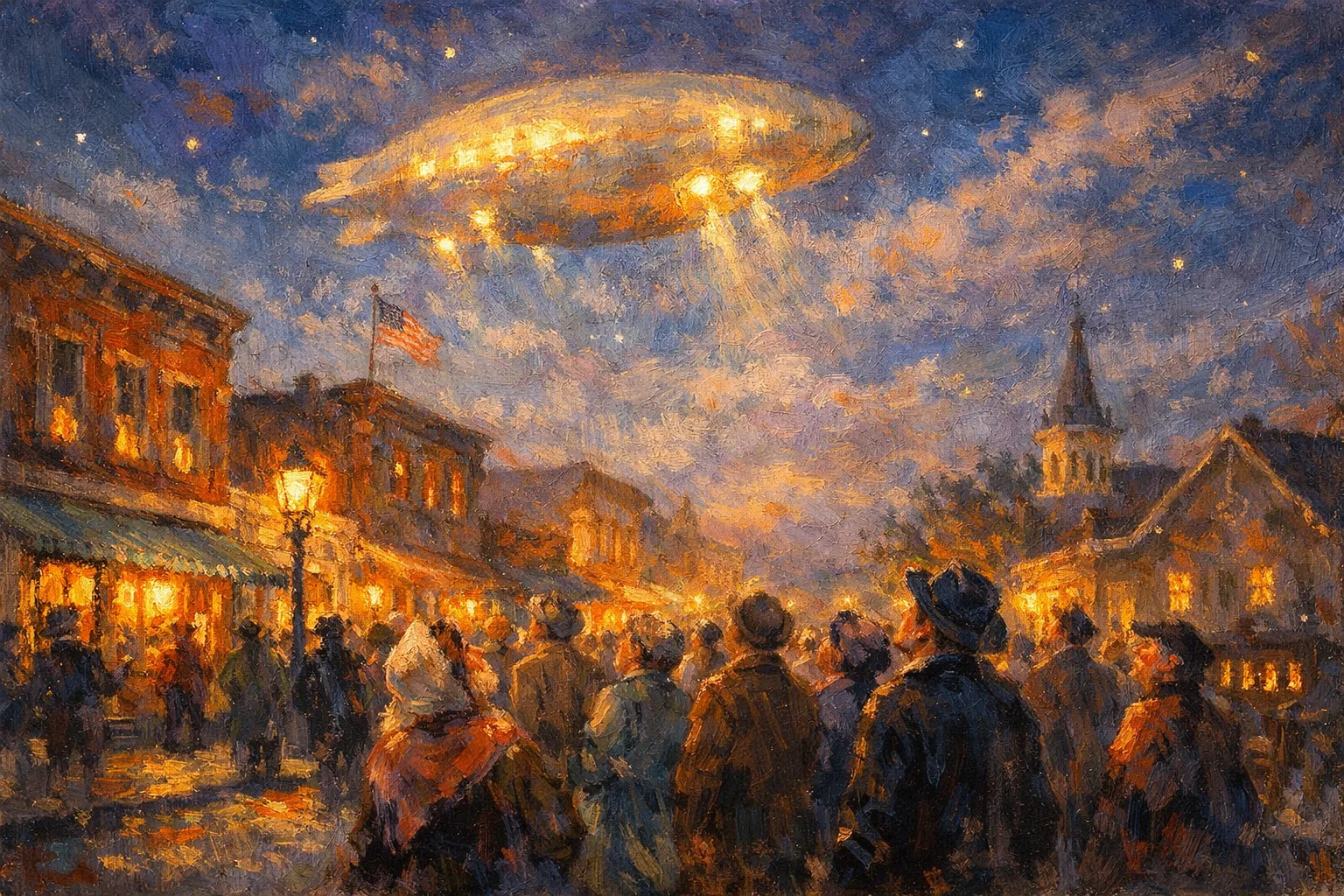
Nebraska’s 1897 airship wave was an early UFO-like episode that unfolded decades before “flying saucers”, jet aircraft or Cold War secrecy entered the public imagination. Beginning with reports from Hastings and nearby communities in February 1897, Nebraska newspapers described a mysterious lighted “air ship” that hovered, circled, travelled at remarkable speed and was sometimes said to have wings, side lights, an engine noise or even visible passengers. The best modern historical study, Roger L. Welsch’s 1979 article for Nebraska History, found nearly 200 reported sightings in Nebraska newspapers, while also stressing that the subject is as much about newspaper behaviour, public belief and folklore as about anything in the sky.[nebraska]history.nebraska.govState Historical Society Microsoft WordNebraska State Historical SocietyMicrosoft Word - NH1979UFO1897 intro.doc…
The importance of the Nebraska wave is not that it proves a hidden aircraft or extraterrestrial craft was present. It matters because it shows how many later UFO ingredients were already in place in the 1890s: repeating reports, respected witnesses, ridicule, local hoaxes, scientific explanations, newspaper amplification and a public willing to treat strange lights as both news and entertainment. Nebraska’s airship mystery is therefore best read as a founding chapter in the state’s UFO history, but one with evidence that remains intriguing, fragmented and deeply entangled with the press culture of its time.
How the reports spread across Nebraska towns
The reported Nebraska sequence opened publicly on 2 February 1897, when the Omaha Daily Bee carried an account from Hastings. According to Welsch’s reproduction of the report, “several Hastings people” said an airship, or something like one, had been seen west of the city. The account described a bright light that seemed artificial, hovered, circled, moved north, descended and disappeared. The same article said the object may have been noticed the previous autumn, but February 1897 is when the newspaper trail becomes the useful historical record.[nebraska]history.nebraska.govState Historical Society Microsoft WordNebraska State Historical SocietyMicrosoft Word - NH1979UFO1897 intro.doc…
Within days the story moved beyond Hastings. On 5 February, the Omaha Daily Bee reported a sighting at Inavale, roughly 40 miles south of Hastings, including a group returning from a prayer meeting. That report had more of the texture later associated with classic UFO narratives: a conical form, a bright headlight, smaller lights along the sides, possible wings, a rudder-like feature, engine sounds and voices or laughter from the craft. Whether accurate, embellished or partly invented, it gave the mystery a more mechanical and human-made shape than a simple “strange light” report.[nebraska]history.nebraska.govState Historical Society Microsoft WordNebraska State Historical SocietyMicrosoft Word - NH1979UFO1897 intro.doc…
The reports then spread through a recognisable newspaper network. Welsch’s article identifies Omaha, Lincoln, Wymore, Hastings and many other Nebraska towns as places whose papers chronicled the sightings. He also describes reports from Beatrice, Kearney, North Platte, Grand Island, Harrison, Nebraska City and other communities, with the pattern growing from scattered notices into a state-wide talking point.[nebraska]history.nebraska.govState Historical Society Microsoft WordNebraska State Historical SocietyMicrosoft Word - NH1979UFO1897 intro.doc…
Several features made the wave unusually durable in the press. First, the sightings were local enough for editors to make them feel immediate: the airship was not just a distant marvel in California, but something allegedly passing over Nebraska streets, farms and railway towns. Secondly, the reports were repeatable. Newspapers could say that another town had seen it, that a former sceptic had changed his mind, or that a watch party was being organised. Thirdly, the story arrived in a period when “airship” sounded futuristic but not impossible. Controlled aviation was still experimental, and the Wright brothers’ first powered, controlled heavier-than-air flight would not occur until 17 December 1903.[National Air and Space Museum]airandspace.si.eduThey made the first powered,National Air and Space MuseumThe Wright Brothers Made History at Kitty HawkJune 23, 2022 — 23 Jun 2022 — At 10:35 a.m., on December 17, 1…
That technological gap is central to the mystery’s appeal. By 1897, lighter-than-air craft were not pure fantasy: Charles Renard and Arthur Krebs had flown the French military airship La France in 1884, making a controlled circular journey. But the Nebraska accounts often described manoeuvres, speeds, distances and night operations far beyond what a known secret airship would be expected to demonstrate across the Plains. That mismatch between plausible invention and implausible performance is exactly where the folklore took hold.[Encyclopedia Britannica]britannica.comEncyclopedia Britannica Charles Renard | Aviation Pioneer, Balloonist & InventorEncyclopedia Britannica Charles Renard | Aviation Pioneer, Balloonist & Inventor

Credible witnesses, jokes and newspaper doubt
Nebraska’s airship wave did not survive only because people were gullible. It survived because newspapers repeatedly placed ridicule beside testimony from people presented as reliable. Welsch noted that editors often seemed trapped between not wanting to endorse nonsense and not wanting to ignore reports from sober, respectable or named witnesses. In one example, the Hastings Tribune defended a witness by saying he was a total abstainer, a detail that mattered because rival editors were already joking that airship witnesses had been drinking.[nebraska]history.nebraska.govState Historical Society Microsoft WordNebraska State Historical SocietyMicrosoft Word - NH1979UFO1897 intro.doc…
The scepticism was immediate. After the Hastings report, the Norfolk News mocked the idea by asking what brand of liquor could make a correspondent see airships carrying powerful lights. The Beatrice Daily Express ridiculed the Wymore Arbor State for “swallowing” the airship story and believing too readily in the reports. These jokes were not side comments; they were part of the mechanism by which the story spread. A town could be mocked for believing, then another town could report that its own citizens had now seen the object too.[nebraska]history.nebraska.govState Historical Society Microsoft WordNebraska State Historical SocietyMicrosoft Word - NH1979UFO1897 intro.doc…
There were also sincere attempts to explain the sightings. Some editors suggested kites, and Welsch records discussion of box kites flown by an enthusiast near Juniata. Others pointed to Venus. The Grand Island Independent explained one “sighting” as the brilliant evening star, while Father William Rigge, an astronomer at Creighton University in Omaha, argued that an earlier alleged airship was Venus seen through moving cloud and atmospheric conditions.[nebraska]history.nebraska.govState Historical Society Microsoft WordNebraska State Historical SocietyMicrosoft Word - NH1979UFO1897 intro.doc…
Those explanations do not account for every newspaper claim, especially the more elaborate reports of engines, wings and passengers. But that is partly the point: the more detailed the story became, the less it resembled a clean astronomical observation and the more it resembled rumour, expectation and embellishment layered onto a bright light. In modern UFO terms, Nebraska’s 1897 reports show how quickly a basic stimulus can become a structured craft when witnesses and readers already have a cultural template available.
Hoaxes were not merely possible; some were admitted. History Nebraska’s short account says newspaper editors fabricated a few sightings to publicise their communities, while practical jokers used box kites to fool onlookers. Welsch also cites the Wymore Arbor State, which had previously supported the airship’s reality, admitting that the “airship” seen by the Ak-Sar-Bens at Omaha had been declared a balloon and that the men responsible had confessed to the joke.[nebraska]history.nebraska.govState Historical Society Microsoft WordNebraska State Historical SocietyMicrosoft Word - NH1979UFO1897 intro.doc…
The presence of hoaxes weakens any claim that the Nebraska wave can be treated as a single coherent event. It does not prove that every report was invented, but it does show that the press environment rewarded imitation. Once the airship became a popular story, it could be used for jokes, civic boasting, political satire, publicity and practical mischief. That makes the evidence lively but unstable.
Why Nebraska newspapers turned a light into folklore
The 1897 airship stories are hard to separate from the newspapers that carried them. Readex’s survey of historical newspapers notes that, from November 1896 into 1897, papers across the United States described mysterious aircraft and lights, with the Midwest gripped by “UFO fever” by April 1897. Nebraska fits that national pattern, but it also appears to have been one of the places where the second phase of the wave became especially visible.[readex.com]readex.comufo fever americas historical newspapers mysterious airshipsufo fever americas historical newspapers mysterious airships
Several pressures pushed local papers towards keeping the story alive. Newspapers needed copy, competition and colour. A mysterious airship could fill all three needs: it was local, serial, comic, frightening, modern and adaptable. Editors could print straight witness accounts one day and mock the same phenomenon the next. They could connect sightings to inventors, politics, religion, astronomy, local pride or civic spectacle.
Omaha provides a vivid example. Welsch describes an April 1897 Omaha World-Herald “Airship Edition” in everything but name, carrying contradictory treatments of the mystery: one playful item linked to Omaha’s fictional Ak-Sar-Ben monarchy, another more serious discussion of an alleged inventor, and another account of an airship design connected to a patent solicitor. The result was not a simple news report but a blend of journalism, satire, boosterism and speculative technology.[nebraska]history.nebraska.govState Historical Society Microsoft WordNebraska State Historical SocietyMicrosoft Word - NH1979UFO1897 intro.doc…
That blend matters because it explains why the airship could remain culturally powerful while becoming evidentially weaker. A modern reader may ask, “Was it real?” A Nebraska newspaper reader in 1897 may have been offered several answers at once: perhaps it was Venus, perhaps a secret inventor, perhaps a hoax, perhaps a divine sign, perhaps a local joke, perhaps tomorrow’s technology arriving early. The papers did not always resolve those possibilities; they often profited from holding them together.
The state also had a pre-existing newspaper-hoax culture that helps explain the later life of the airship reports. History Nebraska’s discussion of the 1884 Dundy County “Celestial Visitor” shows how a spectacular Nebraska newspaper story about a fallen object was later exposed as a hoax created by Nebraska State Journal managing editor James D. Calhoun. That earlier case is not the same event as the 1897 wave, but it is a useful warning: nineteenth-century newspaper detail can look archival and precise while still being entertainment, satire or invention.[nebraska]history.nebraska.govState Historical Society Microsoft WordNebraska State Historical SocietyMicrosoft Word - NH1979UFO1897 intro.doc…

What the strongest and weakest evidence suggests
The strongest evidence for Nebraska’s 1897 airship wave is not physical evidence. There is no recovered craft, no reliable photograph and no official investigation comparable to later twentieth-century UFO inquiries. The strongest evidence is the breadth of the newspaper record: numerous reports, named towns, repeated dates, witnesses presented as credible, and a pattern that Welsch found large enough to approach nearly 200 sightings in Nebraska sources.[nebraska]history.nebraska.govState Historical Society Microsoft WordNebraska State Historical SocietyMicrosoft Word - NH1979UFO1897 intro.doc…
That breadth should not be dismissed. Mass newspaper patterns can preserve real social events even when they do not prove the literal content of every report. Something happened in Nebraska in 1897 at the level of public attention: people watched the sky, newspapers exchanged reports, sceptics answered believers, and the “airship” became a shared state-wide reference point.
The weakest evidence is the internal inconsistency of the claims. Some reports describe only a bright light. Others describe a canoe-shaped or cigar-shaped machine. Some mention wings, propellers, dynamos, rudders, engines, passengers or voices. Some sightings were explained as Venus, some as kites, some as balloons, and some were openly comic. The more elaborate accounts often read less like observation and more like the language of mechanical imagination in an age fascinated by invention.
A balanced reading therefore avoids two easy mistakes. The first is to treat the whole wave as a confirmed secret aircraft. Known airship development makes experimentation plausible in a broad sense, but the Nebraska reports would require a craft or crafts operating with extraordinary range, secrecy and reliability at a time when aviation was still primitive. The second mistake is to dismiss the whole episode as meaningless nonsense. The reports show how Nebraskans interpreted technology, uncertainty and public testimony before the modern UFO era, and that makes them historically valuable even when individual claims are weak.
Why the airship wave still shapes Nebraska UFO history
Nebraska’s 1897 airship wave is one of the state’s clearest reminders that UFO history did not begin in 1947. The language was different — “airship” rather than “flying saucer” or “UAP” — but the social pattern is familiar. People saw lights or unusual forms in the sky; newspapers amplified the accounts; sceptics proposed ordinary explanations; hoaxers and humorists joined in; and later readers had to decide how much of the record was observation, rumour, satire or belief.
The episode also helps distinguish Nebraska’s UFO history from states whose public identity rests on a single crash legend or one famous military case. Nebraska’s early contribution is more archival and folkloric. Its 1897 wave is not a clean mystery with a neat answer, but a dense record of how a mysterious aerial story moved through small towns, city papers and local credibility networks.
For modern readers, the best question is not simply “What was the airship?” but “How did Nebraskans come to see, report, doubt and retell it?” On that question, the evidence is much stronger. The airship was a newspaper event, a social event and a technological fantasy before it was anything else. Some witnesses may have seen Venus, meteors, kites, balloons or unusual lights. Some stories were jokes. Some remain hard to reduce confidently. Together, they made Nebraska an important early stage for the American habit of turning strange things in the sky into public folklore.
The wave’s lasting value is therefore historical rather than sensational. It shows that UFO-like narratives can emerge before modern aircraft, radar, spaceflight or government secrecy. It also shows that the same problems still facing UFO research — witness reliability, media amplification, ambiguous lights, hoaxes, expert scepticism and the pull of extraordinary interpretation — were already present in Nebraska in 1897.

Amazon book picks
Further Reading
Books and field guides related to Nebraska's Airship Mystery Before Flying Saucers. Use these as the next step if you want deeper reading beyond the article.
Wonders in the Sky
Strong match for the 1897 Nebraska airship wave and pre-UFO reports.
eBay marketplace picks
Marketplace Samples
Example marketplace items related to this page. Use the search link to explore similar finds on eBay.


Endnotes
1.
Source: history.nebraska.gov
Title: State Historical Society Microsoft Word
Link:https://history.nebraska.gov/wp-content/uploads/2017/12/doc_publications_NH1979UFOs.pdf
Source snippet
Nebraska State Historical SocietyMicrosoft Word - NH1979UFO1897 intro.doc...
2.
Source: britannica.com
Title: Encyclopedia Britannica Charles Renard | Aviation Pioneer, Balloonist & Inventor
Link:https://www.britannica.com/biography/Charles-Renard
3.
Source: history.nebraska.gov
Title: State Historical Society”Look! Up in the Air…!
Link:https://history.nebraska.gov/look-up-in-the-air/
4.
Source: readex.com
Title: ufo fever americas historical newspapers mysterious airships 1896 97
Link:https://www.readex.com/blog/ufo-fever-americas-historical-newspapers-mysterious-airships
5.
Source: history.nebraska.gov
Link:https://history.nebraska.gov/flashback-friday-a-celestial-visitor-revisited-a-nebraska-newspaper-hoax-from-1884-patricia-c-gaster/
6.
Source: britannica.com
Title: La France | airship
Link:https://www.britannica.com/topic/La-France
7.
Source: history.nebraska.gov
Title: doc publications NH2013Hoax
Link:https://history.nebraska.gov/wp-content/uploads/2018/01/doc_publications_NH2013Hoax.pdf
8.
Source: history.nebraska.gov
Title: roger l welsch
Link:https://history.nebraska.gov/document-author/roger-l-welsch/
9.
Source: airandspace.si.edu
Title: They made the first powered,
Link:https://airandspace.si.edu/stories/editorial/wright-brothers-made-history-kitty-hawk
Source snippet
National Air and Space MuseumThe Wright Brothers Made History at Kitty HawkJune 23, 2022 — 23 Jun 2022 — At 10:35 a.m., on December 17, 1...
Published: June 23, 2022
10.
Source: youtube.com
Link:https://www.youtube.com/watch?v=7d5fpbVzgVs
11.
Source: youtube.com
Link:https://www.youtube.com/watch?v=nThHfFdS8b4
12.
Source: nebraskalife.com
Title: is there anybody out there
Link:https://www.nebraskalife.com/blog/post/is-there-anybody-out-there?srsltid=AfmBOorKUQp2oQ18lxtq9pYpeotT7gtPIAI_Xu4ahbmLs2wEsbOgjgd-
13.
Source: nebraskaauthors.org
Link:https://nebraskaauthors.org/authors/roger-l-welsch
14.
Source: nebraskapublicmedia.org
Link:https://nebraskapublicmedia.org/en/news/news-articles/flying-saucers-over-the-sandhills-ufo-investigations-now-public-in-university-of-nebraska-archives/
Additional References
15.
Source: youtube.com
Link:http://www.youtube.com/watch?v=WnV5v-ECzPY
Source snippet
1897 mystery airship wave "Mystery Airship" Sightings, 1896 - 1897 Think Anomalous...
16.
Source: youtube.com
Link:http://www.youtube.com/watch?v=DoJUsaTknNw
Source snippet
The Phantom Airship Mystery of 1897: what did the Americans see?...
17.
Source: loc.gov
Link:https://www.loc.gov/pictures/item/00652085/
18.
Source: youtube.com
Link:http://www.youtube.com/watch?v=IBaw2oqVz8w
Source snippet
Airship Mystery of 1896 and 1897 (Mystery Airships, UFOs) - Jimmy Akin's Mysterious World...
20.
Source: reddit.com
Link:https://www.reddit.com/r/UFOs/comments/vwm47k/accounts_of_airship_sightings_in_nebraska_125/
21.
Source: facebook.com
Link:https://www.facebook.com/AerospaceMuseumCA/posts/looking-at-panel-2-of-our-hidden-heroes-of-the-hangar-mural-we-learn-that-in-185/1737677677573147/
22.
Source: facebook.com
Link:https://www.facebook.com/groups/finalfantasyvi/posts/1557239325493236/
23.
Source: blimpinfo.com
Link:https://www.blimpinfo.com/wp-content/uploads/2012/01/First-Fully-Controlled-Flight-of-an-Airship.pdf
24.
Source: facebook.com
Link:https://www.facebook.com/CommemorativeAF/posts/engineers-charles-renard-and-arthur-constantin-krebs-piloted-the-airship-la-fran/903853228447561/
Topic Tree