Within Missouri UFOs
How Strong Is the Cape Girardeau Crash Story?
The Cape Girardeau crash story is dramatic, but its late-arriving evidence keeps it closer to legend than proven history.
On this page
- The Reverend Huffman account and later family testimony
- Why missing contemporary records matter
- How the legend compares with better documented Missouri cases
Page outline Jump by section
Introduction
The Cape Girardeau crash story is one of Missouri’s most dramatic UFO legends: a Baptist minister is said to have been taken to a rural crash site in 1941, expecting an aircraft accident, only to find a broken silver disc and three small non-human bodies. It matters in Missouri UFO history because, if true, it would pre-date Roswell by six years and place a major “crash retrieval” claim in southeast Missouri. The problem is that the case rests mainly on late family testimony and later UFO-investigator retellings, not on contemporary police, fire, military, press, medical, or physical records. Local media have repeatedly treated it as an “alleged” crash or urban legend, and even sympathetic researchers acknowledge how hard it has been to obtain hard evidence.[https://www.kfvs12.com]kfvs12.comOpen source on kfvs12.com.
That does not make the story worthless as folklore. It does, however, put it in a very different category from better-documented Missouri episodes such as the 1973 Piedmont and Wayne County sightings, where there were hundreds of public reports, newspaper coverage, state recognition, and a named scientific field investigation by Harley D. Rutledge. The Cape Girardeau claim is best read as a case study in the evidence gap: how a compelling family memory became a famous UFO narrative, and why that narrative remains much weaker than its dramatic content suggests.[sos.mo.gov]sos.mo.govState UFO Capitals of Missouri…
The Reverend Huffman account and later family testimony
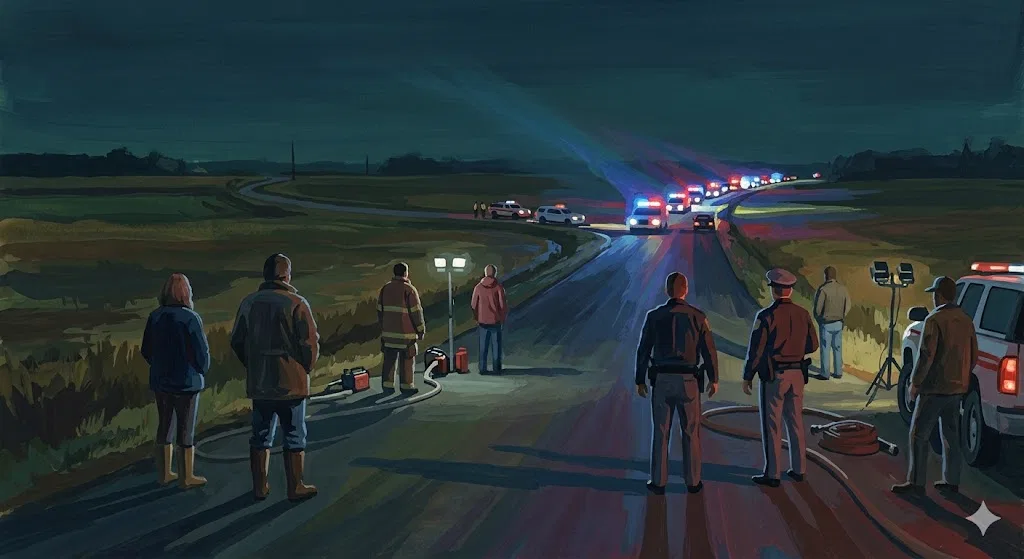
The core story centres on Reverend William G. Huffman, usually described as a Baptist minister connected with Red Star Baptist Church in Cape Girardeau. In the common version, Huffman was called out one evening in spring 1941 to pray over victims of what he believed was a plane crash. When he arrived, he allegedly saw police, fire personnel, photographers, military or federal officials, a damaged metallic disc, and three small bodies unlike ordinary human crash victims. Later accounts add details such as strange writing or controls inside the craft, a surviving occupant who died at the scene, and orders from military personnel that witnesses keep silent.[https://www.kfvs12.com]kfvs12.comOpen source on kfvs12.com.
The story reached wider UFO audiences through the family testimony of Charlotte or Charlette Mann, Huffman’s granddaughter, and through the work of crash-retrieval writer Leonard Stringfield. Local-history retellings say Mann described a deathbed conversation with her grandmother in 1984, in which the older family story was given fuller form. Mann also said she had seen, while growing up, a photograph allegedly showing one of the beings from the crash; in the story, that photograph later left the family’s possession and did not return.[Cape Girardeau History and Photos]capecentralhigh.comCape Girardeau History and Photos Buck Nelson's Spacecraft ConventionCape Girardeau History and Photos Buck Nelson's Spacecraft Convention
That chain of transmission is important. The strongest named witness in the popular version is not a contemporary public witness giving an on-record statement in 1941. It is a later family member reporting what she says her grandparents and relatives had said, decades after the alleged event. This is still testimony, and family testimony can preserve real events. But for a claim as extraordinary as a crashed non-human craft, the evidential burden is far higher than for an ordinary remembered accident. The account asks the reader to accept not only a crash, but also dead occupants, official secrecy, missing photographs, and successful suppression across local and military channels.
The story also varies in date and location. One KFVS report says author Paul Blake Smith placed the crash in late April 1941, west of Cape Girardeau Airport between Cape Girardeau and Chaffee. Another KFVS anniversary piece describes April 12, 1941, and says the minister was driven roughly 18 miles towards the Chaffee area. Other versions use broader phrases such as “spring 1941” or “10–15 miles outside town”. These differences do not automatically disprove the claim, but they show why the case is difficult to test: a crash with no fixed site, no secure date, and no surviving photograph is hard to separate from legend. [https://www.kfvs12.com+2https://www.kfvs12.com]

Why missing contemporary records matter
The main weakness is not merely that the story is strange. It is that the expected paper trail is missing or has not been produced in a form strong enough to carry the claim. A real crash involving police, firefighters, photographers, a minister, military personnel, bodies, debris, a field fire, transport vehicles, and later secrecy should normally leave traces. These might include a local newspaper item, police call log, coroner record, fire department entry, military communication, insurance record, landowner testimony, funeral or medical record, or photographs with a clear chain of custody.
The public record so far does not offer that kind of foundation. The most accessible local reporting presents the Cape Girardeau story as an alleged event and repeatedly frames it as legend. KFVS reported Smith’s own description of the evidence problem: obtaining hard evidence had been like “trying to nail JELL-O to the wall”. That remark matters because it comes from a sympathetic author who investigated and promoted the case, not from a dismissive debunker.[https://www.kfvs12.com]kfvs12.comOpen source on kfvs12.com.
Later researchers have tried to test pieces of the story against 1941 context. One detailed sceptical review points out that some later retellings use institutional terms anachronistically or loosely: in 1941 there was no CIA, no Department of Defense, and no independent U.S. Air Force; the relevant military terminology would have involved the War Department and Army Air Corps. The same review notes that the nearest military-linked aviation facility was at Sikeston, which had opened under contract to the Missouri Institute of Aeronautics, and that the exact alleged location remains uncertain.[Academia]academia.eduThe 1941 Cape Girardeau ConundrumThe 1941 Cape Girardeau Conundrum
Those details are not trivial nit-picking. In a case built from memory and retelling, wrong institutional labels, shifting dates, and unclear geography can reveal how later UFO language has been projected backwards onto an older family story. A witness in 1984, a UFO writer in 1991, a television segment in the 2000s, and a web article in the 2020s all operate in a post-Roswell, post-“grey alien” culture. The Cape Girardeau story now contains familiar motifs: a disc-shaped craft, small grey beings, military secrecy, confiscated photographs, and a pre-Roswell cover-up. The question is whether those motifs were present in a documented 1941 event, or whether they became attached as the story moved through UFO culture.
The missing photograph is especially important. Mann’s claim that the family once had a picture is one of the most memorable parts of the narrative, because a verifiable photograph could change the evidential balance. But an absent photograph cannot be examined for date, source, image manipulation, subject, or provenance. It functions in the story as a lost corroboration, not as available evidence. The same applies to claims of affidavits, fire records, or local confirmations when they are cited in secondary retellings but not placed before readers in a way that can be independently checked.
How late-arriving evidence changes the case
A fair assessment should distinguish between three different things: a family tradition, a historical incident, and proof of a non-human crash. The Cape Girardeau story may well preserve a family tradition that mattered deeply to those who told it. It may also have grown from some real local event, such as an aircraft accident rumour, a military-training incident, a field fire, a misunderstood emergency call, or a private story told inside a church community. But the leap from “a remembered family secret” to “a recovered extraterrestrial craft” is much larger than many retellings admit.
The timing of publication is central. The alleged event occurred in 1941. The story became known to UFO researchers decades later, with Mann’s family account said to have emerged in the late 1970s or 1980s and then entered broader UFO literature through Stringfield’s crash-retrieval work. Local media and later UFO writers have continued to repeat the account, but repetition is not the same as independent corroboration. When later versions all trace back to the same family channel, they may look like multiple sources while actually depending on one narrative root.[https://www.kfvs12.com]kfvs12.comOpen source on kfvs12.com.
That matters because memory is not a recording device. People can honestly preserve striking stories while details shift over time. Family deathbed accounts are powerful, but they are also hard to test because the original speaker may no longer be available for questioning, documents may be absent, and later narrators may blend direct memory with things heard from others. A sceptical reading does not require calling anyone dishonest. It simply asks whether the surviving evidence is strong enough for the claim being made.
The best argument in favour of the case is not physical proof but narrative specificity. The story contains named people, a plausible regional setting, a known church connection in some retellings, and details about local travel, Chaffee, Sikeston, and emergency response. Those details make it more substantial than a completely anonymous internet rumour. Yet the best argument against it is stronger: the details that should be independently verifiable are precisely the ones that remain uncertain or absent.

Why the Missouri setting makes the legend plausible to some readers
Cape Girardeau sits in a part of southeast Missouri with aviation, river, military, and rural-landscape connections that make the story feel locally grounded. Sikeston, not far away, had wartime aviation activity through the Missouri Institute of Aeronautics and Harvey Parks Airport, and National Archives finding aids show federal records connected with the Missouri Institute of Aeronautics and Harvey-Parks Airport among War Assets Administration disposal files. That wartime aviation backdrop gives later storytellers a realistic regional frame for rumours of aircraft, military personnel, and unusual activity.[National Archives]cdn.nationalarchives.gov.ukSource details in endnotes.
But local plausibility is not the same as proof. A nearby wartime aviation facility could explain why people in the area might hear military-aircraft rumours, see unusual traffic, or later connect an unexplained story to official secrecy. It could also provide a conventional setting in which a garbled account of an ordinary aircraft matter became stranger over time. The more ordinary aviation context there is, the more careful investigators must be before treating a remembered “crash” as something beyond aircraft, training, or wartime rumour.
This is where Cape Girardeau differs from many single-night UFO sighting reports. It is not primarily an observation of lights in the sky; it is a crash-retrieval claim. That means it should produce a different kind of evidence. Lights can vanish without leaving a trace. A damaged craft, bodies, fire, witnesses, photographs, and transport operations should leave more than oral tradition. The evidential gap is therefore more damaging here than it would be in a simpler sighting case.
How the legend compares with better-documented Missouri cases
The clearest comparison within Missouri is Piedmont and Wayne County in 1973. The Missouri Secretary of State’s state-symbol page records that the General Assembly designated Piedmont and Wayne County as the “UFO Capitals of Missouri” to mark the 50th anniversary of alleged sightings there, and the statute itself refers to hundreds of sightings between February and April 1973.[sos.mo.gov]sos.mo.govState UFO Capitals of Missouri…
Piedmont is not “proven extraterrestrial” either. But it has a different evidential profile. It involved many reports over a defined period, a public local flap, newspaper and law-enforcement attention, and the field investigation of Harley D. Rutledge, a Southeast Missouri State University physicist. Rutledge’s Project Identification was published by Prentice-Hall in 1981 and is catalogued as a 265-page study of UFO phenomena, including southeast Missouri locations such as Piedmont, Clearwater Lake, Sikeston and Cape Girardeau.[Google Books]books.google.rwSource details in endnotes.
That contrast helps readers place Cape Girardeau fairly. Piedmont has public-event documentation even if many sightings remain arguable. Cape Girardeau has a dramatic narrative but lacks the kind of contemporary documentation that would let investigators reconstruct what happened. Piedmont is a better case for studying a Missouri UFO flap as a social, observational and investigative event. Cape Girardeau is a better case for studying how a high-impact claim can become famous despite a thin evidential base.
Official UFO records also show why documentation matters. The National Archives says Project Blue Book records are declassified and available for examination, with case files arranged chronologically and indexed by date and location; the Air Force fact sheet says Blue Book investigated UFO reports from 1947 to 1969 and recorded 12,618 reports, 701 of which remained unidentified. The Cape Girardeau claim sits outside that formal post-1947 Air Force reporting structure, which means it cannot be assessed through Blue Book in the way later cases sometimes can.[National Archives]cdn.nationalarchives.gov.ukSource details in endnotes.
What would strengthen or weaken the Cape Girardeau claim
The Cape Girardeau story would become significantly stronger if researchers produced contemporary material with clear provenance. The most valuable evidence would be dated 1941 records that do not depend on later UFO retellings: a police or fire log mentioning a crash response near Chaffee or Cape Girardeau, a newspaper notice of a field fire or aircraft incident, military correspondence from Sikeston or another nearby facility, a landowner statement recorded close to the time, or a photograph with a documented chain of custody.
Evidence would also strengthen if independent witness lines could be shown not to derive from the Mann family account or from later UFO publications. For example, a separate family diary, church minute, farm record, or local official’s private paper naming the same date, place and emergency response would matter more than another modern article repeating the same familiar narrative.
By contrast, the claim weakens when later versions add precision without producing new documents. A precise date, a named official, a claimed route, or a description of alien bodies may sound impressive, but if the reader cannot tell whether the detail comes from a 1941 record, a 1980s family memory, a 1990s UFO writer, or a 2020s reconstruction, the detail has limited evidential weight. The more elaborate the story becomes without a better paper trail, the more it resembles folklore shaped by retelling.
The strongest honest position is therefore neither ridicule nor belief. The Cape Girardeau crash legend remains an important Missouri UFO story because it shows how a local family account can become part of national crash-retrieval lore. It remains weak as history because the best-known evidence arrived late, the physical proof is missing, and the contemporary record has not caught up with the scale of the claim.

Why the evidence gap is the main story
The Cape Girardeau legend survives because it has the ingredients of a powerful mystery: a minister, a rural night-time call, a supposed crash before Roswell, dead occupants, official secrecy, and a lost photograph. Those elements make it memorable. They do not, by themselves, make it proven.
For Missouri UFO history, its value lies in the contrast it creates. Piedmont shows what a documented flap looks like: public reports, local institutions, state commemoration, and a named scientific investigator. Cape Girardeau shows the opposite problem: a story with enormous implications but too little contemporary evidence to carry them. That does not erase the human interest of the Huffman and Mann testimony. It simply places the case where the evidence puts it — closer to legend than established history, and more useful as a lesson in evidential standards than as a confirmed crash-retrieval event.
Amazon book picks
Further Reading
Books and field guides related to How Strong Is the Cape Girardeau Crash Story?. Use these as the next step if you want deeper reading beyond the article.
The Report on Unidentified Flying Objects
Explains how evidence and documentation are assessed in UFO cases.
The Roswell Incident
Readers interested in Cape Girardeau almost always overlap with crash-retrieval topics.
Psychic Politics
Provides a documented Missouri UFO case for comparison with the crash legend.
eBay marketplace picks
Marketplace Samples
Example marketplace items related to this page. Use the search link to explore similar finds on eBay.







Endnotes
1.
Source: kfvs12.com
Title: alleged ufo crash cape girardeau area
Link:https://www.kfvs12.com/2021/05/26/alleged-ufo-crash-cape-girardeau-area/
2.
Source: kfvs12.com
Link:https://www.kfvs12.com/story/31705969/75th-anniversary-of-alleged-ufo-crash-in-cape-girardeau/
3.
Source: sos.mo.gov
Link:https://www.sos.mo.gov/symbol/ufo
Source snippet
State UFO Capitals of Missouri...
4.
Source: books.google.rw
Link:https://books.google.rw/books?id=3claAAAAYAAJ&source=gbs_navlinks_s
5.
Source: academia.edu
Title: The 1941 Cape Girardeau Conundrum
Link:https://www.academia.edu/44691331/The_1941_Cape_Girardeau_Conundrum
6.
Source: archives.gov
Title: real property war assets
Link:https://www.archives.gov/kansas-city/finding-aids/real-property-war-assets
7.
Source: archives.gov
Title: National Archives Project BLUE BOOK
Link:https://www.archives.gov/research/military/air-force/ufos
8.
Source: af.mil
Title: Air Force
Link:https://www.af.mil/About-Us/Fact-Sheets/Display/Article/104590/unidentified-flying-objects-and-air-force-project-blue-book/
Source snippet
Unidentified Flying Objects and Air Force Project Blue Book > Air Force > Fact Sheet Display...
9.
Source: archives.gov
Title: do records show proof of ufos
Link:https://www.archives.gov/news/articles/do-records-show-proof-of-ufos
10.
Source: cdn.nationalarchives.gov.uk
Link:https://cdn.nationalarchives.gov.uk/documents/briefing-guide-12-07-12.pdf
11.
Source: books.google.rw
Link:https://books.google.rw/books/about/Project_Identification.html?id=T4NTAAAAMAAJ
12.
Source: capecentralhigh.com
Title: Cape Girardeau History and Photos [Buck Nelson]({{ ‘buck-nelson/’ | relative_url }})’s Spacecraft Convention
Link:https://www.capecentralhigh.com/cape-photos/buck-nelsons-spacecraft-convention/
13.
Source: Wikipedia
Title: Project Blue Book
Link:https://en.wikipedia.org/wiki/Project_Blue_Book
14.
Source: flickr.com
Title: State UFO Capitals of Missouri
Link:https://www.flickr.com/photos/missouristatearchives/53084385890/in/album-72157719977764423/
15.
Source: britannica.com
Title: Project Blue Book
Link:https://www.britannica.com/topic/Project-Blue-Book
Additional References
16.
Source: nsa.gov
Link:https://www.nsa.gov/portals/75/documents/news-features/declassified-documents/ufo/usaf_fact_sheet_95_03.pdf
17.
Source: youtube.com
Title: UFO Crashes in Cape Girardeau, Missouri. Before Roswell
Link:https://www.youtube.com/watch?v=FBzHfom8OGs
Source snippet
Before & After - Backstory of The 1941 Cape Girardeau UFO Crash 4K...
18.
Source: youtube.com
Title: Before & After
Link:https://www.youtube.com/watch?v=bUdBE2ZS1Bc
Source snippet
UFO Museum in the Las Vegas Desert - Outpost 51...
19.
Source: youtube.com
Title: Before & After
Link:https://www.youtube.com/watch?v=CNYfSSKr56E
Source snippet
UFO Crashes in Cape Girardeau, Missouri. Before Roswell...
20.
Source: nsa.gov
Title: United States Air Force Fact Sheet 95-03United States Air Force Fact Sheet 95-03
Link:https://www.nsa.gov/Helpful-Links/NSA-FOIA/Declassification-Transparency-Initiatives/FOIA-Reports-and-Releases/FOIA-Reports-and-Releases-List/igphoto/2002761380/
21.
Source: facebook.com
Link:https://www.facebook.com/12news/posts/at-the-research-center-at-the-mohave-museum-of-history-and-arts-right-off-route-/878440327650692/
22.
Source: ebay.com.au
Link:https://www.ebay.com.au/itm/366392923565?srsltid=AfmBOorDrc4LXSBIYSovVVulA3si0HlCcJhdkJAqlZKEda6UhwIgUM6i
23.
Source: facebook.com
Link:https://www.facebook.com/groups/253557958093480/posts/5383425388440019/
24.
Source: facebook.com
Link:https://www.facebook.com/groups/1565114127094467/posts/2906047826334417/
25.
Source: instagram.com
Link:https://www.instagram.com/reel/DOJ3MP_EgOg/?hl=en
Topic Tree