Within Blue Book
How Iowa Radar Cases Contributed to Blue Book Unknowns
Focuses on radar-based Iowa sightings in Project Blue Book, showing how technical data was collected and interpreted by the Air Force.
On this page
- Waverly AFB radar sighting details
- Technical limitations and operator notes
- Comparison with non radar reports
Page outline Jump by section
Introduction
Iowa’s radar-linked UFO reports occupy a small but revealing corner of the Project Blue Book archive. They matter less because they prove extraordinary objects existed and more because they show how the Air Force tried to treat some sightings as technical problems rather than simple witness stories. In a state better known for scattered civilian reports than headline UFO incidents, radar cases introduced a different kind of evidence: scope returns, operator logs, aircraft tracking, weather conditions and attempts to distinguish genuine targets from false echoes. These reports exposed a recurring problem inside Blue Book itself. Radar seemed more objective than human testimony, yet radar data in the 1950s and 1960s was often incomplete, noisy and difficult to interpret. Even trained operators disagreed about what they were seeing.[Wikipedia]WikipediaProject Blue BookProject Blue Book
 The Iowa material also helps explain why some Blue Book cases remained in “unknown” categories despite official scepticism. A radar return could strengthen a sighting, especially when combined with visual observation, but it could also create new uncertainty. Investigators had to decide whether unusual tracks reflected aircraft, weather effects, equipment limitations or something genuinely unidentified. Iowa’s surviving radar-related records illustrate that tension clearly.
How Radar Evidence Changed Iowa UFO Reports
Most ordinary Blue Book cases depended almost entirely on witness descriptions. Radar cases were different because they appeared to offer measurable data: altitude estimates, direction of travel, speed and duration. During the early Cold War, that mattered to the Air Force because radar stations formed part of the continental defence network. Any unexplained target potentially raised national-security concerns before it became a UFO question.[Wikipedia]Wikipedia1952 Washington, D.C. UFO incident1952 Washington, D.C. UFO incident
In Iowa, reports tied to radar operators or military tracking stations carried greater institutional weight than isolated civilian sightings. Even so, the records rarely provided the kind of clean technical evidence later UFO culture sometimes assumes existed. Blue Book files often contained fragmentary notes rather than complete radar tapes or preserved scope photography. Edward J. Ruppelt, Blue Book’s early director, described attempts to standardise radar reporting procedures and encourage radar units to photograph unusual returns directly from their scopes.[Wikisource]en.wikisource.orgChapter 10The Report on Unidentified Flying Objects/Chapter 1029 Jan 2023 — All radar units equipped with radarscope cameras would be req…
That procedural effort reveals an important point about Iowa’s technical UFO records: the Air Force itself recognised that anecdotal reports alone were insufficient. Radar evidence was valuable precisely because it could, in theory, be checked against aircraft movements, weather conditions and interceptor responses. But the theory was often stronger than the surviving evidence.
The Waverly Radar Connection and Iowa Technical Reporting
One of the Iowa locations repeatedly associated with radar-era UFO discussion is the Air Force radar installation near Waverly. During the height of Cold War air-defence monitoring, radar sites across the Midwest formed part of a wider surveillance network designed to detect Soviet aircraft incursions. In UFO literature, installations like Waverly became significant because unexplained radar tracks carried an implied technical credibility absent from ordinary “light in the sky” reports.
The surviving Iowa references are less dramatic than later retellings sometimes suggest. Available Blue Book-era documentation does not demonstrate a spectacular confirmed radar encounter at Waverly comparable to famous national cases such as the 1952 Washington radar incidents. Instead, the Iowa material illustrates the routine operational ambiguity of radar work during the period. Operators occasionally reported unusual returns, uncertain tracks or targets lacking straightforward identification, but those observations existed within systems already known to generate false or confusing signals.[Wikipedia]WikipediaProject Blue BookProject Blue Book
That distinction matters. A radar operator reporting an unidentified target was not necessarily claiming extraterrestrial craft. In many cases, the operator was recording a technical anomaly that could not immediately be matched to known aircraft traffic. Blue Book investigators then had to determine whether the anomaly represented:
- weather interference or temperature inversion;
- birds or atmospheric clutter;
- equipment malfunction;
- classified or misidentified aircraft;
- incomplete tracking information;
- or a genuinely unexplained target.
The Iowa radar records are therefore valuable less as sensational evidence and more as examples of how uncertainty entered the official archive.
Technical Limitations That Shaped Iowa “Unknowns”
Early radar systems produced misleading returns
Cold War radar technology was far less sophisticated than modern systems. Many sets lacked effective digital filtering and were vulnerable to atmospheric effects. Temperature inversions could bend radar beams and create false targets or apparent movements. Critics later argued that Blue Book relied too heavily on these explanations, but even sceptics acknowledged that radar ambiguity was real.[Wikipedia]Wikipedia1952 Washington, D.C. UFO incident1952 Washington, D.C. UFO incident
This technical background is essential when reading Iowa radar cases. A target appearing briefly on a scope did not automatically indicate a solid object moving through controlled airspace. Operators had to interpret imperfect information in real time.
Operator interpretation mattered
Radar data was never entirely mechanical. Human judgement played a large role in deciding whether a return looked unusual. Experienced operators could often distinguish ordinary clutter from meaningful tracks, but interpretation varied between personnel and installations.
This is one reason radar cases remained controversial inside Blue Book. UFO advocates often treated trained operators as highly reliable witnesses, while sceptics pointed out that training did not eliminate perceptual or procedural errors. The Air Force itself occupied an uneasy middle ground. Blue Book accepted that radar operators could provide useful evidence, yet investigators repeatedly concluded that many unusual returns probably reflected technical artefacts rather than unknown craft.[Wikipedia]Wikipedia1952 Washington, D.C. UFO incident1952 Washington, D.C. UFO incident
Missing records weakened later analysis
Another limitation affecting Iowa’s radar history is archival incompleteness. Many original radar tapes, photographs and operational logs were never preserved in publicly accessible form. The National Archives’ Blue Book holdings contain summaries, memoranda and case files, but not a comprehensive technical database.[National Archives]archives.govNational Archives Project BLUE BOOKNational ArchivesProject BLUE BOOK - Unidentified Flying ObjectsAugust 15, 2016 — 25 Jun 2024 — Pro-UFO researchers claim that an extrate…
As a result, later researchers often relied on secondary catalogues, witness recollections or abbreviated military summaries. That gap helps explain why some Iowa cases remain difficult to classify decisively decades later.
Why Radar Cases Were More Difficult to Debunk
Radar-linked sightings created a problem for straightforward dismissal because they combined two forms of evidence: instrumentation and testimony. Blue Book often found it easier to explain isolated visual sightings as stars, planets or aircraft lights. Cases involving simultaneous radar returns and visual observation were harder to reduce to a single explanation.[Wikipedia]Wikipedia1952 Washington, D.C. UFO incident1952 Washington, D.C. UFO incident
Even so, Iowa never produced a universally accepted “smoking gun” radar case. Instead, the state reflects a broader national pattern in which radar reports occupied an uncertain middle category:
- stronger than ordinary anecdotal reports;
- weaker than later mythology suggested;
- technically intriguing but rarely conclusive.
This middle ground is important historically because it shaped public suspicion about Blue Book. Critics such as J. Allen Hynek argued that radar cases deserved more careful scientific treatment than they received. Supporters of Blue Book countered that many supposedly mysterious radar incidents collapsed under closer technical review.[Internet Archive]ia800501.us.archive.orgInternet Archive The Report on Unidentified Flying ObjectsInternet ArchiveThe Report on Unidentified Flying Objects IntroductionProject Blue Book's chief also reported that when the pilot of the…
Iowa’s technical reports fit squarely inside that dispute.
Comparison With Iowa’s Non-Radar Sightings
The contrast between radar and non-radar Iowa reports helps explain why technical cases still attract disproportionate attention.
Ordinary civilian sightings in Iowa were often brief and difficult to verify. Witnesses described lights, discs or unusual aerial movement, but investigators usually lacked independent confirmation. Such cases tended to end with conventional explanations, insufficient information or unresolved status caused simply by weak evidence.
Radar-linked cases differed in several ways:
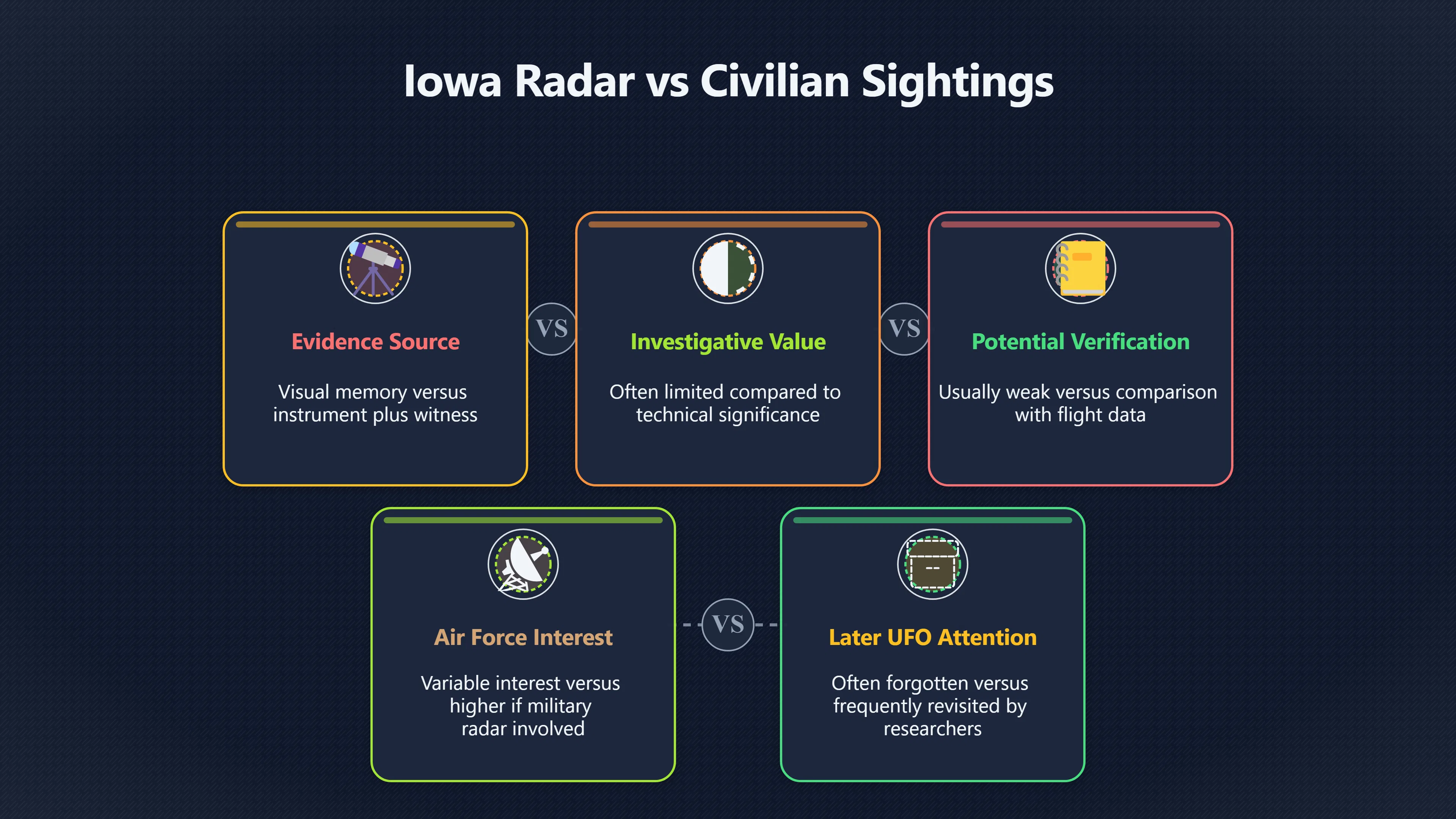
FeatureTypical civilian sightingRadar-linked reportEvidence sourceWitness memoryInstrument plus witnessInvestigative valueOften limitedConsidered technically significantPotential verificationUsually weakCould be compared with flight and weather dataAir Force interestVariableHigher if military radar involvedLater UFO attentionOften forgottenFrequently revisited by researchers
This distinction partly explains why even modest Iowa radar reports remain visible in UFO research literature while many ordinary state sightings faded from memory.
What Iowa Radar Records Actually Contribute to UFO History
The main historical contribution of Iowa’s radar and technical records is methodological rather than spectacular. They show how Project Blue Book struggled to reconcile military surveillance technology with public UFO reporting during the Cold War.
Several broader themes emerge from the Iowa material:
- The Air Force treated at least some UFO reports as operational defence questions before treating them as public-relations problems.
- Radar evidence complicated attempts to dismiss all sightings as simple misidentifications.
- Technical data did not automatically settle disputes because radar interpretation itself was uncertain.
- Many supposedly dramatic cases survive today only in abbreviated or incomplete form.
The Iowa files therefore illustrate a recurring lesson of Blue Book history: an “unknown” classification did not necessarily imply something extraordinary, but neither did it always reflect careless witnesses or obvious mistakes. In technical cases especially, investigators were often dealing with imperfect systems, fragmentary records and real uncertainty. That ambiguity is precisely why radar-linked Iowa reports remain more historically interesting than the state’s routine UFO anecdotes.
eBay marketplace picks
Marketplace Samples
Example marketplace items related to this page. Use the search link to explore similar finds on eBay.



Endnotes
1.
Source: Wikipedia
Title: Project Blue Book
Link:https://en.wikipedia.org/wiki/Project_Blue_Book
2.
Source: en.wikisource.org
Title: Chapter 10
Link:https://en.wikisource.org/wiki/The_Report_on_Unidentified_Flying_Objects/Chapter_10
Source snippet
The Report on Unidentified Flying Objects/Chapter 1029 Jan 2023 — All radar units equipped with radarscope cameras would be req...
3.
Source: ia800501.us.archive.org
Title: Internet Archive The Report on Unidentified Flying Objects
Link:https://ia800501.us.archive.org/20/items/FritjofCapraTheTurningPoint/Edward%20J%20Ruppelt%20-%20The%20Report%20on%20Unidentified%20Flying%20Objects.pdf
Source snippet
Internet ArchiveThe Report on Unidentified Flying Objects IntroductionProject Blue Book's chief also reported that when the pilot of the...
4.
Source: Wikipedia
Title: 1952 Washington, D.C. UFO incident
Link:https://en.wikipedia.org/wiki/1952_Washington%2C_D.C._UFO_incident
5.
Source: archive.org
Link:https://archive.org/stream/TheHynekUFOReport/The_Hynek_UFO_Report_djvu.txt
6.
Source: archive.org
Title: quintanilla djvu.txt
Link:https://archive.org/stream/ufos-an-air-force-dilemma/quintanilla_djvu.txt
Source snippet
Internet ArchiveFull text of "UFO's: An Air Force Dilemma"" PROJECT BLUE BOOK "Blue Book" came into its own in March, 1952, and the... I...
7.
Source: archives.gov
Title: National Archives Project BLUE BOOK
Link:https://www.archives.gov/research/military/air-force/ufos
Source snippet
National ArchivesProject BLUE BOOK - Unidentified Flying ObjectsAugust 15, 2016 — 25 Jun 2024 — Pro-UFO researchers claim that an extrate...
Published: August 15, 2016
8.
Source: prologue.blogs.archives.gov
Title: Pieces of Historyreport.pdf
Link:https://prologue.blogs.archives.gov/wp-content/uploads/sites/9/2018/03/report.pdf
Source snippet
Pieces of HistoryWhatever their long-term historical significance, the case files comprising. Project Blue Book have been well Publicized...
9.
Source: archive.org
Title: Brad Sparks Comprehensive Catalog of 1,600 Project Blue Book UFO Unknowns
Link:https://archive.org/download/BernardSieglerTechnicsAndTime1TheFaultOfEpimetheus/Brad%20Sparks%20-%20Comprehensive%20Catalog%20of%201%2C600%20Project%20Blue%20Book%20UFO%20Unknowns.pdf
Source snippet
Comprehensive Catalog of 1600 Project Blue Book UFO...2 Oct 2009 — Comprehensive Catalog of 1,600 Project Blue Book UFO Unknowns: Work i...
10.
Source: archive.org
Title: Blue Book Artifacts
Link:https://archive.org/details/BlueBookArtifacts
Source snippet
Project Blue Book Artifacts: United States Air Force1 May 2023 — Project Blue Book Artifacts. Photographs of physical artifacts recovere...
Published: May 2023
11.
Source: ia600507.us.archive.org
Title: 36258531 Battelledoc
Link:https://ia600507.us.archive.org/6/items/BattelledocTopSecretWithOrcon.theWorldIsDividedInToThreeClassesOf/36258531-Battelledoc.pdf
Source snippet
very small group that makes things happen, a somew1 Jul 1992 — In March 1952 Grudge II went public as Project Blue Book, and for the next...
Published: March 1952
12.
Source: ia600600.us.archive.org
Title: 492780987 The UFO Book Encyclopedia of the Extraterrestrial PDFDrive
Link:https://ia600600.us.archive.org/32/items/492780987-the-ufo-book-encyclopedia-of-the-extraterrestrial-pdfdrive/492780987-The-UFO-Book-Encyclopedia-of-the-Extraterrestrial-PDFDrive.pdf
Source snippet
The UFO book: encyclopedia of the extraterrestrial / Jerome Clark, p. cm. Includes bibliographic references and index. ISBN 1-57859-029...
13.
Source: ia803206.us.archive.org
Title: David Jacobs The UFO Controversy In America
Link:https://ia803206.us.archive.org/26/items/DavidJacobsTheUFOControversyInAmerica/David%20Jacobs%20-%20The%20UFO%20Controversy%20In%20America.pdf
Source snippet
UFO Controversy In AmericaWorld War II: The "foo-fighters" spotted dur· ing air battles-were they static electricity, enemy secret weapon...
14.
Source: archive.org
Title: Full text of “Battelledoc TOP SECRET with ORCON
Link:https://archive.org/stream/BattelledocTopSecretWithOrcon.theWorldIsDividedInToThreeClassesOf/36258531-Battelledoc_djvu.txt
Source snippet
'The...The Air Force issued the final report as "Project Blue Book Special Report No. 14." It was released in 1 955, accompanied by an A...
15.
Source: archive.org
Title: DTIC AD0688332 djvu.txt
Link:https://archive.org/stream/DTIC_AD0688332/DTIC_AD0688332_djvu.txt
Source snippet
Full text of "DTIC AD0688332: UFOs AND RELATED...This is believed to be the most comprehensive bibliography published to date on the sub...
Additional References
16.
Source: cia.gov
Link:https://www.cia.gov/readingroom/document/cia-rdp81r00560r000100010002-9
Source snippet
FLYING SAUCERS UFO REPORTSSource: The Report On Unidentified Flying Objects by Edward J. Ruppelt, for- mer head of Air Force Project Blue...
17.
Source: esd.whs.mil
Link:https://www.esd.whs.mil/Portals/54/Documents/FOID/Reading%20Room/UFOsandUAPs/proj_b1.pdf?ver=2017-05-22-113513-837
Source snippet
WHS ESDProject Blue BookThe objectives of Project Blue Book are two-fold: first, to determine whether UFOs pose a threat to the security...
18.
Source: facebook.com
Link:https://www.facebook.com/cbcdocs/posts/ufo-landings-secret-documents-a-creepy-government-bunkerlike-a-real-life-episode/10160087257196950/
Source snippet
UFO landings, secret documents, a creepy government...WHY WOULD UFO/ALIENS CHECK THIS BASE OUT? By Jim Lawrence WHY? It's understood by...
19.
Source: documents.theblackvault.com
Link:https://documents.theblackvault.com/documents/ufos/australia/B1497_V116-783-1047_10491375.pdf
Source snippet
theblackvault.cometlt-17 /r7 OF TRANSPORTassociated with a 'UFO sound.' A certain proportion of reports include testimony of individuals...
20.
Source: sofrep.com
Title: the truth behind ufos from project blue book to the pentagons uap task force
Link:https://sofrep.com/news/the-truth-behind-ufos-from-project-blue-book-to-the-pentagons-uap-task-force/
Source snippet
The Truth Behind UFOs: From Project Blue Book to the...8 Feb 2026 — Project Blue Book was the United States Air Force's longest-running p...
21.
Source: youtube.com
Title: Project Blue Book: Declassified
Link:https://www.youtube.com/watch?v=UKzI3uu_oTQ
Source snippet
Project Blue Book radar visual cases Project Blue Book's 10 Scariest UFO Files: Cases They Couldn't Explain America's Strangest History...
22.
Source: sacred-texts.com
Link:https://sacred-texts.com/ufo/rufo/rufo16.htm
Source snippet
The Report on Unidentified Flying Objects: Chapter Fourte...By late August 1952 several groups in Washington were following the UFO situa...
Published: August 1952
23.
Source: horrorbound.net
Title: dont let project blue book fly under your radar
Link:https://www.horrorbound.net/blog/2019/7/31/dont-let-project-blue-book-fly-under-your-radar
Source snippet
The conspiracies. The aliens. Again, Project Blue Book delivers. The UFOs and the alien activity matches very well with the actual...Rea...
24.
Source: upload.wikimedia.org
Title: Project Blue Book, BBA PBSR11 300
Link:https://upload.wikimedia.org/wikipedia/commons/2/21/Project_Blue_Book%2C_BBA-PBSR11-300.pdf
Source snippet
Project Blue Book ArchiveUp to and including 1952, 2,500 reports... For a total of 68 minutes, during both radar sightings, aircraft att...
25.
Source: facebook.com
Title: For 17 years, the U.S
Link:https://www.facebook.com/Theuntoldpastfb/posts/for-17-years-the-us-air-force-chased-lights-in-the-sky-from-1952-to-1969-under-a/1217574073740878/
Source snippet
Air Force chased lights in the sky....From 1952 to 1969, under a classified program called Project Blue Book, the military investigated...
Topic Tree