Within Oklahoma UFOs
Did Radar Make Oklahoma's UFOs Stronger?
Reports near Tinker show why military airspace can make a UFO case seem stronger while also creating more ordinary explanations.
On this page
- Why Tinker matters to Oklahoma UFO history
- What radar can and cannot prove
- Aircraft, weather and data gaps as explanations
Page outline Jump by section
Introduction
Tinker Air Force Base matters to Oklahoma’s UFO history because it gives several local stories a military and radar setting, not because it proves that extraordinary craft were present. The most important pattern is more subtle: when witnesses, police reports and alleged radar contacts appear together, a case can look stronger than a simple lights-in-the-sky report, but the same military airspace also creates more ordinary possibilities, including aircraft, flares, radar limitations, incomplete logs and confused public reporting. Tinker’s official role in air logistics, air control and airborne surveillance makes it a natural focal point for Oklahoma UFO narratives, especially around the 1965 flap. Yet the evidence remains uneven. Some reports include named witnesses and technical claims; others survive mainly through press accounts, later UFO archives or disputed summaries. The safest conclusion is that Tinker made Oklahoma sightings more documentable, but not automatically more conclusive.
Why Tinker matters to Oklahoma UFO history
Tinker is not a remote folklore setting. It is a major military installation on the edge of Oklahoma City, with national defence missions and a long aviation footprint. Official Tinker material describes the base as home to major Department of Defense, Air Force and Navy activities, including the 552nd Air Control Wing, whose E-3 Sentry aircraft use radar and other sensors for “deep-look surveillance, warning, interception control and airborne battle management”.[Tinker Air Force Base]tinker.af.milFact Sheet > Tinker Air Force Base > Display…
That matters because many Oklahoma UFO stories are not just about what one person saw in the sky. They involve police radios, highway patrol calls, air-base switchboards, radar rooms, local journalists and civilian investigators trying to understand reports in real time. Tinker sits at the point where those worlds overlap: a public-facing military base close to a large city, near busy civil routes, and associated in the public mind with aircraft tracking and official secrecy.
Tinker also had a formal place in the old Air Force UFO reporting system. A 1967 Oklahoma City Air Materiel Area supplement to Air Force Regulation 80-17, preserved in the Project Blue Book Archive, established responsibilities for screening, investigating and reporting UFO sightings within the Tinker Air Force Base area.[Project Blue Book Archive]bluebookfiles.orgSource details in endnotes. That does not mean every claim near the base was treated as important. It does show that, by the late 1960s, UFO reports were administrative matters that local Air Force offices had to route, screen and document.
The National Archives’ Project Blue Book page gives the broader frame. Blue Book was the Air Force programme for UFO investigations; its records are declassified, the project closed in 1969, and its case files are available through National Archives microfilm and related holdings. The Air Force’s later fact sheet said Blue Book received 12,618 reports from 1947 to 1969, of which 701 remained “Unidentified”, while also concluding that no investigated UFO report showed a national-security threat, unknown scientific principle or evidence of extraterrestrial vehicles.[National Archives]archives.govNational Archives Project BLUE BOOKNational Archives Project BLUE BOOK
That combination is important for Oklahoma. It leaves room for unresolved reports while discouraging overstatement. A radar-related sighting near Tinker can be historically interesting without being proof of alien technology.

The 1965 flap made Tinker a test of radar credibility
The strongest Tinker-linked UFO cluster is the summer 1965 Oklahoma flap. The central claim is that sightings by police and civilians were accompanied by radar contacts at Tinker and, in some accounts, Carswell Air Force Base in Texas. This is why the episode still appears in Oklahoma UFO histories: it seems to join human testimony with technical detection.
A NICAP document on the Wynnewood report states that at about 1:05 a.m. on 31 July 1965, Wynnewood police officer Lewis Sikes reported an unidentified flying object north-east of Wynnewood. The same document says “simultaneous radar fixes” were obtained by Tinker AFB in Oklahoma City and Carswell AFB in Fort Worth, and that Sikes and his wife watched the object for an extended period. It also describes the object as white with a blue-green centre and a red rotating light.[nicap.org]nicap.org650730wynnewood docs650730wynnewood docs
The same document adds details that make the case both more interesting and more difficult. It says the object was “confirmed by radar at 8,000 ft”, moved, returned to its original position, and was later tracked by both Tinker and Carswell to a point 15 miles south-west of Tinker before disappearing; a few minutes later, it was reportedly tracked 29 miles south of Tinker before being lost again. It also notes that a Braniff airliner in the vicinity was notified, but the airline pilot made no visual contact.[nicap.org]nicap.org540828tinker docs540828tinker docs
That last detail is crucial. If an airliner near the claimed area did not see the object, the radar claim does not collapse, but it becomes more ambiguous. It raises questions about range, altitude, bearing, weather, the difference between a radar return and a visible object, and whether all observers were actually referring to the same thing.
Later local accounts repeat the 1965 pattern in a more public-facing way. Edmond Life & Leisure’s retrospective says Tinker picked up an unidentified blip at the time of the Wynnewood sighting, tracked it at 8,000 feet, and later reported tracking four UFOs at 22,000 feet during the following night’s wave of calls.[edmondlifeandleisure.com]edmondlifeandleisure.comedmond underground in edmond abuzz with uco sightings p10350 87edmond underground in edmond abuzz with uco sightings p10350 87[OklahomaHistory.net]oklahomahistory.netufo scare 1965ufo scare 1965 similarly describes the 1965 scare as a period when reports spread across the state and says the Wynnewood sighting was “verified” by Tinker and Carswell.[oklahomahistory.net]oklahomahistory.netufo scare 1965ufo scare 1965
The word “verified” needs careful handling. In UFO writing, it is often used loosely to mean that a radar operator, police dispatcher or official source reported something unusual at about the same time. It does not necessarily mean the object was identified as a structured craft, physically confirmed, photographed, intercepted or explained as something beyond known technology.
What radar can and cannot prove
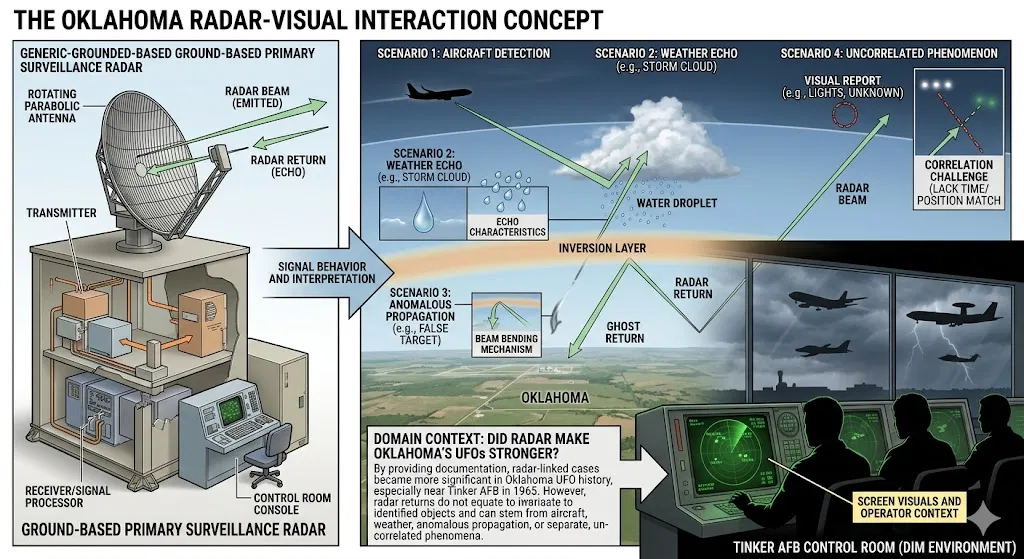
Radar is often treated as the hard evidence in a UFO case, but radar data are not self-explanatory. A radar return can show that a system detected something, or appeared to detect something, in a particular direction or range. It does not automatically show what the target was, whether it was the same object a witness saw, or whether the return was caused by an aircraft, weather, ground reflection, equipment behaviour or atmospheric propagation.
The Federal Aviation Administration’s Aeronautical Information Manual is a useful plain-language reminder that radar performance depends on practical limitations. It notes that reflective surface affects the size of a primary radar return, so a small light aircraft or sleek jet fighter can be harder to see than a large airliner or bomber. It also explains that secondary-radar-only or ADS-B-based coverage cannot provide radar service to aircraft without the right equipment, and that some primary targets and radar-derived weather cannot be handled in the same way as transponder-equipped traffic.[Federal Aviation Administration]faa.govFederal Aviation Administration Section 5. Surveillance SystemsFederal Aviation Administration Section 5. Surveillance Systems
Weather and propagation can also matter. NOAA’s JetStream explainer describes anomalous propagation as false radar echoes that are not precipitation, produced when atmospheric conditions bend the radar beam in unusual ways. Such returns can contaminate radar interpretation because the system is receiving echoes, but not necessarily from what a casual observer imagines as a solid aerial object.[NOAA]noaa.govanomalous propagationanomalous propagation
This does not debunk the 1965 Tinker claims by itself. The surviving accounts do not provide enough technical detail to test every radar return against local weather, equipment settings, operator notes and aircraft traffic. But it does explain why “radar saw it” is the beginning of an investigation, not the end of one.
For a strong radar-UFO case, a reader would want several things at once: precise radar logs, operator statements, equipment type, time synchronisation, weather data, aircraft traffic checks, witness bearings, and an explanation of how the radar target and visual object were matched. The Tinker-linked stories have some of those elements in fragmentary form, but not enough to remove uncertainty.
The Air Force explanation created its own problem
The 1965 Oklahoma reports became controversial partly because the official explanation seemed too blunt for the complexity of the claims. Project Blue Book’s handling of the wider 1965 Midwest and southern sightings has often been criticised because some reports involving police witnesses and radar were publicly reduced to astronomical explanations such as Jupiter or bright stars.
A later summary of the controversy notes that Oklahoma Highway Patrol reports said Tinker had tracked up to four UFOs at once, with some allegedly descending rapidly from around 22,000 feet to 4,000 feet. It also notes that a Wichita meteorologist reported radar tracks at 6,000 to 9,000 feet, and that Blue Book’s explanation was attacked by Robert Riser of the Oklahoma Science and Art Foundation Planetarium, who argued that the cited stars and planets were on the wrong side of the Earth for the time and place.[Wikipedia]WikipediaProject Blue BookProject Blue Book
A congressional-hearing record from the period preserves how the dispute entered public debate. It describes state police in Oklahoma, Texas, Kansas and New Mexico reporting observations “corroborated by radar trackings from the Tinker and Carswell Air Force Bases”, but also says the Air Force later released a statement that the radar trackings did not correspond to the visual findings of the Oklahoma Department of Public Safety.[Internet Archive]archive.orgufo 1966 1 djvu.txtufo 1966 1 djvu.txt
That distinction is the heart of the Tinker problem. There may have been visual reports. There may have been radar returns. The unresolved question is whether they were truly the same event. If the radar and visual evidence did not line up in time, location and movement, the case weakens. If they did line up, the Air Force’s broad astronomical explanation becomes less convincing, because ordinary radar does not detect planets or stars.
This is why Tinker’s role should be described as contested rather than decisive. The base’s radar claims made the Oklahoma flap harder to dismiss casually, but the surviving public record also leaves room for the Air Force’s narrower point: some radar returns and some visual sightings may have been different things grouped together during a fast-moving public scare.
The 1954 Tinker radar story is even thinner
Another Tinker-linked claim sometimes discussed in UFO archives concerns 28 August 1954, when a later enquiry referred to “fifteen UFOs” reportedly seen, tracked by radar and pursued by interceptors over Oklahoma City. The available NICAP-hosted document is not a full original case file; it is a 1960 letter asking the Air Force for analysis of the alleged 1954 formation.[nicap.org]nicap.org650730wynnewood docs650730wynnewood docs
The Air Technical Intelligence Center’s response is sobering. In the same file, an Air Force reply states that the centre had no record of UFOs sighted over Oklahoma City during August 1954.[nicap.org]nicap.org540828tinker docs540828tinker docs
That does not prove nothing happened. Records can be lost, misfiled, dated differently or held in another command’s paperwork. But for a public-facing Oklahoma history page, the evidential weight is limited. The 1954 story is best treated as an archival claim with a negative Air Force record response, not as a securely established radar-intercept case.
It also illustrates a common problem in UFO history: a later letter, secondary index or enthusiast summary can preserve the shape of a dramatic incident more strongly than the official documentation preserves the incident itself. Readers should not ignore such leads, but they should not treat them as equivalent to complete radar logs or contemporaneous operational records.

Aircraft, weather and data gaps as explanations
Tinker’s setting makes ordinary explanations more likely, not less. The area around Oklahoma City has military aircraft, civil traffic, maintenance operations, training activity, weather effects and public awareness of the base. A strange light near a military installation may attract more attention precisely because people assume the base should know what it is.
Several explanation paths are worth keeping separate.
Aircraft and military activity. Tinker’s missions involve aircraft, maintenance and air-control functions. Official material says the base hosts multiple defence activities, while the 552nd Air Control Wing operates E-3 Sentry aircraft with radar and sensor roles.[Tinker Air Force Base]tinker.af.milFact Sheet > Tinker Air Force Base > Display… A witness may honestly report an unknown light, but nearby military and civil aviation create many possible sources that may not be obvious from the ground.
Flares and local misidentification. During the 1965 reporting wave, not every report was treated as mysterious. A contemporary Oklahoma Journal item preserved by a UFO-documentation site says one sighting by two young women turned out to be a parachute flare that police confiscated; the same article also reported that Tinker’s radar approach control tower, using four scopes with a 40-mile range, had no contacts during the height of some local sightings.[ufologie.patrickgross.org]ufologie.patrickgross.orgSource details in endnotes. That does not explain all reports, but it shows how mixed the wave was: some claims were strange, some were mundane, and some radar information cut against the excitement rather than supporting it.
Radar ambiguity. Radar returns need interpretation. The FAA guidance on surveillance systems shows that radar coverage, target size, transponders, ADS-B, terrain and equipment all affect what appears to controllers.[Federal Aviation Administration]faa.govFederal Aviation Administration Section 5. Surveillance SystemsFederal Aviation Administration Section 5. Surveillance Systems NOAA’s discussion of anomalous propagation shows why a radar-like technical claim can still be affected by atmosphere and false echoes.[NOAA]roc.noaa.govData Quality Oddities and AnomaliesData Quality Oddities and Anomalies
Documentation gaps. The most important weakness in the Tinker radar stories is not witness sincerity. It is the lack of a complete public technical chain. The reader rarely gets the original radar scope imagery, raw logs, controller transcripts, equipment status, weather profile and aircraft traffic correlation in one place. Without that chain, the cases remain historically interesting but scientifically underpowered.
Did radar make Oklahoma’s UFOs stronger?
Radar made Oklahoma’s UFO stories stronger in one limited sense: it moved some reports beyond isolated personal testimony. A police officer’s sighting near Wynnewood, alleged radar returns at Tinker and Carswell, highway patrol communications, local press attention and later Project Blue Book controversy together created a more layered record than a single anonymous sighting would have done.[2edmondlifeandleisure.com]edmondlifeandleisure.comedmond underground in edmond abuzz with uco sightings p10350 87edmond underground in edmond abuzz with uco sightings p10350 87
But radar also made the stories more vulnerable to technical scrutiny. Once a claim depends on radar, the key question becomes whether the radar data are recoverable, precise and matched to the visual observation. In the Tinker-linked material, that match is often asserted but not fully demonstrable from the public record. The 1965 reports remain the strongest Tinker-related cluster, while the 1954 claim is much weaker because the available Air Force reply says no record was found for the alleged August 1954 Oklahoma City sighting.[nicap.org]nicap.org540828tinker docs540828tinker docs
The most balanced reading is that Tinker gave Oklahoma UFO history a serious aviation-and-radar dimension, but not a decisive answer. It shows why military airspace can make a UFO report feel more credible while also multiplying ordinary explanations and administrative confusion. In Oklahoma’s wider UFO record, Tinker is therefore best understood as a place where uncertainty became more technical, not where uncertainty disappeared.
Amazon book picks
Further Reading
Books and field guides related to Did Radar Make Oklahoma's UFOs Stronger?. Use these as the next step if you want deeper reading beyond the article.
The UFO Experience
Directly relevant to radar-supported sightings and investigative standards.
The Report on Unidentified Flying Objects
Explains how radar and military reports were handled by investigators.
eBay marketplace picks
Marketplace Samples
Example marketplace items related to this page. Use the search link to explore similar finds on eBay.







Endnotes
1.
Source: tinker.af.mil
Title: Tinker Air Force Base
Link:https://www.tinker.af.mil/About-Tinker/Fact-Sheets/Display/Article/384766/tinker-air-force-base-fact-sheet/
Source snippet
Fact Sheet > Tinker Air Force Base > Display...
2.
Source: archives.gov
Title: National Archives Project BLUE BOOK
Link:https://www.archives.gov/research/military/air-force/ufos
3.
Source: nicap.org
Title: 650730wynnewood docs
Link:https://www.nicap.org/docs/650730wynnewood_docs.pdf
4.
Source: edmondlifeandleisure.com
Title: edmond underground in edmond abuzz with uco sightings p10350 87
Link:https://edmondlifeandleisure.com/edmond-underground-in-edmond-abuzz-with-uco-sightings-p10350-87.htm
5.
Source: oklahomahistory.net
Title: ufo scare 1965
Link:https://oklahomahistory.net/ufo-scare-1965/
6.
Source: faa.gov
Title: Federal Aviation Administration Section 5. Surveillance Systems
Link:https://www.faa.gov/air_traffic/publications/atpubs/aim_html/chap4_section_5.html
7.
Source: noaa.gov
Title: anomalous propagation
Link:https://www.noaa.gov/jetstream/anomalous-propagation
8.
Source: Wikipedia
Title: Project Blue Book
Link:https://en.wikipedia.org/wiki/Project_Blue_Book
9.
Source: archive.org
Title: ufo 1966 1 djvu.txt
Link:https://archive.org/stream/ufo_1966_1/ufo_1966_1_djvu.txt
10.
Source: nicap.org
Title: 540828tinker docs
Link:https://www.nicap.org/docs/540828tinker_docs.pdf
11.
Source: ufologie.patrickgross.org
Link:https://ufologie.patrickgross.org/press/oklahomajournal2aug1965.htm
12.
Source: faa.gov
Link:https://www.faa.gov/air_traffic/publications/atpubs/aim/aim0405.html
13.
Source: Wikipedia
Link:https://en.wikipedia.org/wiki/552nd_Air_Control_Group
14.
Source: Wikipedia
Link:https://en.wikipedia.org/wiki/552nd_Air_Control_Wing
15.
Source: Wikipedia
Title: Oklahoma City Air Logistics Complex
Link:https://en.wikipedia.org/wiki/Oklahoma_City_Air_Logistics_Complex
16.
Source: Wikipedia
Title: Anomalous propagation
Link:https://en.wikipedia.org/wiki/Anomalous_propagation
17.
Source: Wikipedia
Title: Secondary surveillance radar
Link:https://en.wikipedia.org/wiki/Secondary_surveillance_radar
18.
Source: media.defense.gov
Title: AFD 100525 065
Link:https://media.defense.gov/2010/May/25/2001330265/-1/-1/0/AFD-100525-065.pdf
19.
Source: media.defense.gov
Title: CATEGORY C Tinker January
Link:https://media.defense.gov/2006/Dec/28/2001453570/-1/-1/0/CATEGORY%20C_Tinker_January.pdf
20.
Source: ia601405.us.archive.org
Link:https://ia601405.us.archive.org/28/items/B-001-014-055/B-001-014-055.pdf
21.
Source: archive.org
Link:https://archive.org/stream/ryanreporter271303ryan/ryanreporter271303ryan_djvu.txt
22.
Source: archive.org
Title: UFO Magazine Annual 1967 djvu.txt
Link:https://archive.org/stream/UFO_Magazine_Annual_1967/UFO_Magazine_Annual_1967_djvu.txt
23.
Source: archive.org
Title: Brad Sparks Comprehensive Catalog of 1,600 Project Blue Book UFO Unknowns
Link:https://archive.org/download/BernardSieglerTechnicsAndTime1TheFaultOfEpimetheus/Brad%20Sparks%20-%20Comprehensive%20Catalog%20of%201%2C600%20Project%20Blue%20Book%20UFO%20Unknowns.pdf
24.
Source: roc.noaa.gov
Title: Data Quality Oddities and Anomalies
Link:https://www.roc.noaa.gov/public-documents/operations-branch/Data_Quality_Oddities_and_Anomalies.pdf
25.
Source: bluebookfiles.org
Link:https://bluebookfiles.org/doc/6258
26.
Source: vault.fbi.gov
Link:https://vault.fbi.gov/Project%20Blue%20Book%20%28UFO%29%20/Project%20Blue%20Book%20%28UFO%29%20Part%2001%20%28Final%29/at_download/file
27.
Source: internationalufobureau.com
Link:https://www.internationalufobureau.com/pastinvestigations/1965flap
28.
Source: military-history.fandom.com
Title: Project Blue Book
Link:https://military-history.fandom.com/wiki/Project_Blue_Book
Additional References
29.
Source: youtube.com
Link:https://www.youtube.com/watch?v=Ac3hYt3k-Eo
Source snippet
Kecksburg UFO Crash: The Untold Story | The Government Lied! | Full Documentary | UFOTV®...
30.
Source: youtube.com
Link:https://www.youtube.com/watch?v=tU7WSHZye5w
Source snippet
Project Blue Book Exposed (2020) [Documentary]...
31.
Source: youtube.com
Title: UFO incident at Edwards Air Force Base (audio & transcript)
Link:https://www.youtube.com/watch?v=rzlel8Z9oSU
Source snippet
The Mysterious 1965 UFO Crash | Beyond Skinwalker Ranch (S3) | History...
32.
Source: cia.gov
Link:https://www.cia.gov/readingroom/document/cia-rdp81r00560r000100010002-9
33.
Source: nsa.gov
Link:https://www.nsa.gov/portals/75/documents/news-features/declassified-documents/ufo/usaf_fact_sheet_95_03.pdf
34.
Source: govinfo.gov
Link:https://www.govinfo.gov/content/pkg/CHRG-89hhrg50066O/pdf/CHRG-89hhrg50066O.pdf
35.
Source: researchgate.net
Link:https://www.researchgate.net/publication/332254869_Surveillance_Radar_System_Limitations_and_the_Advent_of_the_Automatic_Dependent_Surveillance_Broadcast_system_for_Aircraft_Monitoring
36.
Source: instagram.com
Link:https://www.instagram.com/552daircontrolwing/
37.
Source: academia.edu
Link:https://www.academia.edu/129803577/A_Concise_History_of_the_USAF_UFO_Programs
38.
Source: scribd.com
Link:https://www.scribd.com/document/113740171/Searching-the-Skies-The-Legacy-of-the-United-States-Cold-War-Defense-Radar-Program
Topic Tree