Within Oregon UFOs
How Oregon Entered The Flying Saucer Age
Kenneth Arnold's 1947 flight links Oregon to the birth of the modern flying saucer story through aviation routes and press attention.
On this page
- Arnold's route to Pendleton
- How the story reached the press
- Why Oregon was present at the start
Page outline Jump by section
Introduction
Kenneth Arnold’s famous sighting did not happen in Oregon, but Oregon is where the story became public. On 24 June 1947, Arnold was flying from Chehalis, Washington, towards an air show in Pendleton, Oregon, with a planned fuel stop at Yakima, when he reported seeing nine fast, bright objects near Mount Rainier. The next day, in Pendleton, he told the East Oregonian what he believed he had seen. That local interview helped launch the phrase “flying saucer” into American public life and made Oregon part of the opening chapter of the modern UFO era.[National Air and Space Museum]airandspace.si.edu1947 year flying saucerNational Air and Space Museum1947: Year of the Flying Saucer | National Air and Space Museum…
The case matters for Oregon UFO history because it shows how a sighting becomes a public phenomenon: a pilot’s aviation story, a regional newspaper office, a wire-service summary, national headlines, military interest and later sceptical reinterpretation. Arnold’s report remains unresolved in the narrow sense that no single explanation has been proved, but it is not a simple “proof of aliens” story. Its importance lies in the way Pendleton turned a private pilot’s account into the vocabulary and template that shaped thousands of later UFO reports.[National Archives]archives.govSource details in endnotes.
Arnold’s Route To Pendleton
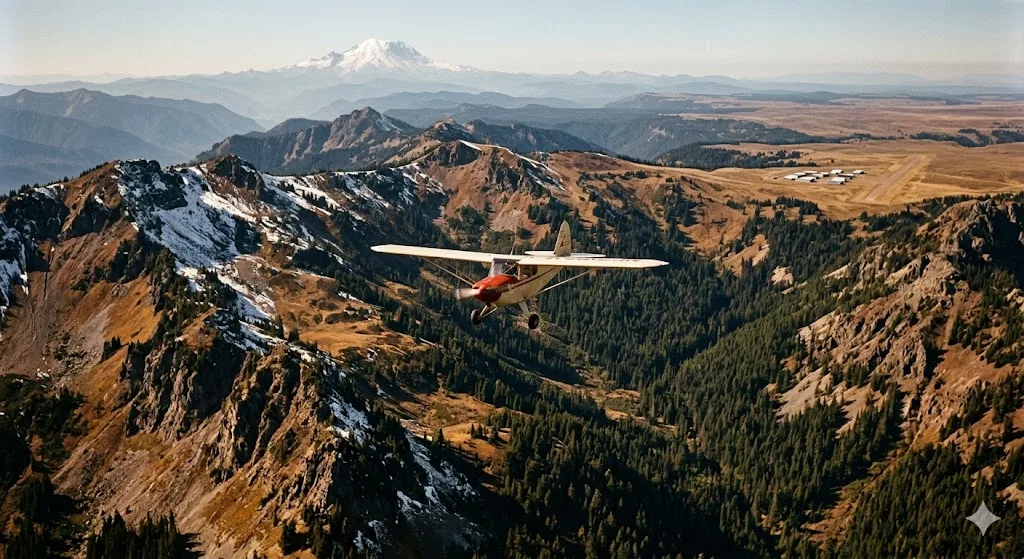
Arnold was not flying a vague recreational loop when the incident occurred. He was an experienced private pilot, flying a single-engine CallAir A-2, and was travelling across the Pacific Northwest on 24 June 1947. The National Air and Space Museum says he had logged about 4,000 flying hours and was heading to an air show in Pendleton, Oregon, with a planned fuel stop in Yakima. He also intended to detour in search of a missing Marine Corps Curtiss C-46 transport aircraft, for which a reward had reportedly been offered.[National Air and Space Museum]airandspace.si.edu1947 year flying saucerNational Air and Space Museum1947: Year of the Flying Saucer | National Air and Space Museum…
That route is why Oregon belongs in the story even though the visual episode centred on Washington’s Cascade Range. Arnold’s destination was Pendleton, and his account travelled with him into Oregon’s local press. Shortly before 3 p.m., while searching near Mount Rainier, he noticed bright flashes, ruled out a nearby Douglas DC-4 as the source, and then reported seeing nine shiny objects moving in formation. He later estimated their speed at around 1,200 mph, with some accounts giving higher figures, far beyond known aircraft performance at the time.[National Air and Space Museum]airandspace.si.edu1947 year flying saucerNational Air and Space Museum1947: Year of the Flying Saucer | National Air and Space Museum…
The sighting’s geography also gave the story its distinctive Pacific Northwest texture. Arnold described objects moving along or across the Cascade setting, with Mount Rainier and Mount Adams functioning as visual reference points. That matters because his speed estimate depended on timing the objects between landmarks, not merely on a fleeting impression of brightness. It also created a built-in uncertainty: distance, size and speed estimates from a moving aircraft can be difficult to validate after the fact, especially when the objects themselves were unidentified.[National Air and Space Museum]airandspace.si.edu1947 year flying saucerNational Air and Space Museum1947: Year of the Flying Saucer | National Air and Space Museum…

How The Story Reached The Press
Pendleton’s role began when Arnold told his story to the East Oregonian. HistoryLink records that during a stop in Pendleton he described the experience to editor Nolan Skiff, saying the objects moved “like a saucer would if you skipped it across the water”. The key point is often misunderstood: the saucer image initially described motion, not necessarily a neat dinner-plate shape.[HistoryLink]historylink.orgFlying saucers, first in world, reported near Mount Rainier on June 24, 1947. - HistoryLink.org…
The phrase hardened quickly in print. The Smithsonian account notes that Skiff used “saucer-like aircraft” in a short article, while reporter Bill Bequette sent an Associated Press dispatch that referred to “nine bright saucer-like objects”. By the afternoon, the story had spread far beyond Pendleton, and the public shorthand “flying saucers” began to overtake the more careful, original wording.[National Air and Space Museum]airandspace.si.edu1947 year flying saucerNational Air and Space Museum1947: Year of the Flying Saucer | National Air and Space Museum…
This is where Oregon’s contribution is specific rather than symbolic. Pendleton was not simply a place Arnold happened to visit; it was the news gateway. A local newspaper office, a pair of Oregon journalists and the Associated Press wire turned a pilot’s unusual aviation report into a national item. Without that media pathway, Arnold might have remained a regional witness rather than the name attached to the birth of the saucer age.
The first reporting also shaped later confusion. “Saucer-like” became easy to read as a statement about shape, even though later retellings stressed Arnold’s comparison to the skipping motion of a saucer on water. That ambiguity helped create one of UFO history’s most durable images: the round flying disc. It is a reminder that UFO history is often built not only from what witnesses say they saw, but from how reporters, headline writers and readers compress those descriptions.[National Archives]archives.govSource details in endnotes.
Why Oregon Was Present At The Start
Oregon’s presence at the beginning of the modern UFO story was partly accidental and partly structural. It was accidental because Arnold’s objects were reported over Washington, not Oregon. It was structural because Pacific Northwest aviation routes, regional newspapers and air-minded communities were exactly the kind of environment in which a strange aerial report could be taken seriously enough to circulate.
Arnold did not present himself as a mystic or contactee in the initial public story. The early accounts describe him as a businessman-pilot trying to make sense of something he could not identify. That credibility mattered to the reporters who spoke with him, and it mattered to readers because the claim was framed as an aviation puzzle rather than a supernatural tale. The National Archives later summarised the event as the “seminal” episode that launched modern UFO interest in the United States, linking Arnold’s report, media interviews and the shortened phrase “flying saucers”.[National Archives]archives.govSource details in endnotes.
For Oregon, the Pendleton connection also anticipates later state-level UFO patterns. The state’s best-known cases would repeatedly sit at the junction of local witnesses, newspapers, official files and later sceptical analysis. The McMinnville photographs in 1950 and the Redmond radar-and-airport reports in 1959 belong to different categories of evidence, but the Arnold-Pendleton episode shows the earlier mechanism: local reporting could transform a puzzling observation into a durable public case.
It is therefore more accurate to say Oregon helped publish the flying saucer age than to say Oregon “started” it. The sighting was Arnold’s, the mountains were largely Washington’s, but the press moment was Pendleton’s. That distinction keeps the history grounded and avoids overstating Oregon’s role.
What The Best Evidence Actually Shows
The strongest evidence for the Arnold case is not a photograph, radar track or recovered object. It is a chain of contemporary reporting and later official documentation: Arnold’s own repeated account, early newspaper coverage, military interest and records preserved in later Air Force UFO files. The National Archives notes that a page from Arnold’s June 24, 1947 sighting report to the Air Force is part of the records connected with Project Blue Book, the later Air Force programme that inherited earlier UFO case material.[National Archives]archives.govSource details in endnotes.
The documentary trail supports several cautious conclusions. Arnold really did report the sighting promptly; Pendleton journalists really did carry the account into the press; the phrase “flying saucer” really did emerge from the way his description was reported; and the military treated the broader wave of reports seriously enough to create formal collection and evaluation projects. The National Archives states that the flood of reports after Arnold’s sighting contributed to the establishment of Project Sign in December 1947, before later programmes such as Grudge and Blue Book.[National Archives]archives.govSource details in endnotes.
What the evidence does not show is equally important. It does not prove the objects were spacecraft, secret aircraft or any other extraordinary technology. Arnold’s speed estimate depended on assumptions about distance and reference points. His description changed slightly across tellings, as often happens when a dramatic experience is retold under public pressure. The phrase that made the case famous may also have simplified or distorted what he meant.
A fair reading is that Arnold was a consequential witness to an unidentified aerial event as he perceived it, not that the event has been conclusively identified as something exotic. The case is historically strong as a media and cultural origin story, but evidentially weaker as a standalone demonstration of unknown technology.
The Main Doubts And Plausible Explanations
Sceptical explanations began almost immediately and have continued for decades. Some officials and commentators suggested conventional aircraft, mirage effects, unusual clouds, reflections, birds, balloons, or even water droplets on the aircraft windscreen. The variety of explanations shows both the richness and the weakness of the case: many ideas are possible, but none has become a universally accepted solution.[Wikipedia]WikipediaKenneth Arnold UFO sightingKenneth Arnold UFO sighting
The most relevant sceptical line for this page is the optical one, because it fits the Cascade setting. Skeptical Inquirer has argued that “mountain-top mirages” could produce hovering or saucer-like appearances, especially under temperature-inversion conditions, with sunlight and mountain geometry contributing to distorted reflections. This explanation directly engages with Arnold’s report of bright flashes, reflected light and objects apparently moving near mountain landmarks.[skepticalinquirer.org]skepticalinquirer.orgMount Rainier: ‘Saucer Magnet’ | Skeptical InquirerMount Rainier: ‘Saucer Magnet’ | Skeptical Inquirer
The bird explanation is also often mentioned, especially American white pelicans, whose pale undersides can reflect light and whose formation flight could appear strange at distance. That interpretation may explain some visual features, such as brightness, formation and apparent wingless shapes, but it struggles with Arnold’s own impression of extreme speed unless his distance estimate was badly wrong. Similarly, conventional aircraft would fit the aviation context but do not neatly match his insistence that he saw no tails and that the objects moved in an unusual, skipping manner.[Wikipedia]Wikipedia1947 flying disc craze1947 flying disc craze
The case therefore sits in a familiar UFO category: not debunked beyond dispute, but also not strong enough to carry extraordinary conclusions. Its unresolved status depends heavily on the limits of one witness’s airborne observation and on the difficulty of reconstructing exact atmospheric, visual and positional conditions many years later.
What Later Reporting Changed
Later reporting strengthened the case’s historical importance more than its physical evidence. The Smithsonian, the National Archives and regional histories all treat Arnold’s sighting as a turning point in the public history of UFOs. They do not need to endorse an extraordinary explanation to recognise that the event changed the language of unexplained aerial reports.[National Air and Space Museum]airandspace.si.edu1947 year flying saucerNational Air and Space Museum1947: Year of the Flying Saucer | National Air and Space Museum…[National Archives]archives.govSource details in endnotes.
Later work also clarified Pendleton’s role. The story was not born as a polished national myth. It passed through a local newsroom, where reporters tried to describe an odd claim quickly and vividly. The words “saucer-like” and “flying saucer” then travelled faster than the nuance behind them. This makes the Arnold case valuable for readers who want to understand how UFO narratives form: a witness account can be sincere, a newspaper report can be broadly faithful, and yet the public phrase that survives can still tilt the meaning.
Official files gave the case an institutional afterlife. The National Archives describes how early UFO concern led from Project Sign to Project Grudge and then Project Blue Book, and notes that Air Force conclusions across the programme found no evidence that investigated UFO reports represented a threat to national security, unknown scientific principles or extraterrestrial vehicles. That broader conclusion does not erase the Arnold case, but it places it within a record of investigation rather than confirmation.[National Archives]archives.govSource details in endnotes.
For Oregon, later reporting has made the Pendleton element easier to see. The state’s role was not as the location of the objects, but as the launch point of the story’s public life. That is why this episode belongs in Oregon’s UFO history alongside better-known in-state cases: it is the moment when Oregon’s press helped give the modern UFO era its most famous image.
How To Read The Arnold-Pendleton Case Today
The most useful way to read the case today is in three layers. As a sighting report, it remains intriguing but uncertain. As a press event, it is exceptionally important. As an Oregon story, it shows how a state can matter to UFO history not only by hosting sightings, but by shaping how those sightings are first recorded and circulated.
A balanced assessment would put the case this way: Kenneth Arnold almost certainly reported an experience he found genuinely puzzling; Pendleton’s East Oregonian played a decisive role in carrying that experience into national media; the phrase “flying saucer” grew from an ambiguous description of motion and shape; and later investigations and sceptical theories have not produced a final, universally accepted identification.[National Air and Space Museum]airandspace.si.edu1947 year flying saucerNational Air and Space Museum1947: Year of the Flying Saucer | National Air and Space Museum… HistoryLink That combination is why the story endures. It is not Oregon’s strongest physical-evidence case[historylink.org]historylink.orgFlying saucers, first in world, reported near Mount Rainier on June 24, 1947. - HistoryLink.org…, nor its clearest official-investigation case. Its value is more foundational: Pendleton marks the point where the Pacific Northwest’s strange-sky report became a public vocabulary. From there, Oregon’s later UFO history unfolded in a world that already had a name for the mystery: flying saucers.
Amazon book picks
Further Reading
Books and field guides related to How Oregon Entered The Flying Saucer Age. Use these as the next step if you want deeper reading beyond the article.
UFOs and Government
Places Arnold's sighting in the broader development of UFO history.
The Report on Unidentified Flying Objects
Useful context for official reactions to early sightings.
The Coming of the Saucers
Firsthand account by Kenneth Arnold, central to the Pendleton story.
eBay marketplace picks
Marketplace Samples
Example marketplace items related to this page. Use the search link to explore similar finds on eBay.



Endnotes
1.
Source: historylink.org
Link:https://www.historylink.org/File/5336
Source snippet
Flying saucers, first in world, reported near Mount Rainier on June 24, 1947. - HistoryLink.org...
Published: June 24, 1947
2.
Source: archives.gov
Link:https://www.archives.gov/news/articles/project-blue-book-50th-anniversary
3.
Source: Wikipedia
Title: Kenneth Arnold UFO sighting
Link:https://en.wikipedia.org/wiki/Kenneth_Arnold_UFO_sighting
4.
Source: skepticalinquirer.org
Title: Mount Rainier: ‘Saucer Magnet’ | Skeptical Inquirer
Link:https://skepticalinquirer.org/2014/05/mount-rainier-saucer-magnet/
5.
Source: archives.gov
Title: Project BLUE BOOK
Link:https://www.archives.gov/research/military/air-force/ufos
6.
Source: historylink.org
Link:https://www.historylink.org/file/2067
7.
Source: Wikipedia
Title: 1947 flying disc craze
Link:https://en.wikipedia.org/wiki/1947_flying_disc_craze
8.
Source: Wikipedia
Title: Flying saucer
Link:https://en.wikipedia.org/wiki/Flying_saucer
9.
Source: history.com
Title: Kenneth Arnold
Link:https://www.history.com/articles/kenneth-arnold
10.
Source: history.com
Title: Project Blue Book
Link:https://www.history.com/articles/project-blue-book
11.
Source: airandspace.si.edu
Title: 1947 year flying saucer
Link:https://airandspace.si.edu/stories/editorial/1947-year-flying-saucer
Source snippet
National Air and Space Museum1947: Year of the Flying Saucer | National Air and Space Museum...
12.
Source: project1947.com
Link:https://www.project1947.com/fig/1947a.htm
Source snippet
Project 1947PROJECT 1947 - UFO REPORTS: 1947...
13.
Source: project1947.com
Link:https://www.project1947.com/fig/1947b.htm
14.
Source: en.wikiquote.org
Title: Kenneth Arnold
Link:https://en.wikiquote.org/wiki/Kenneth_Arnold
15.
Source: eastoregonian.com
Title: the sighting
Link:https://eastoregonian.com/2017/06/16/the-sighting/
Additional References
16.
Source: youtube.com
Link:https://www.youtube.com/watch?v=bretHCA89bQ
Source snippet
The Coming of the Saucers By Kenneth Arnold, Raymond Palmer. FULL Audiobook...
17.
Source: youtube.com
Title: Kenneth Arnold UFO Sighting The First UFOs
Link:https://www.youtube.com/watch?v=xLuHgsXGpqc
Source snippet
BW - EP129—001: Radio, Roswell And The Flying Saucer Craze—Kenneth Arnold And The...
18.
Source: youtube.com
Title: The Coming of the Saucers By Kenneth Arnold, Raymond Palmer. FULL Audiobook
Link:https://www.youtube.com/watch?v=12uXbLC7Xug
Source snippet
Kenneth Arnold and the First UFOs - Jimmy Akin's Mysterious World...
19.
Source: scribd.com
Link:https://www.scribd.com/document/293042073/GROSS-Mystery-of-UFOs-a-Prelude
20.
Source: facebook.com
Link:https://www.facebook.com/nbc10/posts/over-the-course-of-several-years-arnold-has-won-tens-of-thousands-of-dollars-fro/1445876327583382/
21.
Source: dailykos.com
Link:https://www.dailykos.com/stories/2009/4/18/720521/community/Saturday-Night-Uforia-It-seems-impossible-but-there-it-is-Repost/
22.
Source: facebook.com
Link:https://www.facebook.com/KGWTV8/posts/speaking-of-ufosshortly-before-dawn-on-september-24-1959-police-officer-robert-d/10156433561235736/
23.
Source: reddit.com
Link:https://www.reddit.com/r/UFOs/comments/1ffvc1r/the_only_recorded_interview_of_kenneth_arnold/
24.
Source: facebook.com
Link:https://www.facebook.com/groups/bookjunkiepromotions/posts/26376839405259772/
25.
Source: dailykos.com
Link:https://www.dailykos.com/stories/2009/4/18/720521/-
Topic Tree