Within Iowa UFOs
Did Something Fall at Council Bluffs?
The 1977 Council Bluffs case stands out because witnesses, officials and recovered hot metal made it more than a routine light report.
On this page
- What witnesses and responders reported
- What the metal evidence can and cannot show
- Mundane explanations and unresolved gaps
Page outline Jump by section
Introduction
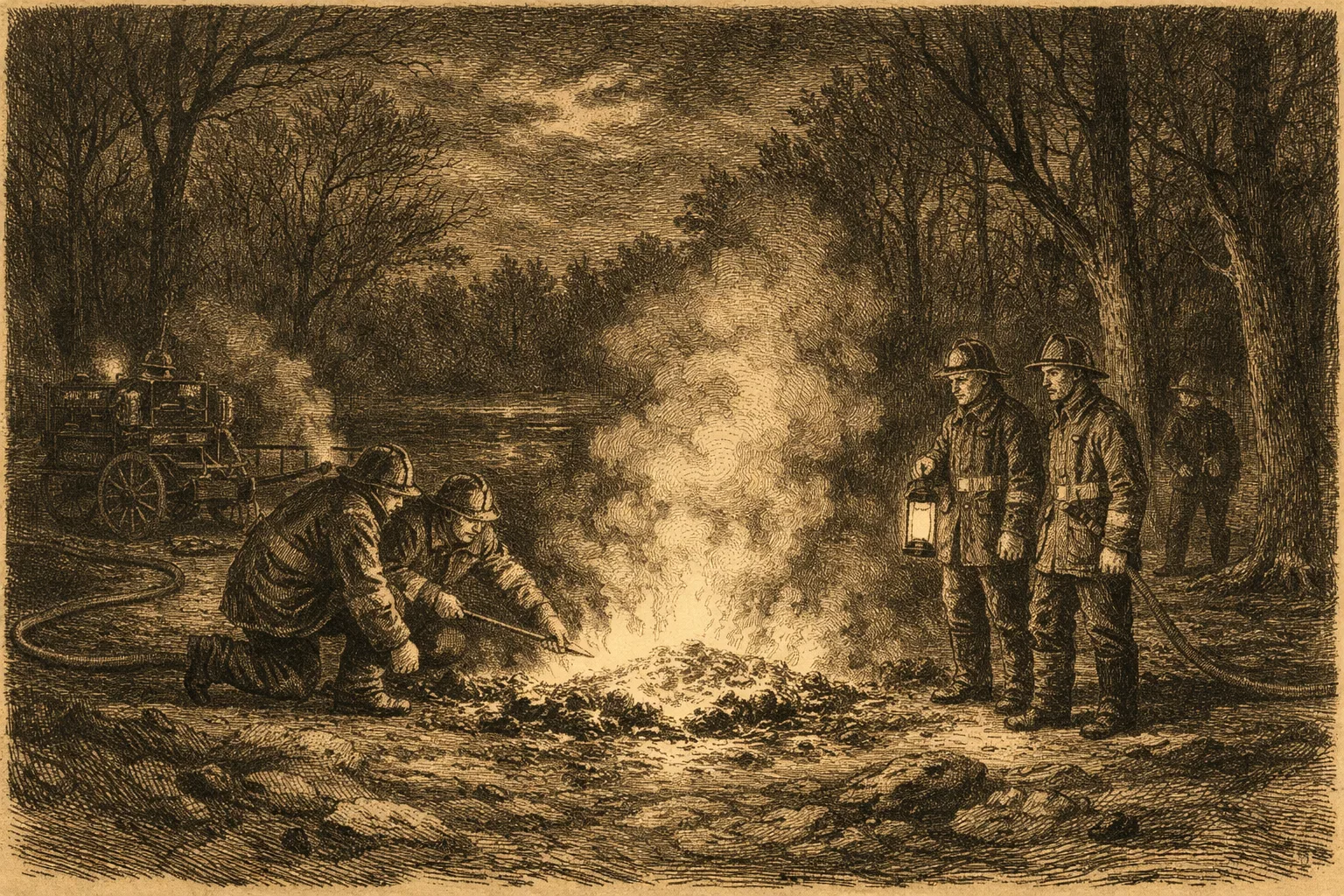
The Council Bluffs molten metal case matters because it is Iowa’s best-known UFO incident with physical material at the centre of the debate. On 17 December 1977, witnesses in Council Bluffs reported a red aerial object or falling fireball near Big Lake Park, followed by a flash, flames and a hot mass of metal on the ground. Police and fire personnel responded, and samples were later analysed. That makes the case stronger than a routine “light in the sky” report, but not strong enough to prove an exotic craft. The best-supported conclusion is narrower: something hot, metallic and unusual was found at the scene, but the material itself appears broadly consistent with terrestrial industrial metal or slag, while the route by which it arrived there remains disputed.[The Historical Society]thehistoricalsociety.orgThe Historical Society UFO Crash at Big Lake ParkThe Historical Society UFO Crash at Big Lake Park[Academia]academia.eduOpen source on academia.edu.
What witnesses and responders reported
The central event took place on a cold Saturday evening at Big Lake Park, on the north side of Council Bluffs, across the Missouri River from Omaha. Jacques Vallée’s 1998 review gives the date and time as 7:45 pm on 17 December 1977, with overcast weather, a 2,500-foot ceiling, 10-mile visibility, freezing temperature and gusty west-north-westerly winds. It places the site near Gilbert’s Pond at Big Lake Park, close to Eppley Airfield across the river.[Academia]academia.eduOpen source on academia.edu.
The first group usually named in published accounts were Kenny Drake, Carol Drake and Randy James. They reportedly saw a red object descend near the park, then a bluish-white flash and flames. When they reached the spot, they described a glowing orange mass with a bluish or crystalline-looking centre, hot enough to be dangerous and apparently cooling like lava. UFO writer Kevin Randle’s later summary, based on local and published accounts, also describes a young couple seeing a “big round thing” or hovering red object before going to the park and calling the fire department.[Kevin Randle]kevinrandle.blogspot.comSource details in endnotes.
The strongest non-UFO part of the case is the response on the ground. The Historical and Preservation Society of Pottawattamie County states that there was “no question” a fireball of molten metal was present, and says the observation was confirmed by eleven independent witnesses as well as Council Bluffs fire and police personnel. That does not mean eleven people all saw the same object fall from the sky. It means the case had multiple witnesses to the aftermath, including official responders, which is why Council Bluffs has remained unusually persistent in Iowa UFO history.[The Historical Society]thehistoricalsociety.orgThe Historical Society UFO Crash at Big Lake ParkThe Historical Society UFO Crash at Big Lake Park
Vallée’s 1998 account adds several details that make the physical scene more specific. It describes a burn area about four feet by nine feet, a secondary burn area around 27 feet away, small metal spherules scattered in the area, no crater, and some material embedded in the ground. Those details matter because they complicate both sides of the debate: a real heat event seems to have occurred, but the absence of a crater weakens any simple “object crashed intact from high altitude” interpretation.[Academia]academia.eduOpen source on academia.edu.
Why the metal made this more than a routine sighting
Most Iowa UFO reports depend almost entirely on testimony. Council Bluffs is different because the debate quickly moved from “what did people see?” to “what was the material?” That shift is important. A witness account can be vivid but difficult to test; a sample can at least be weighed, photographed, cut, scanned and chemically analysed. The case therefore became one of the relatively small number of UFO-related incidents in which material evidence, rather than only memory, became the focus.[ADS]ui.adsabs.harvard.eduADSImproved instrumental techniques, including isotopicADSImproved instrumental techniques, including isotopic
The early descriptions are often more dramatic than the later laboratory findings. The mass was said to be glowing red-orange and hot enough to ignite grass. Published estimates of the quantity vary, but modern discussions often give a range around 35 to 55 pounds. That is not a tiny trace sample, yet it is also not the wreckage of a vehicle. The scene reads more like a deposit or spill of hot metal than a conventional crash site.[Medium]medium.comAn Inquiry into the Material Evidence of Non-HumanAn Inquiry into the Material Evidence of Non-Human
Early analysis pointed away from a meteorite. Vallée’s 1998 paper lists the Council Bluffs material among cases of reported aerial phenomena with recovered residues and says laboratory work had been performed, but it also stresses a broader caution: without a firm chain of evidence and professional field investigation, most such cases cannot yield definite conclusions about the nature of the phenomenon. That caveat applies strongly here. The case has samples and named responders, but not a clean, modern forensic recovery from the first minute onward.[Academia]academia.eduOpen source on academia.edu.
The material has generally been described as iron-rich, with other elements or slag-like inclusions. In summaries of the older work, the residue is treated less like a manufactured aerospace component and more like common terrestrial material altered by extreme heat. This is the uncomfortable middle ground that defines the case: the material is real enough to investigate, but its composition does not by itself look exotic.[Academia]academia.eduOpen source on academia.edu.
What the metal evidence can and cannot show
The most important modern technical reference is the 2022 paper by Garry P. Nolan, Jacques Vallée, Sizun Jiang and Larry G. Lemke in Progress in Aerospace Sciences. The paper used modern analytical techniques, including secondary ion mass spectrometry, to examine material associated with the Council Bluffs case. Its value is that it brought better instrumentation to an old sample; its limitation is that better instrumentation cannot repair every weakness in the original recovery history.[ADS]ui.adsabs.harvard.eduADSImproved instrumental techniques, including isotopicADSImproved instrumental techniques, including isotopic
The key finding is not that the metal was alien, unknown or impossible to manufacture. A detailed sceptical review of the paper notes that the authors’ isotope results for titanium, iron and chromium were consistent with terrestrial values, and that the paper itself said there were no significant isotopic differences from normal terrestrial material in the subsamples tested. In plain English, the elements looked like they could have come from Earth.[Metabunk]metabunk.orgSource details in endnotes.
That result narrows the debate. If someone argues that the Council Bluffs material proves an extraterrestrial machine, the metal does not do that work for them. If someone argues that the event was merely invented, the police, fire and witness record makes that too dismissive. The evidence supports a real local incident involving hot metal, but not a confirmed non-human craft.
The analysis also found inhomogeneity, meaning the sample was not uniform throughout. That matters because a carefully engineered aerospace alloy would usually invite questions about consistent composition, manufacturing pattern and structural purpose. A mixed, slag-like or uneven sample is easier to reconcile with an industrial source, a heat reaction, scrap metal, furnace residue or a messy deposit than with a neatly designed component.[Metabunk]metabunk.orgSource details in endnotes.
Mundane explanations and unresolved gaps
The obvious mundane explanations have always had problems, which is why the case has not disappeared. A meteorite explanation is weak because iron meteorites normally contain much higher nickel levels than the Council Bluffs material, a point repeated in discussion of the 2022 paper and earlier analysis. Satellite debris is also unconvincing as a direct explanation: the famous Cosmos 954 nuclear-powered Soviet satellite re-entered over Canada on 24 January 1978, more than a month after Council Bluffs, and scattered radioactive debris across a huge northern area. Health Canada describes Cosmos 954 as a January 1978 crash in the Northwest Territories, not an Iowa event in December 1977.[Metabunk]metabunk.orgSource details in endnotes.
Aircraft debris is possible in a broad sense because Council Bluffs sits close to Eppley Airfield and under busy regional airspace. But a falling aircraft part would normally raise questions about matching materials, missing parts, flight paths, witness distribution and whether the object could arrive molten rather than as a solid fragment. The available public record does not provide a neat aircraft match. That leaves “aircraft debris” as a category to consider, not a settled answer.[Academia]academia.eduOpen source on academia.edu.
The hoax or thermite-style explanation is one of the more serious sceptical possibilities. Thermite reactions can produce molten iron and intense light, and a staged deposit near a park or railway area would not require a whole vehicle to fall from the sky. The Metabunk critique argues that the 2022 paper did not adequately address the possibility that the falling-object testimony itself could be part of, or confused by, a hoax scenario. It also notes that the amount of material described, although heavy, was not impossible for a person to transport.[Metabunk]metabunk.orgSource details in endnotes.
Yet the hoax explanation has its own gaps. It must explain why someone would create a dangerous molten-metal event in a public park, how the timing lined up with multiple witness reports, why no culprit or clear source emerged, and why local responders treated the event as unusual. A hoax is possible; it is not demonstrated simply by saying the material looks terrestrial.
Industrial slag is another plausible category, especially because several analyses and summaries describe the material in terms compatible with slag-like residue or common metal. But slag still needs a delivery mechanism. Slag sitting at a furnace, foundry or industrial site is ordinary. Slag glowing hot in a park after witnesses report a falling light is the unresolved part. That is the difference between identifying the substance and explaining the event.
How later reporting changed the case
Later reporting has mostly weakened the extraordinary interpretation while preserving the mystery of placement. The case is stronger than many UFO stories because there were named witnesses, official responders and analysable material. It is weaker than believers often suggest because the material has not shown clear non-terrestrial isotopic signatures, and because several ordinary mechanisms remain possible.[The Historical Society]thehistoricalsociety.orgThe Historical Society UFO Crash at Big Lake ParkThe Historical Society UFO Crash at Big Lake Park
The 2022 scientific paper gave Council Bluffs fresh visibility because it appeared in a mainstream aerospace journal and treated the sample as a legitimate object for materials analysis. That is important for UFO studies generally: it shows that unusual claims can be examined with ordinary laboratory tools. But the same paper’s findings do not lift Council Bluffs into proof of alien technology. If anything, the technical work makes the case more sober: the material appears terrestrial, while the circumstances remain unclear.[ADS]ui.adsabs.harvard.eduADSImproved instrumental techniques, including isotopicADSImproved instrumental techniques, including isotopic
The sceptical response has also become more detailed. Rather than simply mocking the case, critics have looked at sample composition, witness count, location, possible thermite, possible industrial sources, mapping issues and the difference between seeing a light and proving that metal fell from it. That is useful because it moves the argument away from belief versus disbelief and towards testable questions.[Metabunk]metabunk.orgSource details in endnotes.
For Iowa’s UFO history, Council Bluffs is therefore best understood as a physical-trace debate, not a solved crash story. It sits between weak anecdote and conclusive evidence. Something hot and metallic was present; witnesses and responders made the case memorable; laboratories found ordinary elements rather than an obvious exotic alloy; and no mundane explanation has closed every gap in a way that satisfies both the local testimony and the material evidence.

Why Council Bluffs still matters in Iowa UFO history
Council Bluffs remains Iowa’s landmark UFO-related incident because it forces a better standard of argument. A reader does not have to choose between “nothing happened” and “a spacecraft crashed”. The better reading is more careful: the incident involved a real local emergency, credible enough to draw police and fire attention, but the recovered metal points towards terrestrial material rather than extraordinary manufacture.[The Historical Society]thehistoricalsociety.orgThe Historical Society UFO Crash at Big Lake ParkThe Historical Society UFO Crash at Big Lake Park Academia That makes the case valuable for the wider Iowa project. It shows how a state-level UFO case can be interesting without being conclusive. It[academia.edu]academia.eduOpen source on academia.edu. also shows why physical evidence is not automatically decisive. A sample can prove that a substance existed, show what it was made from, and rule out some claims, while still leaving the event sequence uncertain.
The most honest classification is unresolved but constrained. Council Bluffs is not merely folklore, because the hot metal and official response are well attested in the public record. It is not proof of an exotic craft, because the material evidence does not require one. Its lasting importance lies in that tension: the Council Bluffs case is one of the rare Iowa UFO stories where the debate can be anchored to something that was reportedly still hot on the ground, yet the hardest question remains not what the metal was, but how and why it got there.
Amazon book picks
Further Reading
Books and field guides related to Did Something Fall at Council Bluffs?. Use these as the next step if you want deeper reading beyond the article.
Forbidden Science
Connects directly to physical-evidence UFO cases and investigative history.
eBay marketplace picks
Marketplace Samples
Example marketplace items related to this page. Use the search link to explore similar finds on eBay.







Endnotes
1.
Source: academia.edu
Link:https://www.academia.edu/8412505/Physical_Analyses_in_Ten_Cases_of_Unexplained_Aerial_Objects_with_Material_Samples
2.
Source: metabunk.org
Link:https://www.metabunk.org/threads/is-improved-instrumental-techniques-nolan-vallee-jiang-lemke-2022-a-useful-paper.13286/
3.
Source: ui.adsabs.harvard.edu
Title: ADSImproved instrumental techniques, including isotopic
Link:https://ui.adsabs.harvard.edu/abs/2022PrAeS.12800788N/abstract
4.
Source: medium.com
Title: An Inquiry into the Material Evidence of Non-Human
Link:https://medium.com/quantum-psychology-and-engineering/an-inquiry-into-the-material-evidence-of-non-human-intelligence-04dc38a85103
5.
Source: canada.ca
Title: cosmos 954
Link:https://www.canada.ca/en/health-canada/services/health-risks-safety/radiation/radiological-nuclear-emergencies/previous-incidents-accidents/cosmos-954.html
6.
Source: academia.edu
Link:https://www.academia.edu/37136826/What_do_we_Know_about_the_Material_Composition_of_UFOs
7.
Source: thehistoricalsociety.org
Title: The Historical Society UFO Crash at Big Lake Park
Link:https://www.thehistoricalsociety.org/h/ufo.html
8.
Source: kevinrandle.blogspot.com
Link:https://kevinrandle.blogspot.com/2024/08/given-what-we-have-learned-from.html
9.
Source: kevinrandle.blogspot.com
Title: jacques vallee and ten unexplained ufo
Link:https://kevinrandle.blogspot.com/2021/12/jacques-vallee-and-ten-unexplained-ufo.html
Additional References
10.
Source: youtube.com
Title: Professor Garry Nolan & Ross Coulthart: Full interview | UFO UAP News
Link:https://www.youtube.com/watch?v=XR0JtbuLhPo
Source snippet
Garry Nolan "Testing Materials Recovered From UFO Crashes"...
11.
Source: researchgate.net
Link:https://www.researchgate.net/publication/395858774_Toward_a_Reliability_Scale_for_Assessing_Reports_of_Unidentified_Anomalous_Phenomena_UAP
12.
Source: barnet.gov.uk
Link:https://www.barnet.gov.uk/
13.
Source: scribd.com
Link:https://www.scribd.com/presentation/507021259/What-Do-We-Know-About-the-Material-Compo-1
14.
Source: ealing.gov.uk
Link:https://www.ealing.gov.uk/
15.
Source: stanfordmag.org
Link:https://stanfordmag.org/contents/first-contact
16.
Source: reddit.com
Link:https://www.reddit.com/r/UFOs/comments/s27hzr/i_managed_to_get_a_hold_of_the_paper_by_nolan/
17.
Source: facebook.com
Link:https://www.facebook.com/OfficialUnsolvedMysteries/posts/its-only-fitting-for-unsolved-mysteries-to-cover-the-most-famous-ufo-case-of-all/850396467269029/
18.
Source: lambeth.gov.uk
Link:https://www.lambeth.gov.uk/
19.
Source: londoncouncils.gov.uk
Link:https://www.londoncouncils.gov.uk/node/171
Topic Tree