Within Colorado UFOs
Did Colorado End Project Blue Book?
Colorado's most important UFO story is a disputed scientific review that helped close the Air Force's public investigation programme.
On this page
- Why the Air Force chose Colorado
- What the report concluded
- Why critics still dispute it
Page outline Jump by section
Introduction
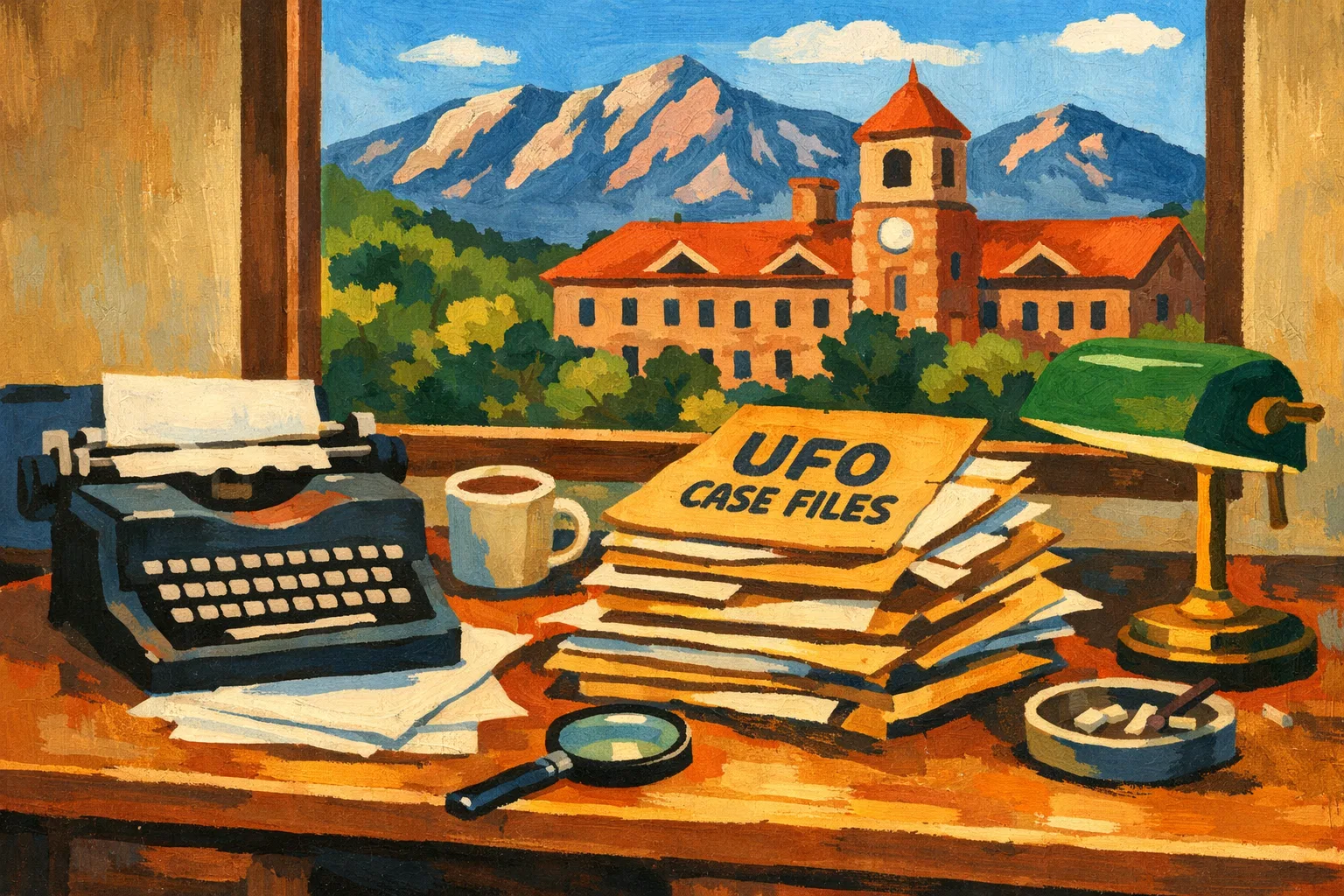
Colorado did not single-handedly “solve” UFOs, but a University of Colorado study did help end the US Air Force’s public UFO investigation programme. The Condon Report, formally Scientific Study of Unidentified Flying Objects, was produced at Boulder under physicist Edward U. Condon after the Air Force sought an outside scientific judgement on whether UFO reports deserved continued official study. Its central conclusion was that more extensive UFO research was unlikely to advance science, and the Air Force used that judgement, together with a National Academy of Sciences review and earlier Air Force experience, when it terminated Project Blue Book on 17 December 1969.[NCAS Files]files.ncas.orgSource details in endnotes.
The importance of the Colorado episode lies less in one spectacular sighting than in governance: who gets to decide when an unexplained report is worth public money, military attention, or scientific effort. For sceptics, the report brought discipline to a confused subject. For critics, it closed the door too firmly, especially because some cases remained unresolved and because the project’s neutrality was disputed from the start.
Why the Air Force chose Colorado
By the mid-1960s, Project Blue Book had become a public burden as well as an investigative programme. It was supposed to determine whether UFO reports posed a national-security threat and to analyse the data scientifically, but the Air Force’s own files had accumulated thousands of reports, civilian UFO groups were pressing for stronger investigation, and public confidence in official answers was uneven. The Condon Report itself says the Colorado project grew out of a 1966 Air Force Scientific Advisory Board review chaired by Brian O’Brien, which concluded that Blue Book was organised but thinly staffed and that a more detailed study might show whether any scientific value could come from new reports.[NCAS Files]files.ncas.orgSource details in endnotes.
Colorado mattered because the Air Force wanted an external academic authority rather than another purely military review. The University of Colorado contract was publicly announced in October 1966, and the first research contract with the Air Force Office of Scientific Research provided $313,000 for the first 15 months, beginning in November 1966.[NCAS Files]files.ncas.orgSource details in endnotes. That arrangement gave the study a double role: it was framed as independent science, but it was also commissioned to answer a practical government question about whether Project Blue Book still deserved resources.
This is why the Condon Report belongs at the centre of Colorado’s UFO history. Colorado was not merely the setting for a local sighting flap; it became the place where a federal programme sought academic closure. The project drew on Air Force records, civilian UFO material, field investigations, photographic analysis, radar questions, astronaut reports, psychology, public attitudes, and atmospheric science. The report’s own summary lists topics ranging from field investigations and UFO photographs to radar sightings, visual perception, public attitudes, and instrumentation for UFO searches.[NCAS Files]files.ncas.orgSource details in endnotes.
The study also defined “UFO” carefully, and less sensationally than popular culture often did. It treated a UFO as the stimulus for a report made by someone who could not identify what they had seen, not as proof that an exotic craft existed. That distinction is crucial: under the Colorado project’s usage, UFO reports certainly existed, but the key question was what kinds of natural, human-made, perceptual, or other stimuli produced them.[NCAS Files]files.ncas.orgSource details in endnotes.
What the report concluded
The headline conclusion was stark. Condon wrote that studying UFOs over the previous 21 years had added nothing of substance to scientific knowledge, and that further extensive study probably could not be justified on the expectation that science would advance.[NCAS Files]files.ncas.orgSource details in endnotes. This did not mean every case had been explained. It meant the project did not see the unexplained residue as strong enough to justify a continuing large-scale government research programme.
The report’s reasoning rested on several practical observations. UFO reports were often brief, late, incomplete, or dependent on witness memory after the event. The Colorado team had hoped that rapid field response might allow photographs, spectrograms, radiation measurements, magnetic readings, or sound measurements while a UFO was still present, but the report says this expectation proved unrealistic because most sightings were short-lived and investigators usually arrived after the object or light had vanished.[NCAS Files]files.ncas.orgSource details in endnotes.
The report also treated ordinary misidentification as a major driver. It noted that a commonplace object such as Venus could become a UFO if the observer did not recognise it, and that identifications could remain tentative or controversial when the available data were poor.[NCAS Files]files.ncas.orgSource details in endnotes. For a public reader, this is one of the report’s most useful contributions: it separates “unidentified to the witness” from “unexplainable in principle”.
At the same time, the report was not simply a short dismissal. It was a large technical archive, including discussion of witness reliability, field methods, optics, radar, photographs, claimed physical traces, and the problems of collecting scientific data from rare and fleeting events. CU Boulder’s own retrospective describes the Condon Report as one of the few official UFO studies and notes its scale: 14,885 pages and 59 sighting case studies from 1947 to 1968.[University of Colorado Boulder]colorado.eduSource details in endnotes.
The National Academy of Sciences then reviewed the Colorado report. Its panel agreed that no high priority in UFO investigations was warranted by the data of the previous two decades, while also acknowledging that not all reported sightings were easy to explain. The panel’s conclusion was not that every witness was wrong, but that the evidence did not justify treating extraterrestrial visitation as the likely explanation or maintaining Blue Book as a special unit.[NICAP]nicap.orgNAS Review of Condon Report 1969NAS Review of Condon Report 1969
How Colorado helped close Project Blue Book
The Air Force announced the termination of Project Blue Book on 17 December 1969. Its official fact sheet states that the programme had investigated UFOs from 1947 to 1969, was headquartered at Wright-Patterson Air Force Base in Ohio, and ended with 12,618 reported sightings, of which 701 remained “unidentified”.[Air Force]af.milUnidentified Flying Objects and Air Force Project Blue Book > Air Force > Fact Sheet Display… The National Archives repeats the same figures and notes that the declassified Blue Book records are available for research, with case files, administrative files, OSI-related records, microfilm, photographs, film, and sound material held through archival channels.[National Archives]archives.govNational Archives Project BLUE BOOKNational Archives Project BLUE BOOK
The termination decision did not rest on the Condon Report alone, but Colorado was central. The Air Force said the decision was based on the University of Colorado report, the National Academy of Sciences review of that report, past UFO studies, and Air Force investigative experience from the 1940s through the 1960s.[Air Force]af.milUnidentified Flying Objects and Air Force Project Blue Book > Air Force > Fact Sheet Display… A contemporary Defence Department news release put the point even more directly: the continuation of Project Blue Book could not be justified on national-security or scientific grounds, and the Colorado report was listed first among the reasons for discontinuing the programme.[Defense Logistics Agency]esd.whs.milDefense Logistics Agency
The Air Force’s closing position had three main parts. It said no UFO investigated by the Air Force had shown itself to be a threat to national security; no evidence showed that “unidentified” sightings represented technology or scientific principles beyond modern knowledge; and no evidence indicated that unidentified sightings were extraterrestrial vehicles.[Air Force]af.milUnidentified Flying Objects and Air Force Project Blue Book > Air Force > Fact Sheet Display… This was a policy judgement as much as a scientific one: even with 701 unexplained cases, the Air Force decided the remaining uncertainty did not warrant a standing public UFO office.
That distinction matters for interpreting Colorado’s role. The Condon Report did not erase UFO reports from American culture, and it did not prevent later official interest in unusual aerial reports. It ended a particular model of public Air Force investigation: a named, centralised programme receiving and evaluating civilian UFO reports under the Blue Book label. After Blue Book closed, the Air Force regulation establishing the programme was rescinded, and documentation was transferred for archival access.[Air Force]af.milUnidentified Flying Objects and Air Force Project Blue Book > Air Force > Fact Sheet Display…

Why critics still dispute it
The most damaging criticism of the Colorado project concerned the Robert Low memorandum, written before the contract was accepted. Low, a University of Colorado administrator involved in setting up the study, suggested that the project could be described to the public as objective while presenting to the scientific community the image of non-believers trying to be objective, with “almost zero expectation” of finding a saucer.[NICAP]nicap.orgRobert Low "trick" memoRobert Low "trick" memo For critics, that memo made the project look pre-judged before the fieldwork had properly begun.
The memo did not prove that every case analysis was wrong, but it did create a lasting trust problem. If a study is asked to settle a disputed public issue, its legitimacy depends not only on its data but on whether participants believe the process was open-minded. In UFO history, the Low memo became shorthand for the suspicion that the Colorado study was designed to make continued investigation look unnecessary while preserving the appearance of neutrality.
Civilian UFO researchers and some scientists also argued that Condon’s broad conclusion sat uneasily beside unresolved material inside the report. The National Academy’s review itself accepted that not all UFO sightings were easily explained, although it still agreed with the recommendation against giving UFO investigations high priority.[NICAP]nicap.orgNAS Review of Condon Report 1969NAS Review of Condon Report 1969 That tension remains central to the debate: does a residue of unexplained reports justify more study, or does weak and incomplete evidence make further study unlikely to produce anything useful?
A fair reading keeps both points in view. The sceptical case is strong where reports are late, brief, single-witness, poorly documented, or compatible with aircraft, planets, balloons, atmospheric effects, birds, satellites, hoaxes, or perception errors. The critical case is strongest where official closure sounds broader than the data can support. “No sufficient evidence for extraterrestrial craft” is a narrower claim than “nothing interesting ever happened”, and the best version of the Colorado controversy depends on not confusing those two statements.
The report’s own methods also left room for debate. It concluded that old cases were often of limited value because the evidence had gone stale, but that decision inevitably reduced the chance of revisiting famous earlier cases with fresh seriousness. It hoped for rapid-response data collection but found this impractical. It studied photographs and radar questions, yet many UFO advocates wanted more weight given to unusual radar-visual reports or trained witnesses. These disagreements were not just about belief in aliens; they were about what standard of evidence should govern rare, transient events.
What changed after Blue Book ended
The immediate institutional change was clear: the Air Force stopped operating Blue Book as its public UFO clearing house. People who wanted to report sightings were directed away from a dedicated Air Force programme, and the archived Blue Book material became historical evidence rather than the working files of an active investigation. The National Archives now presents Blue Book primarily as a declassified record series, not as a live reporting channel.[National Archives]archives.govNational Archives Project BLUE BOOKNational Archives Project BLUE BOOK
The longer-term change was more complicated. The Condon Report helped make UFO research look scientifically unrewarding for a generation, especially in universities. Yet later debates over UAP, the more recent official term for unidentified anomalous phenomena, show that the underlying governance problem never disappeared: how should public agencies collect reliable data on unusual aerial reports without exaggerating weak evidence or stigmatising witnesses? NASA’s 2023 UAP work, for example, framed the modern problem around better data collection, reduced stigma, and scientific analysis rather than around confirming extraordinary explanations.[NASA Science]science.nasa.govSource details in endnotes.
That later shift does not overturn the Condon Report, but it does change how readers may understand it. The Colorado study was right to stress that anecdotes, delayed reports, and poor measurements are a weak foundation for extraordinary claims. Modern UAP discussions often make the same point in updated language. The difference is that recent official and scientific efforts tend to ask how better sensors, standardised reporting, and open data might improve future assessment, rather than simply whether a permanent Blue Book-style office should continue.
For Colorado’s UFO history, the legacy is therefore double-edged. The state is associated with the report that gave the Air Force a credible route out of public UFO investigation, but also with one of the most persistent disputes in the history of official UFO science. The Condon Report remains useful because it shows how difficult it is to turn sightings into evidence. It remains disputed because many readers think its policy conclusion outran the unresolved cases and the damaged trust surrounding the project.
The balanced takeaway
Colorado did help end Project Blue Book, but not by disproving every UFO report. It did so by hosting a federally funded academic review that judged the accumulated evidence too weak, too poorly collected, and too scientifically unproductive to justify a continued Air Force UFO programme. The Air Force then adopted that judgement, reinforced by the National Academy of Sciences review, and closed Blue Book in December 1969.[Air Force]af.milUnidentified Flying Objects and Air Force Project Blue Book > Air Force > Fact Sheet Display…
The strongest evidence for the official decision is documentary: the Condon Report’s recommendation, the National Academy’s concurrence, the Air Force termination announcement, and the archived Blue Book figures. The strongest doubts concern process and interpretation: the Low memo, the handling of unresolved cases, the gap between “not proven extraordinary” and “not worth further study”, and the continuing problem of how to investigate rare aerial events with poor data.
That is why the Colorado story still matters. It is not mainly a tale of a saucer sighting or a secret hangar. It is a case study in how institutions decide when uncertainty is no longer enough to keep an investigation alive.
Amazon book picks
Further Reading
Books and field guides related to Did Colorado End Project Blue Book?. Use these as the next step if you want deeper reading beyond the article.
The Report on Unidentified Flying Objects
Provides essential context for Project Blue Book and its legacy.
eBay marketplace picks
Marketplace Samples
Example marketplace items related to this page. Use the search link to explore similar finds on eBay.


Endnotes
1.
Source: files.ncas.org
Link:https://files.ncas.org/condon/text/sec-i.htm
2.
Source: af.mil
Title: Air Force
Link:https://www.af.mil/About-Us/Fact-Sheets/Display/Article/104590/unidentified-flying-objects-and-air-force-project-blue-book/
Source snippet
Unidentified Flying Objects and Air Force Project Blue Book > Air Force > Fact Sheet Display...
3.
Source: files.ncas.org
Title: Files Condon Report, Section II
Link:https://files.ncas.org/condon/text/sec-ii.htm
4.
Source: colorado.edu
Link:https://www.colorado.edu/coloradan/2021/11/05/condon-report-cu-boulders-historic-ufo-study
5.
Source: nicap.org
Title: NAS Review of Condon Report 1969
Link:https://www.nicap.org/docs/NAS%20Review%20of%20Condon%20Report%201969.pdf
6.
Source: archives.gov
Title: National Archives Project BLUE BOOK
Link:https://www.archives.gov/research/military/air-force/ufos
7.
Source: esd.whs.mil
Title: Defense Logistics Agency
Link:https://www.esd.whs.mil/Portals/54/Documents/FOID/Reading%20Room/UFOsandUAPs/asdpa1.pdf?ver=2017-05-22-113454-807
8.
Source: nicap.org
Title: Robert Low “trick” memo
Link:https://www.nicap.org/docs/660809lowmemo.htm
9.
Source: science.nasa.gov
Link:https://science.nasa.gov/uap/
10.
Source: archives.gov
Link:https://www.archives.gov/research/catalog/catalog-bulk-downloads/uap-bulk-download
11.
Source: prologue.blogs.archives.gov
Title: saucers over washington the history of project blue book
Link:https://prologue.blogs.archives.gov/2019/12/19/saucers-over-washington-the-history-of-project-blue-book/
12.
Source: archives.gov
Title: project blue book 50th anniversary
Link:https://www.archives.gov/news/articles/project-blue-book-50th-anniversary
13.
Source: archives.gov
Title: Project BLUE BOOK
Link:https://www.archives.gov/foia/ufos.html
14.
Source: science.nasa.gov
Title: uap independent study team final report
Link:https://science.nasa.gov/wp-content/uploads/2023/09/uap-independent-study-team-final-report.pdf
15.
Source: media.defense.gov
Title: DOPSR 2024 0263 AARO HISTORICAL RECORD REPORT VOLUME 1 2024
Link:https://media.defense.gov/2024/Mar/08/2003409233/-1/-1/0/DOPSR-2024-0263-AARO-HISTORICAL-RECORD-REPORT-VOLUME-1-2024.PDF
16.
Source: archive.org
Link:https://archive.org/stream/pdfy-4vyHjooOJagoGAwN/Scientific%2BStudy%2BOf%2BUnidentified%2BFlying%2BObjects_djvu.txt
17.
Source: archive.org
Link:https://archive.org/download/aliensinskies00unit/aliensinskies00unit.pdf
18.
Source: files.ncas.org
Link:https://files.ncas.org/condon/text/appndx-a.htm
19.
Source: files.ncas.org
Link:https://files.ncas.org/condon/
20.
Source: history.com
Title: Project Blue Book
Link:https://www.history.com/articles/project-blue-book
21.
Source: colorado.edu
Title: cu site one last government commissioned reports ufos what does it say
Link:https://www.colorado.edu/today/2021/06/09/cu-site-one-last-government-commissioned-reports-ufos-what-does-it-say
22.
Source: youtube.com
Title: The Condon Report | NASA’s Unexplained Files
Link:https://www.youtube.com/watch?v=_W7SqS6UhE4
Source snippet
The UFO Question: How One Mystery Went From Fringe Story to Global Issue...
23.
Source: Wikipedia
Title: Project Blue Book
Link:https://en.wikipedia.org/wiki/Project_Blue_Book
24.
Source: britannica.com
Title: Project Blue Book
Link:https://www.britannica.com/topic/Project-Blue-Book
25.
Source: britannica.com
Title: Condon Report
Link:https://www.britannica.com/topic/Condon-Report
26.
Source: facebook.com
Link:https://www.facebook.com/groups/485702340808422/posts/1003041539074497/
27.
Source: pubs.aip.org
Title: Scientific Study of Unidentified Flying Objects
Link:https://pubs.aip.org/aapt/ajp/article/37/10/1071/1048124/Scientific-Study-of-Unidentified-Flying-Objects
28.
Source: globalsecurity.orgglobalsecurity.org
Link:https://www.globalsecurity.orgwww.globalsecurity.org/intell/ops/condon.htm
29.
Source: origins.osu.edu
Title: air force investigation ufos
Link:https://origins.osu.edu/read/air-force-investigation-ufos
30.
Source: slideshare.net
Link:https://www.slideshare.net/slideshow/project-blue-book-140388203/140388203
31.
Source: encyclopedia.com
Title: condon report
Link:https://www.encyclopedia.com/science/encyclopedias-almanacs-transcripts-and-maps/condon-report
Additional References
32.
Source: youtube.com
Link:https://www.youtube.com/watch?v=D3qWyN8rxzw
Source snippet
Project Blue Book Sneak Peek: The True Story Behind the Government's UFO Investigation - IGN First...
33.
Source: youtube.com
Title: The UFO Question: How One Mystery Went From Fringe Story to Global Issue
Link:https://www.youtube.com/watch?v=ZsP8-2qpAOQ
Source snippet
Project Blue Book: America's Obsession with UFOs...
34.
Source: cia.gov
Link:https://www.cia.gov/readingroom/docs/CIA-RDP81R00560R000100010008-3.pdf
35.
Source: youtube.com
Title: Project Blue Book: America’s Obsession with UFOs
Link:https://www.youtube.com/watch?v=Xu4oTBBI5UE
Source snippet
1966 UFO Sightings in Dexter, Michigan - A Mini-Documentary...
36.
Source: archivesfoundation.org
Link:https://archivesfoundation.org/documents/50-years-ago-government-stops-investigating-ufos/
37.
Source: amazon.com
Link:https://www.amazon.com/Report-Historical-Record-Government-Involvement/dp/B0F218QF2L
38.
Source: apnews.com
Link:https://apnews.com/article/8b477a5ed6a42f99bb13a4518368ce9a
39.
Source: facebook.com
Link:https://www.facebook.com/usnationalarchives/posts/after-investigating-a-possible-ufo-sighting-theunited-states-air-force-would-pla/10156582716052994/
40.
Source: enigmalabs.io
Link:https://enigmalabs.io/library/a255a907-d10f-49f2-89e0-13e57b0e006a
41.
Source: aaro.mil
Link:https://www.aaro.mil/Congressional-Press-Products/
Topic Tree