Within Oklahoma UFOs
Oklahoma's First Flying Disc Mystery
Byron Savage's early Oklahoma City report places the state inside the opening months of modern American flying saucer culture.
On this page
- Byron Savage and the Oklahoma City report
- Why 1947 changed UFO reporting
- How strong the early evidence really is
Page outline Jump by section
Introduction
Byron B. Savage’s 1947 Oklahoma City “flying disc” report matters because it places Oklahoma inside the opening weeks of the modern American UFO story, not as a later imitator but as one of the earliest places where the new language of “flying saucers” attached itself to a local witness account. Savage, a private pilot and field engineer for the Radio Corporation of America, said he saw a round, flat, high-speed object pass over Oklahoma City in May 1947, several weeks before Kenneth Arnold’s famous June 24 sighting near Mount Rainier made “flying saucers” a national phrase. Later Air Force-era summaries treated Savage’s case as an early official-file report, but not as a solved case. The best reading is cautious: the report is historically important, locally distinctive and stronger than many casual saucer stories of the period, yet still rests on a single-witness observation without physical evidence, photographs, radar data or independent confirmation.[dokumen.pub]dokumen.pubreport on the ufo wave of 1947DOKUMEN.PUB[National Air and Space Museum]airandspace.si.edu1947 year flying saucerNational Air and Space Museum1947: Year of the Flying Saucer | National Air and Space Museum…
Byron Savage and the Oklahoma City report
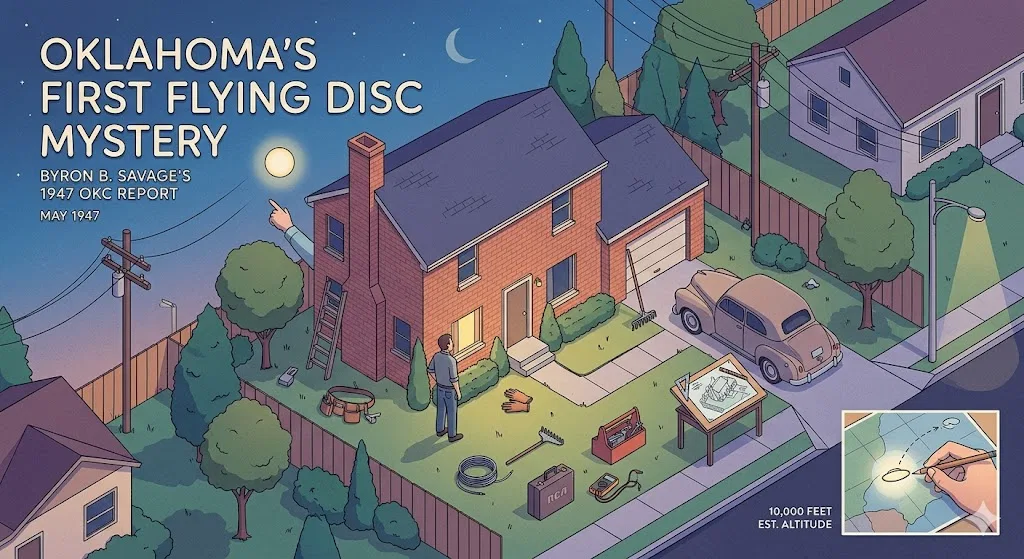
Savage’s sighting is usually dated to 17 or 18 May 1947, when he was in the yard of his home at 416 N.W. 29th Street in Oklahoma City. In the later FBI-linked file description, he is identified as Byron B. Savage, aged 38, a field engineer for RCA, and the interview is recorded as taking place at his residence on 23 July 1947. That detail matters because it anchors the story in a traceable official interview rather than only in later UFO retellings.[beannames.com]beannames.comMemo re: Byron BSavage Flying Disc Sighting… - FBI UFO Files(Residence: 416 N. W. 29th Street, Oklahoma City, Oklahoma.) RE: Flying Disc. On 23 July 1…
The basic claim was vivid but brief. Savage said that at dusk, while the sky was still light, he saw an object come across Oklahoma City from a little east of south. He estimated it was very high, somewhere around 10,000 feet, though he admitted uncertainty. He said it made no engine noise, left no trail and was gone within roughly 15 to 20 seconds. In one account it was described as shiny and silvery, “perfectly round and flat”; in the Blue Book-linked summary it appeared ellipsoidal as it approached and circular as it passed overhead. He also described it as frosty white and moving perhaps three times faster than a jet.[dokumen.pub]dokumen.pubreport on the ufo wave of 1947DOKUMEN.PUB
Those details are exactly why the case became memorable. Savage was not simply reporting “a light” or an indistinct flash. He was using aircraft language: altitude, speed, direction, engine noise and shape. As a private pilot and technical worker, he looked like the sort of witness early investigators and newspapers were inclined to take more seriously than a casual passer-by. American Heritage’s recent account of the early saucer story notes that, after Arnold’s report spread, Savage was one of the first additional witnesses to receive attention, and that he was quoted as supporting Arnold’s credibility.[American Heritage]americanheritage.comwas first reported ufowas first reported ufo
But the report also has a built-in weakness. It appears to have become public only after Arnold’s account had already made national headlines. That does not prove Savage invented or reshaped his memory, but it does mean the report entered the record inside a fast-forming media category. Once “flying saucers” existed as a public label, witnesses could compare earlier odd observations with the new story and decide that they had seen something similar. That is one reason Savage’s case is best treated as an important early report, not as secure evidence that an extraordinary craft crossed Oklahoma City.

Why 1947 changed UFO reporting
The Oklahoma City report cannot be understood without the sudden change in American sky-watching culture in late June 1947. Kenneth Arnold, an experienced private pilot, reported seeing nine bright objects near Mount Rainier on 24 June. Smithsonian’s National Air and Space Museum explains that Arnold’s story, as carried by reporters and wire services, helped introduce “flying saucer” into ordinary public language, even though Arnold later objected that the label did not exactly match what he had meant.[National Air and Space Museum]airandspace.si.edu1947 year flying saucerNational Air and Space Museum1947: Year of the Flying Saucer | National Air and Space Museum…
That language shift is central to Savage’s place in Oklahoma UFO history. Before Arnold, a person who saw an odd high-speed object might have told a spouse, dismissed it, or hesitated to report it. After Arnold, there was suddenly a ready-made frame: flying discs, saucers, secret aircraft, strange aerial objects. Ted Bloecher’s 1967 report on the 1947 UFO wave stresses this point: Arnold’s sighting was not necessarily the first observation of the period, but it drew earlier witnesses into the open. Savage is one of Bloecher’s clearest examples of that pattern, because his alleged sighting pre-dated Arnold but became news only after Arnold’s account made such reports discussable.[dokumen.pub]dokumen.pubreport on the ufo wave of 1947DOKUMEN.PUB
The broader wave was short, intense and confusing. Bloecher described June and July 1947 as a national “wave” or “flap”, meaning a sudden increase in reports accompanied by intense news coverage and public uncertainty. He found that newspapers across the country carried large numbers of local accounts, many of which were never preserved in official files. He also argued that the apparent start date of 24 June was partly misleading, because earlier observations were often reported only after people realised that others had seen something strange too.[dokumen.pub]dokumen.pubreport on the ufo wave of 1947DOKUMEN.PUB
For Oklahoma, this matters in two ways. First, Savage’s report makes Oklahoma part of the first national flying-disc moment, rather than merely a state with later 1950s and 1960s UFO claims. Second, the case shows how UFO history often begins as a collision between private memory, public language and official concern. A sighting that might have remained a family anecdote became part of a national intelligence and press environment because the country had just learned to call such things “saucers”.
How the case entered official and UFO records
Savage’s report sits in an awkward place between newspaper culture, early military interest and later UFO cataloguing. The case is not famous because investigators solved it. It is famous because it appears in early official-file contexts and in later chronologies of the 1947 wave. A file-index summary describes a 24 July 1947 memo by Kalman D. Simon of U.S. Army intelligence concerning an interview with Savage conducted the day before at his Oklahoma City home.[beannames.com]beannames.comOpen source on beannames.com.
This places the case before Project Blue Book itself, which began in 1952. The U.S. Air Force says it investigated UFOs under Project Blue Book from 1947 to 1969, with 12,618 sightings ultimately reported to the programme and 701 remaining “unidentified”; the National Archives gives a more precise institutional sequence, explaining that Project Sign began in December 1947, Project Grudge followed in 1949, and Project Blue Book ran from March 1952 to December 1969.[Air Force]af.milUnidentified Flying Objects and Air Force Project Blue Book > Air Force > Fact Sheet Display…
That sequence is useful because it prevents a common misunderstanding. Savage did not report into a mature UFO bureaucracy. He reported during the messy pre-Blue Book period, when the Army Air Forces, soon to become the independent U.S. Air Force, were still trying to decide whether “flying discs” were enemy aircraft, experimental technology, misidentified natural phenomena, hoaxes, or simply a press-driven craze. The National Archives notes that the flood of reports after Arnold’s sighting led the Air Force Chief of Staff to order the creation of Project Sign to collect, evaluate and distribute UFO information of possible national-security concern.[National Archives]archives.govSource details in endnotes.
Later UFO researchers gave the Savage case a prominent early slot. Bloecher listed it among the early official-file cases and judged that, although its details were more complete than many “explained” Blue Book cases, it still fell into the category of insufficient information. That is an important distinction. “Insufficient information” is not the same as “confirmed unknown craft”. It means the record did not contain enough reliable data to identify the object confidently.[dokumen.pub]dokumen.pubreport on the ufo wave of 1947DOKUMEN.PUB
What makes the evidence interesting
The most interesting part of the Savage report is not any single spectacular claim. It is the combination of timing, witness profile and technical description. Savage was not a celebrity witness, not a later contactee, and not someone reporting an elaborate encounter. His account was short, observational and aviation-minded. That gives the case a different texture from later UFO stories built around occupants, messages or conspiracy claims.
Several features make the report worth preserving in Oklahoma’s UFO history:
The sighting was early. If the May dating is accepted, Savage’s observation came before the Arnold report that popularised the saucer label. That makes it one of the cases later researchers used to argue that the 1947 wave was not simply a chain of post-Arnold copycat sightings.[dokumen.pub]dokumen.pubreport on the ufo wave of 1947DOKUMEN.PUB
The witness had aviation and technical credibility. Savage’s private pilot status and RCA engineering work do not make him infallible, but they do make it less easy to dismiss his account as that of a person wholly unfamiliar with aircraft, apparent speed or engine sound. The file-index summaries identify him as an RCA field engineer, while later accounts note his private-pilot background.[beannames.com]beannames.comOpen source on beannames.com.
The description resembled the emerging saucer pattern. A round or ellipsoidal object, silent motion, high speed, no visible propulsion and a metallic or frosty-white appearance all fit the language that became common in 1947 disc reports. That resemblance is historically significant, though it cuts both ways: it can be read as pattern evidence, or as evidence that reports were being filtered through a new shared vocabulary.[dokumen.pub]dokumen.pubreport on the ufo wave of 1947DOKUMEN.PUB
The case was not simply ignored. The interview record shows that officials took at least some interest in the account. This is a modest point, but important. It does not mean the government validated the sighting; it means the report was considered worth collecting during a moment of uncertainty about whether flying-disc stories might have national-security implications.[beannames.com]beannames.comOpen source on beannames.com.
Where the doubts begin
The same facts that make the Savage case interesting also expose its limits. The report depends on one observer’s estimate of a fast, distant object seen for seconds. Even trained observers can misjudge altitude, size and speed when there is no known reference point. If an object’s true size and distance are unknown, apparent speed becomes especially uncertain: something small and close can seem astonishingly fast, while something large and distant can seem slower or higher than it really is.
The timing problem also matters. Savage reportedly told his wife at the time, but the story entered wider public discussion only after Arnold’s report had changed the cultural setting. That creates the possibility of retrospective framing. A witness may honestly remember an unusual sighting and later describe it using language that did not exist, or was not yet salient, when the event occurred.
There is also no known physical or instrument record tied to the sighting. No photograph, debris, radar return, simultaneous pilot report or independent ground witness has emerged as the anchor for the case. Bloecher’s conclusion that the report had “insufficient information” remains a fair summary of its evidential status: the story is too specific to ignore as local UFO history, but too thin to resolve as an aircraft, astronomical object, balloon, meteor, atmospheric effect or genuinely unexplained aerial vehicle.[dokumen.pub]dokumen.pubreport on the ufo wave of 1947DOKUMEN.PUB
The broader 1947 environment was also full of noise. Newspapers reported sincere observations alongside jokes, hoaxes, mistaken identifications and speculative explanations. American Heritage’s survey of the early saucer craze gives an example of how quickly ordinary events could be pulled into the new saucer frame, including a supposed backyard “saucer” that turned out to be an ordinary circular saw. That does not explain Savage’s sighting, but it shows why historians have to separate the cultural wave from the quality of each individual report.[American Heritage]americanheritage.comwas first reported ufowas first reported ufo
What the case means for Oklahoma UFO history
Savage’s report gives Oklahoma a front-row position in the origin story of modern American UFO reporting. It is not the state’s strongest case in a forensic sense, and it is not a dramatic multi-witness incident like later flap-era reports. Its value is historical. It shows Oklahoma City appearing at the moment when “flying discs” moved from isolated oddity to public category, from private sky story to newspaper item, and from newspaper item to government file.
That makes the case a useful starting point for Oklahoma’s later UFO record. The state would later produce reports tied more explicitly to law enforcement, radar claims, air bases and public flaps, especially around Oklahoma City and Tinker Air Force Base. Savage’s case is earlier and simpler: a lone technical witness, an evening sky, a silent object, and an official interview conducted while the federal government was still deciding what kind of problem, if any, flying discs represented.
The correct conclusion is therefore neither credulous nor dismissive. The 1947 Oklahoma City disc report should not be presented as proof of extraterrestrial visitation, secret aircraft or any other fixed explanation. It should be presented as an early, historically significant, unresolved report from a credible but single witness, preserved because it captures the exact moment when Oklahoma entered the modern UFO age.
Amazon book picks
Further Reading
Books and field guides related to Oklahoma's First Flying Disc Mystery. Use these as the next step if you want deeper reading beyond the article.
The Report on Unidentified Flying Objects
Strong fit for early post-1947 flying disc history.
The Hynek UFO Report
Places early flying-disc reports into a broader investigative context.
UFOs and Government
Explores official handling of early UFO reports from the 1940s onward.
Inside the Real Area 51
Provides additional perspective on unusual aerial traditions in the region.
eBay marketplace picks
Marketplace Samples
Example marketplace items related to this page. Use the search link to explore similar finds on eBay.


Endnotes
1.
Source: dokumen.pub
Title: report on the ufo wave of 1947
Link:https://dokumen.pub/report-on-the-ufo-wave-of-1947.html
2.
Source: beannames.com
Title: Memo re: Byron B
Link:https://beannames.com/documents/1594
Source snippet
Savage Flying Disc Sighting... - FBI UFO Files(Residence: 416 N. W. 29th Street, Oklahoma City, Oklahoma.) RE: Flying Disc. On 23 July 1...
3.
Source: beannames.com
Link:https://beannames.com/sections/1108
4.
Source: af.mil
Title: Air Force
Link:https://www.af.mil/About-Us/Fact-Sheets/Display/Article/104590/unidentified-flying-objects-and-air-force-project-blue-book/
Source snippet
Unidentified Flying Objects and Air Force Project Blue Book > Air Force > Fact Sheet Display...
5.
Source: archives.gov
Link:https://www.archives.gov/news/articles/project-blue-book-50th-anniversary
6.
Source: archives.gov
Link:https://www.archives.gov/research/alic/periodicals/nara-citations/foreign-affairs.html
7.
Source: archives.gov
Link:https://www.archives.gov/research/alic/special-collections/taylor-collection.html
8.
Source: archives.gov
Link:https://www.archives.gov/research/alic/periodicals/nara-citations/genealogy.html
9.
Source: archives.gov
Title: special access foia logs 2016 2017
Link:https://www.archives.gov/files/foia/tracking/special-access-foia-logs-2016-2017.pdf
10.
Source: georgewbush-whitehouse.archives.gov
Title: gov1. Instructions
Link:https://georgewbush-whitehouse.archives.gov/omb/procurement/fair/2004fair_spreadsheet.xls
11.
Source: beannames.com
Link:https://beannames.com/sections/1102
12.
Source: beannames.com
Link:https://beannames.com/documents/2315
13.
Source: beannames.com
Link:https://beannames.com/documents/987
14.
Source: beannames.com
Link:https://beannames.com/documents/986
15.
Source: beannames.com
Title: FB I UFO Files
Link:https://beannames.com/timeline
16.
Source: airandspace.si.edu
Title: 1947 year flying saucer
Link:https://airandspace.si.edu/stories/editorial/1947-year-flying-saucer
Source snippet
National Air and Space Museum1947: Year of the Flying Saucer | National Air and Space Museum...
17.
Source: americanheritage.com
Title: was first reported ufo
Link:https://www.americanheritage.com/was-first-reported-ufo
18.
Source: origins.osu.edu
Title: project blue book
Link:https://origins.osu.edu/watch/project-blue-book
19.
Source: documents2.theblackvault.com
Title: FBIPreprocessedlist fbi1
Link:https://documents2.theblackvault.com/documents/fbifiles/FBIPreprocessedlist-fbi1.pdf
Additional References
20.
Source: youtube.com
Title: Project Blue Book: America’s Obsession with UFOs
Link:https://www.youtube.com/watch?v=Xu4oTBBI5UE
Source snippet
Kenneth Arnold UFO Sighting details the cultural and historical environment of the summer 1947 flying disc craze, which provides direct c...
21.
Source: youtube.com
Title: Kenneth Arnold UFO Sighting The First UFOs
Link:https://www.youtube.com/watch?v=xLuHgsXGpqc
Source snippet
The Mysterious Roswell UFO Incident of 1947...
22.
Source: youtube.com
Title: The Report on UFO [Audiobook part 1] by Edward J. Ruppelt
Link:https://www.youtube.com/watch?v=O-Fmax00XbA
Source snippet
Project Blue Book: America's Obsession with UFOs...
23.
Source: scribd.com
Link:https://www.scribd.com/document/838955243/Ufos-and-Intelligence
24.
Source: radiooklahomanews.com
Link:https://www.radiooklahomanews.com/post/declassified-oklahoma-city-ufo-files-released
25.
Source: archive.org
Link:https://archive.org/stream/TheInvestigator/FBI-TheInvestigator_djvu.txt
26.
Source: reddit.com
Link:https://www.reddit.com/r/UfoUapNews/comments/1toxxho/declassified_oklahoma_city_ufo_files_under_pursue/
27.
Source: facebook.com
Link:https://www.facebook.com/groups/THEUFOFILESGROUP/posts/2461341017636870/
28.
Source: academia.edu
Link:https://www.academia.edu/43868466/UFOs_and_Intelligence_A_Timeline_By_George_M_Eberhart
29.
Source: youtube.com
Link:https://www.youtube.com/watch?v=odUSnDgU-oo
Source snippet
The Report on UFO [Audiobook part 1] by Edward J. Ruppelt...
Topic Tree