Within Green Bank
What Project Ozma Really Found
Project Ozma made Green Bank famous by showing how alien-life claims could be tested without confirming any West Virginia UFO story.
On this page
- Why Frank Drake chose Green Bank
- What the telescope search did and did not detect
- Why a no result still matters to UFO history
Page outline Jump by section
Introduction
Project Ozma is important to West Virginia UFO history for an unusual reason: it became famous by not finding anything. In 1960, astronomer Frank Drake used a radio telescope at Green Bank to listen for possible artificial radio signals from nearby stars. No confirmed extraterrestrial transmission was detected. Yet that apparent failure helped establish one of the most influential ideas in the search for life beyond Earth: extraordinary claims should be tested with instruments, repeat observations and attempts to rule out mistakes. For readers interested in UFO stories, that lesson may be more important than any signal Ozma might have found. Green Bank entered extraterrestrial history not because of a flying-saucer report in West Virginia, but because it became the site of a scientific experiment that asked a clear question and accepted a negative answer when the evidence did not appear.[SETI Institute]seti.orgSETI InstituteProject OzmaProject Ozma was named after the queen of L. Frank Baum's imaginary land of Oz – a place "very far away, diffi…
Why Frank Drake chose Green Bank
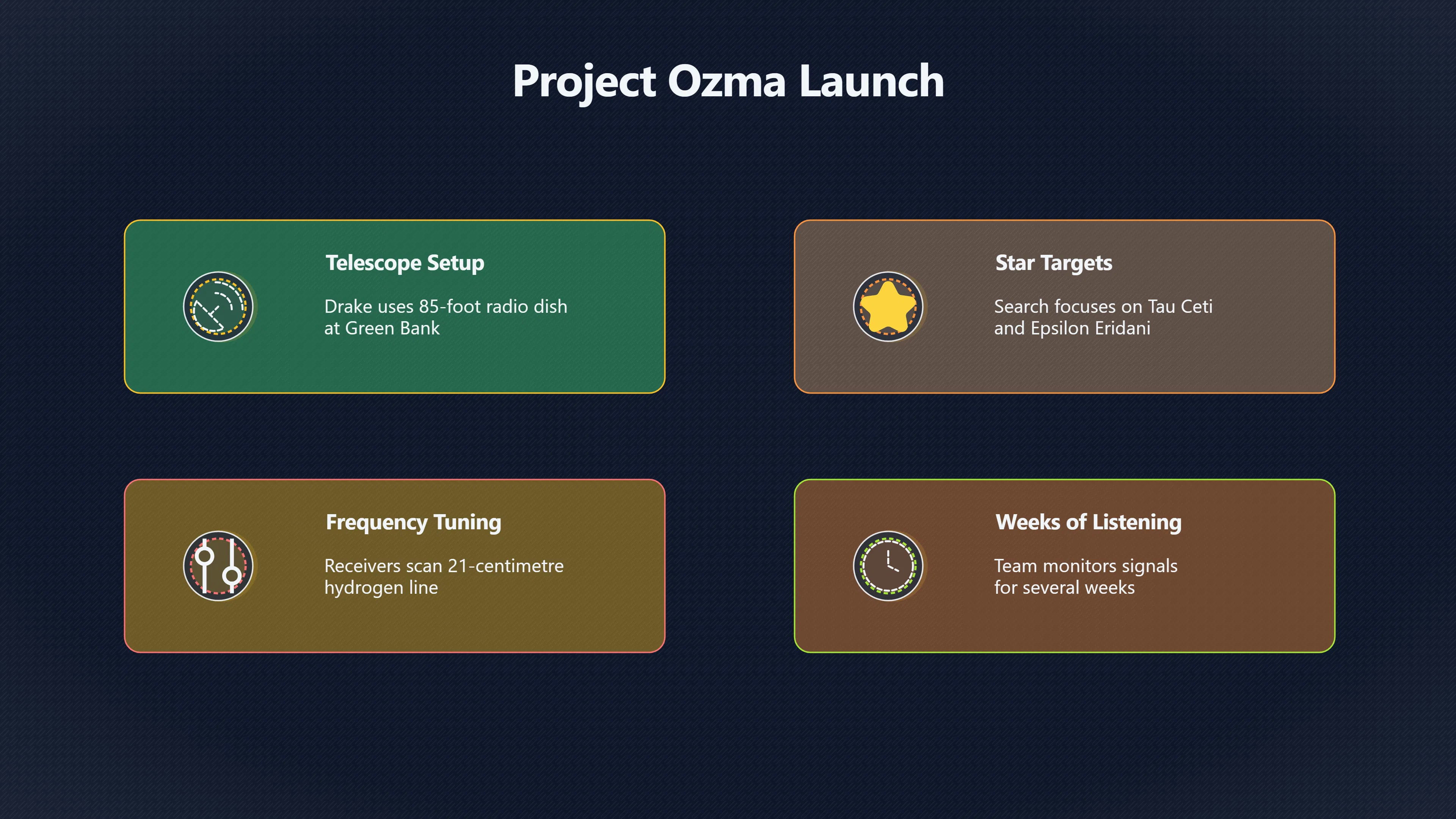
When Project Ozma began in the spring of 1960, Green Bank was already emerging as one of the leading centres of radio astronomy in the United States. The National Radio Astronomy Observatory had recently established major facilities there, and Drake had access to the 85-foot Howard E. Tatel telescope. Rather than searching randomly across the sky, he selected two nearby Sun-like stars: Tau Ceti and Epsilon Eridani. Both were considered plausible places where planets and, perhaps, technological life might exist. Encyclopedia Britannica[2bigear.org]bigear.orgCosmic Search Vol1, No. 1 - A Reminiscence of Project…21 Sept 2004 — Drake was 29 when, on April 8, 1960, he turned the 85-foot Howard Tatel telescope…
The choice itself reflected a major shift away from popular UFO thinking. Much UFO discussion starts with a reported object, light or encounter and then asks what it might have been. Drake began with a different question: if another civilisation wanted to communicate across interstellar distances, what kind of detectable signal might it produce? Following ideas proposed by physicists Giuseppe Cocconi and Philip Morrison, he focused on radio frequencies near the 21-centimetre hydrogen line, a natural radio wavelength thought likely to be recognised by any scientifically advanced civilisation.[Encyclopedia Britannica]britannica.comEncyclopedia BritannicaProject Ozma | SETI, Radio Astronomy & Extraterrestrial LifeThe first modern SETI search was Project Ozma (1960)…
That distinction matters in the wider West Virginia context. Green Bank’s place in extraterrestrial history comes from radio astronomy and signal detection, not from local witness reports. The observatory was looking outward into deep space rather than investigating unexplained objects over the state.[SETI Institute]seti.orgSETI InstituteProject OzmaProject Ozma was named after the queen of L. Frank Baum's imaginary land of Oz – a place "very far away, diffi…
What the telescope search did and did not detect
The popular memory of Project Ozma sometimes blurs into a story of scientists almost finding aliens. The reality is more restrained and more useful.
For several weeks in 1960, Drake’s team monitored Tau Ceti and Epsilon Eridani for narrow-band radio emissions that might indicate technology rather than natural astrophysical processes. The telescope collected data, receivers examined specific frequencies, and any unusual signal had to survive checks against interference and equipment problems.[Time]time.comScience: Project OzmaIn Project Ozma, Green Bank's 85-ft. radio telescope is turned toward Epsilon Eridani and another star, Tau Ceti…[Sky & Telescope]skyandtelescope.orgproject ozma the first setiSky & TelescopeProject Ozma: The First SETIApr 8, 2010 — In 1960 Drake used this 26-m radio telescope at Green Bank, West Virginia, to ca…
At one point the project encountered a striking signal while observing Epsilon Eridani. For a short time it appeared unusual enough to raise excitement. However, investigation showed that the source was not extraterrestrial. The signal was eventually traced to a terrestrial origin, commonly described in historical accounts as interference from a military aircraft. The apparent mystery disappeared once additional checking was carried out.[ok2kkw.com]ok2kkw.comProject OZMA 1959-1960"Frank Drake conducted Project Ozma, the world's first modern SETI experiment, from this 85 foot (26m) diameter dis…
This episode is one of the most revealing parts of the Ozma story. The important outcome was not that researchers briefly became excited. It was that they kept testing the signal until a conventional explanation emerged. A weaker investigative culture might have stopped at the exciting stage and treated the event as evidence of contact.
In the end, Project Ozma detected no verified extraterrestrial radio transmission. Green Bank’s own historical material and later SETI summaries consistently describe the experiment as producing no confirmed alien signal.[gb.nrao.edu]gb.nrao.edudrake lecturePublic LectureThe Project Ozma observations were made in the spring and summer of 1960, and although no detections resulted, the experime…[SETI Institute]seti.orgSETI InstituteProject OzmaProject Ozma was named after the queen of L. Frank Baum's imaginary land of Oz – a place "very far away, diffi…
Why a no-result still matters to UFO history
For UFO readers, the most enduring lesson of Project Ozma is methodological rather than astronomical.
Many famous UFO cases remain disputed because the evidence consists mainly of eyewitness recollections, photographs of uncertain quality, media reports or later retellings. Those sources can be valuable, but they are often difficult to test decades later. Project Ozma demonstrated a different model. A claim could be examined through repeatable observations, recorded measurements and attempts to eliminate alternative explanations.[SETI Institute]seti.orgSETI InstituteProject OzmaProject Ozma was named after the queen of L. Frank Baum's imaginary land of Oz – a place "very far away, diffi…
The experiment also showed that a lack of evidence is still information. Drake did not conclude that extraterrestrial civilisations were impossible. He concluded only that no detectable signal had been found in that search. This careful distinction is one reason Ozma remains respected in scientific history. It neither declared success nor transformed uncertainty into certainty.[National Geographic]nationalgeographic.comNational Geographic My dad launched the quest to find alien intelligence19, 2020 — Even though Ozma failed to find evidence of extraterrestrial technologies, the project was uniquely transformative—t…
That approach contrasts with some UFO narratives in which unexplained automatically becomes extraterrestrial. Project Ozma suggested a tougher standard: unexplained observations should remain unexplained until stronger evidence arrives. The burden is on the evidence, not on the excitement generated by the possibility.
The false-alarm lesson and later SETI searches
One reason Project Ozma still appears in discussions of SETI is that its experience with apparent signals anticipated a recurring problem. Radio telescopes operate in a world crowded with human-made transmissions. A signal that initially looks extraordinary can later prove to be interference from Earth-based technology.[ok2kkw.com]ok2kkw.comProject OZMA 1959-1960"Frank Drake conducted Project Ozma, the world's first modern SETI experiment, from this 85 foot (26m) diameter dis…
Modern SETI programmes have repeatedly encountered this challenge. Candidate signals occasionally attract attention before follow-up analysis identifies terrestrial interference or technical artefacts. A well-known recent example involved the Breakthrough Listen project’s “BLC1” signal, which initially appeared intriguing but was later traced to human-generated interference. Researchers published detailed verification procedures specifically to prevent premature conclusions.[arXiv]arxiv.orgSource details in endnotes.
Seen from that perspective, Project Ozma established a pattern that continues today:[britannica.com]britannica.comEncyclopedia BritannicaProject Ozma | SETI, Radio Astronomy & Extraterrestrial LifeThe first modern SETI search was Project Ozma (1960)…
- An unusual signal appears.
- Researchers investigate whether it is real.
- Alternative explanations are tested.
- Most candidates are eliminated.
- Only evidence that survives repeated scrutiny remains worth considering.
That process can feel unsatisfying to people hoping for dramatic confirmation. Yet it is precisely why Green Bank occupies a different place in extraterrestrial history from folklore, rumours or sensational UFO claims.
What Green Bank’s no-detection really tells readers
Project Ozma did not confirm alien visitors, hidden bases or flying saucers over West Virginia. It did something quieter and arguably more significant. It helped create a scientific framework for asking whether technological life exists elsewhere in the universe.[Encyclopedia Britannica]britannica.comEncyclopedia BritannicaProject Ozma | SETI, Radio Astronomy & Extraterrestrial LifeThe first modern SETI search was Project Ozma (1960)…
The Green Bank experiment showed that searching for extraterrestrial intelligence could be treated as a measurable research problem rather than a matter of speculation alone. It also demonstrated that negative results, rejected signals and false alarms are not failures. They are part of the process of separating genuine evidence from wishful thinking, misunderstanding and interference.[gb.nrao.edu]gb.nrao.edudrake lecturePublic LectureThe Project Ozma observations were made in the spring and summer of 1960, and although no detections resulted, the experime…
Within West Virginia’s broader UFO history, that may be Green Bank’s most important contribution. The observatory’s legacy is not a mysterious sighting that remains unresolved. It is the example of a disciplined search that accepted uncertainty, reported no confirmed detection, and still changed how humanity looks for answers.[SETI Institute]seti.orgSETI InstituteProject OzmaProject Ozma was named after the queen of L. Frank Baum's imaginary land of Oz – a place "very far away, diffi…[National Geographic]nationalgeographic.comNational Geographic My dad launched the quest to find alien intelligence19, 2020 — Even though Ozma failed to find evidence of extraterrestrial technologies, the project was uniquely transformative—t…
Amazon book picks
Further Reading
Books and field guides related to What Project Ozma Really Found. Use these as the next step if you want deeper reading beyond the article.
Contact
Rating: 4.0/5 from 21 Google Books ratings
Closely reflects the scientific search for extraterrestrial radio signals pioneered by projects like Ozma.
The Search for Extraterrestrial Intelligence
Directly addresses the development of SETI and radio signal searches.
Cosmos
Explains why scientists search for intelligent life despite long periods without detections.
The Eighth Tower
Provides a contrasting paranormal framework to scientific SETI investigations.
eBay marketplace picks
Marketplace Samples
Live-tested eBay searches with available results related to this page.




Endnotes
1.
Source: seti.org
Link:https://www.seti.org/research/seti-101/project-ozma/
Source snippet
SETI InstituteProject OzmaProject Ozma was named after the queen of L. Frank Baum's imaginary land of Oz -- a place "very far away, diffi...
2.
Source: gb.nrao.edu
Title: drake lecture
Link:https://www.gb.nrao.edu/OZMA%4050/drake_lecture.html
Source snippet
Public LectureThe Project Ozma observations were made in the spring and summer of 1960, and although no detections resulted, the experime...
3.
Source: britannica.com
Link:https://www.britannica.com/event/Project-Ozma
Source snippet
Encyclopedia BritannicaProject Ozma | SETI, Radio Astronomy & Extraterrestrial LifeThe first modern SETI search was Project Ozma (1960)...
4.
Source: bigear.org
Title: Cosmic Search Vol
Link:https://www.bigear.org/vol1no1/ozma.htm
Source snippet
1, No. 1 - A Reminiscence of Project...21 Sept 2004 — Drake was 29 when, on April 8, 1960, he turned the 85-foot Howard Tatel telescope...
Published: April 8, 1960
5.
Source: seti.org
Title: a primer on seti at the seti institute
Link:https://www.seti.org/research/seti-101/a-primer-on-seti-at-the-seti-institute/
Source snippet
SETI InstituteA Primer on SETI at the SETI InstituteThe first actual SETI experiment, Project Ozma, was conducted by Frank Drake in 1960...
6.
Source: time.com
Link:https://time.com/archive/6811702/science-project-ozma/
Source snippet
Science: Project OzmaIn Project Ozma, Green Bank's 85-ft. radio telescope is turned toward Epsilon Eridani and another star, Tau Ceti...
7.
Source: ok2kkw.com
Link:https://www.ok2kkw.com/eme1960/ozma1960.htm
Source snippet
Project OZMA 1959-1960"Frank Drake conducted Project Ozma, the world's first modern SETI experiment, from this 85 foot (26m) diameter dis...
8.
Source: astronomy.com
Link:https://www.astronomy.com/today-in-the-history-of-astronomy/april-8-1960-frank-drake-begins-project-ozma/
Source snippet
Astronomy MagazineApril 8, 1960: Frank Drake begins Project Ozma8 Apr 2026 — Frank Baum's fictional monarch of Oz), was both the first SE...
Published: April 8, 1960
9.
Source: arxiv.org
Link:https://arxiv.org/abs/2111.06350
10.
Source: seti.org
Link:https://www.seti.org/
Source snippet
SETI InstituteAt the SETI Institute, we explore the origins of life, the search for extraterrestrial intelligence, and the mysteries of t...
11.
Source: technosearch.seti.org
Title: Project Ozma
Link:https://technosearch.seti.org/wp-content/uploads/2018-09/ProjectOzma.pdf
Source snippet
SEARCH FOR EXTRATERRESTRIAL INTELLIGENCEIn April 1960 the system went into operation and started observing our two target stars which wer...
Published: April 1960
12.
Source: history.com
Title: project ozma launches search extraterrestrial life
Link:https://www.history.com/this-day-in-history/april-12/project-ozma-launches-search-extraterrestrial-life
Source snippet
Project Ozma, the first modern experiment to search for extraterrestrial intelligence (SETI) by aiming to detect radio signals from deep...
13.
Source: astronomy.com
Link:https://www.astronomy.com/https%3A/april-8-1960-frank-drake-begins-project-ozma/
Source snippet
April 8, 1960: Frank Drake begins Project OzmaApr 8, 2026 — But on April 8, 1960, Drake and his colleagues instead tuned in to two nearby...
Published: April 8, 1960
14.
Source: skyandtelescope.org
Title: project ozma the first seti
Link:https://skyandtelescope.org/astronomy-news/project-ozma-the-first-seti/
Source snippet
Sky & TelescopeProject Ozma: The First SETIApr 8, 2010 — In 1960 Drake used this 26-m radio telescope at Green Bank, West Virginia, to ca...
15.
Source: nationalgeographic.com
Title: National Geographic My dad launched the quest to find alien intelligence
Link:https://www.nationalgeographic.com/science/article/father-launched-quest-find-alien-intelligence-changed-astronomy
Source snippet
19, 2020 — Even though Ozma failed to find evidence of extraterrestrial technologies, the project was uniquely transformative—t...
16.
Source: Wikipedia
Title: Project Ozma
Link:https://en.wikipedia.org/wiki/Project_Ozma
Source snippet
Project OzmaProject Ozma was a search for extraterrestrial intelligence (SETI) experiment started in 1960 by Cornell University astron...
17.
Source: greenbankobservatory.org
Title: Project Ozma
Link:https://greenbankobservatory.org/wp-content/uploads/2021/04/seti_werthimer_gbt_21april2021a.pdf
Source snippet
1960 Green Bank22 Apr 2021 — It's naïve to think we know how best to search today, given our history of changing SETI fashion. • Multiple...
Additional References
18.
Source: setileague.org
Link:https://www.setileague.org/articles/ham/10fall.pdf
Source snippet
Remembering Project OzmaThe 85-foot diameter Howard Tatel Telescope at the National Radio Astronomy Observatory, Green Bank, West Virgini...
19.
Source: greenbankobservatory.org
Link:https://greenbankobservatory.org/about/history/timeline-green-bank-observatory/
Source snippet
Historical TimelineFrank Drake was the scientist and he chose two sources 10 light years away, Tau Ceti and Epsilon Eridani.... Project...
20.
Source: facebook.com
Title: onthisday in april 1960 radio astronomer frank drake launched project ozma the f
Link:https://www.facebook.com/GreenBankObservatory/posts/onthisday-in-april-1960-radio-astronomer-frank-drake-launched-project-ozma-the-f/1251149937182396/
Source snippet
OnThisDay In April 1960, radio astronomer Frank Drake...While he didn't detect any signal of extraterrestrial origin, Drake's Project Oz...
Published: april 1960
21.
Source: phys.org
Title: 2023 11 seti telescopes double check
Link:https://phys.org/news/2023-11-seti-telescopes-double-check.html
Source snippet
SETI works best when telescopes double-check each otherNov 6, 2023 — The Search for Extraterrestrial Intelligence (SETI) has evolved cons...
22.
Source: interestingengineering.com
Title: aliens silent extinct part 1
Link:https://interestingengineering.com/science/aliens-silent-extinct-part-1
Source snippet
Aliens are silent because they may be going extinct — part 16 Nov 2023 — In 1960, Frank Drake and his colleagues at the National Radio As...
23.
Source: universetoday.com
Title: A Brief-ish History of SETI
Link:https://www.universetoday.com/articles/a-brief-ish-history-of-seti-part-i-where-is-everybody
Source snippet
Part I: "Where is Everybody?"2 days ago — In essence, they were trying to calculate the odds of extraterrestrial civilizations existing i...
24.
Source: universetoday.com
Title: A Brief-ish History of SETI
Link:https://www.universetoday.com/articles/a-brief-ish-history-of-seti-part-ii-ozma-and-the-drake-equation
Source snippet
Part II: Ozma and the Drake...9 May 2026 — In 1960, Frank Drake and his colleagues conducted the first systematic SETI survey at the Gre...
Published: May 2026
25.
Source: adsabs.harvard.edu
Link:https://adsabs.harvard.edu/full/2008ASPC..395..213D
Source snippet
(SETI) was conducted at Green Bank in 1960. The Tatel 85 foot telescope... Tau Ceti and Epsilon Eridani. The results of the experiment w...
26.
Source: airandspace.si.edu
Title: search for extraterrestrial intelligence
Link:https://airandspace.si.edu/air-and-space-quarterly/issue-11/search-for-extraterrestrial-intelligence
Source snippet
si.eduLong-Distance CallJun 20, 2024 — And so began the first coordinated search for radio signals from an extraterrestrial civilization—...
27.
Source: planetary.org
Link:https://www.planetary.org/articles/2658
Source snippet
The Planetary SocietyReport from SETI workshop marking 50 years…Sep 12, 2010 — In 1960, a young astronomer named Frank Drake monitored tw...
Topic Tree