Within Iowa UFOs
What Did Blue Book Make of Iowa?
Iowa's federal-era UFO files show why an official record is only a starting point, not proof that a case was strong.
On this page
- How Iowa reports entered official channels
- Why some official files were still weak cases
- What Blue Book's national conclusions mean locally
Page outline Jump by section
Introduction
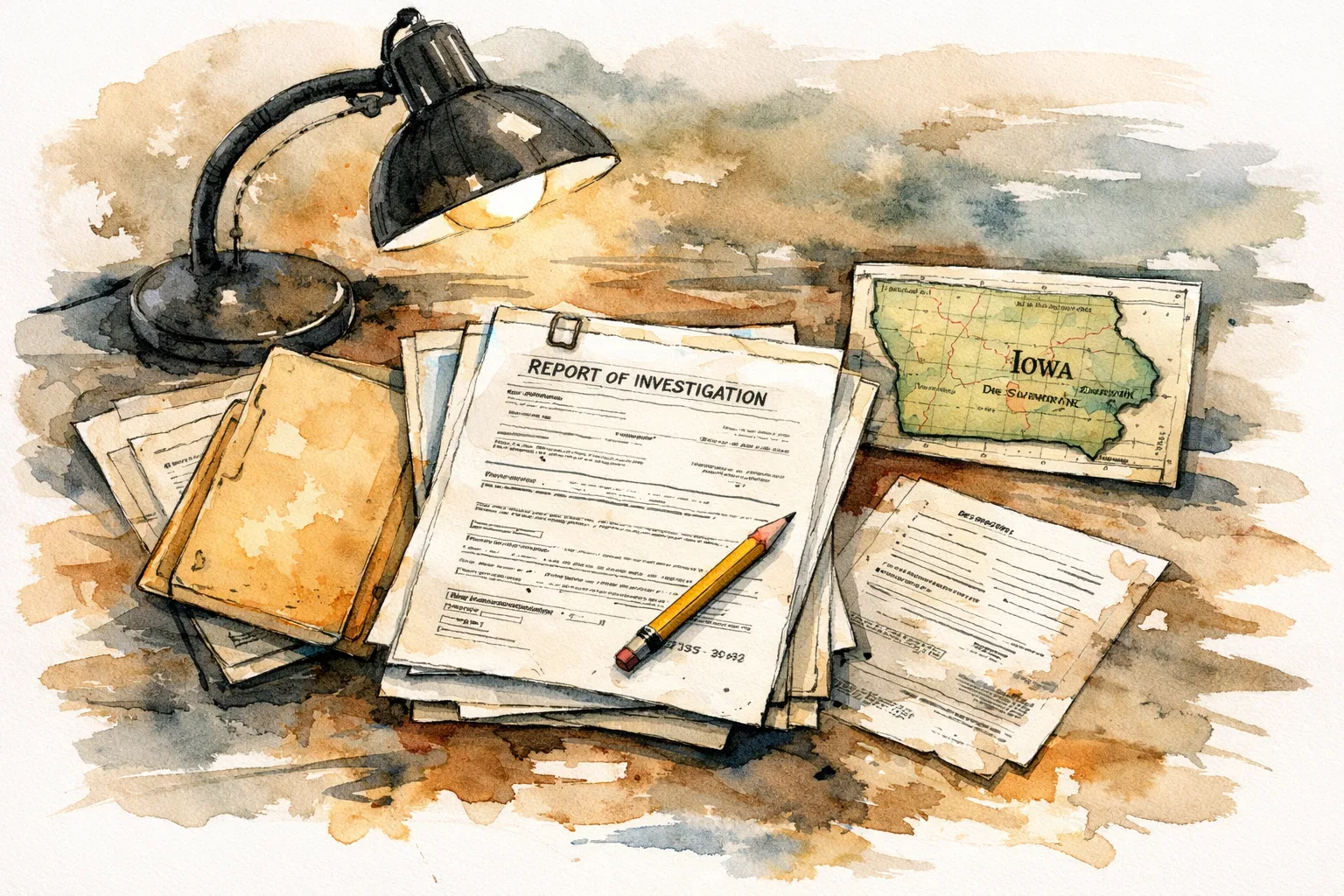
Project Blue Book made Iowa part of the federal UFO record, but it did not turn Iowa sightings into confirmed evidence of extraordinary craft. The useful lesson is almost the opposite: an official case file shows that a report entered a government process, not that the report was strong, complete, or inexplicable. Iowa cases in and around the Blue Book record range from early “flying saucer” reports and pilot encounters to radar entries and late, weak witness accounts. Some were classified as unidentified by later catalogues of Blue Book “unknowns”; others were logged but marked unreliable or thin. The value of the Iowa material is therefore historical and evidential: it shows how sightings from ordinary Midwestern places became federal paperwork, and why paperwork still needs careful reading. Project Blue Book as a whole recorded 12,618 sightings, of which 701 remained “unidentified”, while the Air Force concluded that none proved a national-security threat, advanced technology beyond known science, or extraterrestrial vehicles.[Air Force]af.milUnidentified Flying Objects and Air Force Project Blue Book > Air Force > Fact Sheet Display…
How Iowa Reports Entered Official Channels
Blue Book was not a single Iowa investigation, nor a local UFO office. It was a United States Air Force programme based at Wright-Patterson Air Force Base in Ohio, operating after earlier Air Force efforts such as Project Sign and Project Grudge. The National Archives describes the surviving Blue Book record as a declassified body of case files, project files and Office of Special Investigations material, with individual sightings arranged chronologically and searchable by date and location through finding aids and microfilm.[National Archives]archives.govSource details in endnotes.
That matters for Iowa because the route into the record was often indirect. A witness might report a sighting to local police, a newspaper, a military base, an Air National Guard unit, a radar station or another official contact. The report could then become a short card, a memo, a teletype, an investigator’s note or a small bundle of supporting material. Some entries contain useful detail: time, direction, duration, witness role, weather, aircraft checks and possible explanations. Others are little more than a brief description and a classification.
Digitisation has made the record easier to browse, but it has not made every case equally robust. Fold3’s Blue Book collection identifies the source as National Archives microfilm publication T1206 and describes it as records and case files relating to UFO investigations, with 129,658 records in the online publication.[Fold3]fold3.comUS, Project Blue BookUS, Project Blue Book The National Archives, however, is clear that the original textual Blue Book holdings included administrative files, chronological case files and OSI-related material, and that photographs were scattered and separately filmed.[National Archives]archives.govSource details in endnotes. A reader looking at an Iowa case should therefore ask not simply “Was this in Blue Book?” but “What exactly survived, who reported it, and what did investigators actually do with it?”
Iowa also has a small biographical connection to the Blue Book story. Edward J. Ruppelt, the early Blue Book director whose name is closely associated with the term “unidentified flying object”, was born in Iowa and later wrote an insider account of the early Air Force UFO programme. Project Gutenberg’s public-domain text identifies him as the former head of Project Blue Book.[Project Gutenberg]gutenberg.orgSource details in endnotes. That connection is interesting, but it should not be overstated: Iowa’s importance in the files comes from the cases themselves, not from claiming that the state shaped the whole programme.
Iowa Cases Show the Range of Blue Book Evidence
The Iowa-linked material is not one uniform category. It includes early post-war saucer reports, military-pilot reports, radar reports and late civilian accounts. That variety is why Iowa is a useful state-level example of how Blue Book functioned: the same federal system could hold a case with trained aviators and a case with little more than a witness narrative.
One early Iowa entry appears in Brad Sparks’s catalogue of Project Blue Book unknowns, which lists a 29 June 1947 report from Des Moines, with Clarion noted as a possible location. The witness, bus driver Dale Bays, reportedly saw a single-file line of “dirty white” round or oval objects, with later objects also reported; the catalogue notes uncertainty about details such as the number of objects and location.[NICAP]nicap.orgMicrosoft WordMicrosoft Word This is a classic early saucer-era problem: the report is historically valuable because it falls within the first national wave of 1947, but the surviving description contains ambiguities that limit what can safely be concluded.
A stronger-looking Iowa case, at least on witness qualifications, is the 29 January 1955 Winterset-area report near Des Moines. Sparks’s catalogue describes Iowa Air National Guard pilots Major A. Packer and Lieutenant D. Myers flying a T-33A jet when they saw a flashing white light on what appeared to be a head-on course at about 20,000 feet; according to the summary, it rose over the jet and then outclimbed and out-turned the aircraft when pursued.[NICAP]nicap.orgUFO ReportUFO Report A separate Project Blue Book Archive PDF surfaced in search results for the same case, with the Blue Book record card describing a Winterset, Iowa observation and a head-on pass with the observer’s T-33 aircraft.[The Project Blue Book Archive]theprojectbluebookarchive.orgThe Project Blue Book Archive UntitledThe Project Blue Book Archive Untitled The case is notable because it involves military pilots and an aircraft encounter, but it is still a short-duration sighting rather than a physical recovery or instrument-rich event.
The 28 February 1961 Waverly Air Force Base case shows another kind of record: a radar-centred report. NICAP’s case page says the surviving material includes the Project 10073 record card, Air Force communications, a request for analysis, a track made by the UFO, radar flight-following material and a note suggesting a possible supersonic aircraft, though “no evidence” was apparent in the listed note.[NICAP]nicap.orgOpen source on nicap.org. The Sparks catalogue lists “Waverly AFB, Iowa” among Blue Book unknown entries but gives only a bare summary in the visible table.[NICAP]nicap.orgOpen source on nicap.org. For readers, the important point is that radar cases can look more technical, but they still depend on calibration, tracking context, operator interpretation, possible aircraft activity and what supporting documents survived.
Late Blue Book-era Iowa material could be much weaker. Military Times, using Project Blue Book file images, highlighted a 1969 Davenport, Iowa report described as “unreliable reports, ground visual sighting”, with the observer also having earlier reports from 1967 and 1968.[Military Times]militarytimes.comMilitary Times UFOs from the files of Project Blue BookMilitary Times UFOs from the files of Project Blue Book That is precisely the kind of entry that cautions against treating a federal file as an endorsement. Blue Book collected reports; it did not make every collected report a strong case.
Why Some Official Files Were Still Weak Cases
The most common misunderstanding about Blue Book is to treat “official” as meaning “validated”. In practice, the official system often preserved weak material because that was part of the administrative job. A report could be logged because someone made it, not because investigators found it convincing.
AARO’s 2024 historical review summarises Blue Book’s own categories as “identified”, “insufficient data” and “unidentified”. It also notes the kinds of explanations Blue Book used for identified cases: astronomical objects, balloons, aircraft, afterburners, satellites, missiles, reflections, searchlights, birds, kites, false radar indications, fireworks, flares and hoaxes.[AARO]aaro.milUnclassified Final DSD AARO Historical ReportUnclassified Final DSD AARO Historical Report This is directly relevant to Iowa. A light over a farm road, a bright object near an air route, a radar return near a military installation, or a report during a wider national flap all had to be tested against ordinary possibilities before “unknown” meant anything.
Blue Book’s categories also had different evidential weight. “Insufficient data” is not the same as “unidentified after strong investigation”. A case may be impossible to solve because it lacks time, direction, weather, witness distance, angular size, corroboration or records of aircraft and balloon activity. That kind of uncertainty is real, but it is not strong evidence for an extraordinary object.
The 1947 Des Moines/Clarion entry illustrates this problem well. It is intriguing because it sits near the beginning of the modern flying-saucer era and reports multiple objects, yet the catalogue itself shows uncertainty over location, time and object count.[NICAP]nicap.orgOpen source on nicap.org. The Winterset T-33 case appears stronger because the witnesses were military pilots and the report involved an aircraft encounter, but it lasted only about 25 seconds in the Sparks summary, leaving little room for independent measurement.[NICAP]nicap.orgReportUFOWave1947 SectionIReportUFOWave1947 SectionI The Waverly radar case looks more technical, but the surviving public-facing index still points readers back to the original documents rather than offering a neat solution.[NICAP]nicap.orgjse 08 1 sturrockjse 08 1 sturrock
That unevenness is not a reason to dismiss the Iowa files. It is a reason to read them case by case. The best Iowa Blue Book material is useful because it preserves how witnesses, military units and investigators described events at the time. The weakest material is useful because it shows how easily an unusual sky report could become part of a federal archive without becoming a persuasive mystery.
What Blue Book’s National Conclusions Mean for Iowa
Blue Book’s national conclusions set a cautious frame for Iowa. The Air Force’s public fact sheet says that no investigated and evaluated UFO report showed a threat to national security, no evidence showed technology beyond modern scientific knowledge, and no evidence indicated that unidentified sightings were extraterrestrial vehicles.[Air Force]af.milUnidentified Flying Objects and Air Force Project Blue Book > Air Force > Fact Sheet Display… Those conclusions do not solve each Iowa case individually, but they do warn against reading the Iowa entries as hidden proof of alien visitation.
The National Archives gives the same broad numbers and notes that Project Blue Book closed in 1969, with no information on sightings after that date.[National Archives]archives.govSource details in endnotes. That boundary is important for Iowa’s wider UFO history. A famous later Iowa incident such as Council Bluffs in 1977 belongs to a different evidential and institutional setting. It cannot be treated as a Blue Book case because Blue Book had already ended.
AARO’s historical review adds a modern official reading of the same record. It states that Blue Book organised reports into identified, insufficient-data and unidentified categories, and that AARO’s review of the Blue Book holdings involved thousands of files and tens of thousands of digital records.[AARO]aaro.milUnclassified Final DSD AARO Historical ReportUnclassified Final DSD AARO Historical Report For Iowa readers, that reinforces a practical point: the old files are large and historically serious, but their existence does not remove the need for sceptical evaluation.
The Condon Report and the National Academy of Sciences review were central to Blue Book’s closure. The Air Force fact sheet says the decision to discontinue UFO investigations was based on the University of Colorado study, the National Academy review, earlier UFO studies and Air Force experience.[Air Force]af.milUnidentified Flying Objects and Air Force Project Blue Book > Air Force > Fact Sheet Display… AARO’s summary quotes the Condon panel’s broad conclusion that UFO study had not added to scientific knowledge and that further extensive study probably could not be justified on that basis.[AARO]aaro.milUnclassified Final DSD AARO Historical ReportUnclassified Final DSD AARO Historical Report Locally, that means Iowa’s unresolved or thinly explained Blue Book entries should be understood as unresolved reports within a programme that ultimately judged the overall body of evidence insufficient for continued Air Force investigation.
How to Read an Iowa Blue Book Case Today
A good reading of an Iowa Blue Book file starts with restraint. The first question is not “Was it real?” but “What does this file actually document?” In some cases, it documents a witness statement. In others, it documents a radar return, a military message, a press clipping, a classification card or an attempted explanation. Those are different kinds of evidence.
A useful reader’s test is to separate four issues:
- Entry into the system: Did the sighting reach an Air Force, police, aviation or other official channel?
- Witness quality: Was the observer a pilot, radar operator, officer, civilian witness, repeated claimant or anonymous reporter?
- Data quality: Does the file include time, direction, duration, weather, angular size, aircraft checks, radar data or corroboration?
- Classification quality: Was the case genuinely unresolved after investigation, merely lacking enough data, or considered unreliable?
Using that test, the Winterset T-33 case deserves more attention than a vague late civilian report because it involved trained military pilots and an aircraft encounter.[NICAP]nicap.orgOpen source on nicap.org. The Waverly case deserves attention because radar documentation may exist beyond a simple witness statement.[NICAP]nicap.orgOpen source on nicap.org. The Davenport 1969 example deserves caution because it was explicitly described in later presentation of the file as unreliable.[Military Times]militarytimes.comMilitary Times UFOs from the files of Project Blue BookMilitary Times UFOs from the files of Project Blue Book The 1947 Des Moines/Clarion report deserves historical interest, but its uncertainties over location and details weaken any strong claim.[NICAP]nicap.orgOpen source on nicap.org.
This approach also helps connect Blue Book to the broader Iowa UFO record without blurring boundaries. Blue Book-era Iowa cases show how federal investigators received and classified reports before 1970. Later Iowa cases, modern NUFORC entries and local physical-trace stories belong to different archives and standards of evidence. The continuity is not that they all prove the same thing; it is that each record has to be read for what it can and cannot support.

The Local Takeaway
Project Blue Book made Iowa part of the official American UFO archive, but Iowa’s Blue Book record is strongest as a study in investigation, not as a catalogue of confirmed anomalies. It contains cases that are intriguing, cases that are ambiguous, and cases that are plainly weak. That mix is exactly why the files matter.
For Iowa’s UFO history, the federal-era record offers three durable lessons. First, an official file is a lead, not a verdict. Second, “unidentified” is a limited classification, not a synonym for extraterrestrial. Third, the best cases are those with multiple independent details: trained observers, precise timing, radar or aviation context, and surviving documentation that can be checked against ordinary explanations.
Read that way, Blue Book does not make Iowa a dramatic UFO hotspot. It makes Iowa a useful test case in how ordinary sightings, military reports and incomplete evidence were filtered through a national system that was trying to classify the unknown without always having enough information to explain it.
Amazon book picks
Further Reading
Books and field guides related to What Did Blue Book Make of Iowa?. Use these as the next step if you want deeper reading beyond the article.
The Hynek UFO Report
Strong match for a page focused on Blue Book investigations and conclusions.
eBay marketplace picks
Marketplace Samples
Example marketplace items related to this page. Use the search link to explore similar finds on eBay.







Endnotes
1.
Source: af.mil
Title: Air Force
Link:https://www.af.mil/About-Us/Fact-Sheets/Display/Article/104590/unidentified-flying-objects-and-air-force-project-blue-book/
Source snippet
Unidentified Flying Objects and Air Force Project Blue Book > Air Force > Fact Sheet Display...
2.
Source: archives.gov
Title: National Archives Project BLUE BOOK
Link:https://www.archives.gov/research/military/air-force/ufos
3.
Source: fold3.com
Title: US, Project Blue Book
Link:https://www.fold3.com/publication/461/us-project-blue-book-ufo-investigations
4.
Source: gutenberg.org
Link:https://www.gutenberg.org/cache/epub/17346/pg17346-images.html
5.
Source: nicap.org
Title: Microsoft Word
Link:https://www.nicap.org/bb/BB_Unknowns.pdf
6.
Source: nicap.org
Title: UFO Report
Link:https://www.nicap.org/reports/610228waverlyafb_rep.htm
7.
Source: aaro.mil
Title: Unclassified Final DSD AARO Historical Report
Link:https://www.aaro.mil/Portals/136/PDFs/AARO_Historical_Record_Report_Vol_1_2024.pdf
8.
Source: archives.gov
Link:https://www.archives.gov/citizen-archivist/missions
9.
Source: archives.gov
Link:https://www.archives.gov/
10.
Source: archives.gov
Title: Federal Records Guide: Alphabetical Index
Link:https://www.archives.gov/research/guide-fed-records/index-alpha/p.html
11.
Source: archives.gov
Title: Federal Records Guide: Alphabetical Index
Link:https://www.archives.gov/research/guide-fed-records/index-alpha/a.html
12.
Source: archives.gov
Title: nara documents2
Link:https://www.archives.gov/research/foreign-policy/cold-war/1961-berlin-crisis/nara-documents2
13.
Source: archives.gov
Title: project blue book 50th anniversary
Link:https://www.archives.gov/news/articles/project-blue-book-50th-anniversary
14.
Source: archives.gov
Title: Federal Records Guide: Alphabetical Index
Link:https://www.archives.gov/research/guide-fed-records/index-alpha/b.html
15.
Source: archives.gov
Title: 1977 annual report
Link:https://www.archives.gov/files/about/history/sources/reports/1977-annual-report.pdf
16.
Source: archives.gov
Link:https://www.archives.gov/files/declassification/iscap/pdf/2014-004-doc01.pdf
17.
Source: archives.gov
Link:https://www.archives.gov/research/guide-fed-records/groups/220.html
18.
Source: archives.gov
Link:https://www.archives.gov/research/topics/uaps/moving-images-and-sound
19.
Source: archives.gov
Link:https://www.archives.gov/files/research/cartographic/pi-195-soil-conservation-service.pdf
20.
Source: fold3.com
Title: cedar rapids iowa blank page 7 us project blue book ufo investigations 1947 1969
Link:https://www.fold3.com/document/7339311/cedar-rapids-iowa-blank-page-7-us-project-blue-book-ufo-investigations
21.
Source: archive.org
Title: Project Blue Book Indexes
Link:https://archive.org/details/ProjectBlueBookIndexes
22.
Source: archive.org
Title: Blue Book Artifacts
Link:https://archive.org/details/BlueBookArtifacts
23.
Source: archive.org
Title: Brad Sparks Comprehensive Catalog of 1,600 Project Blue Book UFO Unknowns
Link:https://archive.org/download/BernardSieglerTechnicsAndTime1TheFaultOfEpimetheus/Brad%20Sparks%20-%20Comprehensive%20Catalog%20of%201%2C600%20Project%20Blue%20Book%20UFO%20Unknowns.pdf
24.
Source: nicap.org
Link:https://www.nicap.org/bluebook/unknowns.htm
25.
Source: nicap.org
Link:https://www.nicap.org/bluebook/51-69.htm
26.
Source: nicap.org
Link:https://www.nicap.org/bios/WHO-WAS/BLUE_BOOK.htm
27.
Source: nicap.org
Title: ReportUFOWave1947 SectionI
Link:https://nicap.org/waves/Wave47Rpt/ReportUFOWave1947_SectionI.htm
28.
Source: nicap.org
Title: jse 08 1 sturrock
Link:https://www.nicap.org/papers/jse_08_1_sturrock.pdf
29.
Source: nicap.org
Link:https://nicap.org/waves/Wave47Rpt/ReportOnWaveOf1947.pdf
30.
Source: nicap.org
Link:https://www.nicap.org/bluebook/bluelist.htm
31.
Source: nicap.org
Link:https://www.nicap.org/chronos/1961fullrep.htm
32.
Source: nicap.org
Title: What Our Air Force Found Out About UFOs
Link:https://www.nicap.org/true-rup1.htm
33.
Source: nicap.org
Link:https://www.nicap.org/chronos/1955fullrep.htm
34.
Source: nicap.org
Title: NSID DBListingby Date
Link:https://www.nicap.org/NSID/NSID_DBListingbyDate.pdf
35.
Source: nicap.org
Title: NSID DBListingby State Country
Link:https://www.nicap.org/NSID/NSID_DBListingbyStateCountry.pdf
36.
Source: history.com
Title: ufos washington dc news reports
Link:https://www.history.com/articles/ufos-washington-dc-news-reports
37.
Source: theprojectbluebookarchive.org
Title: The Project Blue Book Archive Untitled
Link:https://theprojectbluebookarchive.org/archive/Sanitized%20Version%20of%20Project%20Blue%20Book%20Case%20Files-PDFs-Part2/28960972.pdf
38.
Source: militarytimes.com
Title: Military Times UFOs from the files of Project Blue Book
Link:https://www.militarytimes.com/2017/07/19/ufos-from-the-files-of-project-blue-book/
39.
Source: Wikipedia
Title: Project Blue Book
Link:https://en.wikipedia.org/wiki/Project_Blue_Book
40.
Source: Wikipedia
Title: Edward J. Ruppelt
Link:https://en.wikipedia.org/wiki/Edward_J._Ruppelt
41.
Source: imdb.com
Title: Edward J. Ruppelt
Link:https://www.imdb.com/name/nm7067432/bio/
42.
Source: britannica.com
Link:https://www.britannica.com/topic/Project-Blue-Book
Additional References
43.
Source: youtube.com
Link:https://www.youtube.com/watch?v=PEB-Y9iDrDA
Source snippet
Project Blue Book UFO Files: 15 True Declassified Cases | Fall Asleep to UFO Stories (Episode 2)...
44.
Source: youtube.com
Link:https://www.youtube.com/watch?v=2j2YPSSQLQM
Source snippet
PROJECT BLUEBOOK Classic UFO Documentary 1970's...
45.
Source: youtube.com
Title: MUFON Midwest: UFOs in Iowa Towns: David Kreiter
Link:https://www.youtube.com/watch?v=spztEKRJvEE
Source snippet
Project Blue Book UFO investigations documentary PROJECT BLUEBOOK Classic UFO Documentary 1970's MiuwKee...
46.
Source: nsa.gov
Link:https://www.nsa.gov/portals/75/documents/news-features/declassified-documents/ufo/usaf_fact_sheet_95_03.pdf
47.
Source: youtube.com
Title: Iowa Files: UFOs in Iowa
Link:https://www.youtube.com/watch?v=Eb54ZwPYKFQ
Source snippet
Project Blue Book UFO Files: 20 True Declassified Cases | Fall Asleep to UFO Stories (Episode 1)...
48.
Source: amazon.com
Link:https://www.amazon.com/stores/author/B002JTQ71Q
49.
Source: reddit.com
Link:https://www.reddit.com/r/UFOs/comments/16vc2eu/have_you_read_the_report_on_unidentified_flying/
50.
Source: txarchives.org
Link:https://txarchives.org/tamucush/finding_aids/00151.xml
51.
Source: docsteach.org
Link:https://docsteach.org/document/project-blue-book-status-report-number-eight/
52.
Source: astronomyufo.com
Link:https://www.astronomyufo.com/UFO/SUNliteBBSUPV1.pdf
Topic Tree