Within Wisconsin UFOs
Did Eagle River's Pancakes Prove Anything?
The 1961 Joe Simonton case is Wisconsin's strangest close encounter, but its famous pancakes weakened rather than proved the claim.
On this page
- What Joe Simonton said happened
- The pancake samples and official attention
- Why the case still divides readers
Page outline Jump by section
Introduction
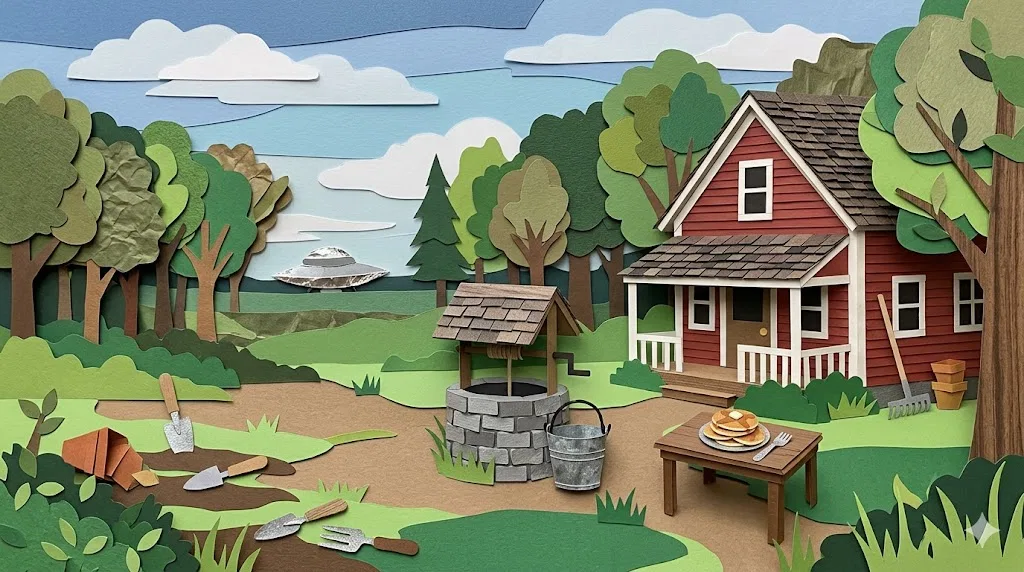
The Eagle River pancake case is one of Wisconsin’s strangest UFO stories because it offers exactly what many close-encounter reports lack: a claimed physical sample. On 18 April 1961, Joe Simonton, a plumber living outside Eagle River, said a shiny, saucer-shaped craft appeared near his home, that one of its occupants asked him for water, and that he was given several small pancake-like cakes in return. The obvious question is whether those cakes proved anything. They did not. Laboratory attention made the case more interesting, but the reported ingredients were ordinary: fat, starch, buckwheat hulls, wheat bran and soybean hulls, with bacteriology and radioactivity results consistent with a terrestrial pancake. [Center for UFO Studies+2Center for UFO Studies]
That is why Eagle River matters in Wisconsin UFO history. It is not a strong proof case disguised as a joke, nor merely a joke with no evidential value. It is a useful example of the limits of “physical evidence” when the object can be tested but its origin, chain of custody and surrounding claim remain uncertain. The pancakes did not confirm a visitor from elsewhere. They did, however, show how a humble object could pull in local officials, civilian UFO groups, Project Blue Book and J. Allen Hynek, while still leaving the central event unresolved in any satisfying way.
What Joe Simonton said happened
Simonton’s account placed the incident at about 11 a.m. on 18 April 1961, four miles west of Eagle River in northern Wisconsin. Early local reporting described him as a 54-year-old Eagle River resident who claimed that a hatch opened in a roughly 30-foot-diameter craft and that he could see three men inside. He said one man held up a jug and gestured for water; Simonton filled it and returned it, then saw one occupant cooking food on a flameless grill. According to the account, after Simonton gestured interest in the food, one of the men handed him three small cakes.[Center for UFO Studies]cufos.orgCenter for UFO Studies
The details are strange even by UFO standards. Simonton described the visitors as human-like, about five feet tall, smooth-shaven, dressed in dark clothing, and not speaking to him. The craft reportedly made a whining or generator-like sound, had a dark interior with control panels, and departed rapidly after a short exchange. He said the entire episode lasted about five minutes.[Center for UFO Studies]cufos.orgCenter for UFO Studies
For readers trying to judge the case, the important point is not whether the story sounds charming, absurd or uncanny. It is that the narrative depends almost entirely on one witness. There were no photographs of the alleged craft in the act of landing, no independent observers of the encounter, no radar case attached to it, and no clear landing trace that could securely anchor the story. The pancakes were therefore not one piece in a strong evidence chain. They were the chain.

Why the pancakes drew official attention
The samples mattered because they turned a rural close-encounter claim into a testable object. Simonton reportedly turned over cakes to local authorities, and Vilas County Judge Frank W. Carter became an important early figure in moving the claim beyond gossip. In later documentation, Carter’s cover letter to Donald Keyhoe of the National Investigations Committee on Aerial Phenomena, or NICAP, asked whether the greasy, perforated “pancake” contained earthly or unknown ingredients.[Center for UFO Studies]cufos.orgCenter for UFO Studies
That act of sending a sample helped bring the case into a wider UFO politics of the early 1960s. NICAP was a major civilian UFO organisation, but it was wary of being publicly tied to stories about occupants and “little green men”. Jerome Clark’s later review of the case notes that NICAP preferred to press the Air Force over serious aerial reports and did not want its reputation tied to an outlandish food-sample story.[Center for UFO Studies]cufos.orgCenter for UFO Studies
Project Blue Book was drawn in partly because Air Force personnel worried that NICAP might make much of the case. Major Robert Friend contacted J. Allen Hynek, Blue Book’s scientific consultant, and Hynek went to Eagle River with two graduate students, Walter Weller and John Tumlin. They interviewed Simonton, spoke with local people, examined the site and obtained part of a pancake sample.[Center for UFO Studies]cufos.orgCenter for UFO Studies
This is one reason the case survived in UFO history. Many odd local stories vanish because no institution touches them. Eagle River did not vanish. It entered newspaper files, civilian UFO files, Blue Book paperwork and later historical discussion. The U.S. National Archives confirms that Project Blue Book records were declassified and transferred to the archives, with case files arranged chronologically and available on microfilm; Fold3’s Project Blue Book database lists Eagle River, Wisconsin, under April 1961 in the NARA T1206 record set.[National Archives]archives.govNational Archives Project BLUE BOOKNational Archives Project BLUE BOOK
What the samples showed — and did not show
The pancake analysis is the centre of this page because it is where the case moves from testimony to material evidence. The available record is clear on the broad result. One sample sent through Air Force channels was described as having been prepared from low-protein flour with small quantities of sugar and salt and cooked in hydrogenated oil. The Food and Drug Administration analysis reported fat, starch, buckwheat hulls, wheat bran and soybean hulls. It concluded that the material appeared to be an ordinary pancake, mainly buckwheat, with bacteriological and radioactivity findings consistent with terrestrial origin.[Center for UFO Studies]cufos.orgCenter for UFO Studies
That result weakens the claim as proof of extraterrestrial contact. A sample that looks like a pancake, tests like a pancake and contains recognisable terrestrial ingredients cannot, by itself, support the extraordinary origin story attached to it. At most, it shows that Simonton had unusual pancake-like objects after the date of the alleged encounter.
There are three separate evidential limits here:
Composition is not provenance. A laboratory can describe what a sample contains. It cannot, without supporting context, prove where the witness obtained it. Ordinary ingredients do not prove a hoax, but they also do not prove a landed craft.
A sample is only as strong as its chain of custody. The cakes moved through local hands, civilian UFO channels and official attention after the story had already begun to spread. That is not the same as a controlled recovery from a secured scene.
Testing can answer the wrong question. The useful question was not simply “what is this made of?” but “does this object independently support the alleged encounter?” The answer to the first question was ordinary food chemistry. The answer to the second was no.
The physical object therefore changed the shape of the debate but not the strength of the proof. Without the pancakes, Eagle River might be just another single-witness occupant story. With the pancakes, it became a famous lesson in how “something tangible” can still fail to establish the central claim.

Why investigators disagreed about the witness
The strongest point for Simonton has always been character rather than chemistry. Hynek’s field notes, as later quoted in case literature, did not portray him as an obvious showman. Hynek reported that Simonton answered directly, did not contradict himself, refused embellishments, and said he did not care whether he was believed. Hynek also wrote that Simonton appeared sincere and did not appear to be perpetrating a hoax, although deciding whether the event was physical or psychological moved the issue into psychology.[Center for UFO Studies]cufos.orgCenter for UFO Studies
Local reaction also mattered. Hynek reported that in Eagle River, Simonton was greeted as a respected member of the community, and that many locals seemed inclined to believe him, although there were sceptics. The sheriff was quoted in later summaries as saying that Simonton really believed what he said and was not a drinking man.[Center for UFO Studies]cufos.orgCenter for UFO Studies
But sincerity does not settle a case. The Blue Book record card listed the observation as ground-visual, noted a physical specimen described as a pancake, summarised the craft as like two soup bowls together, and marked the conclusion as “Hallucination”. The comments said investigators considered the witness balanced and of good mental health, and that he seemed to believe the events had happened, but that inconsistencies and lack of supporting evidence pointed to hallucination followed by delusion.[Center for UFO Studies]cufos.orgCenter for UFO Studies
That judgement is blunt and unsatisfying, but it shows the official logic. Blue Book did not have to prove that Simonton was dishonest. It only had to decide whether the report was supported enough to remain unidentified or physically significant. The cakes did not do that work, so the case was filed as a psychological episode rather than an unknown craft.
Why the case still divides readers
The Eagle River pancakes divide readers because the case sits awkwardly between categories. It is too strange and under-supported to stand as strong UFO evidence, but too well documented to dismiss as a rumour that never entered serious files. That tension is exactly why it remains useful within Wisconsin’s UFO history.
For sceptical readers, the case is a warning about evidential theatre. A material sample sounds impressive until the test shows ordinary ingredients and the rest of the story still rests on one man’s account. In that reading, the pancakes made the claim more memorable but less persuasive, because they turned the alleged visitors’ “proof” into something any kitchen could produce.
For sympathetic readers, the case remains harder to discard. Simonton did not seem to behave like a polished contactee seeking a following. Hynek’s own field impressions were more nuanced than the final Blue Book label, and later commentary noted that Hynek’s views on the UFO subject became more open over time.[Center for UFO Studies]cufos.orgCenter for UFO Studies A sincere witness, a small rural setting and a sample that really existed are enough to keep the story alive, even if they are not enough to prove the claim.
For historians of UFO culture, the case is valuable for a different reason. It exposes the uneasy relationship between official investigators, civilian UFO organisations and local communities. NICAP feared ridicule, Blue Book feared publicity, the local judge wanted an analysis, and Eagle River became briefly famous for a story that was both comic and difficult to categorise.[Center for UFO Studies]cufos.orgCenter for UFO Studies

What Eagle River teaches about physical evidence
The lesson of the Eagle River pancakes is not that physical evidence never matters. It is that physical evidence has to be relevant, controlled and discriminating. A radar track, a securely recovered fragment with unusual properties, a set of independent observations, or a documented environmental effect would all raise different questions. A pancake-like object made of ordinary ingredients does not.
The case also shows why UFO history often turns on the gap between “unexplained to the witness” and “evidentially strong to outsiders”. Simonton may have experienced something that felt completely real to him. The official record can still be weak. A witness can be sincere, local officials can be interested, and a sample can be physically present, while the case as a whole still fails to prove an extraordinary event.
Within Wisconsin’s UFO record, Eagle River is therefore best read as a landmark of evidential limits. It is more grounded than a tale with no documents, more vivid than a distant light in the sky, and less persuasive than cases with multiple independent witnesses or technical corroboration. The pancakes gave the story its fame, but the analysis gave it its real meaning: tangible evidence is not the same as decisive evidence.
Amazon book picks
Further Reading
Books and field guides related to Did Eagle River's Pancakes Prove Anything?. Use these as the next step if you want deeper reading beyond the article.
The UFO Experience
Hynek was directly connected to the Eagle River pancake case and its evidential debates.
The Hynek UFO Report
Covers official investigations and the kinds of cases represented by Eagle River.
The Report on Unidentified Flying Objects
Provides Project Blue Book context relevant to the Eagle River investigation.
Passport to Magonia
Explores unusual encounter narratives that resemble high-strangeness cases.
eBay marketplace picks
Marketplace Samples
Example marketplace items related to this page. Use the search link to explore similar finds on eBay.






Endnotes
1.
Source: cufos.org
Title: Center for UFO Studies
Link:https://cufos.org/PDFs/cases/1961_04_18_US_WI_Eagle-River_HYNEK_Simonton-CE-III.pdf
2.
Source: cufos.org
Title: Center for UFO Studies
Link:https://cufos.org/PDFs/cases/1961_04_18_US_WI_Eagle-River_CLARK_IUR.pdf
3.
Source: archives.gov
Title: National Archives Project BLUE BOOK
Link:https://www.archives.gov/research/military/air-force/ufos
4.
Source: fold3.com
Title: Page 73 in US, Project Blue Book
Link:https://www.fold3.com/document/8680116/eagle-river-wisconsin-blank-page-73-us-project-blue-book-ufo-investigations
5.
Source: fold3.com
Title: U S, Project Blue Book
Link:https://www.fold3.com/publication/461/us-project-blue-book-ufo-investigations
6.
Source: facebook.com
Link:https://www.facebook.com/groups/1432338325093596/posts/1473237151003713/
7.
Source: dictionary.cambridge.org
Link:https://dictionary.cambridge.org/dictionary/english/project
8.
Source: Wikipedia
Link:https://en.wikipedia.org/wiki/Project
9.
Source: Wikipedia
Title: Project Blue Book
Link:https://en.wikipedia.org/wiki/Project_Blue_Book
Additional References
10.
Source: youtube.com
Link:https://www.youtube.com/watch?v=19hqrhUlPzI
Source snippet
This video breaks down Joe Simonton's famous 1961 encounter and the subsequent Project Blue Book testing, demonstrating the limits of ana...
11.
Source: youtube.com
Title: Robert Anton Wilson Cosmic Trigger
Link:https://www.youtube.com/watch?v=xoV6nmngWCQ
Source snippet
Eagle River, Wisconsin Full Episode | Lakes, Snowmobiles, and Northwoods Traditions...
12.
Source: youtube.com
Title: WEIRD WISCONSIN: Eagle River & Joe Simonton’s BIZARRE UFO Pancakes
Link:https://www.youtube.com/watch?v=PXw0AN9S_5A
Source snippet
Robert Anton Wilson Cosmic Trigger - 'Pancakes from Outer Space' (J. Simonton's Alien Encounter)...
13.
Source: youtube.com
Link:https://www.youtube.com/watch?v=auD14Gh4ILM
Source snippet
Eagle River: Up North...Down to Earth | Discover Wisconsin...
14.
Source: science.org
Link:https://www.science.org/doi/pdf/10.1126/science.135.3503.518.a
15.
Source: cia.gov
Link:https://www.cia.gov/readingroom/document/cia-rdp81r00560r000100010001-0
16.
Source: youtube.com
Title: Mindless Banter 139: Joe Simonton & the Alien Pancakes
Link:https://www.youtube.com/watch?v=a7MmWf8f_wc
Source snippet
WEIRD WISCONSIN: Eagle River & Joe Simonton's BIZARRE UFO Pancakes...
17.
Source: reddit.com
Link:https://www.reddit.com/r/HighStrangeness/comments/i6nhqq/aliens_serve_a_wisconsin_man_pancakes_from_their/
18.
Source: cultofweird.com
Link:https://www.cultofweird.com/ufo-sightings/wisconsin-alien-pancakes/
19.
Source: governmentattic.org
Link:https://www.governmentattic.org/13docs/UFOsRelatedSubjBiblio_Catoe_1969.pdf
Topic Tree