Within Nebraska UFOs
Why the Ashland Police UFO Case Still Matters
The Ashland case is Nebraska's best-known UFO story because it pairs a sincere police witness with disputed physical proof.
On this page
- What Officer Herbert Schirmer reported
- What the Condon investigators found
- Why sincerity was not enough proof
Page outline Jump by section
Introduction
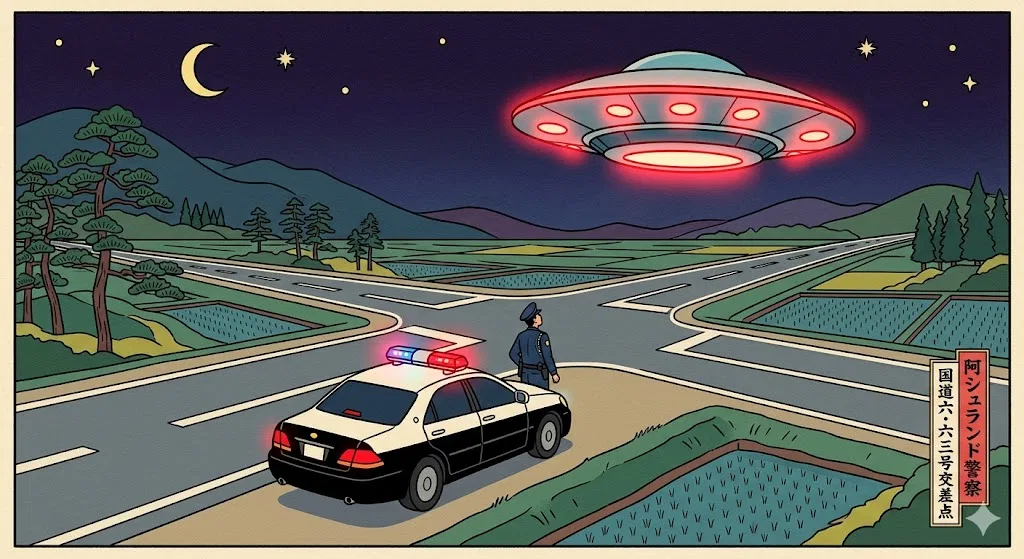
The Ashland police UFO case still matters because it is Nebraska’s clearest example of the gap between a credible witness and conclusive evidence. In the early hours of 3 December 1967, Ashland police officer Herbert Schirmer reported a strange object near the junction of U.S. Highway 6 and Nebraska Highway 63. The case became famous because Schirmer was a serving police officer, because he described missing time and physical after-effects, and because the incident was examined by the University of Colorado UFO project, commonly known as the Condon Committee. Yet the same investigation found no reliable physical evidence that an extraordinary object had been present. The result is not a simple “solved” or “proved” story. It is a case about evidence: what a sincere officer said, what investigators could check, and why belief in the witness was not enough to establish the event as physically real.[NCAS]files.ncas.orgCondon Report, Case 42: State Trooper Sighting…
What Officer Herbert Schirmer reported
The basic report, as summarised by the Condon investigators under the anonymised title “Case 42: State Trooper Sighting”, begins with a lone officer on late-night duty. The report places the encounter at about 2.30 am, after earlier checks in the area, including observations of cattle behaving unusually at a local sale barn. Near a highway intersection, the officer noticed red lights that he first took to be on a stopped truck. When he returned to investigate, he described a saucer-shaped object hovering low over the road, brightly lit, tilted, and fitted with red blinking lights or portholes.[NCAS]files.ncas.orgsec iisec ii
According to the Condon account, the officer said the object rose, made a siren-like sound, moved almost overhead and then shot away at high speed. He also reported a troubling time discrepancy: he believed only a short time had passed, but on returning to the police station or barracks found that roughly 20 minutes could not be accounted for. He reported feeling paralysed during part of the incident and later feeling weak, sick, strange and nervous. These details explain why the Ashland case grew beyond a normal light-in-the-sky sighting into one of Nebraska’s best-known UFO stories.[NCAS]files.ncas.orgCondon Report, Case 42: State Trooper Sighting…
The public identification of the officer as Herbert Schirmer is well established in later Nebraska and local reporting. In 2021, the Nebraska Legislature passed a resolution recognising Ashland’s “Stir-Up Days: Alien Encounter” theme as commemorating the reported 1967 experience of Ashland police officer Herbert Schirmer. Local reporting has also treated Schirmer’s story as a continuing piece of Ashland folklore, revived through community events, a graphic novel and Nebraska-themed popular culture.[Nebraska Legislature]nebraskalegislature.govNebraska Legislature[Nebraska Legislature]nebraskalegislature.govNebraska Legislature
The case’s appeal is easy to understand. Schirmer was not presented as an anonymous prankster or a vague rumour. He was a young officer claiming that something had happened while he was on duty. The report included a specific time, a specific road junction, a described object, a time gap, later physical discomfort and a small piece of alleged material from the scene. For UFO believers, that combination made the case unusually compelling. For investigators, it created a sharper question: which parts could actually be tested?
What the Condon investigators found
The University of Colorado investigation is the central reason the Ashland case remains important. The Condon Committee was not a local fan club or a later television reconstruction. It was an Air Force-funded academic study that examined selected UFO reports in the late 1960s. The University of Colorado itself describes the “Condon Report” as a rare official UFO study commissioned by the U.S. Air Force, and notes that its overall conclusion was that UFOs did not warrant further investigation.[University of Colorado Boulder]colorado.educondon report cu boulders historic ufo studycondon report cu boulders historic ufo study
In Case 42, the investigators did not simply dismiss the officer as dishonest. The report records that his superior described him as dependable and truthful, and said he was convinced the report was not the result of hallucination or deliberate deceit. It also records that the officer had reportedly taken a polygraph examination at his own request, with no indication that the report was other than truthful. These are important details because they show the case was not rejected on the easy assumption that the witness had lied.[NCAS]files.ncas.orgsec iisec ii
The investigators nevertheless found the physical evidence weak. The officer’s superior checked the area the next morning and found a small, metallic-looking piece of material beneath the place where the object was said to have hovered. The Condon report describes it as less than one centimetre long and paper-thin, black on one side and bright like aluminium paint on the other. A partial analysis found iron and silicon as major constituents, but the investigators judged its link to the reported UFO to be too tenuous. They said it could plausibly be ordinary corroded earthly waste.[NCAS]files.ncas.orgsec iisec ii
Other checks were similarly unhelpful to the extraordinary claim. The site was examined for radioactivity and none was found. The report says no other evidence was found that an unusual object had landed on, or hovered over, the site. That absence matters because the story itself involved a low-hovering object close to a public road, not a distant light seen briefly across the sky. If a large, brilliant object had been physically present at low altitude, investigators would reasonably hope for stronger traces than a tiny ambiguous fragment and a witness account.[NCAS]files.ncas.orgsec iisec ii
The committee also arranged psychological assessment, with Schirmer’s approval and cooperation. The tests included standard psychological instruments, and a session using partial hypnotic techniques conducted by Dr R. Leo Sprinkle of the University of Wyoming. The report says the hypnosis session produced new information, but that the authenticity of the reported experience remained unestablished. Sprinkle’s opinion, as reported there, was that the officer believed in the reality of what he described.[NCAS]files.ncas.orgsec iisec ii
That distinction is the heart of the evidence problem. The investigation supported the idea that Schirmer was sincere. It did not establish that the object, the missing time or the later expanded contact narrative corresponded to a physically real event. The Condon staff concluded that interviews, psychological assessment and the lack of evidence left them with no confidence that the reported UFO experience was physically real.[NCAS]files.ncas.orgsec iisec ii
Why the “evidence problem” is the case
The Ashland encounter is often retold as an abduction story, but its strongest historical value is not the most dramatic version of the tale. It is the way the case exposes the difference between several kinds of evidence that are often blurred together in UFO culture.
Witness credibility is one layer. Schirmer’s occupation, the reported support of his superior, and the fact that he cooperated with testing all count in his favour as a witness. A police officer on duty has more reason than many people to notice road hazards, unusual vehicles and local disturbances. His report cannot fairly be reduced to a throwaway campfire tale.[NCAS]files.ncas.orgsec iisec ii
Witness certainty is another layer. A person can be sincere, frightened and consistent in broad outline without the event being exactly as remembered. The Condon report’s own phrasing is careful: the psychological work failed to provide evidence that the reported object was physically real, while Sprinkle believed the officer believed what he said. That is not a trivial distinction. It is the difference between “the witness is lying” and “the witness’s account is not enough to prove the event”.[NCAS]files.ncas.orgsec iisec ii
Physical corroboration is the layer the case never really supplied. The small metallic-looking chip did not have a secure chain of connection to the alleged object. It was found in ordinary roadside litter, was tiny, and had ordinary constituents. No radioactivity or other site evidence confirmed a landing or hover event. The physical record therefore did not match the dramatic force of the story.[NCAS]files.ncas.orgsec iisec ii
Recovered or expanded memory is the most fragile layer. Hypnosis gave the case much of its later strangeness, but hypnosis is not a simple truth machine. Modern memory research and professional caution around recovered memory show why investigators should be careful: memory can be altered by suggestion, expectation and reconstruction, and hypnosis can increase confidence without reliably increasing accuracy. A British Psychological Society summary states the point bluntly: hypnosis can make memory more confident and less reliable.[American Psychological Association]apa.orgSource details in endnotes.
For a public reader, this is the most useful way to understand the Ashland case. The question is not whether Schirmer was “credible” in a general moral sense. The question is whether the available evidence can carry the full weight of the claim. On that test, the case remains weak.
Why sincerity was not enough proof
The Schirmer case is a good antidote to a common mistake in UFO discussion: treating honesty as the same thing as verification. A sincere witness can report a real experience without correctly identifying its cause. A sincere witness can also misjudge time, distance, size, speed or sequence, especially at night, under stress, after a long shift, and while trying to interpret lights or movement in an unexpected setting. The Condon account itself notes a distance discrepancy: the officer initially thought the light source was around 40 feet ahead, while the distance was later measured at about 150 feet.[NCAS]files.ncas.orgsec iisec ii
That does not make the report worthless. It makes it human. Many serious UFO and UAP investigations turn on exactly this problem: eyewitness reports may point to something worth checking, but they rarely settle the matter alone. NASA’s modern UAP work has made the same general point in more technical language, saying there are too few high-quality observations to draw firm scientific conclusions and that analysis is hampered by poor calibration, lack of multiple measurements, missing sensor metadata and weak baseline data.[NASA]nasa.govOpen source on nasa.gov.
Seen from that perspective, the Ashland case is almost a textbook example of insufficient data. There was a single principal witness, no photograph, no radar record, no multiple independent observation stream, no unambiguous landing trace, no unusual radiation and no recovered material that could be convincingly tied to the event. What remained was a sincere report, a puzzling time gap, a tiny ambiguous fragment, and later hypnotic elaboration. That is enough to make the case historically interesting. It is not enough to prove an extraordinary craft or encounter.[NCAS]files.ncas.orgsec iisec ii
The case also shows why polygraph claims should be treated carefully. The Condon report says a polygraph reportedly showed no indications that the UFO report was other than truthful, but a polygraph does not demonstrate that an event happened as described. At most, it may support the narrower idea that the person was not knowingly fabricating the story. That is relevant to character assessment, not decisive physical evidence.[NCAS]files.ncas.orgsec iisec ii
How later retellings changed the case’s weight
Later popular culture has strengthened the Ashland story’s visibility more than its evidential foundation. In 2019, KMTV reported on the renewed local interest around Schirmer’s story, including a Nebraska brewery release and Michael Jasorka’s graphic novel based on Schirmer’s verbal account. The article presented believers who found the case compelling because Schirmer was a police officer and because the details seemed too elaborate to be invented casually.[KMTV 3 News Now Omaha]3newsnow.comSource details in endnotes.
That revival matters for Nebraska’s UFO history because it shows how an investigated report becomes local heritage. Ashland’s later “Alien Encounter” festival theme, recognised in a Nebraska legislative resolution, did not settle the truth of the 1967 report. It showed that the story had become a shared civic reference point: something Ashland could remember, perform, market and debate.[Nebraska Legislature]nebraskalegislature.govNebraska Legislature
But retellings can also inflate weak evidence. The more the story is framed as an alien abduction, the more attention shifts away from the original evidence problem. The Condon case file is comparatively restrained: it records the report, the alleged time loss, the physical checks, the material analysis, the psychological testing and the cautious conclusion. Later versions often foreground the beings, messages, symbols and onboard details. Those may be the most memorable parts of the legend, but they are also the parts most dependent on memory expansion and retelling rather than independent verification.[NCAS]files.ncas.orgsec iisec ii
This is why the Ashland case should be read in two layers. As a cultural story, it has clearly grown stronger over time: it remains searchable, retold, locally commemorated and recognisable within Nebraska UFO lore. As an evidential case, later attention has not solved the original weaknesses identified in the Condon investigation. Publicity preserved the story; it did not add the missing corroboration.
Where the case fits in Nebraska UFO history
Within Nebraska, the Ashland case stands apart because it combines a named law-enforcement witness, a specific late-night road location, claimed physical after-effects, official-style investigation and enduring local memory. Nebraska has older aerial mystery traditions and other UFO-adjacent stories, but the Schirmer case is the one most likely to appear when readers search for a modern Nebraska UFO incident.
Its importance is not that it proves extraterrestrial visitation. The stronger reading is more modest and more useful. The case shows how Nebraska’s UFO history is built from a mixture of sincere testimony, patchy documentation, official scrutiny, local media, sceptical interpretation and community memory. It also shows why “unexplained” should not automatically be upgraded to “confirmed”. In the Ashland case, the Condon investigators did not provide a tidy mundane explanation for every element of Schirmer’s experience. They did, however, make clear that the evidence did not establish a physically real UFO event.[NCAS]files.ncas.orgsec iisec ii
That makes the case a valuable hinge between belief and investigation. Believers can reasonably point to Schirmer’s apparent sincerity and the seriousness with which the case was examined. Sceptics can reasonably point to the lack of hard corroboration, the ambiguous material sample, the absence of site effects and the problems of hypnotically expanded memory. A balanced Nebraska UFO history has to hold both facts at once.
The clearest judgement
The Ashland police UFO case is best described as a sincere, historically important and weakly corroborated report. It deserves attention because Herbert Schirmer’s status as a police officer, the detailed Condon case file and the later Ashland legacy make it one of Nebraska’s most distinctive UFO stories. It also deserves caution because the strongest investigation found no convincing physical evidence that the reported object was real.
The case still matters because it teaches the central lesson of many serious UFO disputes: credibility begins an investigation, but it does not finish one. Schirmer may well have experienced something frightening and unusual on a Nebraska highway in December 1967. What the public record does not provide is the independent, durable evidence needed to move the case from memorable testimony to confirmed event.
Amazon book picks
Further Reading
Books and field guides related to Why the Ashland Police UFO Case Still Matters. Use these as the next step if you want deeper reading beyond the article.
The UFO Experience
Focuses on witness reports, investigation standards and evidence quality.
The Report on Unidentified Flying Objects
Explains how official investigators approached UFO evidence claims.
The Ufo Encyclopedia
Includes major police and witness cases such as Ashland-era reports.
eBay marketplace picks
Marketplace Samples
Example marketplace items related to this page. Use the search link to explore similar finds on eBay.


Endnotes
1.
Source: files.ncas.org
Link:https://files.ncas.org/condon/text/case42.htm
Source snippet
Condon Report, Case 42: State Trooper Sighting...
2.
Source: nebraskalegislature.gov
Title: Nebraska Legislature
Link:https://nebraskalegislature.gov/FloorDocs/107/PDF/Intro/LR245.pdf
3.
Source: 3newsnow.com
Link:https://www.3newsnow.com/news/local-news/local-ufo-story-revitalized-after-beer-comic-book-comes-out
4.
Source: colorado.edu
Title: condon report cu boulders historic ufo study
Link:https://www.colorado.edu/coloradan/2021/11/05/condon-report-cu-boulders-historic-ufo-study
5.
Source: nasa.gov
Link:https://www.nasa.gov/news-release/nasa-to-release-discuss-unidentified-anomalous-phenomena-report/
6.
Source: science.nasa.gov
Link:https://science.nasa.gov/wp-content/uploads/2023/09/uap-independent-study-team-final-report.pdf
7.
Source: files.ncas.org
Title: sec ii
Link:https://files.ncas.org/condon/text/sec-ii.htm
8.
Source: science.nasa.gov
Link:https://science.nasa.gov/uap/
9.
Source: science.nasa.gov
Link:https://science.nasa.gov/uap/faqs/
10.
Source: statepatrol.nebraska.gov
Title: public records requests
Link:https://statepatrol.nebraska.gov/services/public-records-requests
11.
Source: omaha.com
Link:https://omaha.com/lifestyles/article_9e87f69c-96d6-5ff9-96f7-dc0e27c9852c.html
12.
Source: apa.org
Link:https://www.apa.org/news/podcasts/speaking-of-psychology/memory-manipulated
13.
Source: Wikipedia
Title: Herbert Schirmer
Link:https://it.wikipedia.org/wiki/Herbert_Schirmer
14.
Source: Wikipedia
Title: Condon Committee
Link:https://en.wikipedia.org/wiki/Condon_Committee
15.
Source: maryevans.com
Title: herbert schirmer
Link:https://www.maryevans.com/contributors/com/herbert-schirmer-45390940.html
Additional References
16.
Source: youtube.com
Title: Police officer Herbert Schirmer talks about being taken onboard a UFO, Nebraska,
Link:https://www.youtube.com/watch?v=l927-8UCnqU
Source snippet
Herbert Schirmer UFO Ashland Nebraska The Herbert Schirmer Abduction: Revisiting Nebraska’s Most Documented UFO Encounter (1967–2025) X-F...
Published: December 3, 1967
17.
Source: youtube.com
Title: Ashland, Nebraska,
Link:https://www.youtube.com/watch?v=JMsFFMoKtM8
Source snippet
December 3, 1967. Interviews with Officer Herbert Schirmer, Officer Pat Scholting...
Published: December 3, 1967
18.
Source: youtube.com
Title: Police officer Herbert Schirmer talks about being taken onboard a UFO, Nebraska,
Link:https://www.youtube.com/watch?v=s-XpymjSBo0
Source snippet
Ashland, Nebraska, December 3, 1967. Officer Herbert Schirmer gives an account of his encounter and...
Published: December 3, 1967
19.
Source: youtube.com
Link:https://www.youtube.com/watch?v=8SvW4GDkbf0
Source snippet
Police officer Herbert Schirmer talks about being taken onboard a UFO, Nebraska, December 3, 1967...
Published: December 3, 1967
20.
Source: youtube.com
Title: Ashland, Nebraska,
Link:https://www.youtube.com/watch?v=fsthZPqd4Xs
Source snippet
The Herbert Schirmer Abduction: Revisiting Nebraska’s Most Documented UFO Encounter (1967–2025)...
Published: December 3, 1967
21.
Source: cia.gov
Link:https://www.cia.gov/readingroom/document/cia-rdp81r00560r000100010001-0
22.
Source: facebook.com
Link:https://www.facebook.com/aigkenham/posts/some-report-communication-with-aliens-and-some-even-claim-to-have-been-taken-abo/3517722971591367/
23.
Source: facebook.com
Link:https://www.facebook.com/groups/ancientnexus/posts/2353931454985677/
24.
Source: cufos.org
Link:https://cufos.org/PDFs/UFOI_and_Selected_Documents/UFOI/041%20MAR%201968.pdf
25.
Source: facebook.com
Link:https://www.facebook.com/usnationalarchives/posts/after-investigating-a-possible-ufo-sighting-theunited-states-air-force-would-pla/10156582716052994/
Topic Tree