Within South Dakota UFOs
Why the 1953 Rapid City Case Still Matters
The 1953 Rapid City-Ellsworth case remains South Dakota's landmark UFO report because it joined observers, radar and jet intercepts.
On this page
- What witnesses and radar crews reported
- How the F 84 intercepts unfolded
- Why strong evidence still falls short of proof
Page outline Jump by section
Introduction
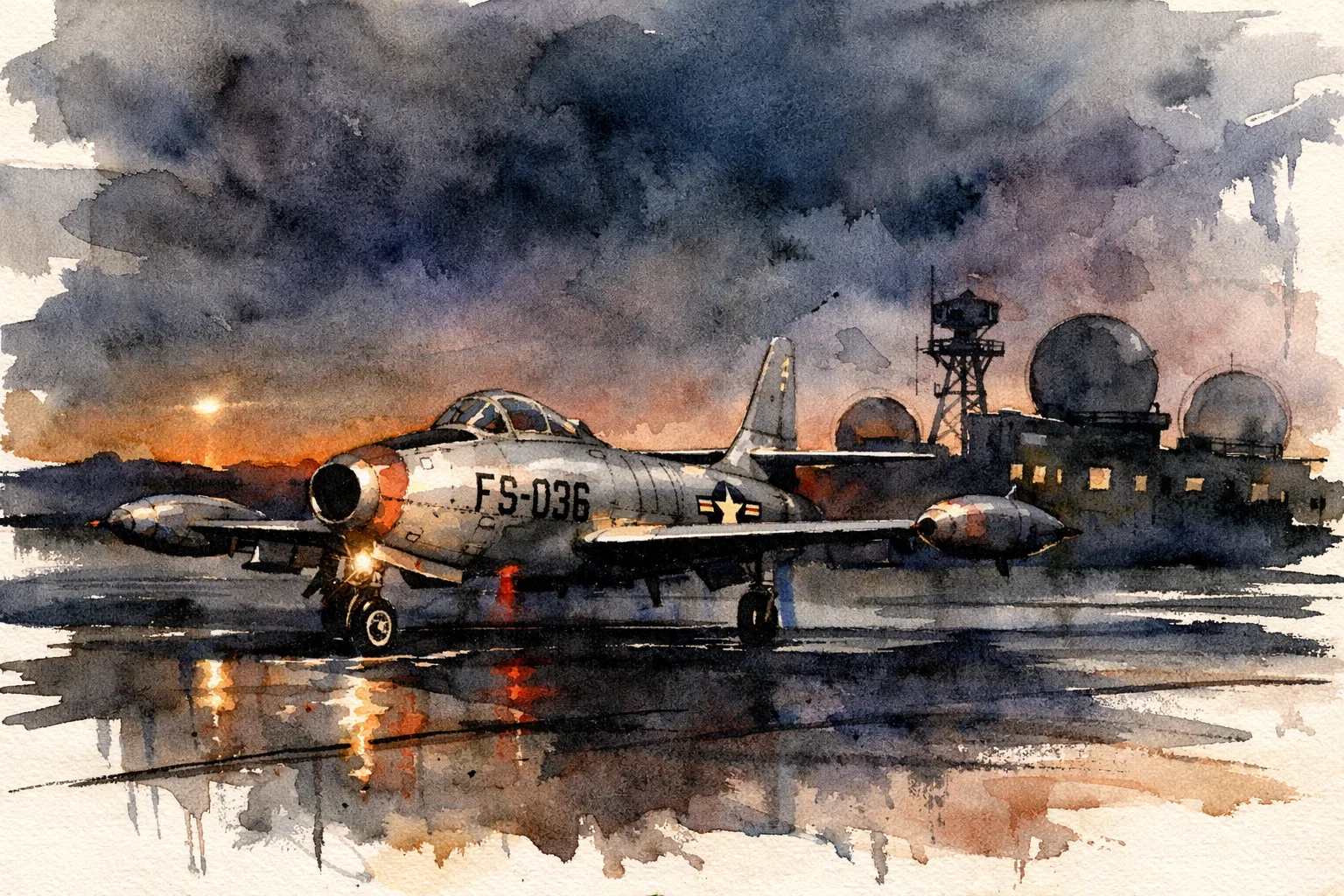
The 1953 Rapid City-Ellsworth incident is South Dakota’s landmark UFO case because it brought together the three things UFO investigators most wanted: visual witnesses, ground radar and jet intercepts. The core report began near Black Hawk, west of Rapid City, when a Ground Observer Corps observer reported a bright light, after which radar personnel at Ellsworth Air Force Base and F-84 pilots became involved. Former Project Blue Book director Edward J. Ruppelt later called it “an unknown—the best”, but later official and sceptical readings argued that the episode may have been a tangle of stars, meteors, radar artefacts, equipment problems and excited interpretation.[Project Gutenberg]gutenberg.orgSource details in endnotes.
That tension is why the case still matters. It is not good evidence of alien visitation, but it is unusually good evidence of how a serious Cold War UFO report could form: several observers, a defence radar environment, hurried intercept decisions and later disagreement about what the records actually proved.
What witnesses and radar crews reported
The event is usually associated with 12 August 1953 in Ruppelt’s published account, but the Project Blue Book file and later case summaries place the main Rapid City-Black Hawk sequence on 5-6 August 1953. That date issue is part of the case’s documentary problem: the famous retelling and the official file do not align perfectly, even though they describe the same broad Ellsworth-Rapid City incident.[NICAP]nicap.orgOpen source on nicap.org.
The first South Dakota report came from Black Hawk, about ten miles west of Ellsworth Air Force Base. A Ground Observer Corps observer, named in later summaries as Mrs Phyllis Killian, reported a stationary light northeast of her post. The Blue Book trip report says Warrant Officer Bennett, the duty controller, was on duty at about 2005 Mountain Standard Time when the report arrived through the Rapid City Filter Centre. The object was described as stationary, then moving south towards Rapid City; three airmen sent outside from the radar site reported a light moving generally north to south at high speed, while Bennett saw radar “blips” going south on the scope but had difficulty getting a clean track because of ground clutter.[NICAP]nicap.orgOpen source on nicap.org.
Ruppelt’s later book presents the same episode in stronger, more dramatic terms. In his version, the radar crew adjusted their scan after the telephone call, found a target in the reported area and used height-finding radar to place it at about 16,000 feet. He emphasised that the civilian spotter, radar controller and jet pilot later seemed to be reacting to the same moving object at the same time, which is why the case became so memorable in UFO literature.[Project Gutenberg]gutenberg.orgSource details in endnotes.
The most important evidential point is that this was not a simple “light in the sky” story. The report involved a local observer, radar operators, airmen sent outside to look, and at least two F-84 intercept attempts. That does not make the object extraordinary by itself, but it does put the case in the small group of radar-visual reports that Blue Book and later UFO researchers treated more seriously than single-witness sightings.
How the F-84 intercepts unfolded
The first F-84 was already airborne on combat air patrol west of the base. According to Ruppelt, the controller turned the pilot south of the base and then onto a course intended to bring him towards the light, still reported at around 16,000 feet. The pilot saw the light and closed to within about three miles, at which point the object reportedly began moving; Ruppelt stressed that the controller, the spotter and the pilot all saw or tracked that movement at the same time.[Project Gutenberg]gutenberg.orgSource details in endnotes.
Ruppelt’s account then becomes the source of the case’s most famous “cat and mouse” quality. The F-84 chased the light northwards, with the pilot reporting changes in brightness and the controller continuing to see a radar target. The object supposedly kept roughly three miles ahead, then both the jet and the target went beyond the radar scope. When the F-84 returned because of fuel, Ruppelt said a target reappeared behind it, about 10 to 15 miles back.[Project Gutenberg]gutenberg.orgSource details in endnotes.
A second F-84 was then scrambled. The second pilot, described as a veteran of both the Second World War and Korea, saw the light, climbed after it and tried several checks against ordinary explanations. Ruppelt wrote that the pilot turned off his aircraft lights to rule out reflection, rolled the aircraft to test whether the light’s position changed with his own movement, and compared it against nearby stars. The striking detail is the claimed radar-ranging gunsight response: Ruppelt said the red light on the gunsight blinked on, suggesting “something real and solid” ahead, after which the pilot requested permission to break off the intercept.[Project Gutenberg]gutenberg.orgSource details in endnotes.
The official material is less clean. The Blue Book trip report notes that photos of the radar track were attempted but the camera malfunctioned and the pictures were “no good”. It also says the last radar “blip” was at about 70 miles and that the account did “not exactly correlate” with the pilot’s report. Those two details matter: the case’s reputation rests heavily on radar-visual correlation, yet the surviving record itself warns that some parts did not line up neatly and that the hoped-for photographic record failed.[NICAP]nicap.orgOpen source on nicap.org.
Why the case looked strong at the time
The Rapid City-Ellsworth report looked powerful because it seemed to answer a common criticism of UFO cases. One witness can misperceive Venus; one radar return can be anomalous propagation; one pilot can misjudge distance at night. But when a ground observer, radar controller and interceptor pilot appear to describe the same thing, the case becomes harder to dismiss casually.
That is why Ruppelt treated it as exceptional. In his book, he wrote that the sighting had been “thoroughly investigated” and that every angle examined left “nothing but a big question mark”. His final line on the case, “This was an unknown—the best,” helped cement the incident’s status in later UFO writing.[Project Gutenberg]gutenberg.orgSource details in endnotes.
It also helped that the setting was militarily sensitive. Ellsworth, near Rapid City, was part of the Cold War air-defence landscape, and the witnesses were not merely casual sky-watchers. Ground Observer Corps personnel, radar controllers and fighter pilots all had roles in watching the sky, identifying aircraft and reacting to possible intrusions. That does not make their perceptions infallible, but it explains why Project Blue Book took the incident seriously enough for Ruppelt to travel to Rapid City to interview personnel and review the report.[NICAP]nicap.orgOpen source on nicap.org.
The case also sits within a broader South Dakota pattern. Historian Lawrence H. Larsen, writing in South Dakota History, noted that Air Force UFO investigations on the Great Plains were often forced to judge fleeting events from thin evidence, sometimes using only a record card or short telex message. Against that backdrop, the Ellsworth case stood out because it had more moving parts than most South Dakota reports: multiple observers, base involvement, radar and fighter response.[South Dakota Historical Society Press]sdhspress.comSouth Dakota Historical Society Press
Why strong evidence still falls short of proof
The case weakens when the evidence is separated into its parts. There is no surviving clear radar photograph, no physical trace, no instrument package from the object, no reliable independent film and no later technical reconstruction that proves a structured craft was present. The strongest version depends on witness memory, real-time radio/radar interpretation and Ruppelt’s narrative synthesis.
The University of Colorado’s later UFO study, commonly known as the Condon Report, offered a sceptical reconstruction. It treated the Rapid City-Bismarck sequence as a mixture of ordinary causes: stars seen through an inversion layer, at least one meteor, anomalous propagation echoes on ground-controlled-intercept radar, possible ghost echoes, and a possible malfunction of the airborne radar gunsight. It specifically suggested that one F-84 may have been chasing Pollux and that another may have been chasing Mirfak, both bright stars in plausible positions for the headings involved.[Ufologie]ufologie.patrickgross.orgSource details in endnotes.
The Condon account also noted weather conditions favourable to optical and radar confusion. It described a dark, moonless night, clear visibility, stable air, temperature inversions and radio ducts. Such conditions can make stars shimmer, brighten, appear to change colour or seem to move; they can also produce misleading radar returns. That does not prove every observation was a star or radar ghost, but it gives sceptics a coherent way to explain why several confusing things might have happened on the same night.[Ufologie]ufologie.patrickgross.orgSource details in endnotes.
The second pilot’s radar gunsight is one of the case’s most disputed details. In Ruppelt’s telling, the gunsight response strengthened the impression of a solid object ahead. The later Condon discussion, however, says the pilot told Dr J. Allen Hynek that the gunlock was due to equipment malfunction and that the radar gunsight continued malfunctioning on the return to base; it also notes that the equipment was apparently not checked before or during the Air Force investigation.[Project Gutenberg]gutenberg.orgSource details in endnotes.
This is the key difference between “interesting” and “proof”. The Rapid City-Ellsworth incident is interesting because the reports overlap in suggestive ways. It falls short of proof because the overlaps are not preserved in a clean, testable record. The case asks readers to trust a chain of human interpretation under pressure, rather than allowing them to examine hard instrument data for themselves.
How later investigation changed the meaning of the case
| The incident’s reputation changed because later investigators did not simply repeat Ruppelt’s conclusion. Hynek, who served as an Air Force astronomy consultant and later became one of the best-known UFO researchers, appears to have moved from concern to scepticism on this case. A modern Enigma Labs summary of the Blue Book file says Hynek first wrote that “solid objects” seemed indicated and that failure to identify the object could expose a weakness in defence, but later, in January 1954, he “totally discounted” the incident as a series of coincident circumstances.[Enigma Labs]enigmalabs.ioSource details in endnotes. | Report a UFO sighting |
That change matters because Hynek was not a simple debunker in the long run; he later criticised shallow official explanations in other UFO cases. If he became sceptical of Rapid City-Ellsworth after further review, that should carry weight. At the same time, the sceptical reconstruction is not airtight either. It asks readers to accept several overlapping ordinary explanations: a tower light or mistaken initial object, a meteor, stars, radar propagation effects, possible ghost echoes and possible equipment malfunction. A cluster of ordinary causes is plausible, especially on a night with inversion conditions, but it can feel less satisfying than a single clear identification.[Ufologie]ufologie.patrickgross.orgSource details in endnotes.
The official Blue Book context also complicates the case. The National Archives notes that Project Blue Book records were later transferred to public custody, and the Air Force fact sheet says Blue Book collected 12,618 reports from 1947 to 1969, with 701 left “Unidentified”. The Air Force’s final position was that no investigated UFO showed evidence of a national-security threat, unknown scientific principles or extraterrestrial vehicles.[National Archives]archives.govNational Archives Project BLUE BOOKNational Archives Project BLUE BOOK
That final Air Force conclusion does not erase the Rapid City-Ellsworth mystery; it frames it. In official terms, an “unidentified” or unresolved case meant the available data did not support a firm identification. It did not mean the Air Force had established an exotic craft. Larsen’s review of Great Plains cases makes the same caution useful in reverse: some Blue Book identifications were thin, arbitrary or based on insufficient evidence, so an official explanation also should not be treated as automatically decisive.[South Dakota Historical Society Press]sdhspress.comSouth Dakota Historical Society Press

What the best evidence really shows
The best evidence for the Rapid City-Ellsworth case is the convergence of reports, not any single spectacular item. The strongest case for something unusual rests on three linked claims: the Black Hawk observer reported an odd light; Ellsworth radar personnel believed they had a corresponding target; and F-84 pilots visually pursued lights that behaved oddly from their perspective. Ruppelt’s account adds the most force by presenting these as synchronised observations of one object.[Project Gutenberg]gutenberg.orgSource details in endnotes.
The best evidence against a dramatic interpretation is the case’s messy fit with ordinary night-sky and radar problems. The Blue Book trip report itself mentions ground clutter, poor radar-track photography and imperfect correlation with the pilot’s report. The Condon analysis then gives a technically grounded alternative: stars, meteor, inversion effects, anomalous propagation, possible ghost echoes and possible radar-gunsight malfunction.[NICAP]nicap.orgOpen source on nicap.org.
A balanced reading should therefore avoid two easy mistakes. The first is to say “radar plus pilots equals proof”. Radar returns can be misleading, pilots can misjudge lights at night, and stressful intercept situations can reinforce a mistaken interpretation. The second mistake is to say “stars and radar ghosts explain everything” with more confidence than the surviving record deserves. The official and later sceptical accounts include uncertainties of their own, including failed photos, untested equipment and conflicting recollections.[Ufologie]ufologie.patrickgross.orgSource details in endnotes.
For South Dakota’s UFO history, that is exactly why the case remains important. It is a high-quality unresolved-or-disputed report, not because it proves extraordinary technology, but because it preserves the whole evidential problem in one night near Rapid City: trained observers, military systems, ambiguous instruments, later reinterpretation and a record strong enough to be memorable but too incomplete to settle the matter.
Amazon book picks
Further Reading
Books and field guides related to Why the 1953 Rapid City Case Still Matters. Use these as the next step if you want deeper reading beyond the article.
The Report on Unidentified Flying Objects
Contains the Rapid City-Ellsworth case and its significance.
UFOs and Government
Places the incident within military and government investigations.
eBay marketplace picks
Marketplace Samples
Example marketplace items related to this page. Use the search link to explore similar finds on eBay.






Endnotes
1.
Source: gutenberg.org
Link:https://www.gutenberg.org/cache/epub/17346/pg17346.html
2.
Source: nicap.org
Link:https://www.nicap.org/Good_Cases/530805ellsworth_dir.htm
3.
Source: nicap.org
Link:https://www.nicap.org/docs/530805EllsworthPBB1_109-111_docs.pdf
4.
Source: enigmalabs.io
Link:https://enigmalabs.io/library/cbebd9ab-9279-43fa-9f20-6830f0113c1d
5.
Source: sdhspress.com
Title: South Dakota Historical Society Press
Link:https://www.sdhspress.com/journal/south-dakota-history-12-1/united-states-air-force-efforts-to-investigate-ufos-great-plains-encounters/vol-12-no-1-united-states-air-force-efforts-to-investigate-ufos.pdf
6.
Source: archives.gov
Title: National Archives Project BLUE BOOK
Link:https://www.archives.gov/research/military/air-force/ufos
7.
Source: archives.gov
Title: listdigitizedpartnerdata.xlsx
Link:https://www.archives.gov/files/digitization/listdigitizedpartnerdata-.xlsx
8.
Source: archives.gov
Link:https://www.archives.gov/files/research/foreign-policy/state-dept/finding-aids/inventory15-part2.pdf
9.
Source: declassification.blogs.archives.gov
Title: indexing queue for blog part one
Link:https://declassification.blogs.archives.gov/wp-content/uploads/sites/16/2015/10/indexing-queue-for-blog-part-one.pdf
10.
Source: archives.gov
Title: 07166993 hcsa report 1976 1979 jfk
Link:https://www.archives.gov/files/research/mlk/releases/2025/0721/07166993_hcsa_report_1976_1979_jfk.pdf
11.
Source: colorado.edu
Title: condon report cu boulders historic ufo study
Link:https://www.colorado.edu/coloradan/2021/11/05/condon-report-cu-boulders-historic-ufo-study
12.
Source: ufologie.patrickgross.org
Link:https://www.ufologie.patrickgross.org/htm/ellsworth53condon.htm
13.
Source: ufologie.patrickgross.org
Link:https://www.ufologie.patrickgross.org/htm/ellsworth53harney.htm
14.
Source: ufologie.patrickgross.org
Link:https://ufologie.patrickgross.org/htm/ellsworth53.htm
15.
Source: ufologie.patrickgross.org
Link:https://www.ufologie.patrickgross.org/htm/ellsworth53ruppelttrue.htm
16.
Source: Wikipedia
Title: Project Blue Book
Link:https://en.wikipedia.org/wiki/Project_Blue_Book
17.
Source: vault.fbi.gov
Link:https://vault.fbi.gov/Project%20Blue%20Book%20%28UFO%29%20/Project%20Blue%20Book%20%28UFO%29%20Part%2001%20%28Final%29/at_download/file
18.
Source: scribd.com
Link:https://www.scribd.com/document/427182434/Ufo
19.
Source: britannica.com
Title: Condon Report
Link:https://www.britannica.com/topic/Condon-Report
Additional References
20.
Source: youtube.com
Link:https://www.youtube.com/watch?v=RBAISwCZ2v0
Source snippet
"Ellsworth" UFO 1953 The Ellsworth UFO Encounter #unsolvedmystery The UFO Detective...
21.
Source: youtube.com
Title: What the Wall Street Journal isn’t telling you about UFOs | Reality Check
Link:https://www.youtube.com/watch?v=FVpWXxneti4
Source snippet
Estimating Flight Characteristics of Anomalous Unidentified Aerial Vehicles...
22.
Source: youtube.com
Link:https://www.youtube.com/watch?v=mv2EBM3El1w
Source snippet
UFO whistleblower David Grusch: 'We are not alone' | Official Ross Coulthart NewsNation interview...
23.
Source: youtube.com
Link:https://www.youtube.com/watch?v=D2KwttbD1r8
Source snippet
What the Wall Street Journal isn't telling you about UFOs | Reality Check...
24.
Source: youtube.com
Title: Estimating Flight Characteristics of Anomalous Unidentified Aerial Vehicles
Link:https://www.youtube.com/watch?v=fU6LOfiUJ6Q
Source snippet
1977 Nuke UAP Incident PART 1 - Mario Woods...
25.
Source: scribd.com
Link:https://www.scribd.com/document/838955243/Ufos-and-Intelligence
26.
Source: ufoevidence.org
Link:https://www.ufoevidence.org/cases/case41.htm
27.
Source: files.bluebookfiles.org
Link:https://files.bluebookfiles.org/pdfs/1953.08%20-%206979324%20-%20Rapid%20City%2C%20Blackhawk%2C%20Sough%20Dakota%20Area.pdf
28.
Source: archive.org
Link:https://archive.org/stream/anon_pdf_from_markdown/anon_pdf_from_markdown_djvu.txt
29.
Source: facebook.com
Link:https://www.facebook.com/groups/237316961284593/posts/788315899518027/
Topic Tree