Within West Virginia UFOs
What Does Green Bank Actually Search For?
Green Bank matters because real scientific listening for distant signals is often confused with eyewitness UFO claims in West Virginia lore.
On this page
- Project Ozma and early SETI listening
- Why the Radio Quiet Zone matters
- How SETI evidence differs from UFO testimony
Page outline Jump by section
Introduction
Green Bank matters to West Virginia UFO history because it is one of the few places in the state where “searching for extraterrestrial intelligence” is not folklore, tourism shorthand or witness rumour, but real scientific work. The confusion is easy to understand: Green Bank Observatory has listened for possible radio signals from distant technological civilisations, while West Virginia’s better-known UFO stories involve people reporting lights, creatures or frightening encounters. Those are not the same kind of claim. SETI looks for repeatable, measurable signals in telescope data; UFO testimony usually begins with human observation under uncertain conditions. Green Bank’s importance is therefore clarifying rather than sensational: it shows how a serious search for life beyond Earth can sit beside, but not validate, the state’s UFO lore. Frank Drake’s Project Ozma began there in 1960, and later programmes such as Breakthrough Listen have continued using the Green Bank Telescope for technosignature searches.[SETI Institute]seti.orgproject ozmaproject ozma[National Radio Astronomy Observatory]public.nrao.eduSource details in endnotes.
Why Green Bank gets pulled into UFO conversations
Green Bank is often mentioned alongside West Virginia’s famous UFO and monster stories because all of them touch the same large question: are humans alone? But they approach that question from very different directions. Flatwoods and Mothman are remembered through eyewitness accounts, local newspapers, later retellings and competing explanations. Green Bank is remembered through observatory records, radio astronomy hardware, published data work and a traceable scientific method.
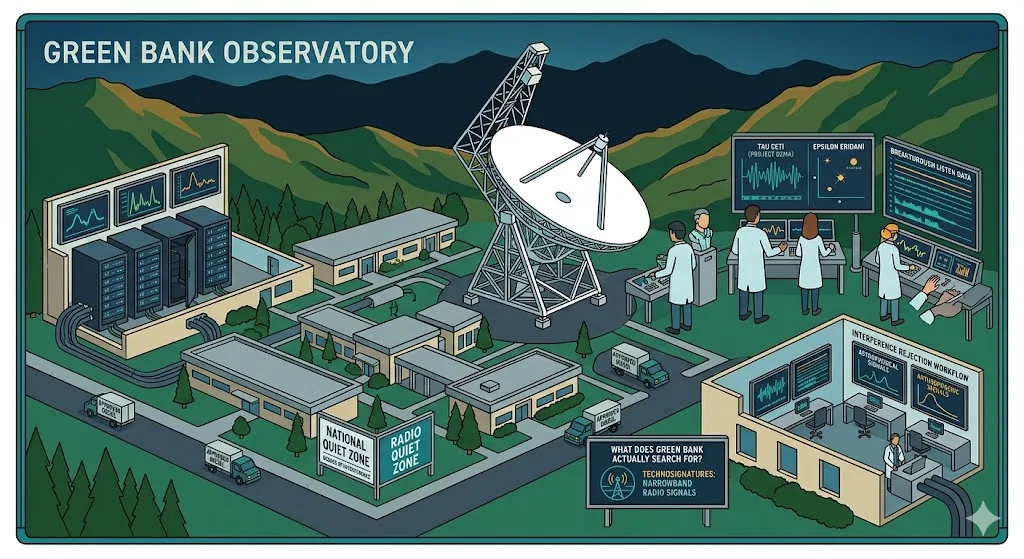
That distinction matters because the word “alien” can blur categories. In popular writing, a radio telescope “hunting aliens” may sound as if it is looking for flying saucers over Pocahontas County. It is not. SETI, the Search for Extraterrestrial Intelligence, is mainly a search for “technosignatures”: possible signs of technology, such as narrowband radio signals, that might come from a distant civilisation. Green Bank is listening outward across space, not investigating objects seen in West Virginia skies.[Green Bank Observatory]greenbankobservatory.orgGreen Bank Observatory
The state tourism and media angle adds another layer. West Virginia can truthfully point to Green Bank as a landmark in the scientific search for extraterrestrial intelligence, while also marketing folklore around Flatwoods and Point Pleasant. That can be useful for public interest, but it can also create a false impression that Green Bank somehow supports the strongest UFO claims. A better reading is that Green Bank gives the state two separate extraterrestrial traditions: one folkloric and witness-led, the other scientific and instrument-led.[WVExplorer]wvexplorer.comWest Virginia ground-zero for UFO research, ET encountersWest Virginia ground-zero for UFO research, ET encounters
Project Ozma and early SETI listening
Project Ozma is the reason Green Bank has a permanent place in SETI history. In 1960, radio astronomer Frank Drake used the 85-foot Howard E. Tatel telescope at the National Radio Astronomy Observatory in Green Bank, West Virginia, to conduct what is widely described as the first modern search for radio transmissions from extraterrestrial intelligence. The experiment focused on two nearby Sun-like stars, Tau Ceti and Epsilon Eridani.[SETI Institute]seti.orgproject ozmaproject ozma
The project was modest by modern standards, but its method was revolutionary. Instead of waiting for a spectacular sighting, Drake asked whether a civilisation elsewhere might produce detectable radio emissions. That made the question testable in a way that most UFO reports are not. The telescope could be pointed, the receiver tuned, the data examined, and possible interference checked. NRAO’s own historical material notes that Drake and his team observed the two target stars for two months and detected no signs of extraterrestrial intelligence.[National Radio Astronomy Observatory]public.nrao.eduSource details in endnotes.
That “no detection” is important. Project Ozma did not prove aliens were present, and it did not turn Green Bank into a UFO base. Its real achievement was methodological: it showed that the search for intelligent life could be framed as an astronomical experiment. In West Virginia’s UFO history, this is a useful counterweight to the state’s dramatic sighting cases. Green Bank’s strongest claim is not “something landed here”, but “scientists here helped create a disciplined way to look”.
The following year, Green Bank also became associated with the Drake equation. The SETI Institute states that the 1961 conference connected with the equation took place at Green Bank, the site of Project Ozma. The equation was less a firm calculation than a way to organise discussion about the factors that would affect the number of detectable civilisations in the galaxy. That origin story deepens Green Bank’s relevance: the place helped shape the vocabulary of scientific extraterrestrial inquiry, not just a single telescope run.[SETI Institute]seti.orgproject ozmaproject ozma

Why the Radio Quiet Zone matters
Green Bank is not simply a picturesque mountain location with a large dish. Its scientific value depends on radio quietness. The National Radio Quiet Zone was established in 1958 by the Federal Communications Commission and the Interdepartment Radio Advisory Committee to reduce harmful interference affecting the National Radio Astronomy Observatory at Green Bank and the US Navy radio receiving facilities at Sugar Grove.[Green Bank Observatory]greenbankobservatory.orgGreen Bank Observatory
That radio quietness is easily misunderstood. It does not mean the area is mystical, cut off from the modern world by legend, or unusually prone to strange aerial events. It means radio astronomy is vulnerable. The signals astronomers seek can be extraordinarily faint, while nearby human devices can be loud in comparison. Green Bank Observatory explains that locally produced radio-frequency interference can damage observations, and its interference protection work covers the observatory site, the West Virginia Radio Astronomy Zone and the wider National Radio Quiet Zone.[Green Bank Observatory]greenbankobservatory.orgGreen Bank Observatory
The rules also make Green Bank feel unusual to visitors. Observatory guidance describes restrictions on intentional radio emitters, including many wireless devices, and notes that only approved diesel vehicles are allowed in the most protected zone because ordinary spark-ignition engines can create interference. The point is practical, not paranormal: reduce local radio noise so instruments can detect weak cosmic signals.[Green Bank Observatory]greenbankobservatory.orgGreen Bank Observatory
Recent changes show that the Quiet Zone is a managed scientific environment rather than a frozen relic. In 2025, Green Bank Observatory published guidance explaining that Wi-Fi rules depend on overlapping zones, including the state-recognised West Virginia Radio Astronomy Zone within a 10-mile radius of the observatory. The continuing debate over Wi-Fi and interference is a reminder that Green Bank’s “silence” is not absolute; it is a negotiated balance between community needs and sensitive research.[Green Bank Observatory]greenbankobservatory.orgGreen Bank Observatory
How SETI evidence differs from UFO testimony
The simplest way to separate Green Bank SETI from UFO reports is to ask what kind of evidence is being evaluated. A UFO report usually begins with a witness: someone saw a light, shape, object, creature or movement they could not identify. Investigators then ask whether the observation could have been a planet, aircraft, meteor, balloon, drone, atmospheric effect, hoax, misperception or genuinely unresolved event. The evidence often depends on memory, timing, location, weather, stress, viewing angle and the availability of independent records.
SETI reverses the starting point. It begins with an instrument, a defined target, a frequency range, a data stream and a filtering problem. Researchers are not asking whether a frightened witness saw something correctly. They are asking whether a signal in telescope data has the characteristics expected of technology and whether it can be separated from radio-frequency interference, satellites, aircraft, terrestrial transmitters or known astrophysical sources.
That difference does not make SETI easy. In fact, modern searches show how hard it is. A 2024 technosignature search using the Breakthrough Listen Green Bank Telescope archive described human-generated radio-frequency interference as a primary challenge even though the telescope sits in a radio-quiet zone. The study searched thousands of observation cadences and thousands of stars, looking for narrowband drifting radio signals, and still had to treat interference rejection as central to the work.[arXiv]arxiv.orgarXiv Results of ten years of UCLA SETI searches with the Green Bank TelescopearXiv Results of ten years of UCLA SETI searches with the Green Bank Telescope
A 2026 UCLA SETI results paper using the Green Bank Telescope reported more than 100 million candidate signals, all of which had so far been confirmed as anthropogenic, meaning human-made. That is a striking example for UFO readers: a “candidate” is not a discovery. In SETI, interesting signals are expected to face layers of rejection before anyone treats them as possible evidence of extraterrestrial technology.[arXiv]arxiv.orgarXiv Results of ten years of UCLA SETI searches with the Green Bank TelescopearXiv Results of ten years of UCLA SETI searches with the Green Bank Telescope
NASA’s 2023 UAP work helps underline the same principle from the UFO side. Its independent study argued that UAP research needs rigorous, evidence-based methods and better data acquisition. Reuters summarised the panel’s message bluntly: existing data and eyewitness reports alone were insufficient to draw firm conclusions about every UAP event. That does not dismiss witnesses; it explains why testimony and instrument-quality evidence are not equivalent.[NASA Science]science.nasa.govScience Independent Study Team ReportScience Independent Study Team Report
The 1988 telescope collapse shows how rumours form
One Green Bank episode directly illustrates the gap between dramatic explanation and investigated cause. On 15 November 1988, the observatory’s 300-foot telescope collapsed. NRAO preserves an example of the sensational aftermath under the title “Zapped by Aliens?”, showing a newspaper claim that the telescope had been attacked by “hostile space aliens”. The official explanation was very different: later investigation found that the collapse was caused by a worn or cracked metal connector plate, not by an extraterrestrial attack.[National Radio Astronomy Observatory]public.nrao.eduSource details in endnotes.
This incident belongs in a West Virginia UFO discussion because it shows the mechanism of confusion in miniature. A large scientific instrument associated with space and “alien signals” suffers a sudden failure. The image is dramatic. The public setting already carries extraterrestrial associations. A speculative explanation appears. Then engineering investigation supplies a mundane cause.
That pattern is familiar across UFO history. The first story may be memorable, but the later evidence may be stronger. In the Green Bank case, the later evidence weakened the alien claim decisively. It did not weaken Green Bank’s importance; it clarified it. The observatory is not valuable because it generates alien rumours, but because it has the tools and discipline to separate signal from noise.
Breakthrough Listen and the modern Green Bank role
Green Bank’s SETI connection did not end with Project Ozma. Breakthrough Listen, launched in 2015 as a large-scale search for evidence of technological civilisations, has used the Robert C. Byrd Green Bank Telescope as one of its major radio facilities. Green Bank Observatory describes Breakthrough Listen as a programme surveying nearby stars, the centre and plane of the Milky Way, and nearby galaxies for possible evidence of distant civilisations.[Green Bank Observatory]greenbankobservatory.orgGreen Bank Observatory
The scale is far beyond Ozma. Breakthrough Listen systems at the Green Bank Telescope were designed to handle enormous data rates, with a 2017 technical paper describing a wide-bandwidth recording system capable of digitising up to 6 GHz of bandwidth and writing data at 24 GB per second. A later paper on Breakthrough Listen public data described raw data volumes averaging more than a petabyte per day during early observations across Green Bank, Parkes and other facilities.[arXiv]arxiv.orgarXiv Results of ten years of UCLA SETI searches with the Green Bank TelescopearXiv Results of ten years of UCLA SETI searches with the Green Bank Telescope
For a mainstream UFO-curious reader, the takeaway is not “scientists have found aliens”. They have not. The takeaway is that modern SETI is a large data problem. It involves target lists, signal processing, public archives, machine learning, citizen-science classification and constant interference rejection. When a signal appears, the first assumption is not “contact”, but “what known source or human-made interference could explain this?”[arXiv]arxiv.orgarXiv Results of ten years of UCLA SETI searches with the Green Bank TelescopearXiv Results of ten years of UCLA SETI searches with the Green Bank Telescope
Green Bank’s public presentation has also changed. Reporting on Green Bank’s SETI tours has noted that visitors can see the historic Project Ozma setting and learn about the observatory’s role in the search for extraterrestrial intelligence. That public-facing “alien hunting” language is understandable and engaging, but it needs careful handling. It should draw people toward science, not encourage them to merge SETI with every West Virginia UFO legend.[Green Bank Observatory]greenbankobservatory.orgGreen Bank Observatory
What Green Bank does not prove about West Virginia UFOs
Green Bank does not prove that the Flatwoods Monster was an alien, that Mothman was connected to extraterrestrial craft, or that unusual lights reported in West Virginia skies are technological visitors. It also does not provide a hidden archive of solved UFO cases. Its relevance is narrower and stronger: it shows that West Virginia has a genuine, documented place in the scientific search for extraterrestrial intelligence.
That matters because UFO culture often treats all “alien” material as one pile. A monster sighting, a military case file, a radio telescope, a NASA report, a local legend and a speculative headline can be made to look mutually reinforcing when they are really different evidential categories. Green Bank is a useful corrective. It says: yes, scientists have searched for evidence of other technological civilisations from West Virginia; no, that does not automatically upgrade eyewitness UFO reports into confirmed alien events.
The Air Force’s Project Blue Book history gives a useful comparison. The Air Force investigated 12,618 UFO reports from 1947 to 1969 and left 701 classified as unidentified, but “unidentified” did not mean “extraterrestrial”. It meant the available information did not support a firm identification. Green Bank SETI uses the opposite pressure: even a promising candidate signal must survive aggressive attempts to identify it as interference or ordinary human technology before it could become extraordinary evidence.[U.S. Air Force]af.milSource details in endnotes.
The best way to read Green Bank within West Virginia UFO history
Green Bank should be treated as a boundary marker in West Virginia’s UFO landscape. On one side are stories built around witnesses, memory, fear, place and folklore: Flatwoods, Point Pleasant and local sighting clusters. On the other side is instrument-based extraterrestrial research: Project Ozma, the Drake equation, radio quietness, Breakthrough Listen and modern technosignature searches.
The two sides can speak to each other, but they should not be collapsed into one claim. Green Bank helps readers ask better questions of UFO stories: What exactly was recorded? Was the observation repeatable? Were there independent sensors? Could interference, aircraft, astronomical objects or local conditions explain it? What would count as stronger evidence?
That is why Green Bank is so valuable in this state project. It gives West Virginia a real extraterrestrial-science landmark without requiring any exaggeration of UFO claims. Its legacy is not a confirmed message from another civilisation, nor an official endorsement of flying-saucer lore. Its legacy is a disciplined search: listening carefully, rejecting weak signals, documenting methods, and keeping the difference between curiosity and evidence clear.
Amazon book picks
Further Reading
Books and field guides related to What Does Green Bank Actually Search For?. Use these as the next step if you want deeper reading beyond the article.
The Search for Extraterrestrial Intelligence
Closely matches Green Bank's role in listening for signals rather than investigating UFO sightings.
Cosmos
Explains humanity's place in the universe and the scientific search for life beyond Earth.
Contact
Rating: 4.0/5 from 21 Google Books ratings
Centres on radio astronomy and the search for extraterrestrial intelligence.
eBay marketplace picks
Marketplace Samples
Example marketplace items related to this page. Use the search link to explore similar finds on eBay.








Endnotes
1.
Source: seti.org
Title: project ozma
Link:https://www.seti.org/research/seti-101/project-ozma/
2.
Source: public.nrao.edu
Link:https://public.nrao.edu/gallery/project-ozma-hardware/
3.
Source: greenbankobservatory.org
Link:https://greenbankobservatory.org/science/partners/breakthrough-listen/
4.
Source: arxiv.org
Title: arXiv Results of ten years of UCLA SETI searches with the Green Bank Telescope
Link:https://arxiv.org/abs/2605.05408
5.
Source: wvexplorer.com
Title: West Virginia ground-zero for UFO research, ET encounters
Link:https://wvexplorer.com/west-virginia-ufo-seti-green-bank-flatwoods-mothman/
6.
Source: seti.org
Title: drake equation
Link:https://www.seti.org/research/seti-101/drake-equation/
7.
Source: greenbankobservatory.org
Link:https://greenbankobservatory.org/about/national-radio-quiet-zone/
8.
Source: science.nrao.edu
Link:https://science.nrao.edu/spectrum/services/nrqz
9.
Source: greenbankobservatory.org
Link:https://greenbankobservatory.org/about/interference-protection/
10.
Source: greenbankobservatory.org
Link:https://greenbankobservatory.org/about/rfi-mitigation/
11.
Source: greenbankobservatory.org
Title: Green Bank Observatory Wi Fi in the “Quiet Zone” FAQs
Link:https://greenbankobservatory.org/news/wifi-in-the-quiet-zone-faqs/
12.
Source: arxiv.org
Link:https://arxiv.org/abs/2412.05786
13.
Source: science.nasa.gov
Title: Science Independent Study Team Report
Link:https://science.nasa.gov/wp-content/uploads/2023/09/uap-independent-study-team-final-report.pdf
14.
Source: reuters.com
Title: nasa panel hold first public meeting ufo study ahead report 2023 05 31
Link:https://www.reuters.com/world/us/nasa-panel-hold-first-public-meeting-ufo-study-ahead-report-2023-05-31/
15.
Source: public.nrao.edu
Link:https://public.nrao.edu/gallery/zapped-by-aliens/
16.
Source: greenbankobservatory.org
Link:https://greenbankobservatory.org/about/telescopes/300-foot-telescope/
17.
Source: arxiv.org
Link:https://arxiv.org/abs/1707.06024
18.
Source: arxiv.org
Link:https://arxiv.org/abs/1906.07391
19.
Source: greenbankobservatory.org
Title: Green Bank Observatory SETI Tour
Link:https://greenbankobservatory.org/events/seti-tour/
20.
Source: wvpublic.org
Title: green bank observatory offers behind the scenes seti tours
Link:https://wvpublic.org/story/health-science/green-bank-observatory-offers-behind-the-scenes-seti-tours/
21.
Source: af.mil
Link:https://www.af.mil/About-Us/Fact-Sheets/Display/Article/104590/unidentified-flying-objects-and-air-force-project-blue-book/
22.
Source: science.nrao.edu
Link:https://science.nrao.edu/facilities/gbt
23.
Source: info.nrao.edu
Title: national radio quiet zone nrqz 1
Link:https://info.nrao.edu/do/spectrum-management/national-radio-quiet-zone-nrqz-1
24.
Source: gb.nrao.edu
Title: drake lecture
Link:https://www.gb.nrao.edu/OZMA%4050/drake_lecture.html
25.
Source: science.nrao.edu
Link:https://science.nrao.edu/facilities/gbt/interference-protection/nrqz
26.
Source: science.nrao.edu
Title: breakthrough listen
Link:https://science.nrao.edu/science/meetings/2016/breakthrough_listen
27.
Source: library.nrao.edu
Link:https://library.nrao.edu/public/collection/02000000000301.pdf
28.
Source: public.nrao.edu
Title: achilles heel of the 300foot
Link:https://public.nrao.edu/gallery/achilles-heel-of-the-300foot/
29.
Source: gb.nrao.edu
Title: FCC Docket 11745 NRQZ
Link:https://www.gb.nrao.edu/nrqz/FCC_Docket_11745_NRQZ.pdf
30.
Source: gb.nrao.edu
Title: The Enemy Is Us
Link:https://www.gb.nrao.edu/visitors/TheEnemyIsUs.pdf
31.
Source: Wikipedia
Title: Project Ozma
Link:https://en.wikipedia.org/wiki/Project_Ozma
32.
Source: Wikipedia
Title: Breakthrough Listen
Link:https://en.wikipedia.org/wiki/Breakthrough_Listen
33.
Source: Wikipedia
Title: Drake equation
Link:https://en.wikipedia.org/wiki/Drake_equation
34.
Source: Wikipedia
Title: Green Bank Telescope
Link:https://en.wikipedia.org/wiki/Green_Bank_Telescope
35.
Source: Wikipedia
Title: Project Blue Book
Link:https://en.wikipedia.org/wiki/Project_Blue_Book
36.
Source: greenbankobservatory.org
Link:https://greenbankobservatory.org/nrqz-old/interference-protection/
37.
Source: greenbankobservatory.org
Title: green bank observatory mourns the loss of frank drake
Link:https://greenbankobservatory.org/front-page-news/green-bank-observatory-mourns-the-loss-of-frank-drake/
38.
Source: greenbankobservatory.org
Title: Green Bank Observatory
Link:https://greenbankobservatory.org/
39.
Source: greenbankobservatory.org
Link:https://greenbankobservatory.org/about-old/radio-interference/
40.
Source: greenbankobservatory.org
Title: green bank observatory works with local school to allow wifi in the quiet zone
Link:https://greenbankobservatory.org/front-page-news/green-bank-observatory-works-with-local-school-to-allow-wifi-in-the-quiet-zone/
41.
Source: greenbankobservatory.org
Link:https://greenbankobservatory.org/quiet-zones/
42.
Source: greenbankobservatory.org
Title: ozma at 60
Link:https://greenbankobservatory.org/science/meetings-and-workshops/ozma-at-60/
43.
Source: greenbankobservatory.org
Link:https://greenbankobservatory.org/what-is-the-green-bank-observatory/
44.
Source: greenbankobservatory.org
Title: breakthrough listen releases 2 pb of data from seti survey of milky way
Link:https://greenbankobservatory.org/news/breakthrough-listen-releases-2-pb-of-data-from-seti-survey-of-milky-way/
45.
Source: greenbankobservatory.org
Link:https://greenbankobservatory.org/front-page-news/seti-breakthrough-listen-and-cornell-university-search-for-extraterrestrial-pulses-in-gbt-data/
46.
Source: astronomy.com
Title: april 8 1960 frank drake begins project ozma
Link:https://www.astronomy.com/https%3A/april-8-1960-frank-drake-begins-project-ozma/
47.
Source: astronomy.com
Title: april 8 1960 frank drake begins project ozma
Link:https://www.astronomy.com/today-in-the-history-of-astronomy/april-8-1960-frank-drake-begins-project-ozma/
48.
Source: ebsco.com
Title: drake equation
Link:https://www.ebsco.com/research-starters/astronomy-and-astrophysics/drake-equation
49.
Source: archives.gov
Title: Project BLUE BOOK
Link:https://www.archives.gov/research/military/air-force/ufos
50.
Source: seti.org
Title: a primer on seti at the seti institute
Link:https://www.seti.org/research/seti-101/a-primer-on-seti-at-the-seti-institute/
51.
Source: seti.org
Title: drake equation 55 years old
Link:https://www.seti.org/news/drake-equation-55-years-old/
52.
Source: astrobites.org
Title: drake equation
Link:https://astrobites.org/2022/09/04/drake-equation/
53.
Source: youtube.com
Link:https://www.youtube.com/watch?v=T5vvK2L1FL8
54.
Source: history.com
Title: project ozma launches search extraterrestrial life
Link:https://www.history.com/this-day-in-history/april-12/project-ozma-launches-search-extraterrestrial-life
55.
Source: wdtv.com
Title: green bank observatory allows wifi their quiet zone first time
Link:https://www.wdtv.com/2025/08/06/green-bank-observatory-allows-wifi-their-quiet-zone-first-time/
56.
Source: science.nasa.gov
Link:https://science.nasa.gov/uap/
57.
Source: wvexplorer.com
Title: national radio quiet zone west virginia
Link:https://wvexplorer.com/national-radio-quiet-zone-west-virginia/
58.
Source: britannica.com
Title: Extraterrestrial intelligence
Link:https://www.britannica.com/science/extraterrestrial-intelligence/Radio-searches
59.
Source: britannica.com
Link:https://www.britannica.com/event/Project-Ozma
60.
Source: space.com
Title: arecibo observatory green bank telescope collapse lessons
Link:https://www.space.com/arecibo-observatory-green-bank-telescope-collapse-lessons
61.
Source: aps.org
Title: green bank observatory radio silent
Link:https://www.aps.org/apsnews/2024/01/green-bank-observatory-radio-silent
Additional References
62.
Source: washingtonpost.com
Link:https://www.washingtonpost.com/opinions/2025/08/27/wifi-quiet-school-west-virginia-astronomy/
Source snippet
Various proposals to introduce connectivity without disrupting telescope operations were considered but proved impractical. The new compr...
63.
Source: youtube.com
Link:https://www.youtube.com/watch?v=apVKobWigMw
Source snippet
OTD in Space – April 11: 'Project Ozma' Begins Search for Alien Life...
64.
Source: youtube.com
Title: A Tour of the Green Bank Observatory and Breakthrough Listen
Link:https://www.youtube.com/watch?v=7HVVNujXK2Q
Source snippet
Sarah Scoles, Author of “They Are Already Here: UFO Culture and Why We See Saucers” (043)...
65.
Source: nsa.gov
Link:https://www.nsa.gov/portals/75/documents/news-features/declassified-documents/ufo/usaf_fact_sheet_95_03.pdf
66.
Source: youtube.com
Title: Why the Biggest Radio Telescope Is Practically Useless
Link:https://www.youtube.com/watch?v=WntZu73iwUA
Source snippet
What Does The Mystery Signal From Space Mean?...
67.
Source: facebook.com
Link:https://www.facebook.com/GreenBankObservatory/posts/debunking-misconceptions-about-life-in-the-quiet-zones-myth-the-quiet-zone-is-th/1067006448930080/
68.
Source: facebook.com
Link:https://www.facebook.com/WIONews/posts/declassified-documents-raise-intrigueus-air-force-document-cites-12618-ufo-sight/1335121142060390/
69.
Source: foothill.edu
Link:https://www.foothill.edu/attach/938/Drake_equation.pdf
70.
Source: bigear.org
Link:https://www.bigear.org/CSMO/HTML/CS01/cs01p10.htm
71.
Source: reddit.com
Link:https://www.reddit.com/r/space/comments/16ij6ui/nasa_shares_unidentified_anomalous_phenomena/
Topic Tree