Within Elmendorf
Why Alaska's defences produced UFO reports
Alaska's Cold War radar network made unidentified lights and tracks more likely to be noticed, recorded and misunderstood.
On this page
- How Elmendorf fitted into Alaska air defence
- Why radar posts and controllers recorded unknowns
- Natural and technical explanations that complicate the record
Page outline Jump by section
Introduction
Alaska’s Cold War air-defence system created ideal conditions for UFO reports to emerge, spread and sometimes persist unresolved. Long before modern debates about unidentified aerial phenomena, the state’s radar operators, interceptor pilots and ground controllers were watching one of the most sensitive frontiers in the world: the Arctic approaches between the Soviet Union and North America. In that environment, unusual lights, strange radar returns and unidentified aircraft tracks were treated first as potential military threats and only secondarily as mysteries. That helps explain why Alaska produced a steady stream of military UFO stories linked to Elmendorf Air Force Base, remote radar stations and NORAD operations.
 The important point is not that Alaska generated uniquely convincing evidence of extraterrestrial craft. Rather, the state’s geography and defence network made unusual aerial events more likely to be detected, recorded and escalated through official channels. Some reports probably reflected equipment limits, weather effects or misidentifications. Others remain unresolved because the original records were incomplete, classified or never fully investigated publicly. Understanding the radar network itself is therefore essential to understanding Alaska’s place in American UFO history.[National Archives]archives.govNational ArchivesProject BLUE BOOK - Unidentified Flying ObjectsAugust 15, 2016 — Project BLUE BOOK has been declassified and the records…[Wikipedia]WikipediaElmendorf Air Force BaseElmendorf Air Force Base
How Elmendorf fitted into Alaska air defence
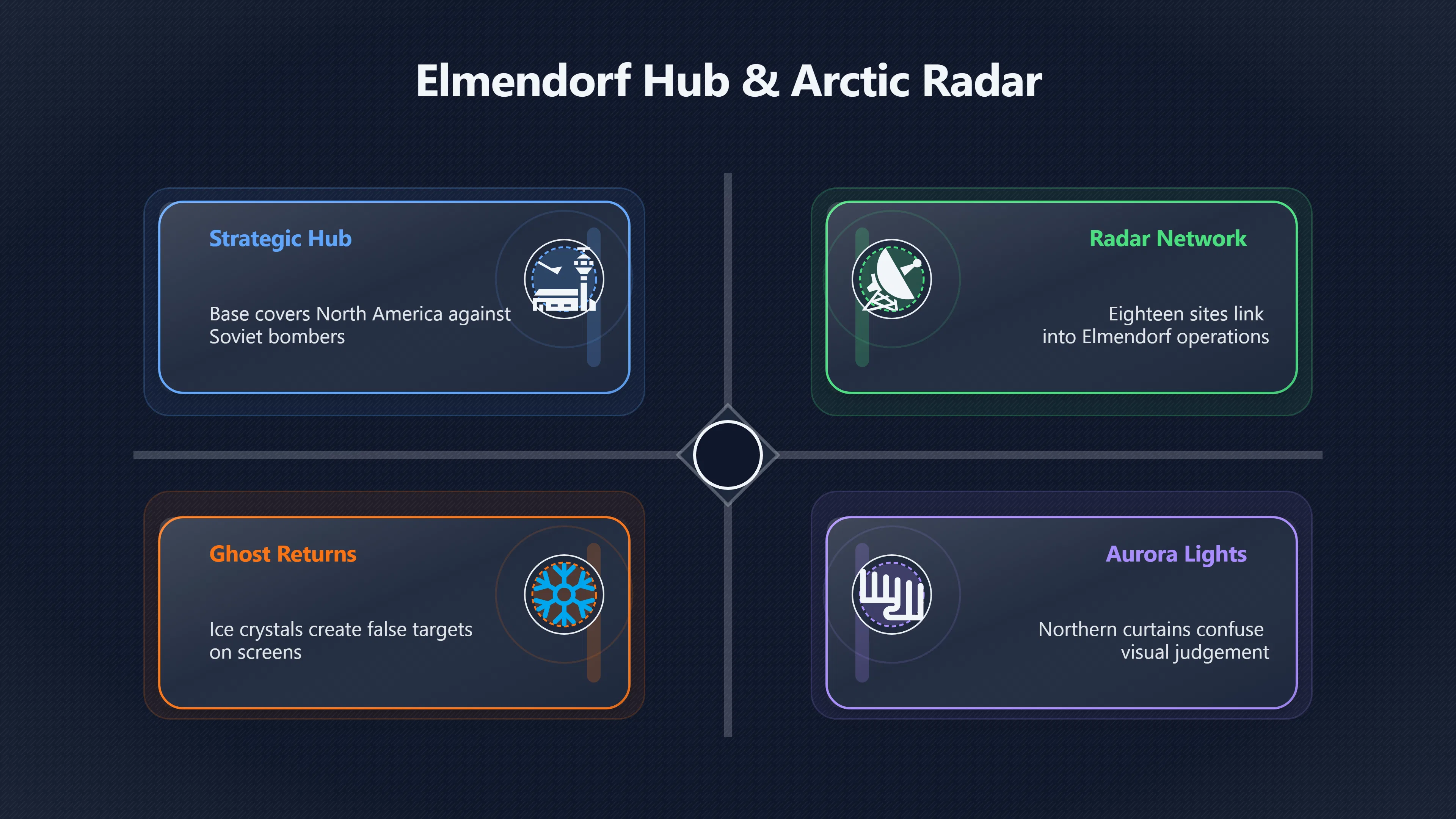
During the early Cold War, Alaska was treated as a likely avenue for Soviet bomber attack. The shortest route between the USSR and the continental United States crossed the Arctic, making Alaska strategically critical decades before intercontinental missiles reduced the importance of bomber interception. In response, the United States built an extensive warning system of radar stations, communications relays and interceptor bases across the territory. Elmendorf Air Force Base near Anchorage became the operational hub for much of this activity.[alaska]dnr.alaska.govNorthern Defenders Cold War Context of Ladd Air Force BaseAlaska Department of Natural Resourcescold war context of - ladd air force baseAlaska, as the closest American territory to the Soviet Un… Department of Natural Resources
By the 1950s, Alaska’s defence network included aircraft control and warning squadrons, Ground Control Intercept stations and increasingly sophisticated radar coverage stretching across remote regions. Controllers tracked unknown aircraft, directed fighters toward suspicious targets and coordinated with what later became NORAD’s continental defence structure. Eighteen radar sites were eventually tied into Elmendorf’s operations, reinforcing the base’s reputation as “Top Cover for North America”.[Wikipedia]WikipediaProject Blue BookProject Blue Book
This structure mattered because radar operators were under constant pressure to distinguish between ordinary activity and possible hostile intrusion. A radar blip was not merely an abstract anomaly. It could represent a Soviet reconnaissance aircraft, a navigation error, atmospheric clutter, equipment malfunction or an object that genuinely could not be identified in the moment. Reports that later entered UFO literature often originated in this high-alert environment rather than in casual observation.
The military culture of the period also encouraged formal reporting. Personnel were expected to document unusual tracks, visual sightings and unidentified aircraft behaviour. That produced records more detailed than many civilian UFO accounts, but it also meant that incidents were framed primarily through the lens of air defence rather than scientific investigation.
Why radar posts and controllers recorded unknowns
Alaska’s radar network generated UFO reports for practical reasons rooted in geography, technology and Cold War readiness.
Arctic conditions produced difficult radar environments
Radar systems in Alaska operated under harsh conditions that complicated interpretation. Temperature inversions, ice crystals, auroral activity and unusual atmospheric layering could all affect radar performance. Operators sometimes encountered “ghost” returns, anomalous reflections or intermittent tracks that appeared solid on screens but did not correspond neatly to visible aircraft.
The aurora borealis created additional confusion. Bright moving curtains of light could distort visual judgement and occasionally coincide with radar irregularities, especially on early systems that lacked modern filtering and signal processing. Pilots and controllers already primed to watch for hostile aircraft could interpret ambiguous signals more dramatically under those conditions.
Mountain terrain also mattered. Alaska’s rugged geography created radar shadows and unpredictable reflections. Aircraft moving through valleys or around coastal terrain could appear, disappear and reappear suddenly on scopes. In some cases, operators interpreted these abrupt changes as extraordinary manoeuvres rather than limitations of coverage.
Early radar systems were imperfect
Cold War radar technology was impressive for its time but still relatively primitive by modern standards. Operators relied heavily on human interpretation. Clutter rejection systems were limited, tracking continuity could fail and false returns were common enough that experienced crews developed informal judgement methods rather than relying purely on instrumentation.
This context helps explain why some military UFO reports combined radar and visual observations without producing clear conclusions. A radar return might briefly align with a distant light, encouraging operators to treat both as the same object even when the connection was uncertain.
The broader history of Project Blue Book shows that radar-visual cases received particular attention because they appeared more credible than simple eyewitness testimony. Yet even Air Force investigators acknowledged that radar data could be ambiguous and vulnerable to misinterpretation.[Air Force]youtube.comUS Military Helicopter Tracks UFO Across Alaska | Aliens In AlaskaAir Force Radar Operator's Terrifying UFO Encounter in Alaska | Aliens In Alaska…
Alaska’s alert posture amplified uncertainty
The Alaskan defence network existed to detect threats quickly, not to conduct slow scientific analysis. Operators were trained to err on the side of caution. An unexplained radar track might trigger interceptor responses before investigators had time to determine whether it represented equipment noise, weather effects or a genuine aircraft.
That operational mindset encouraged rapid reporting and sometimes preserved incidents in official files before mundane explanations emerged. In other cases, explanations never became definitive because records remained classified, incomplete or dispersed across different commands.
The 1950 Elmendorf sighting reflected this culture. Witnesses from an aircraft control and warning squadron described a reddish-orange object manoeuvring unusually over Anchorage before disappearing rapidly to the north-east. Because trained personnel submitted a formal report, the incident gained lasting status in UFO literature even though no decisive explanation followed publicly.[Discovery UK]discoveryuk.comt same year via three teenagers from Anchorage who reported seeing a white…Read more…
Why military UFO reports carried extra weight
Many Alaska UFO stories attracted attention because they involved trained observers rather than casual civilian witnesses. Radar controllers, interceptor pilots and air-defence personnel were assumed to possess stronger aircraft recognition skills and greater familiarity with atmospheric phenomena.
That assumption has some validity, but it can also be misleading.
Military observers were skilled within specific operational contexts. They knew how aircraft normally behaved, how radar contacts usually appeared and what common equipment problems looked like. However, they also operated in stressful conditions shaped by fatigue, secrecy and the expectation of potential Soviet attack. Under those circumstances, unusual observations could become psychologically magnified.
This tension appears repeatedly in Cold War UFO history. Reports from military personnel often sound more credible because of the technical language involved: tracked targets, vector changes, radar lock-ons and interceptor scrambles. Yet technical vocabulary does not automatically mean the underlying interpretation was correct.
The wider American UFO record contains many examples where later analysis identified stars, planets, classified aircraft or atmospheric conditions behind initially alarming military reports. The U-2 reconnaissance programme is a famous example. High-altitude flights during the 1950s produced numerous UFO reports because civilian and military observers were unfamiliar with aircraft operating at such extreme altitudes.[Naval History and Heritage Command]history.navy.milu2s ufos and operation blue bookNaval History and Heritage CommandU-2s, UFOs, and Operation Blue Book24 Jan 2024 — Consequently, once U-2s started flying at altitudes ab…
In Alaska, the same pattern likely affected some reports involving interceptor crews and radar stations. The combination of secrecy, limited public information and genuine uncertainty allowed unresolved incidents to accumulate a mystique that persisted long after the original operational context faded.
The Japan Air Lines case and the limits of radar evidence
Although it occurred decades after the earliest Cold War sightings, the 1986 Japan Air Lines incident near Alaska illustrates the continuing difficulties of interpreting radar-associated UFO reports.
Captain Kenju Terauchi and his crew reported unusual lights while flying over Alaska, and Anchorage air traffic control became involved as controllers attempted to assess what the crew was seeing. The case gained international attention because radar data appeared at first to support the sightings. However, later Federal Aviation Administration review concluded that the radar evidence did not confirm a solid unknown object shadowing the aircraft in the way initially reported.[UPI]upi.comRadar review fails to confirm UFORadar review fails to confirm UFO - UPI Archives8 Jan 1987 — ANCHORAGE, Alaska – Federal investigators said a review of radar tapes f…
The case remains controversial in UFO circles precisely because it exposed the ambiguity of radar interpretation. Supporters point to pilot testimony and controller concern. Sceptics emphasise the absence of definitive radar confirmation and the possibility of planetary or atmospheric misidentification.
What matters for Alaska’s broader UFO history is that the incident echoed older Cold War patterns:
- Highly trained observers reported unusual aerial phenomena.
- Radar data appeared significant initially but proved difficult to interpret conclusively.
- Public retellings often simplified the uncertainty.
- The lack of a universally accepted explanation kept the case alive.
In that sense, the Japan Air Lines encounter was less an isolated mystery than a late example of the same radar-and-uncertainty dynamic that had shaped Alaska military UFO reports since the 1950s.
Natural and technical explanations that complicate the record
Many Alaska military UFO reports become less mysterious once the operational environment is understood.
Several recurring explanations appear repeatedly in historical analysis:
- Atmospheric effects: Temperature inversions, auroras, ice crystals and unusual Arctic lighting conditions could distort perception visually and electronically.
- Radar clutter: Early radar systems regularly produced false or fragmented targets, especially in mountainous or coastal terrain.
- Secret military activity: Classified aircraft and reconnaissance programmes sometimes generated sightings that investigators themselves could not explain fully at the time.
- Astronomical misidentification: Bright planets, meteors and low-angle celestial objects often appeared unusually dramatic in dark northern skies.
- Human interpretation under stress: Operators working in a tense Cold War defence environment naturally tended toward caution and threat-oriented judgement.
Modern NORAD operations show that this basic dynamic has never disappeared entirely. Radar systems today are vastly more advanced, yet defence officials still adjust tracking filters and detection thresholds depending on perceived threats. During the 2023 and later unidentified-object incidents over North America, officials openly discussed how changes in radar sensitivity caused more slow or small airborne objects to be detected.[DefenseScoop]defensescoop.comOn Monday, President Biden also formed a…Read more…
That modern example offers a useful perspective on Cold War Alaska. If contemporary systems still struggle with filtering clutter, balloons and ambiguous tracks, then the uncertainties surrounding 1950s-era radar reports become easier to understand.
Why Alaska remains important in UFO history
Alaska occupies a distinctive place in American UFO history not because it produced the strongest evidence for extraterrestrial visitation, but because it exposed how military surveillance systems interact with uncertainty.
The state’s radar network sat at the meeting point of three forces:
- genuine national-security anxiety,
- rapidly evolving detection technology,
- and an extreme natural environment that complicated observation.
That combination produced a steady flow of unexplained military reports, some mundane, some unresolved and some later mythologised far beyond their original context.
Elmendorf and the wider Alaskan radar chain therefore matter less as proof of extraordinary craft than as a case study in how Cold War defence systems generated UFO narratives. Controllers and pilots were often dealing with real unknowns in the literal sense: targets or lights that they could not immediately identify. The unresolved nature of many reports reflected operational limits as much as hidden knowledge.
For readers exploring Alaska’s UFO history, the key lesson is that radar reports are neither automatic proof nor meaningless noise. They sit in a complicated middle ground where technology, perception, secrecy and geopolitical tension overlap. Alaska’s Cold War defence network made that overlap visible more clearly than almost anywhere else in the United States.
Amazon book picks
Further Reading
Books and field guides related to Why Alaska's defences produced UFO reports. Use these as the next step if you want deeper reading beyond the article.
The Flying Saucers are Real
Reflects the era when military sightings became public controversies.
eBay marketplace picks
Marketplace Samples
Example marketplace items related to this page. Use the search link to explore similar finds on eBay.


Endnotes
1.
Source: archives.gov
Link:https://www.archives.gov/research/military/air-force/ufos
Source snippet
National ArchivesProject BLUE BOOK - Unidentified Flying ObjectsAugust 15, 2016 — Project BLUE BOOK has been declassified and the records...
Published: August 15, 2016
2.
Source: Wikipedia
Title: Elmendorf Air Force Base
Link:https://en.wikipedia.org/wiki/Elmendorf_Air_Force_Base
3.
Source: dnr.alaska.gov
Title: Northern Defenders Cold War Context of Ladd Air Force Base 1947 1961
Link:https://dnr.alaska.gov/parks/oha/publications/Northern%20Defenders%20Cold%20War%20Context%20of%20Ladd%20Air%20Force%20Base%201947-1961.pdf
Source snippet
Alaska Department of Natural Resourcescold war context of - ladd air force baseAlaska, as the closest American territory to the Soviet Un...
4.
Source: Wikipedia
Title: Project Blue Book
Link:https://en.wikipedia.org/wiki/Project_Blue_Book
5.
Source: discoveryuk.com
Link:https://www.discoveryuk.com/mysteries/mystery-at-the-edge-of-the-map-alaska-ufos/
Source snippet
t same year via three teenagers from Anchorage who reported seeing a white...Read more...
6.
Source: upi.com
Title: Radar review fails to confirm UFO
Link:https://www.upi.com/Archives/1987/01/08/Radar-review-fails-to-confirm-UFO/8875537080400/
Source snippet
Radar review fails to confirm UFO - UPI Archives8 Jan 1987 — ANCHORAGE, Alaska -- Federal investigators said a review of radar tapes f...
7.
Source: defensescoop.com
Link:https://defensescoop.com/2023/02/13/norad-adjusts-radar-gates-to-sharpen-detection-of-anomalous-objects-as-ufo-recovery-intensifies/
Source snippet
On Monday, President Biden also formed a...Read more...
8.
Source: youtube.com
Title: US Military Helicopter Tracks UFO Across Alaska | Aliens In Alaska
Link:https://www.youtube.com/watch?v=AFluEcC354M
Source snippet
Air Force Radar Operator's Terrifying UFO Encounter in Alaska | Aliens In Alaska...
9.
Source: youtube.com
Title: Air Force Radar Operator’s Terrifying UFO Encounter in Alaska | Aliens In Alaska
Link:https://www.youtube.com/watch?v=oCof55P5dqM
Source snippet
UFOs Covered Up By US Military In Alaska | Aliens In Alaska...
10.
Source: af.mil
Link:https://www.af.mil/About-Us/Fact-Sheets/Display/Article/104590/unidentified-flying-objects-and-air-force-project-blue-book/
Source snippet
Air ForceUnidentified Flying Objects and Air Force Project Blue BookOf a total of 12,618 sightings reported to Project Blue Book, 701 rem...
11.
Source: britannica.com
Title: Project Blue Book
Link:https://www.britannica.com/topic/Project-Blue-Book
Source snippet
Encyclopedia BritannicaProject Blue Book | Definition, History, Aliens, UFOs, & Facts16 May 2026 — Project Blue Book, code name for the U...
Published: May 2026
12.
Source: history.navy.mil
Title: u2s ufos and operation blue book
Link:https://www.history.navy.mil/browse-by-topic/disasters-and-phenomena/u2s-ufos-and-operation-blue-book.html
Source snippet
Naval History and Heritage CommandU-2s, UFOs, and Operation Blue Book24 Jan 2024 — Consequently, once U-2s started flying at altitudes ab...
13.
Source: facebook.com
Title: For 17 years, the U.S
Link:https://www.facebook.com/Theuntoldpastfb/posts/for-17-years-the-us-air-force-chased-lights-in-the-sky-from-1952-to-1969-under-a/1217574073740878/
Source snippet
Air Force chased lights in the sky....From 1952 to 1969, under a classified program called Project Blue Book, the military investigated...
14.
Source: youtube.com
Link:https://www.youtube.com/watch?v=D2ZFtwLmnpA
Source snippet
Did Aliens Make a Military Plane Disappear? | The Alaska...A top secret intelligence report from February 10th 1950 reveals that UFOs we...
Additional References
15.
Source: academia.edu
Link:https://www.academia.edu/143227050/The_Selfridge_AFB_Radar_UFO_Encounter_of_9_March_1950_A_Narrative_Reconstruction_and_Its_Implications_for_Cold_War_Air_Defense
Source snippet
The Selfridge AFB Radar-UFO Encounter of 9 March 1950On the night of March 9, 1950, radar operators at Selfridge Air Force Base, Michigan...
Published: March 1950
16.
Source: aaro.mil
Link:https://www.aaro.mil/UAP-Cases/Official-UAP-Imagery/
Source snippet
UAP ImageryThe United States European Command submitted a report of an unidentified anomalous phenomenon to the All-domain Anomaly Resolu...
17.
Source: upload.wikimedia.org
Link:https://upload.wikimedia.org/wikipedia/commons/2/21/Project_Blue_Book%2C_BBA-PBSR11-300.pdf
Source snippet
Wikimedia CommonsThe Project Blue Book ArchiveThe Project Blue Book Archive contains tens of thousands of documents generated by United...
18.
Source: forbes.com
Link:https://www.forbes.com/sites/mattnovak/2023/02/12/norad-detects-radar-anomaly-over-montana-as-us-on-high-alert-for-state-operated-ufos/
Source snippet
NORAD Detects 'Radar Anomaly' Over Montana As U.S....12 Feb 2023 — NORAD issued a statement late Saturday saying it had detected a "rada...
19.
Source: facebook.com
Title: in 1952 a military aircraft disappeared near anchorage just miles from its desti
Link:https://www.facebook.com/ChillsDylan/posts/in-1952-a-military-aircraft-disappeared-near-anchorage-just-miles-from-its-desti/866487859814247/
Source snippet
In 1952, a military aircraft disappeared near Anchorage...In the days following the Skymaster's disappearance, additional sightings were...
20.
Source: youtube.com
Link:https://www.youtube.com/watch?v=-I_zwRH-sB4
Source snippet
UFO Witnessed By Military Radar Operators | Aliens In AlaskaUFO Witnessed By Military Radar Operators | Aliens In Alaska. 226K... Hundre...
21.
Source: youtube.com
Link:https://www.youtube.com/watch?v=MKxbblLlZ-A
Source snippet
Increase in observed UFO activity reflects NORAD shift in...NORAD said it's taking the raw radar data and they are now looking at smalle...
22.
Source: forcesnews.com
Title: project blue book what was us air force operation investigate ufos
Link:https://www.forcesnews.com/usa/project-blue-book-what-was-us-air-force-operation-investigate-ufos
Source snippet
Project Blue Book: What was US Air Force operation to...3 Aug 2022 — A look back to the US Air Force programme to log reports of unident...
23.
Source: taskandpurpose.com
Link:https://taskandpurpose.com/news/pentagon-ufo-files-2026/
Source snippet
The site includes about 160 documents, from Apollo moon landings to Global War on...Read more...
24.
Source: altpropulsion.com
Title: ufos and radar targets clutter safety and false certainty
Link:https://www.altpropulsion.com/ufos-and-radar-targets-clutter-safety-and-false-certainty/
Source snippet
UFOs and Radar: Targets, Clutter, Safety, and False Certainty30 Mar 2026 — Not whether every UFO is an alien craft, but whether modern ra...
Topic Tree