Within Condon Report
Did the Colorado UFO study start with a verdict?
A leaked planning memo turned the Colorado UFO study into a lasting argument about whether the investigation was fair from the start.
On this page
- What the Robert Low memo actually said
- How critics used the memo against the project
- Whether the case findings still hold up
Page outline Jump by section
Introduction
The most damaging accusation against the University of Colorado UFO study was not about a particular sighting or scientific mistake. It centred on a leaked internal document written before the investigation had properly begun. Known as the Robert Low memo, the document appeared to suggest that the project could present itself publicly as objective while privately expecting to disprove UFO claims from the outset. For critics of the later Condon Report, the memo became evidence that the study was biased before any fieldwork was completed.[Wikipedia]WikipediaCondon CommitteeCondon Committee
 The controversy mattered far beyond one university dispute in Boulder. The Air Force relied heavily on the Condon Report when it closed Project Blue Book in 1969, effectively ending the US government’s main public UFO investigation programme. If the Colorado study had been compromised from the start, critics argued, then one of the most important official decisions in American UFO history rested on questionable foundations. Supporters of the project answered that the memo was embarrassing but did not invalidate the actual case investigations or the report’s overall conclusions. That disagreement has continued for decades.
What the Robert Low memo actually said
Robert J. Low was the University of Colorado administrator who helped organise the UFO study before physicist Edward Condon formally took charge. On 9 August 1966, months before the investigation became fully operational, Low wrote an internal memorandum discussing whether the university should accept the Air Force contract.[NICAP]nicap.orgRobert Low "trick" memoRobert Low "trick" memoAugust 9, 1966. MEMO TO: E. James Archer and Thurston E. Manning. FROM: Robert J. Low. SUBJECT: Some Thoughts…
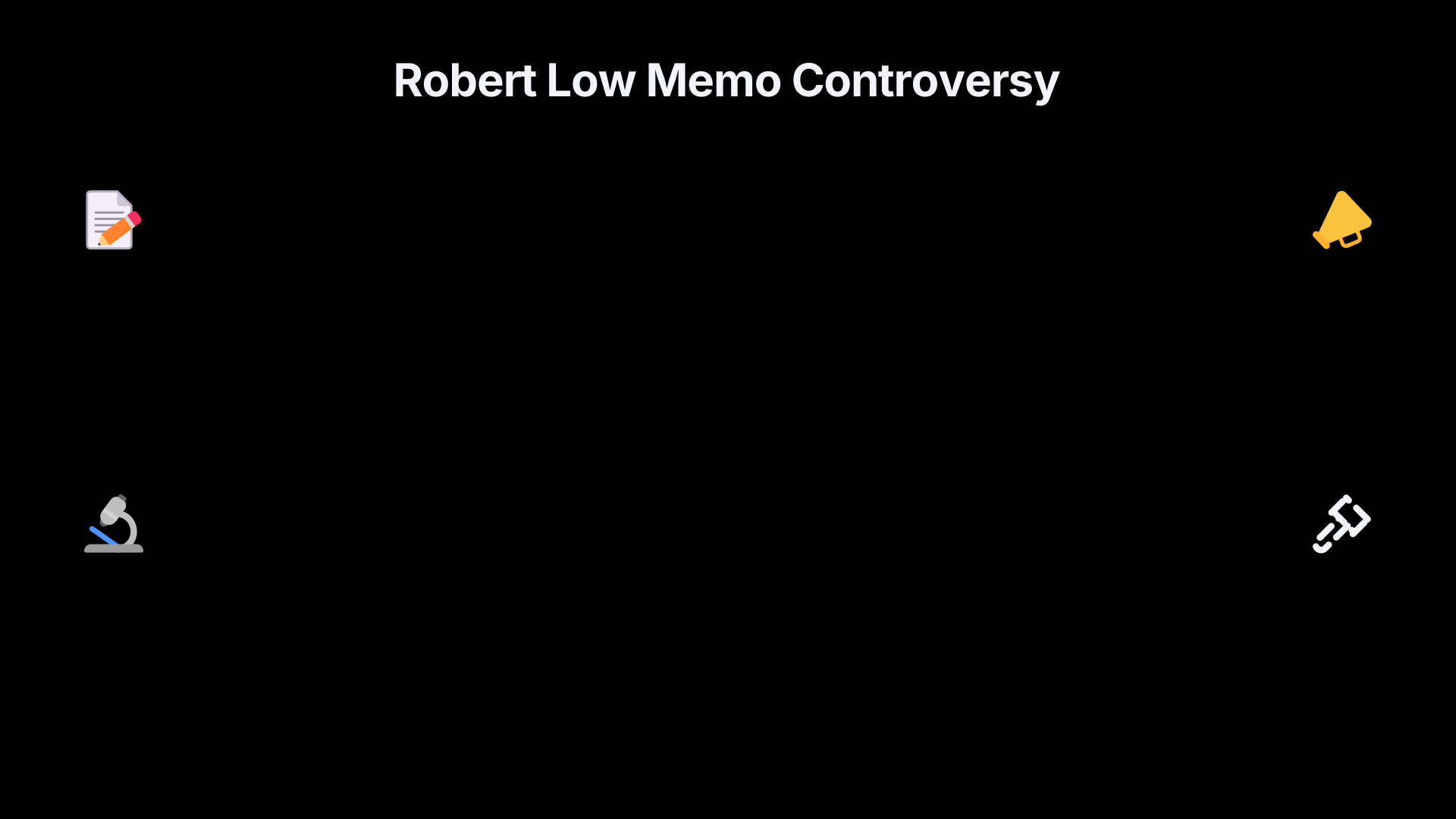
The memo became notorious because of one passage in particular. Low suggested that the study could probably be run by people who were largely sceptical of UFO claims while still appearing objective to the public. He wrote that the “trick” would be to present the project as an impartial scientific inquiry while the researchers themselves had “almost zero expectation” of finding evidence for flying saucers.[Wikipedia]WikipediaCondon CommitteeCondon Committee
That wording became central to later accusations of bad faith. Critics argued that the memo implied the conclusion had effectively been chosen before the investigation started. The phrase “the trick would be” was especially damaging because it sounded less like scientific caution and more like a public-relations strategy.
However, the full memo was more complicated than the famous quotation often suggested. Low was mainly trying to reassure cautious university administrators who worried that studying UFOs could damage Colorado’s academic reputation. The memo described resistance from faculty members who considered the subject unserious or scientifically risky.[NICAP]nicap.orgRobert Low "trick" memoRobert Low "trick" memoAugust 9, 1966. MEMO TO: E. James Archer and Thurston E. Manning. FROM: Robert J. Low. SUBJECT: Some Thoughts…
In that sense, the document reflected a real tension inside the university. By the mid-1960s, UFOs carried strong associations with sensational media coverage, contactee stories, and fringe claims. Many scientists feared ridicule if they became publicly linked to the subject. Low’s memo attempted to frame the project as a sober scientific exercise rather than an endorsement of extraterrestrial visitors.
Even so, the language was unusually blunt. It suggested that at least some senior organisers believed the most likely outcome would be negative before the investigation had examined the strongest cases.
How the memo became public
The memo remained obscure until 1967 and 1968, when physicist James E. McDonald and other UFO researchers learned of its existence through the project’s own files. McDonald, one of the most scientifically qualified critics of the Air Force UFO position, was deeply alarmed by what he read.[Wikipedia]WikipediaCondon CommitteeCondon Committee
The controversy escalated after the National Investigations Committee on Aerial Phenomena (NICAP), a major civilian UFO organisation led by Donald Keyhoe, broke cooperation with the Colorado project. Copies of the memo circulated widely among UFO researchers and journalists.[Wikipedia]WikipediaCondon CommitteeCondon Committee
A major turning point came with journalist John G. Fuller’s 1968 Look magazine article “Flying Saucer Fiasco”. Fuller portrayed the Colorado project as deeply divided internally, with some investigators believing the study was being steered toward a predetermined sceptical conclusion. The article quoted critics who described the investigation as a “trick” on the public.[Wikipedia]WikipediaCondon CommitteeCondon Committee
The dispute became public enough to attract congressional attention. Representative J. Edward Roush questioned the objectivity of the project and called for scrutiny of the study’s conduct.[Wikipedia]WikipediaCondon CommitteeCondon Committee
The internal tensions also damaged the project itself. Staff members David Saunders and Norman Levine were dismissed after conflicts connected to the controversy, and Low eventually resigned from the study in 1968.[Wikipedia]WikipediaCondon CommitteeCondon Committee
Why critics thought the study was biased
For UFO researchers already suspicious of Air Force intentions, the memo appeared to confirm their worst fears. Several aspects of the Colorado project reinforced those suspicions.
First, Edward Condon himself sometimes made public comments that sounded dismissive before the study was complete. In one widely quoted remark from early 1967, he joked that he was “not supposed to reach” a conclusion for another year while already expressing scepticism about UFOs. Critics argued that such comments matched the tone of Low’s memo.[Wikipedia]WikipediaCondon CommitteeCondon Committee
Second, critics believed the project focused too heavily on psychological and sociological explanations rather than the strongest physical evidence cases. Some investigators thought the committee spent too much attention on unreliable witnesses, folklore, and publicity issues instead of concentrating on military radar reports or high-credibility pilot sightings.[Wikipedia]WikipediaCondon CommitteeCondon Committee
Third, sceptics of the report later pointed out that several unresolved cases remained in the final study despite Condon’s strongly negative summary. Astronomer J. Allen Hynek argued that the report’s introduction gave readers a more dismissive impression than the detailed case chapters justified.[Wikipedia]WikipediaCondon CommitteeCondon Committee
This became one of the most enduring criticisms of the Condon Report: some readers believed the headline conclusions were more sceptical than the evidence inside the report itself.
The Low memo therefore served as a framework through which critics interpreted everything else. Once the document became public, every negative statement by project leaders looked potentially suspect.
The arguments made in defence of the study
Defenders of the Colorado project did not usually claim that the Low memo looked good. Instead, they argued that critics exaggerated its importance.
One common defence was that the memo represented Robert Low’s private effort to persuade nervous university administrators to accept the contract, not the formal scientific policy of the investigation. Low was not the lead scientist, and Edward Condon later insisted that the memo did not reflect the actual aims of the project.[Wikipedia]WikipediaCondon CommitteeCondon Committee
Some staff members who worked on the study also argued that the project was not simply a conspiracy to debunk UFOs. Investigator Roy Craig later wrote that the memo did not influence his own work and noted that Condon himself had not even known about the memo for many months.[Wikipedia]WikipediaCondon CommitteeCondon Committee
Even David Saunders, one of the project’s most vocal internal critics, eventually argued that portraying Low as a deliberate conspirator oversimplified events.[Wikipedia]WikipediaCondon CommitteeCondon Committee
Another defence was methodological rather than personal. Supporters of the report argued that scepticism is normal in science, especially when extraordinary claims are involved. From this perspective, expecting investigators to begin with caution about extraterrestrial explanations was not inherently dishonest.
There was also the practical issue facing the Air Force by the late 1960s. Project Blue Book had accumulated thousands of reports over two decades, yet no case had produced widely accepted physical proof of alien spacecraft. Even some scientists open to further research doubted that UFO studies justified large continuing government programmes.
That distinction is important because the Condon Report did not claim every UFO report had been explained. Instead, its central judgement was that further large-scale official study was unlikely to produce major scientific advances.[The Black Vault]documents2.theblackvault.comCondon Report Complete1%8. Final Report of the. Scicntifi c Study of Un',dentified Plying Objects cond'Jcted by the "r…Read more…

Whether the case findings still hold up
The Low memo damaged the credibility of the Colorado study, but it did not automatically invalidate every investigation carried out under the project. That is why the controversy remains historically important rather than decisively settled.
Some later scientific reviews took a middle position. In 1970, a panel organised through the American Institute of Aeronautics and Astronautics criticised parts of the Condon Report and argued that its negative recommendation against future study was not fully supported by the evidence presented.[Wikipedia]WikipediaCondon CommitteeCondon Committee
At the same time, mainstream scientific opinion largely accepted the report’s broad conclusions. The Air Force closed Project Blue Book in 1969, and no equivalent large-scale public government UFO investigation replaced it for decades. The Colorado study therefore succeeded institutionally even while remaining controversial.[The Black Vault]documents2.theblackvault.comCondon Report Complete1%8. Final Report of the. Scicntifi c Study of Un',dentified Plying Objects cond'Jcted by the "r…Read more…
Modern historians of UFO culture often treat the Low memo less as proof of a secret cover-up and more as evidence of conflicting assumptions inside the project. Many participants entered the study with strong prior beliefs, both sceptical and pro-UFO. The memo exposed those tensions in unusually explicit language.
The controversy also changed how later UFO researchers viewed official investigations. For many believers, the Colorado episode became a warning that institutional studies could be shaped by reputational concerns and political pressures. For sceptics, the memo was embarrassing but secondary to the broader lack of conclusive physical evidence.
Within Colorado’s UFO history, the Low memo matters because it transformed a university research project into a lasting dispute over scientific neutrality itself. The argument was no longer only about strange lights in the sky. It became a debate about whether official investigators had genuinely kept an open mind while deciding the future of America’s public UFO programme.
Amazon book picks
Further Reading
Books and field guides related to Did the Colorado UFO study start with a verdict?. Use these as the next step if you want deeper reading beyond the article.
The Report on Unidentified Flying Objects
Shows earlier government approaches to UFO research.
UFOs and Government
Directly relevant to debates about official investigations and bias.
The Demon-Haunted World
Rating: 4.5/5 from 43 Google Books ratings
Addresses scientific skepticism, bias, and evidence evaluation.
eBay marketplace picks
Marketplace Samples
Example marketplace items related to this page. Use the search link to explore similar finds on eBay.


Endnotes
1.
Source: Wikipedia
Title: Condon Committee
Link:https://en.wikipedia.org/wiki/Condon_Committee
2.
Source: nicap.org
Title: Robert Low “trick” memo
Link:https://www.nicap.org/docs/660809lowmemo.htm
Source snippet
Robert Low "trick" memoAugust 9, 1966. MEMO TO: E. James Archer and Thurston E. Manning. FROM: Robert J. Low. SUBJECT: Some Thoughts...
Published: August 9, 1966
3.
Source: colorado.edu
Title: condon report cu boulders historic ufo study
Link:https://www.colorado.edu/coloradan/2021/11/05/condon-report-cu-boulders-historic-ufo-study
Source snippet
University of Colorado BoulderThe Condon Report: CU Boulder's Historic UFO Study5 Nov 2021 — A former CU professor of physics and astroph...
4.
Source: youtube.com
Title: Decades of UFO sightings documented in Condon Report at CU Boulder archives
Link:https://www.youtube.com/watch?v=wMIsiMreDkE
Source snippet
The Condon Report | NASA's Unexplained Files...
5.
Source: youtube.com
Title: The Condon Report | NASA’s Unexplained Files
Link:https://www.youtube.com/watch?v=_W7SqS6UhE4
Source snippet
The UFO Question: How One Mystery Went From Fringe Story to Global Issue...
6.
Source: documents2.theblackvault.com
Title: Condon Report Complete
Link:https://documents2.theblackvault.com/documents/ntis/CondonReport-Complete.pdf
Source snippet
1%8. Final Report of the. Scicntifi c Study of Un',dentified Plying Objects cond'Jcted by the "r...Read more...
7.
Source: documents.theblackvault.com
Link:https://documents.theblackvault.com/documents/ufos/australia/A13693_3092-2-000_30030606.pdf
Source snippet
theblackvault.com000Past UFO studies include one conducted by a Scientific Advisory. Panel of UFOs in January, 1953 (Robertson Panel); an...
Additional References
8.
Source: archive.org
Link:https://archive.org/download/aliensinskies00unit/aliensinskies00unit.pdf
Source snippet
Aliens in the skiesThe implication was obvious: The Colorado study, judging by the words of one of the men who actively directed it, seem...
9.
Source: encyclopedia.com
Link:https://www.encyclopedia.com/science/encyclopedias-almanacs-transcripts-and-maps/condon-report
Source snippet
Condon ReportThe report was skeptical and ascribed most UFO sightings to weather balloons, stars, birds, insects, optical illusions, or a...
10.
Source: centerforinquiry.s3.amazonaws.com
Link:https://centerforinquiry.s3.amazonaws.com/wp-content/uploads/sites/29/1986/07/22165324/p42.pdf
Source snippet
Serious Business, written by a strongly pro-UFO author, Saunders had visited the headquarters of...Read more...
11.
Source: archive.org
Title: Full text of “Scientific Study Of Unidentified Flying Objects
Link:https://archive.org/stream/pdfy-4vyHjooOJagoGAwN/Scientific%2BStudy%2BOf%2BUnidentified%2BFlying%2BObjects_djvu.txt
Source snippet
Condon & Walter Sullivan Condon Report, University of Colorado Submission... American Institute of Public Opinion, popularly known as th...
12.
Source: jstor.org
Link:https://www.jstor.org/stable/1724207
Source snippet
UFO Project: Trouble on the Groundby PM Boffey · 1968 · Cited by 6 — Condon discussed the controversy briefly in pre- liminary telep...
13.
Source: facebook.com
Link:https://www.facebook.com/Saganism101/posts/condons-study-concluded-that-nothing-has-come-from-the-study-of-ufos-in-the-past/859599565974307/
Source snippet
in the past 21 years that has added to scientific knowledge, and that further extensive...
14.
Source: cia.gov
Title: CIA RDP81R00560R000100010008 3
Link:https://www.cia.gov/readingroom/docs/CIA-RDP81R00560R000100010008-3.pdf
Source snippet
UFO CONSENSUSThe project staff received a minor jolt early in October of 1966, when the Denver Post published a story: CU AIDE SLAPS UFO...
15.
Source: scribd.com
Link:https://www.scribd.com/document/655222157/Flying-Saucer-Fiasco
Source snippet
en't the Air Force's business and hinting at a preexisting...Read more...
16.
Source: scribd.com
Title: Condon the Scientific Study of UFOss
Link:https://www.scribd.com/doc/53729897/Condon-the-Scientific-Study-of-UFOss
Source snippet
Colorado UFO Project Analysis | PDFAugust 1966 memo do not characterize an individual with an irrevocable negative. bias towards UFOs. Hi...
Published: August 1966
17.
Source: academia.edu
Link:https://www.academia.edu/80003091/UFOCRITIQUE_UFOs_Social_Intelligence_and_the_Condon_Committee
Source snippet
UFOCRITIQUE UFOs, Social Intelligence, and the Condon...10 Oct 2025 — On August 9,1966, University of Colorado Assistant Dean Robert Low...
Topic Tree