Within Maryland UFOs
How Project Blue Book Shaped Maryland UFO History
Explains what ‘unidentified’ meant historically and how federal records contextualize Maryland sightings.
On this page
- Air Force investigation and classification
- Unidentified vs confirmed sightings
- Modern federal reviews and AARO conclusions
Page outline Jump by section
Introduction
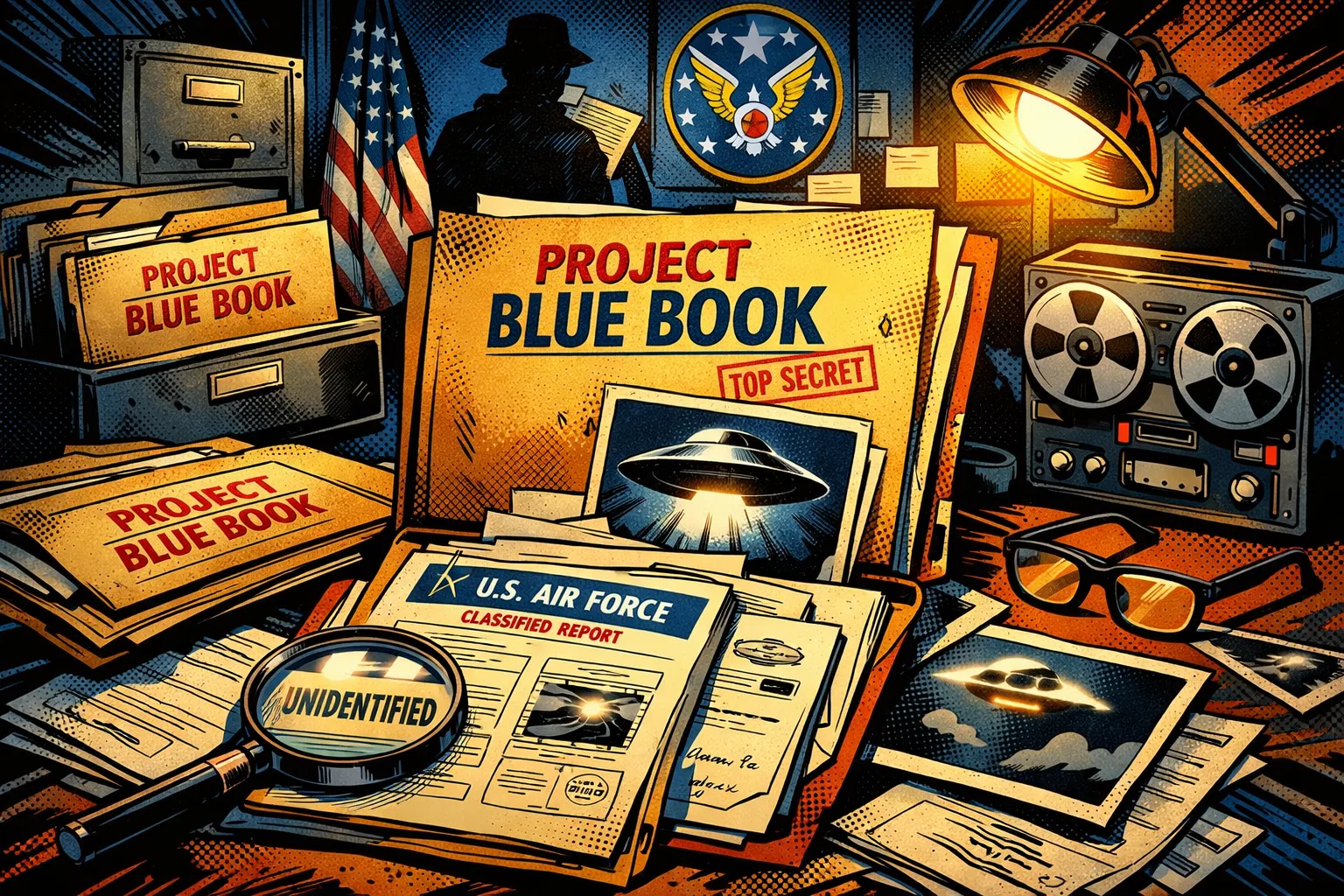
Project Blue Book matters to Maryland UFO history because it explains what an official “unidentified” label did — and did not — mean. In the state’s best-known federal-era case, the 1958 Loch Raven Reservoir incident near Baltimore, the Air Force classification helped preserve the report as an unresolved case, but it did not confirm an extraterrestrial craft. Blue Book was a Cold War record-keeping and threat-assessment programme: it gathered reports, sorted them, looked for national-security implications, and often closed cases as aircraft, balloons, astronomical objects, weather effects or insufficient evidence. Maryland’s value in that record lies less in sensational proof than in showing how federal review turned local witness stories into archival cases that later researchers could check, challenge and reinterpret. The same caution applies today: modern UAP reviews use different language and better intelligence structures, but they still separate “not identified yet” from “proved extraordinary”.[National Archives]archives.govNational Archives Project BLUE BOOKNational Archives Project BLUE BOOK
Why Blue Book became the filter for Maryland reports
Project Blue Book was the United States Air Force’s best-known UFO investigation, active during the period when many classic American sightings entered the public record. The National Archives describes its textual holdings as case files arranged chronologically, project and administrative files, and Office of Special Investigations material, with finding aids by date and location. That matters for Maryland because local reports did not simply remain newspaper stories or folklore: when they reached the Air Force system, they could become searchable federal records.[National Archives]archives.govNational Archives Project BLUE BOOKNational Archives Project BLUE BOOK
The Air Force’s stated purpose was not to prove alien visitation. Its fact sheet says Project Blue Book ended after review of the University of Colorado UFO study, the National Academy of Sciences review, previous UFO studies and Air Force experience. By closure, 12,618 sightings had been reported to the programme, with 701 remaining “unidentified”. The same Air Force summary states that no investigated UFO indicated a national-security threat, no “unidentified” cases demonstrated technology beyond modern scientific knowledge, and no evidence showed they were extraterrestrial vehicles.[Air Force]af.milUnidentified Flying Objects and Air Force Project Blue Book > Air Force > Fact Sheet Display…
For Maryland readers, this is the central interpretive point. A Blue Book “unknown” was not a hidden admission that something non-human had appeared over the state. It meant the available file, as assessed under that programme’s procedures, did not support a confident conventional identification. That could happen because a case was genuinely puzzling, because the observation was brief, because weather or aircraft data were incomplete, because witnesses disagreed, or because the local investigation did not collect enough detail.
The National Archives’ own historical explanation frames Blue Book as a Cold War response to public anxiety, possible Soviet technology and mass reporting. Civilians were given packets asking where they were, how the object moved, what it sounded like and even space to draw it. That standardisation is one reason Maryland cases can still be discussed with more precision than ordinary folklore, but it also reminds us that the system depended heavily on human reports and variable follow-up.[Pieces of History]prologue.blogs.archives.govSource details in endnotes.
Loch Raven shows what an “unknown” could preserve
The Loch Raven Reservoir case is the clearest Maryland example of how Blue Book shaped later UFO history. On 26 October 1958, Phillip Small and Alvin Cohen reportedly saw a large, flat, egg-shaped object over a bridge near Loch Raven Dam. Later summaries of the Blue Book-era material describe the car’s electrical system failing as they approached, a brilliant flash, a loud noise, heat felt by the witnesses, and the object rising quickly before disappearing. UFO researcher Brad Sparks’s catalogue lists the case as Project Blue Book case 6148 and places it among the programme’s “unknowns”.[Internet Archive]archive.orgBrad Sparks Comprehensive Catalog of 1,600 Project Blue Book UFO UnknownsBrad Sparks Comprehensive Catalog of 1,600 Project Blue Book UFO Unknowns
The reason the case has stayed prominent is not simply that it was strange. It combined features that UFO investigators often treat as more interesting than a distant light: two named witnesses, a close-range object, claimed vehicle interference, claimed heat or skin effects, a specific location, and federal-era documentation. Specialist and local accounts continue to cite its Blue Book number because that number ties the story to a record trail rather than leaving it as a loose tale about “something seen near Baltimore”.[Isaac Koi Archive]isaackoi.com19581026 loch raven dam incident19581026 loch raven dam incident
Yet the Blue Book label should be read carefully. “Unknown” preserved the case as unresolved; it did not settle what happened. The evidential weakness remains obvious: there is no widely accepted photograph, recovered material, independent radar track, modern medical documentation in public circulation, or repeatable physical test. The case rests mainly on witness testimony and the quality of the original investigation. That does not make it worthless. It means the right conclusion is narrower: Loch Raven is an important unresolved Maryland report in the federal record, not a confirmed extraordinary vehicle.
This distinction also helps explain why Loch Raven works well as a bridge between Maryland’s local UFO culture and national archives. A purely local legend can become exaggerated over time. A federal case file can become over-interpreted too, but it gives later readers a firmer starting point: date, place, classification, reported effects and a record of how the authorities treated it.
“Unidentified” was a category, not a verdict of alien origin
The most common misunderstanding about Project Blue Book is the idea that “unidentified” means “proved beyond ordinary explanation”. In practice, it was a classification reached after the available evidence failed to support a satisfactory identification. That could be because the report was impressive, but it could also be because key details were missing. The Air Force’s own conclusion explicitly separated the unresolved category from claims of advanced technology or extraterrestrial vehicles.[Air Force]af.milUnidentified Flying Objects and Air Force Project Blue Book > Air Force > Fact Sheet Display…
For Maryland cases, this prevents two opposite errors. The first is dismissing every Blue Book case as nonsense because many reports were later explained as ordinary objects. The second is treating every unresolved file as proof of a hidden breakthrough. Both readings flatten the record. A more useful approach asks: what did the witnesses report, what did investigators check, what alternative explanations were considered, and what evidence was absent?
Blue Book’s structure also affects how Maryland sightings should be ranked. A brief report of a light over Baltimore or the Eastern Shore with no timing, direction, aircraft check or weather context is weak even if it remains unidentified in a civilian database. Loch Raven is stronger as a historical case because it has named witnesses, a specific mechanism claim and Blue Book association. But it is still not strong enough to carry the weight of a firm extraordinary conclusion.
The Air Force closure statements also show why federal review can frustrate UFO enthusiasts. Once a case was filed as unidentified, the programme did not necessarily turn it into a deep scientific research project. J. Allen Hynek, the astronomer associated with Air Force UFO work, later criticised aspects of Blue Book’s methods and argued that “unknowns” should have been the beginning of serious inquiry rather than the end of administrative classification. That criticism is relevant to Maryland because Loch Raven’s enduring appeal partly comes from the feeling that the file was classified but not fully resolved.[dokumen.pub]dokumen.pubSource details in endnotes.
Maryland’s federal setting made official review especially important
Maryland is not just another state in UFO history. It sits beside Washington, DC, contains major aviation corridors, military and government facilities, and has coastal and Chesapeake Bay environments where lights, aircraft, ships, weather and reflections can be difficult to interpret. That geography gives federal review a special role: unusual reports in or near Maryland could raise questions about airspace, military awareness and public reassurance as much as about mystery objects.
The 1952 Washington radar flap is the best nearby example of why this mattered. Although centred on Washington rather than Maryland alone, it involved the same regional airspace and Cold War security atmosphere that shaped later interpretation of Mid-Atlantic reports. The National Archives notes that “Saucers over Washington” formed part of the Blue Book public record and that Blue Book arose in a period when federal officials feared possible Soviet weapons as well as public panic.[Pieces of History]prologue.blogs.archives.govSource details in endnotes.
This regional context should not be used to make every Maryland report sound more dramatic. It should be used to ask better questions. Was the sighting near controlled airspace? Was there radar confirmation? Were military flights, weather balloons, astronomical objects, helicopters, drones, satellites or aircraft landing patterns checked? Did the witness see an object, a light, a reflection or a sensor return? Blue Book’s most useful legacy is not that it solved those questions perfectly; it is that it shows why those questions mattered.
For Loch Raven, the location north of Baltimore and the alleged vehicle interference make it a classic “close encounter” case rather than a radar-airspace case. For other Maryland reports, especially in the Baltimore-Washington corridor, the aviation environment may be more important than the strangeness of the witness description. Federal review helps separate a memorable story from a tested case.
Modern AARO reviews echo Blue Book’s caution, with different tools
Modern federal UAP review is not simply Project Blue Book revived under a new name. The All-domain Anomaly Resolution Office, or AARO, was created in a different security and sensor environment, with attention to air, space, sea and possible cross-domain observations. Its historical report says it reviewed official US government investigatory efforts since 1945, researched classified and unclassified archives, conducted interviews, and worked with intelligence and defence officials. It describes the recurring government concern as whether UAP represent flight-safety risks, competitor technology, or evidence of off-world technology under intelligent control.[aaro.mil]aaro.milUnclassified Final DSD AARO Historical ReportUnclassified Final DSD AARO Historical Report
That modern framing is useful for Maryland because it reinforces the same disciplined reading: unresolved does not mean alien, and explained does not mean foolish. AARO’s historical report states that many cases probably could be resolved as ordinary objects or phenomena if additional quality data were available. That is directly relevant to old Maryland files, where the missing data cannot easily be recreated decades later.[aaro.mil]aaro.milOfficial UAP ImageryAARO UAP Imagery…
The 2021 Office of the Director of National Intelligence preliminary assessment made a similar point about modern cases. It said limited data and inconsistent reporting were key challenges, and that no standardised reporting mechanism existed until the Navy established one in 2019, later adopted by the Air Force. It also noted stigma, sensor limitations, vantage point problems and missing metadata as obstacles. These are modern versions of problems that also weaken older Maryland cases: a compelling report can still be hard to evaluate if the observation was fleeting and the supporting data are thin.[Director of National Intelligence]dni.govDirector of National Intelligence
AARO’s public case imagery page also shows how current review can resolve some cases while leaving others open for prosaic reasons. Some posted cases are assessed as balloons or birds with high confidence; others remain unresolved because the data are insufficient to determine performance, origin or even whether a heat signature comes from a physical source or a sensor/environmental effect. That is a useful model for reading Maryland history: “unresolved” can mean “interesting but underdetermined”, not “confirmed exotic”.[aaro.mil]aaro.milAARO Brief at Annual Transportation Research Board JanuaryAARO Brief at Annual Transportation Research Board January
How federal records should guide Maryland UFO research
The best use of Project Blue Book in Maryland is as a sorting tool, not a belief system. It helps readers distinguish between cases with a federal paper trail and cases known only from later retellings. It also gives a vocabulary for uncertainty: identified, probably identified, insufficient information, and unidentified. Those categories are less exciting than “real” or “fake”, but they are much more useful.
A careful Maryland UFO reader can apply five practical tests:
- Is there a dated official record? A Blue Book case number, National Archives reference or contemporary official correspondence gives a report more historical weight than a late internet retelling.
- What exactly was classified as unknown? The unknown may be the whole event, one witness claim, a radar return, a light source or a mismatch between reports.
- What ordinary checks were possible? Aircraft, astronomical objects, weather, balloons, drones, satellites, reflections and sensor artefacts should be considered before treating a case as anomalous.
- What evidence is missing? A case may remain unresolved because of lost records, poor reporting, no photographs, no instrument data, or no independent witnesses.
- Did later review strengthen or weaken the claim? A case gains weight if later researchers find contemporary documents; it weakens if the story grows more elaborate without new evidence.
On those tests, Loch Raven remains one of Maryland’s most important UFO cases, but its importance is historical and evidential rather than conclusive. It is a strong example of how a local report entered the federal system, how an “unknown” label preserved public interest, and how later researchers could keep debating the case. It is not strong enough to prove a non-human craft over Baltimore County.
What Blue Book still changes about Maryland’s UFO story
Without Project Blue Book, Maryland’s UFO history would be easier to sensationalise and harder to check. The programme left behind a record structure that anchors claims to dates, places and classifications. It also left behind a caution: official interest is not the same as official confirmation. Federal investigators cared because unidentified reports could involve air safety, public anxiety, enemy technology, misidentified military activity or genuine unknowns. That broad mandate explains why Maryland cases could matter even when they did not prove anything extraordinary.
Modern federal review has changed the terminology from UFO to UAP and expanded the sensor and intelligence setting, but the central lesson is similar. The most honest reading of Maryland’s record is neither dismissive nor credulous. Project Blue Book shows that some reports, especially Loch Raven, deserved documentation and remain unresolved in the historical sense. AARO and other modern reviews show that unresolved cases still require better data before they can support extraordinary conclusions.
For Maryland, that is the real value of federal review. It keeps the state’s UFO history grounded in records rather than rumour, while leaving room for genuine uncertainty where the evidence has not caught up with the story.
Amazon book picks
Further Reading
Books and field guides related to How Project Blue Book Shaped Maryland UFO History. Use these as the next step if you want deeper reading beyond the article.
The Report on Unidentified Flying Objects
Directly tied to Air Force UFO investigations.
eBay marketplace picks
Marketplace Samples
Example marketplace items related to this page. Use the search link to explore similar finds on eBay.


Endnotes
1.
Source: archives.gov
Title: National Archives Project BLUE BOOK
Link:https://www.archives.gov/research/military/air-force/ufos
2.
Source: af.mil
Title: Air Force
Link:https://www.af.mil/About-Us/Fact-Sheets/Display/Article/104590/unidentified-flying-objects-and-air-force-project-blue-book/
Source snippet
Unidentified Flying Objects and Air Force Project Blue Book > Air Force > Fact Sheet Display...
3.
Source: prologue.blogs.archives.gov
Link:https://prologue.blogs.archives.gov/2019/12/19/saucers-over-washington-the-history-of-project-blue-book/
4.
Source: archive.org
Title: Brad Sparks Comprehensive Catalog of 1,600 Project Blue Book UFO Unknowns
Link:https://archive.org/download/BernardSieglerTechnicsAndTime1TheFaultOfEpimetheus/Brad%20Sparks%20-%20Comprehensive%20Catalog%20of%201%2C600%20Project%20Blue%20Book%20UFO%20Unknowns.pdf
5.
Source: dokumen.pub
Link:https://dokumen.pub/the-ufo-experience-evidence-behind-close-encounters-project-blue-book-and-the-search-for-answers-9781590033081-9781633412903-1590033086-q-4845629.html
6.
Source: aaro.mil
Title: Unclassified Final DSD AARO Historical Report
Link:https://www.aaro.mil/Portals/136/PDFs/AARO_Historical_Record_Report_Vol_1_2024.pdf
7.
Source: dni.gov
Title: Director of National Intelligence
Link:https://www.dni.gov/files/ODNI/documents/assessments/Prelimary-Assessment-UAP-20210625.pdf
8.
Source: aaro.mil
Title: Official UAP Imagery
Link:https://www.aaro.mil/UAP-Cases/Official-UAP-Imagery/
Source snippet
AARO UAP Imagery...
9.
Source: aaro.mil
Title: AARO Brief at Annual Transportation Research Board January 11 2023 508
Link:https://www.aaro.mil/Portals/136/PDFs/AARO_Brief_at_Annual_Transportation_Research_Board-January_11_2023_508.pdf
10.
Source: aaro.mil
Title: UNCLASSIFIED FY23 Consolidated Annual Report on UAP Oct 25 2023 1236
Link:https://www.aaro.mil/Portals/136/PDFs/UNCLASSIFIED-FY23_Consolidated_Annual_Report_on_UAP-Oct_25_2023_1236.pdf
11.
Source: aaro.mil
Link:https://www.aaro.mil/
12.
Source: unwritten-record.blogs.archives.gov
Title: project blue book looking to the film record
Link:https://unwritten-record.blogs.archives.gov/2013/09/30/project-blue-book-looking-to-the-film-record/
13.
Source: archives.gov
Title: do records show proof of ufos
Link:https://www.archives.gov/news/articles/do-records-show-proof-of-ufos
14.
Source: archives.gov
Link:https://www.archives.gov/research/catalog/catalog-bulk-downloads/uap-bulk-download
15.
Source: unwritten-record.blogs.archives.gov
Link:https://unwritten-record.blogs.archives.gov/2013/09/
16.
Source: archives.gov
Link:https://www.archives.gov/files/declassification/iscap/pdf/2014-004-doc01.pdf
17.
Source: unwritten-record.blogs.archives.gov
Link:https://unwritten-record.blogs.archives.gov/page/69/
18.
Source: prologue.blogs.archives.gov
Title: ufos natural explanations
Link:https://prologue.blogs.archives.gov/2018/04/16/ufos-natural-explanations/
19.
Source: archives.gov
Title: 1977 annual report
Link:https://www.archives.gov/files/about/history/sources/reports/1977-annual-report.pdf
20.
Source: archives.gov
Title: presidential libraries
Link:https://www.archives.gov/research/topics/uaps/presidential-libraries
21.
Source: archives.gov
Title: project blue book 50th anniversary
Link:https://www.archives.gov/news/articles/project-blue-book-50th-anniversary
22.
Source: archives.gov
Link:https://www.archives.gov/news/articles
23.
Source: war.gov
Title: dod examining unidentified anomalous phenomena
Link:https://www.war.gov/News/News-Stories/Article/Article/3965403/dod-examining-unidentified-anomalous-phenomena/
24.
Source: history.navy.mil
Title: u2s ufos and operation blue book
Link:https://www.history.navy.mil/browse-by-topic/disasters-and-phenomena/u2s-ufos-and-operation-blue-book.html
25.
Source: isaackoi.com
Title: 19581026 loch raven dam incident
Link:https://isaackoi.com/ufo-history/ufo/19581026-loch-raven-dam-incident/
26.
Source: Wikipedia
Title: Loch Raven Reservoir
Link:https://en.wikipedia.org/wiki/Loch_Raven_Reservoir
27.
Source: Wikipedia
Title: Project Blue Book
Link:https://en.wikipedia.org/wiki/Project_Blue_Book
28.
Source: mapuap.com
Link:https://mapuap.com/sightings/maryland
29.
Source: britannica.com
Title: Project Blue Book
Link:https://www.britannica.com/topic/Project-Blue-Book
30.
Source: origins.osu.edu
Title: air force investigation ufos
Link:https://origins.osu.edu/read/air-force-investigation-ufos
Additional References
31.
Source: dni.gov
Link:https://www.dni.gov/index.php/newsroom/reports-publications/reports-publications-2021/3550-preliminary-assessment-unidentified-aerial-phenomena
32.
Source: nsa.gov
Link:https://www.nsa.gov/portals/75/documents/news-features/declassified-documents/ufo/usaf_fact_sheet_95_03.pdf
33.
Source: greydynamics.com
Link:https://greydynamics.com/all-domain-anomaly-resolution-office-pentagons-alien-hunters/
34.
Source: theblackvault.com
Link:https://www.theblackvault.com/documentarchive/wp-content/uploads/2020/01/kitgreen-dird.pdf
35.
Source: facebook.com
Link:https://www.facebook.com/WIONews/posts/declassified-documents-raise-intrigueus-air-force-document-cites-12618-ufo-sight/1335121142060390/
36.
Source: amazon.ca
Link:https://www.amazon.ca/Into-Mike-John/dp/B0GD2851CH
37.
Source: reddit.com
Link:https://www.reddit.com/r/space/comments/16ij6ui/nasa_shares_unidentified_anomalous_phenomena/
38.
Source: facebook.com
Link:https://www.facebook.com/groups/AstroCosmoNews/posts/3169113986727486/
39.
Source: studylib.net
Link:https://studylib.net/doc/18714430/catalog-of-project-blue-book-unknowns
40.
Source: facebook.com
Link:https://www.facebook.com/OriginsOSU/posts/recently-the-pentagon-released-more-files-on-ufos-it-seems-like-every-few-months/1809383503713749/
Topic Tree