Within North Dakota UFOs
Was Fargo's Famous UFO Dogfight a Balloon?
The 1948 Fargo chase became a classic pilot UFO case, but its strongest explanation still points to a lighted weather balloon.
On this page
- What Gorman and other witnesses reported
- Why the Air Force took the case seriously
- How the weather balloon explanation holds up
Page outline Jump by section
Introduction
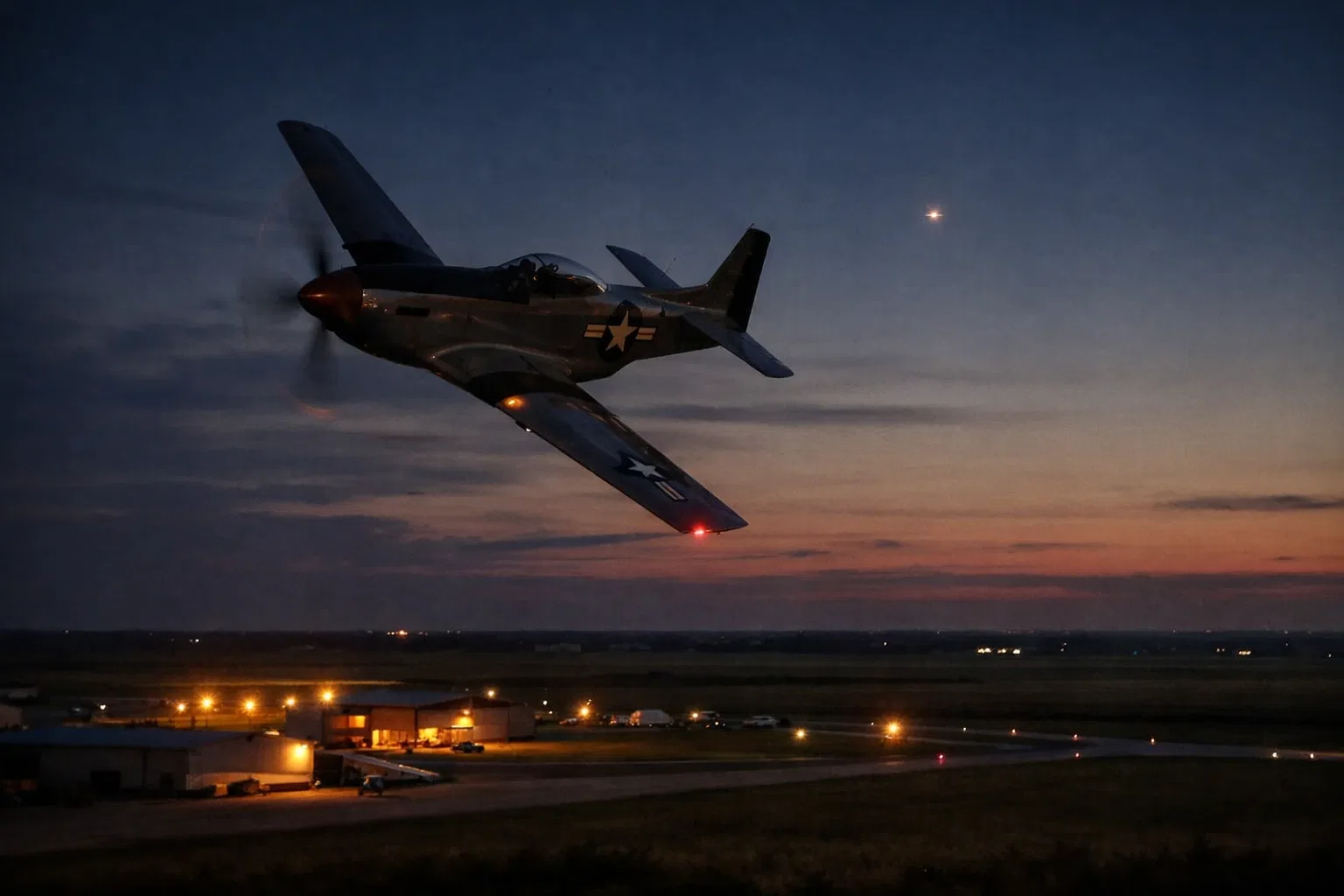
Fargo’s 1948 “Gorman dogfight” is one of North Dakota’s most famous UFO cases because it was not just a vague report from the ground. A Second World War veteran and North Dakota Air National Guard pilot, George F. Gorman, chased a blinking light over Fargo for about 27 minutes; tower staff and the occupants of a Piper Cub also saw a light; and Air Force investigators arrived quickly enough to interview witnesses and inspect Gorman’s aircraft. That makes it a serious historical case within North Dakota’s UFO record. It does not, however, make it a strong case for an extraordinary craft. The best-supported explanation remains the one the Air Force eventually adopted: Gorman probably chased a lighted weather balloon, with his own night-time manoeuvres making the light appear faster, more evasive and more intelligent than it really was.[Wikisource]en.wikisource.orgThe Report on Unidentified Flying Objects/Chapter 3The Report on Unidentified Flying Objects/Chapter 3 - Wikisource, the free online library…[The New Yorker]newyorker.comThe New Yorker Something in the Sky | The New YorkerThe New Yorker Something in the Sky | The New Yorker
What Gorman and other witnesses reported
The incident took place on the evening of 1 October 1948, after Gorman returned to Hector Airport in Fargo from a cross-country flight with other North Dakota Air National Guard pilots. Instead of landing with the rest of the group, he stayed airborne to log night-flying time. Around 9 p.m., while preparing to land, he saw the known Piper Cub below him and then noticed what looked like another light in the area. The tower told him no other aircraft were known to be there, so Gorman decided to investigate.[NICAP]nicap.orgGorman "DogfightGorman "Dogfight
Gorman’s own description is the reason the case became dramatic. He said the light was small, white, round and blinking; when he approached it, the light seemed to become steady, bank sharply and climb. He reported pushing his F-51 Mustang hard, making turns to cut the object off, and at one point diving away when the light appeared to be on a collision course. Later accounts describe him as shaken after landing, even though he was an experienced wartime pilot and flying instructor.[The New Yorker]newyorker.comThe New Yorker Something in the Sky | The New YorkerThe New Yorker Something in the Sky | The New Yorker
The case did not rest only on Gorman’s impressions. The Piper Cub pilot, Dr A. D. Cannon, and his passenger, Einar Nielson, reported seeing a fast-moving light. Two Civil Aeronautics Administration employees in the tower also saw a light, though Edward Ruppelt, later head of Project Blue Book, stressed an important limitation: the other witnesses only partly corroborated Gorman’s story. They saw a light moving over or near the field; they did not all see the full set of intricate “dogfight” manoeuvres that Gorman described from the cockpit.[Wikisource]en.wikisource.orgThe Report on Unidentified Flying Objects/Chapter 3The Report on Unidentified Flying Objects/Chapter 3 - Wikisource, the free online library…
That distinction matters. Multiple witnesses make the sighting harder to dismiss as a lone hallucination or made-up story. But the strongest and strangest parts of the case — apparent head-on passes, impossible turns, and a climb beyond the fighter’s ability to follow — came mainly from the pilot who was actively chasing the light at night. In a fast aircraft, without a clear background, judging another object’s distance, size and speed is difficult even when the object is ordinary.[The New Yorker]newyorker.comThe New Yorker Something in the Sky | The New YorkerThe New Yorker Something in the Sky | The New Yorker
Why the Air Force took the case seriously
The Air Force took the Fargo incident seriously because it arrived at exactly the wrong moment for a simple public-relations dismissal. The modern flying-saucer wave had begun only the previous year, and by 1948 Air Force investigators at Air Technical Intelligence Center were receiving a stream of reports from pilots, military personnel and civilians. Ruppelt later described the Fargo case as the third of the major 1948 “classic” incidents, after the Mantell case and the Chiles-Whitted airline encounter.[Wikisource]en.wikisource.orgThe Report on Unidentified Flying Objects/Chapter 3The Report on Unidentified Flying Objects/Chapter 3 - Wikisource, the free online library…
The immediate response was more than paperwork. Project Sign investigators rushed to Fargo, took witness statements and grounded Gorman’s aircraft so they could examine it. They used a Geiger counter on the F-51 and compared readings with another similar aircraft that had not recently flown. Gorman’s plane showed higher radioactivity, and this initially gave the case an exotic flavour at a time when some investigators were willing to consider advanced or even interplanetary explanations.[Wikisource]en.wikisource.orgThe Report on Unidentified Flying Objects/Chapter 3The Report on Unidentified Flying Objects/Chapter 3 - Wikisource, the free online library…
The radiation point later weakened rather than strengthened the case. Ruppelt wrote that the higher reading was explained by a Wright Field laboratory memorandum: a recently flown aircraft can show more radioactivity than one that has been on the ground for several days, because aircraft at altitude are exposed to more cosmic radiation than aircraft shielded closer to the ground. In other words, the Geiger-counter evidence did not show that Gorman had encountered an “atomic-powered” object; it showed why a quick field measurement can be misleading without a proper control and physical explanation.[Wikisource]en.wikisource.orgThe Report on Unidentified Flying Objects/Chapter 3The Report on Unidentified Flying Objects/Chapter 3 - Wikisource, the free online library…
The official setting also helps explain why the case stayed famous. Project Blue Book itself later became the best-known name for the Air Force UFO programme, though the early Fargo work belonged to the Project Sign era. The National Archives notes that Project Blue Book records were transferred to federal custody, include chronological case files and are available on microfilm; the Air Force states that its UFO investigations from 1947 to 1969 received 12,618 reports, of which 701 remained “unidentified”.[National Archives]archives.govNational Archives Project BLUE BOOKNational Archives Project BLUE BOOK
How the weather-balloon explanation holds up
The balloon explanation has three main strengths: there was a real balloon, the timing fits the beginning of the sighting, and the reported motion can be explained by relative motion and night-time perception.
The key fact is that the Fargo weather station had released a lighted weather balloon shortly before the chase. Ruppelt wrote that an Air Weather Service analysis sent to Air Technical Intelligence Center in January 1949 “proved” that Gorman had fought a lighted balloon. A later New Yorker account of Project Saucer made the same core point: the Fargo station had released a lighted balloon only about ten minutes before Gorman’s routine patrol turned into a chase, and the object’s steady climb fitted balloon behaviour.[Wikisource]en.wikisource.orgThe Report on Unidentified Flying Objects/Chapter 3The Report on Unidentified Flying Objects/Chapter 3 - Wikisource, the free online library…
The most persuasive part of the explanation is not simply “there was a balloon”. It is the way a slowly rising light can appear to dodge a pursuing aircraft. A former Project Saucer technician quoted by The New Yorker compared the problem to trying to chase a buoyant ball underwater: the ball may be rising steadily, but the swimmer’s own zigzags make the target seem elusive. Applied to Fargo, the idea is that Gorman’s turns, dives and climbs created the impression that the light was responding to him.[The New Yorker]newyorker.comThe New Yorker Something in the Sky | The New YorkerThe New Yorker Something in the Sky | The New Yorker
That analysis was reportedly tested. The New Yorker account says a controlled experiment at Wright Field used a weather balloon and a pilot who knew what he was chasing; the pilot was able to duplicate the sort of manoeuvres Gorman had made, showing that a pilot could mistakenly experience a balloon as evasive. Ruppelt also cited similar lighted-balloon incidents in which pilots reported dramatic manoeuvres before the objects were identified.[The New Yorker]newyorker.comThe New Yorker Something in the Sky | The New YorkerThe New Yorker Something in the Sky | The New Yorker
The balloon explanation also accounts for why witnesses saw a light but not a detailed craft. Gorman described a small round light, with no sound, odour or exhaust trail. Tower witnesses and the Cub occupants saw a light moving fast, but they did not provide a consistent, close-range description of a structured object. For a sceptical reading, this is important: the physical evidence is thin, while the perceptual situation — night flying, a bright point source, changing angles, and a motivated pursuit — is exactly the sort of setting in which apparent speed and direction can be badly misjudged.[The New Yorker]newyorker.comThe New Yorker Something in the Sky | The New YorkerThe New Yorker Something in the Sky | The New Yorker
What still gives the case its pull
The Gorman case still attracts attention because the human story is unusually vivid. Gorman was not an anonymous witness glancing at a light from a porch; he was an experienced pilot in a powerful aircraft, speaking to a control tower, chasing the object over a recognisable city. Local retellings have kept that drama alive, including Prairie Public’s Dakota Datebook account, which emphasises the 27-minute chase, the tower observations and the way the story survived the official balloon explanation.[Prairie Public]news.prairiepublic.orgPrairie Public Gorman Dogfight | Prairie PublicPrairie Public Gorman Dogfight | Prairie Public
There are also fair reasons why some readers hesitate before accepting the balloon explanation as complete. Gorman believed the light acted with intention. He reported near-collision impressions and performance beyond his fighter’s ability. Other witnesses did see a light, and the official investigation initially treated the case as puzzling. Those points explain why the case became a “classic” and why it remained attractive to UFO writers who distrusted Air Force conclusions.[Wikisource]en.wikisource.orgThe Report on Unidentified Flying Objects/Chapter 3The Report on Unidentified Flying Objects/Chapter 3 - Wikisource, the free online library…
But the doubts do not carry equal weight. The most dramatic claims depend heavily on cockpit perception during a night pursuit. The radiation evidence faded under ordinary physical explanation. The Air Weather Service supplied a specific, local, time-matched object. And the balloon hypothesis did not require a vague hand-wave: it included a mechanism, a comparison with other balloon chases, and an experiment showing how a pilot could be fooled by relative motion.[Wikisource]en.wikisource.orgThe Report on Unidentified Flying Objects/Chapter 3The Report on Unidentified Flying Objects/Chapter 3 - Wikisource, the free online library…
That is why the Fargo case is best read as historically important but evidentially weakened. It remains central to North Dakota’s UFO history because it brought the state into the early national UFO debate and involved military aviation, official investigation and multiple witnesses. It is not one of the strongest unresolved cases once the balloon evidence is taken seriously.
What the case means for North Dakota’s UFO history
Within North Dakota, the Gorman dogfight sits at the start of a pattern that would later make the state unusually interesting to UFO researchers: sightings tied to aircraft, official records and military settings rather than only casual ground reports. Fargo in 1948 and Minot in 1968 are different cases with different evidence, but both show why North Dakota’s UFO history cannot be reduced to folklore. These were reports that entered formal investigative systems and left a paper trail.[National Archives]archives.govNational Archives Project BLUE BOOKNational Archives Project BLUE BOOK
The lesson of the Gorman case is also cautionary. A trained witness can be sincere, competent and still mistaken about an unfamiliar light under difficult viewing conditions. Multiple witnesses can confirm that something was seen without confirming the extraordinary interpretation placed on it. An official investigation can begin with excitement and end with a mundane explanation as better context arrives.
For readers trying to judge the case today, the most balanced conclusion is clear: Fargo’s famous UFO dogfight was a real reported encounter, seriously investigated and historically significant, but the best evidence points to a lighted weather balloon rather than an unknown craft. Its value is not that it proves an exotic visitor over North Dakota. Its value is that it shows, in unusually concrete form, how a dramatic UFO legend can grow from a genuine aviation incident, a striking witness experience and a later prosaic explanation that many people found less memorable than the chase itself.

Amazon book picks
Further Reading
Books and field guides related to Was Fargo's Famous UFO Dogfight a Balloon?. Use these as the next step if you want deeper reading beyond the article.
The Report on Unidentified Flying Objects
Strong match for readers interested in the Gorman case and official explanations.
eBay marketplace picks
Marketplace Samples
Example marketplace items related to this page. Use the search link to explore similar finds on eBay.


Endnotes
1.
Source: en.wikisource.org
Title: The Report on Unidentified Flying Objects/Chapter 3
Link:https://en.wikisource.org/wiki/The_Report_on_Unidentified_Flying_Objects/Chapter_3
Source snippet
The Report on Unidentified Flying Objects/Chapter 3 - Wikisource, the free online library...
2.
Source: nicap.org
Title: Gorman “Dogfight”
Link:https://www.nicap.org/reports/gorman2.htm
3.
Source: archives.gov
Title: National Archives Project BLUE BOOK
Link:https://www.archives.gov/research/military/air-force/ufos
4.
Source: history.com
Title: ufo dogfight gorman us plane fargo
Link:https://www.history.com/articles/ufo-dogfight-gorman-us-plane-fargo
5.
Source: history.com
Title: Project Blue Book: Declassified
Link:https://www.history.com/videos/project-blue-book-declassified-the-gorman-dogfight
6.
Source: nicap.org
Link:https://www.nicap.org/rufo/rufo-03.htm
7.
Source: newyorker.com
Title: The New Yorker Something in the Sky | The New Yorker
Link:https://www.newyorker.com/magazine/1952/09/06/something-in-the-sky
8.
Source: news.prairiepublic.org
Title: Prairie Public Gorman Dogfight | Prairie Public
Link:https://news.prairiepublic.org/show/dakota-datebook-archive/2022-04-25/gorman-dogfight
9.
Source: Wikipedia
Title: Gorman dogfight
Link:https://en.wikipedia.org/wiki/Gorman_dogfight
10.
Source: news.prairiepublic.org
Title: gorman dogfight
Link:https://news.prairiepublic.org/main-street/2018-12-10/gorman-dogfight
11.
Source: kids.kiddle.co
Title: Gorman dogfight
Link:https://kids.kiddle.co/Gorman_dogfight
12.
Source: hpr1.com
Title: the gorman dogfight
Link:https://hpr1.com/index.php/feature/culture/the-gorman-dogfight
13.
Source: slideshare.net
Link:https://www.slideshare.net/slideshow/project-blue-book-140388203/140388203
Additional References
14.
Source: youtube.com
Title: 12 UFO Stories That Will Keep You Up Tonight | Forgotten History
Link:https://www.youtube.com/watch?v=SoiXiux51uo
Source snippet
UFO देखे जाने की ऐसी घटनाएं, जिसे देख सेना के जवान भी हुए हैरान...
15.
Source: youtube.com
Title: Project Blue Book: Declassified
Link:https://www.youtube.com/watch?v=_ZPbk394_iU
Source snippet
12 UFO Stories That Will Keep You Up Tonight | Forgotten History...
16.
Source: archive.org
Link:https://archive.org/stream/1966CoralLorenzenFlyingSaucersTheStartlingEvidenceOfTheInvasionFromOuterSpacenotOCR/%281966%29%20Coral%20Lorenzen%20-%20Flying%20Saucers%2C%20The%20Startling%20Evidence%20of%20the%20Invasion%20From%20Outer%20Space%20%28not%20OCR%29_djvu.txt
17.
Source: facebook.com
Link:https://www.facebook.com/100095324142521/posts/flying-his-p-51-mustang-on-a-clear-october-evening-gorman-spotted-something-stra/1007643215756474/
18.
Source: archive.org
Link:https://archive.org/stream/dakotadatebook_digital_final2/dakotadatebook_final2_djvu.txt
19.
Source: archive.org
Link:https://archive.org/stream/NewZealandUFO/AIR-39-3-3-Volume-1-Parts-1-and-2-1952-1955_djvu.txt
20.
Source: sacred-texts.com
Link:https://sacred-texts.com/ufo/rufo/rufo05.htm
21.
Source: archive.org
Link:https://archive.org/download/ce-5-close-encounters-of-the-fifth-kind-1999-f-96f-03fa-4e-70790be-7b-062aa-8770dad-5-annas-archive/ce-%205%20close%20encounters%20of%20the%20fifth%20kind%20–%201999%20–%20f96f03fa4e70790be7b062aa8770dad5%20–%20Anna%E2%80%99s%20Archive.pdf
22.
Source: sofrep.com
Link:https://sofrep.com/news/the-time-a-wwii-fighter-pilot-intercepted-a-ufo-over-north-dakota-in-his-p-51-mustang/
23.
Source: fold3.com
Link:https://www.fold3.com/document/7455915/south-hill-virginia-blank-page-62-us-project-blue-book-ufo-investigations
Topic Tree