Within Indiana UFOs
Investigating Indiana UFOs Through Private Investigators and Local Witnesses
Late 1970s–1980s Indiana UFO cases relied on private investigators, local police testimony, and MUFON or NICAP files.
On this page
- Corydon orange light sightings
- MUFON and NICAP involvement
- Analysis of repeated local observations
Page outline Jump by section
Introduction
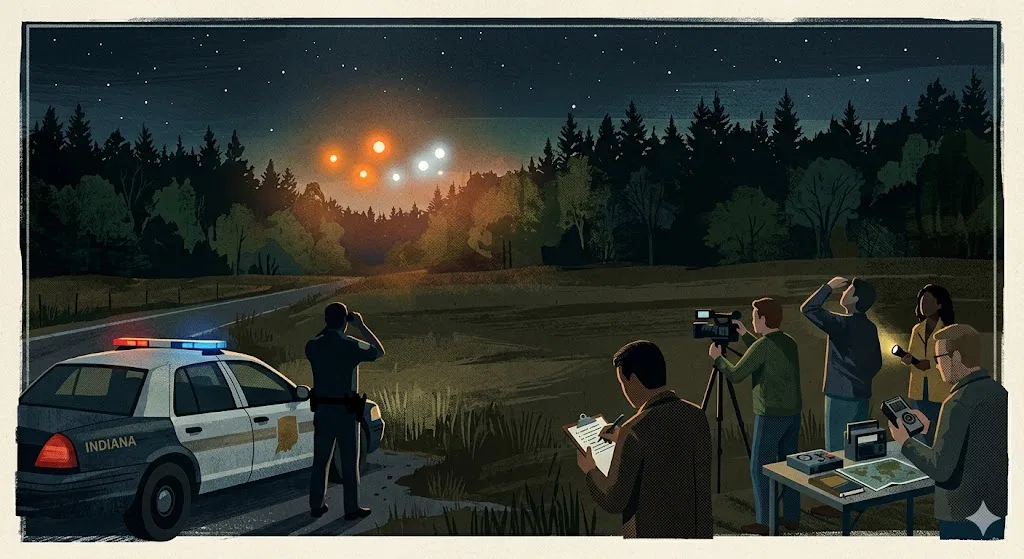
The Corydon UFO cases matter because they show how Indiana’s late-1980s UFO record moved after the Air Force era: not through federal case files, but through frightened residents, sheriff’s deputies, newspaper attention, telephone hotlines, and civilian field investigators. The core reports centred on repeated orange and white lights near Corydon in March 1987, followed by nearby farm and rural-road encounters through the spring and a better-documented August 1987 observation by MUFON investigators themselves. The evidence is stronger than a single rumour because it includes named local witnesses, law-enforcement involvement, contemporary press coverage, investigator logs, maps, forms, and later video analysis. It is also weaker than enthusiasts sometimes imply: most reports were nocturnal lights, distances were uncertain, the video was too small and blurred for firm identification, and conventional explanations such as aircraft or distant headlights could not be dismissed for every observation.[NICAP]nicap.orgOpen source on nicap.org.[NICAP]nicap.orgC:\1HURON\CORYTEXT.HT MC:\1HURON\CORYTEXT.HT M
Why Corydon became a private-investigator case
Corydon sits in Harrison County, roughly west of Louisville, in a rural landscape of fields, treelines, roads, farms, and small communities. That geography matters. Many of the reported objects were low lights near the horizon, over treelines, above fields, or along country roads. In such settings, a witness can easily judge something as nearby, silent, or hovering when its true distance is unknown. At the same time, the rural setting made repeated sightings easier to notice: residents looked out over dark fields rather than bright urban skylines, and several reports came from people already alarmed by earlier appearances.[NICAP]nicap.orgUFO ReportUFO Report
The investigation began in the civilian UFO network rather than in an official government office. The National UFO Reporting Center received a call from a Corydon witness, and MUFON’s international director Walt Andrus asked field investigator James Delehanty to check it. Delehanty’s report says the caller, Mickey Shawler, had already contacted authorities and was frightened; the Harrison County Police Department had been notified before MUFON’s field inquiry began.[NICAP]nicap.orgOpen source on nicap.org.
That chain is typical of the “private-investigator era” in Indiana UFO history. MUFON began in 1969 as the Midwest UFO Network and developed a field-investigator structure in the 1970s, while NUFORC functioned as a public reporting centre that collected and published UFO/UAP reports.[MUFON]mufon.comThrough the AgesThrough the Ages In Indiana, Francis Ridge’s UFO Filter Center and later MUFON Indiana network added another layer: spotters, trained field investigators, local law-enforcement contacts, and monthly status reporting. Ridge later wrote that by 1986 the Indiana group had about 150 members and 36 field investigators.[Avalon Library]avalonlibrary.netAvalon Library Reg Enc[1].pdfAvalon Library Reg Enc[1].pdf
The March 1987 orange-light reports
The best-known Corydon sequence began with repeated reports near Mickey Shawler’s home. Delehanty’s account says the objects had been seen nightly from about 10 March 1987, usually late at night. Shawler described four lights over a treeline: a larger orange light, smaller white lights above it, and red and green lights below. The repeated nature of the observations made the case attractive to investigators because they could attempt follow-up visits rather than merely interview a witness after a one-off event.[NICAP]nicap.orgOpen source on nicap.org.
The case became more significant when Harrison County officer Steve Hamm responded to one of Shawler’s calls. According to Delehanty’s report, Hamm arrived within minutes, confirmed seeing silent lights, and said that as many as twelve lights were visible. Hamm and Shawler reportedly followed the lights in a police cruiser for nearly two hours; off-duty jailer Randy Fessel was also said to have seen them. Sheriff Ed Davis Jr. was reported as downplaying the incident and suggesting there was probably a logical explanation, which is important because even within the local official setting the sighting was not treated as proven extraordinary.[NICAP]nicap.orgUFO ReportUFO Report
The evidential strength of this phase is not that it proves an exotic object. It is that the report moved beyond one witness. A sheriff’s deputy, an off-duty jailer, reporters, and local residents entered the story. Delehanty’s file says eleven people had seen the objects by 24 March, including two newspaper reporters, and that a Louisville Courier-Journal reporter later described seeing a blinking white object and a large glowing orange light over the trees.[NICAP]nicap.orgOpen source on nicap.org.
The weaknesses are just as important. The principal objects were lights at night, often near the horizon or treeline. Some were described as hovering, changing brightness, disappearing, or moving oddly, but exact distance, altitude, and size could not be fixed from the reports. One account noted that aircraft were in the area before, during, and after a sighting. That does not explain every claim, but it makes aircraft misidentification a serious possibility for at least part of the cluster.[Avalon Library]avalonlibrary.netAvalon Library Reg Enc[1].pdfAvalon Library Reg Enc[1].pdf
MUFON, NICAP, and the paper trail
Corydon’s lasting place in Indiana UFO history comes largely from the paperwork. The surviving online record is not a police case file in the modern official sense; it is a civilian-investigator archive, much of it preserved through Francis Ridge’s NICAP-linked materials and MUFON-era reports. The March case file includes a formal field-investigator report, a sighting account, a map reference, and investigator notes.[NICAP]nicap.orgC:\1HURON\CORYTEXT.HT MC:\1HURON\CORYTEXT.HT M
This matters because many local UFO stories fade into folklore. Corydon did not. The reports were collected into a structured UFO-investigation format with named investigators, dates, roles, witness categories, and later cross-references. Ridge’s broader regional archive also places Corydon inside a six-state database of Midwest sightings, rather than treating it as an isolated campfire story.[Avalon Library]avalonlibrary.netAvalon Library Reg Enc[1].pdfAvalon Library Reg Enc[1].pdf
Yet the same archive needs cautious reading. These records were produced by investigators already committed to UFO investigation, not by a neutral public agency with subpoena power, radar access, or full aviation data. MUFON’s own history emphasises its volunteer, field-investigation model, and NUFORC’s public-reporting role depends heavily on what witnesses submit. That makes the files valuable for reconstructing testimony and investigative response, but not automatically decisive about the cause of the lights.[MUFON]mufon.comThrough the AgesThrough the Ages[NUFORC]nuforc.orgNational UFO Reporting Center | Report a UFO | Report a UAPNational UFO Reporting Center | Report a UFO | Report a UAP
The April farm encounter east of Corydon
The Corydon wave did not stop with Shawler’s reports. One striking local account involved Paul Hauswald, aged 14, who was working on a tractor in a field east of Corydon in late April 1987. A Corydon Democrat article, later summarised in the NICAP/Ridge archive, described blue, white, and orange lights above the tractor and a second sighting near a silo. Delehanty later interviewed Paul and Chris Hauswald at their home in October 1987.[NICAP]nicap.orgUFO ReportUFO Report
The farm case is memorable because it was closer and more dramatic than the distant orange-light reports. The boys described sudden illumination, a large object, no sound, and no electromagnetic effect on the tractor. The later investigator note also records that family members had seen the orange-type lights many times in the area.[NICAP]nicap.orgOpen source on nicap.org.
The doubts are familiar. The article and later interview differ in details, including height estimates and the number of witnesses implied. The description blends a close object, coloured lights, a saucer or five-sided shape, and a repeated regional pattern. That makes it interesting as part of the Corydon cluster, but it remains a witness case without independent physical evidence. No trace, radar record, confirmed aviation correlation, or instrument reading appears in the accessible summary.[NICAP]nicap.orgOpen source on nicap.org.
Surrounding-area reports widened the pattern
The Corydon material also includes nearby Harrison County and southern Indiana reports that helped investigators see a cluster rather than a single household’s experience. A March 1987 Mauckport-area report, about 13 miles south of Corydon, described a bright orange-glowing object with a hat-like or domed shape and lights around its rim. The witness was described by investigator Mike Baker as a retired postmaster whom he considered credible.[Avalon Library]avalonlibrary.netAvalon Library Reg Enc[1].pdfAvalon Library Reg Enc[1].pdf
Another report from Central Barren, north of Corydon, involved Deputy Steve Hamm again. Ridge’s chronology describes a late-May 1987 encounter in which Hamm reportedly saw a large boomerang-shaped object near the roadway. This report is relevant because it shows how one law-enforcement witness became a recurring figure in the local case pattern, but that also complicates interpretation: repeated involvement can strengthen continuity, yet it can also concentrate a flap around a small number of active observers.[Avalon Library]avalonlibrary.netAvalon Library Reg Enc[1].pdfAvalon Library Reg Enc[1].pdf
For readers, the key point is that “Corydon” in UFO literature often means a small regional wave: Corydon itself, nearby farms, Mauckport, Central Barren, and other southern Indiana localities observed through MUFON Indiana’s field network. The stronger claim is not that every report describes the same object; it is that the same set of motifs kept recurring in a short period: orange lights, low apparent altitude, silence, treeline observations, rural roads, and local witnesses who called police or investigators.[Avalon Library]avalonlibrary.netAvalon Library Reg Enc[1].pdfAvalon Library Reg Enc[1].pdf
The August 1987 MUFON field observation
The most important Corydon case for evidence assessment is the 23 August 1987 observation, because the investigators were not simply interviewing others. MUFON Indiana’s rapid-deployment group went to Corydon after earlier activity, spoke with about 50 witnesses, and then observed a bright orange object during a field watch. Ridge’s investigation report says at least 12 to 15 people saw the event, including five MUFON field investigators, and that about 1.5 minutes of a 5-to-10-minute event were videotaped.[NICAP]nicap.orgUFO ReportUFO Report
The reported object appeared as a brilliant orange light in the south-south-east, at an initial elevation of roughly 20 to 25 degrees. Witnesses said it seemed to hover or move toward them, wink out and reappear, and later travel east-west at a low elevation. Some binocular observers reported a small red light associated with the orange light. During the final part of the filming, a small aircraft entered the same apparent area, creating what looked like a near miss on the videotape.[NICAP]nicap.orgUFO ReportUFO Report
This is the point at which the case becomes most useful, even for sceptical readers. Ridge did not simply write “unexplained” and stop. The report describes a control sample of a jet aircraft, a call to Evansville Regional Airport Control Tower, discussion of aircraft lighting, and a later computer analysis. The control tower contact reportedly did not identify a known navigation light source, while Ridge considered whether a distant headlight through pollution could produce an orange light.[NICAP]nicap.orgUFO ReportUFO Report
The aircraft-lighting issue cuts both ways. Federal aircraft rules require red and green forward position lights and a white rear position light, while anti-collision lights are aviation red or white and have defined flashing characteristics.[eCFR]ecfr.gov14 CFR Part 25 Subpart F - Lights (FAR Part 25 Subpart F - ECFR0cb7970b9d1fd5f)… Ridge argued that the Corydon light pattern did not fit ordinary aircraft lighting well, particularly because of the missing or oddly placed expected lights. But a witness’s view of a distant aircraft, a landing light, haze, angle, intermittent obstruction, or camera limitations can still produce misleading impressions. The report’s own language leaves aircraft as a remote but not impossible explanation.[NICAP]nicap.orgUFO ReportUFO Report
What the video did and did not prove
The August video is often the feature that makes the Corydon case sound stronger than most orange-light sightings. It should be treated carefully. Video is better than memory alone, but only when it contains enough detail to measure the object’s motion, size, distance, shape, or relation to the background. In this case, the later analysis by David Cook was explicitly inconclusive.[NICAP]nicap.orgUFO ReportUFO Report
Cook’s 1990 analysis found that the images were too small to prove shape or colour. The background was darker than the camera could record usefully, and camera motion caused severe blur. The first object on the tape was analysed as a control and judged to be some type of aircraft. The second object was too small for detailed object analysis, and colour findings were also considered inconclusive because of oversaturation, blur, and lens effects.[NICAP]nicap.orgUFO ReportUFO Report
This weakens any claim that the Corydon video is hard photographic proof of an extraordinary craft. It does not erase the witness reports, but it prevents the video from carrying the case on its own. The fairest assessment is that the film documents a light that investigators could not identify from the available material, not that it proves the light was non-human, non-aircraft, or physically close to the nearby plane.[NICAP]nicap.orgUFO ReportUFO Report
Why repeated local observations are hard to judge
Repeated sightings can make a case look stronger, but they can also create a feedback loop. Once a community expects lights to appear, more people watch the same horizon, interpret ambiguous aircraft or distant lights through the developing story, and call in new reports that resemble earlier ones. Corydon had several features that could amplify that process: local press attention, police involvement, investigators visiting the area, and anxious neighbours. Delehanty’s March report even notes public concern, harassment of the main witness, and talk of people threatening to shoot at objects if they came onto property.[NICAP]nicap.orgUFO ReportUFO Report
At the same time, a feedback-loop explanation cannot fairly dismiss everything. Some reports involved trained or at least experienced observers, including a sheriff’s deputy, a former radar operator among MUFON witnesses, and investigators who deliberately went to observe the area. The August 1987 field watch was not a casual rumour; it was an organised response to an already active local wave.[NICAP]nicap.orgUFO ReportUFO Report
The best evidence-based reading is therefore layered:
- Strongest for historical importance: the case is well documented as an Indiana civilian-investigator wave involving residents, law enforcement, press, MUFON, NUFORC, and NICAP-linked archiving.[NICAP]nicap.orgUFO ReportUFO Report[NICAP]nicap.orgUFO ReportUFO Report
- Moderate for witness credibility: several named or role-identified witnesses reported observations, and some accounts were made close to the events.[NICAP]nicap.orgUFO ReportUFO Report
- Weak for physical proof: the available video analysis was inconclusive, and most reports lack distance, altitude, radar, trace, or instrument data.[NICAP]nicap.orgUFO ReportUFO Report
- Unresolved rather than confirmed: the August case was classed by Ridge as unidentified and of borderline significance, but that is an investigative judgement, not a scientific confirmation of an exotic object.[NICAP]nicap.orgUFO ReportUFO Report
What Corydon adds to Indiana UFO history
Corydon is one of Indiana’s clearest examples of a post-Blue-Book UFO investigation culture. After federal UFO investigation ended, cases like this did not disappear; they moved into private networks, local newspapers, police-dispatch anecdotes, and regional archives. That makes Corydon useful for understanding how Indiana UFO stories were built in the 1980s: by connecting witnesses to hotlines, sending field investigators, collecting forms, making return visits, and trying to compare sightings with ordinary aircraft behaviour.[MUFON]mufon.comThrough the AgesThrough the Ages[Stanford Magazine]stanfordmag.orgStanford Magazine The Truth Is Out There | STANFORD magazineStanford Magazine The Truth Is Out There | STANFORD magazine
It also shows the limits of that system. Civilian investigators could interview witnesses, organise sky watches, call airports, and preserve reports that might otherwise vanish. They could not always obtain decisive aviation records, measure object distance, or prevent a local flap from mixing stronger observations with weaker, second-hand, or emotionally charged claims. The same archive that preserves valuable detail also preserves uncertainty.[NICAP]nicap.orgUFO ReportUFO Report[NICAP]nicap.orgUFO ReportUFO Report
Within the Indiana project, Corydon belongs beside other local flap periods, police-linked reports, and MUFON-era case clusters rather than beside the state’s earliest Air Force files. Its importance is not that it resolves the UFO question. Its importance is that it captures a specific investigative moment: southern Indiana residents seeing strange orange lights, local officers taking calls, private investigators trying to build a case file, and later analysis showing that even unusually well-followed local UFO waves can remain suspended between credible testimony and insufficient proof.
Amazon book picks
Further Reading
Books and field guides related to Investigating Indiana UFOs Through Private Investigators and Local Witnesses. Use these as the next step if you want deeper reading beyond the article.
UFOs and Government
Provides context for the shift from official to civilian investigations.
The UFO Experience: A Scientific Inquiry
Explains investigation standards and witness evaluation.
eBay marketplace picks
Marketplace Samples
Example marketplace items related to this page. Use the search link to explore similar finds on eBay.







Endnotes
1.
Source: nicap.org
Link:https://www.nicap.org/corydon.htm
2.
Source: nicap.org
Title: C:\1HURON\CORYTEXT.HT M
Link:https://www.nicap.org/reports/870823rep.htm
3.
Source: nicap.org
Title: UFO Report
Link:https://www.nicap.org/reports/870823corydon_anal1.htm
4.
Source: mufon.com
Title: Through the Ages
Link:https://mufon.com/history/
5.
Source: nuforc.org
Title: National UFO Reporting Center | Report a UFO | Report a UAP
Link:https://nuforc.org/
6.
Source: nicap.org
Link:https://www.nicap.org/corydon3.htm
7.
Source: nicap.org
Link:https://www.nicap.org/chronos/1987fullrep.htm
8.
Source: nicap.org
Title: UFO Report
Link:https://www.nicap.org/870823corydon_dir.htm
9.
Source: ecfr.gov
Link:https://www.ecfr.gov/current/title-14/chapter-I/subchapter-C/part-25/subpart-F/subject-group-ECFR0cb7970b9d1fd5f
Source snippet
14 CFR Part 25 Subpart F - Lights (FAR Part 25 Subpart F - ECFR0cb7970b9d1fd5f)...
10.
Source: youtube.com
Title: MUFON – The Truth Behind UFOs and Alien Encounters
Link:https://www.youtube.com/watch?v=PSgTuE7HFx0
Source snippet
3 Rural UFO Encounters That Defy Logic | UFO Files...
11.
Source: avalonlibrary.net
Title: Avalon Library Reg Enc[1].pdf
Link:https://avalonlibrary.net/ebooks/Francis%20L.%20Ridge%20-%20Regional%20Encounters%20-%20The%20FC%20Files%20-%20A%20Century%20of%20UFO%20Sightings%20and%20Close%20Encounters%20in%20the%20Midwest.pdf
12.
Source: stanfordmag.org
Title: Stanford Magazine The Truth Is Out There | STANFORD magazine
Link:https://stanfordmag.org/contents/the-truth-is-out-there
Additional References
13.
Source: youtube.com
Title: What It Takes To Be A MUFON Investigator
Link:https://www.youtube.com/watch?v=nrBhhUzwgMk
Source snippet
5 UFOs over Memphis - Originally Aired July 30, 2015...
Published: July 30, 2015
14.
Source: youtube.com
Title: Rural UFO Encounters That Defy Logic | UFO Files
Link:https://www.youtube.com/watch?v=g_sXydyZwDs
Source snippet
4 What It Takes To Be A MUFON Investigator - We Are Not Alone...
15.
Source: youtube.com
Title: UFO: Phantoms of the Night Sky (Southern Indiana)
Link:https://www.youtube.com/watch?v=guXHg6iLqKg
Source snippet
2 MUFON – The Truth Behind UFOs and Alien Encounters...
16.
Source: youtube.com
Title: UFOs over Memphis
Link:https://www.youtube.com/watch?v=nsxgymkGZP8
Published: July 30, 2015
Topic Tree