Within Indiana UFOs
How Indiana’s First UFO Reports Were Documented by the Air Force
Indiana’s 1948–1951 sightings highlight early Air Force files, aviation witnesses, and Project Blue Book entries.
On this page
- Indianapolis 1948 sightings
- Vernon Swigert disc case
- Terre Haute and regional aviation reports
Page outline Jump by section
Introduction
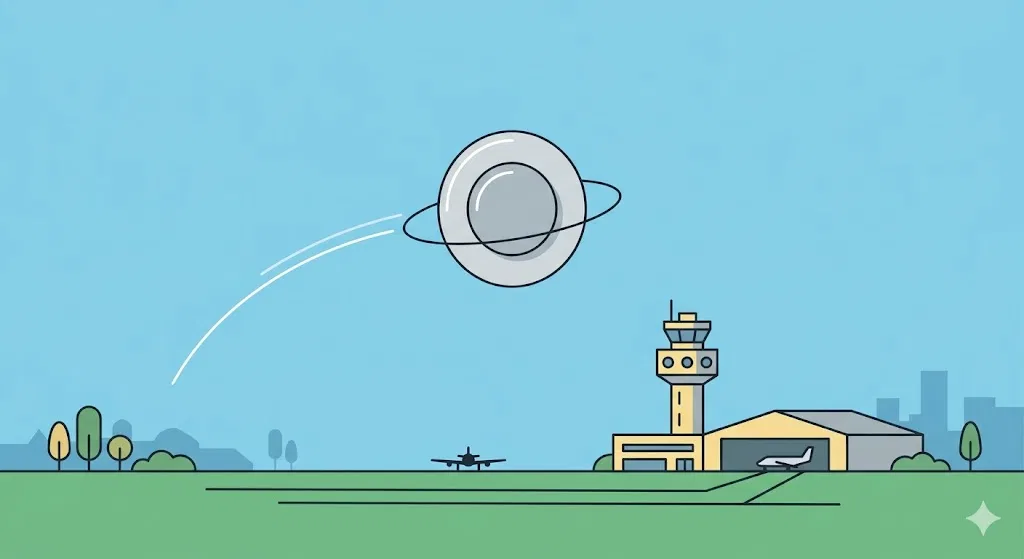
Indiana’s earliest official UFO record is best understood as a small but revealing part of the Air Force era: a handful of 1948–1951 reports in which ordinary Hoosier witnesses, aviation personnel and Air Force investigators tried to describe fast, unfamiliar objects before there was a settled language for doing so. The key Indiana cases are not proof of extraterrestrial craft. They matter because they show how early “flying saucer” reports were gathered, classified, reclassified and later retold through Project Sign, Project Grudge and Project Blue Book. Two Indianapolis sightings in July 1948 and the Terre Haute aviation-linked report of 9 October 1951 stand out because they entered the “unknown” stream of Air Force-era catalogues, while also showing the weakness of brief visual observations: short duration, uncertain distances, no physical trace and little independent instrument data. The strongest reading is balanced: these reports were unusual enough to survive routine explanation, but not strong enough to establish what was seen.
Why Indiana appears in the early Air Force files
The United States Air Force investigated UFO reports between 1947 and 1969, with Project Blue Book later becoming the best-known name for the programme. The Air Force says 12,618 sightings were reported during the full Blue Book period and 701 remained “unidentified”; it also states that no evaluated UFO report showed a national-security threat, unknown scientific principle, or evidence of extraterrestrial vehicles.[Air Force]af.milUnidentified Flying Objects and Air Force Project Blue Book > Air Force > Fact Sheet Display…
For Indiana, that national framework matters because the state’s early cases fall into the first experimental years of official UFO handling. The National Archives notes that Project Blue Book records are declassified and available on 94 rolls of microfilm, but also cautions that it only holds the historic programme records and has no information on later sightings after the project closed in 1969.[National Archives]archives.govNational Archives Project BLUE BOOKNational Archives Project BLUE BOOK
The Indiana reports from 1948 to 1951 sit at the junction between public “flying saucer” excitement and a military bureaucracy still learning how to evaluate such claims. Early Air Force investigations were not a single stable process. A Blue Book archival status report describes the sequence as Project Sign, formally begun in January 1948, renamed Project Grudge in February 1949, and then Project Blue Book in March 1952.[Wikimedia Commons]commons.wikimedia.orgFile:Project Sign reportFile:Project Sign report This changing institutional setting helps explain why some Indiana reports survive today as compact case summaries, while the original investigative depth can be hard to reconstruct.
Indianapolis, July 1948: two short sightings, two lasting records
The first Indiana cases that repeatedly appear in early Air Force-era listings are two Indianapolis reports from the end of July 1948. They are easy to overstate, because later UFO catalogues sometimes present them in a compressed “unknown” format. They are also easy to dismiss too quickly, because both were recorded early, involved named witnesses in later non-government catalogues, and entered the Air Force-derived “unexplained” tradition.
The 29 July 1948 Indianapolis report involved James Toney and Robert Huggins, described in later summaries as employees of a rug-cleaning firm. They were reportedly in a truck when they saw a shiny aluminium object shaped somewhat like an aeroplane propeller, with small cup-like protrusions on the blades. The object was estimated at roughly 6 to 8 feet long and 1.5 to 2 feet wide, crossed the road ahead of them, appeared to descend into a wooded area, and was seen only for a few seconds.[Ufology]ufology.patrickgross.orgSource details in endnotes.
A transcription attributed to Blue Book Special Report No. 14 gives the case a more technical flavour: the object was described as metallic, about 6 to 8 feet long, 2 feet wide, on a flat glide path about 30 feet above the ground, in a moderate left turn, with no trace found afterwards.[Ufology]ufology.patrickgross.orgSource details in endnotes. That final point is important. A close, low-altitude object that apparently went down into woods would be a stronger case if it left recoverable evidence. The absence of a trace does not prove the witnesses were wrong, but it sharply limits what can be concluded.
The 31 July 1948 report is the better-known Vernon Swigert case. Mr and Mrs Vernon Swigert reportedly saw a white cymbal-shaped or domed disc over south-central Indianapolis at 8:25 a.m. Later summaries describe it as about 20 feet across and 6 to 8 feet thick, moving straight and level from west to east across the sky in about ten seconds, with a shimmering effect but no sound or trail.[NICAP]nicap.orgThe Project Bluebook "UnknownsThe Project Bluebook "Unknowns
This is the kind of case that looks stronger in outline than it does under pressure. It has a named couple, a daylight sighting, a distinctive shape and a clear duration. But the apparent speed depends heavily on guesses about distance and altitude. Brad Sparks’s later catalogue, explicitly labelled a database catalogue rather than a “best evidence” list, preserves the uncertainty by noting estimated altitude, possible distance and speed figures with question marks.[Center for UFO Studies]cufos.orgCenter for UFO Studies Microsoft WordCenter for UFO Studies Microsoft Word In plain terms: a short sighting of an object crossing the sky can seem impossibly fast if the object is assumed to be far away, but much less extraordinary if it was smaller or closer than the witnesses believed.
The Vernon Swigert disc case: why it became memorable
The Swigert report became memorable because it fits the early “daylight disc” pattern almost too well: a silent white or metallic-looking object, a simple geometric shape, rapid movement, and no conventional aircraft features. In later lists of Blue Book unknowns, it appears beside other 1948 cases from around the United States, which gave it a place in the national flying-saucer chronology rather than only in local Indiana lore.[NICAP]nicap.orgUFO ReportUFO Report
Its value for Indiana UFO history is not that it proves an exotic object crossed Indianapolis. Its value is that it shows how early official records could preserve a puzzling report while still leaving major interpretive gaps. The description is vivid, but not measurable in the way an investigator would want. There was no photograph, no radar track, no recovered object, and no controlled triangulation from multiple fixed observers. The “unknown” label therefore means something narrower than many casual readers assume: not “confirmed extraordinary craft”, but “not securely identified from the available data”.
The case also illustrates a wider problem in early UFO reporting. Witnesses often gave estimates of size, distance, height and speed during sightings that lasted seconds. Those estimates can be sincere and still unreliable. A white object in bright daylight could be a balloon, aircraft part, bird, debris, atmospheric effect, or something less familiar; the case record may not contain enough evidence to choose among those possibilities. The best conclusion is not that Swigert saw nothing unusual, but that the remaining record cannot carry the heavier claims later attached to it.
Terre Haute, 1951: the aviation report that looks stronger on paper
The Terre Haute case of 9 October 1951 is more substantial because it involved an aviation professional and a nearby pilot report within minutes. Edward J. Ruppelt, the first chief of Project Blue Book and author of an early insider account, described a Civil Aeronautics Administration employee at Terre Haute who saw a bright silver object shaped like a “flattened tennis ball” pass from horizon to horizon in about fifteen seconds. Minutes later, a pilot flying from Greencastle, Indiana, towards Paris, Illinois, radioed Terre Haute to report a large silvery object like a “flattened orange”.[Project Gutenberg]gutenberg.orgSource details in endnotes.
Ruppelt’s account is especially useful because it shows investigation rather than just storytelling. He wrote that the plotted positions suggested both observers could have seen the same object, and that checks were made against balloon paths, weather, air traffic and daylight meteor possibilities. He still did not identify the object.[Project Gutenberg]gutenberg.orgSource details in endnotes. That does not make the case conclusive, but it makes it one of Indiana’s better early official-era reports: it had an aviation setting, a near-contemporary second sighting and at least some attempt to test ordinary explanations.
Later case directories give. They identify the ground witness as CAA Chief Aircraft Communicator Roy Messmore at Hulman Municipal Airport, five miles east of Terre Haute, and the pilot as Charles Warren, flying at about 5,000 feet. These later compilations also note that the Terre Haute sighting was treated as one of the Blue Book unknowns, while the related Paris, Illinois, pilot report was not always listed separately as unknown.[NICAP]nicap.orgUFO ReportUFO Report
The possible connection to the Newport, Indiana, atomic-energy-related facility adds a Cold War texture to the case, but it should be handled carefully. Later summaries say the pilot saw the object head north-east towards the area south of Newport, Indiana.[NICAP]nicap.orgOpen source on nicap.org. That geographical detail explains why the report attracted attention, but it is not evidence that the object had any purposeful connection to the facility. In early 1950s UFO files, proximity to military, atomic or aviation sites often made a sighting feel more significant; it did not by itself identify the object.
What the Air Force could and could not establish
The early Indiana cases show the strengths and limits of the Air Force approach. On the positive side, the official system preserved reports that might otherwise have become only rumours. It recorded dates, times, places, witness roles, approximate shapes and attempted explanations. The Terre Haute case in particular shows a more serious effort to compare two reports and check conventional possibilities.[Project Gutenberg]gutenberg.orgSource details in endnotes.
But the weaknesses are just as important. Don Berliner’s later compilation of Project Blue Book unknowns, based on a 1974 review of Air Force archives, argues that the handling of individual cases was controversial and that many files suffered from missing questionnaires, incomplete follow-up, redaction and inconsistent classification.[NICAP]nicap.orgUFOsand IntelligenceUFOsand Intelligence That criticism does not mean every “unknown” was mishandled or exotic. It means the archive has to be read cautiously: the label attached to a case is not a scientific verdict in the modern sense.
Three practical limits appear again and again in the Indiana material:
- Short duration. The Indianapolis and Swigert sightings lasted only seconds, making precise estimates fragile.
- No physical or instrument record. The early Indiana cases relied mainly on human visual testimony, not radar, photographs, recovered material or multi-station measurement.
- Classification ambiguity. “Unidentified” meant unresolved within the available evidence, not confirmed anomalous technology.
This is why the Air Force’s later public conclusions matter. Its official summary says that after the full programme it found no evidence that unidentified cases represented technology beyond modern scientific knowledge or extraterrestrial vehicles.[Air Force]af.milUnidentified Flying Objects and Air Force Project Blue Book > Air Force > Fact Sheet Display… That conclusion does not solve each Indiana case, but it does set a sober boundary around what the historical files can support.
Terre Haute and regional aviation links
Indiana’s early Air Force-era record is not only an Indianapolis story. Terre Haute matters because it connects UFO reporting to the aviation infrastructure of western Indiana: Hulman Municipal Airport, Civil Aeronautics Administration staff, private flying routes between Indiana and Illinois, and the kind of radio reporting that could quickly bring a sighting to official attention.
The regional setting also shows how state-level UFO history can cross borders. The 1951 incident is partly Indiana and partly Illinois: the ground sighting was at Terre Haute, while the pilot sighting was near Paris, Illinois, after a flight from Greencastle, Indiana.[NICAP]nicap.orgOpen source on nicap.org. For a reader following Indiana UFO history, that matters because the strongest report is not confined neatly within county or state boundaries. It is a moving-airspace case, and the evidence depends on comparing lines of sight across the Wabash Valley region.
A later catalogue by Brad Sparks places the Terre Haute case as case 985 and summarises the object as a silvery “flattened tennis ball” seen by Messmore, followed by Warren’s “flattened orange” report from the air.[Center for UFO Studies]cufos.orgCenter for UFO Studies Microsoft WordCenter for UFO Studies Microsoft Word The catalogue is useful as a map back into the archival tradition, but it should not be treated as a final ruling. Its own style preserves uncertainty with bracketed directions, question marks and cross-references, which is a reminder that even better early cases remain partly reconstructed from imperfect records.
How these early cases shaped Indiana’s later UFO pattern
The 1948–1951 reports set a pattern that repeats in later Indiana UFO history. A sighting becomes more durable when it has at least one of three features: a named or role-based witness, a link to aviation or law enforcement, or a trace in official records. The Indianapolis cases had early catalogue status and named witnesses in later compilations. The Terre Haute case had aviation personnel, a pilot report and a more visible Air Force investigative trail.[NICAP]nicap.orgThe Project Bluebook "UnknownsThe Project Bluebook "Unknowns
They also set a pattern of uncertainty. The most memorable details — a propeller-like object with cups, a white domed disc, a silver flattened sphere — are descriptive rather than diagnostic. They tell us what the witnesses thought they saw, not what the object was. That distinction is central to reading Indiana’s early UFO record fairly.
Later UAP discussions have not overturned that basic lesson. A 2024 Pentagon historical review reported by Reuters found no evidence that any US government investigation or official review confirmed a UAP sighting as extraterrestrial technology, while also noting that better data would probably resolve many unidentified cases as ordinary objects or phenomena.[Reuters]reuters.comPentagon UFO report says most sightings 'ordinary objects' and phenomenaPentagon UFO report says most sightings 'ordinary objects' and phenomena This modern conclusion does not retroactively explain Swigert, Toney, Huggins or Messmore. It does, however, reinforce the cautious standard that should be applied to early Indiana reports: unresolved is not the same as extraordinary.
What readers should take away
Indiana’s first official UFO reports are valuable because they are early, documented and tied to the Air Force investigation era. They are not valuable because they settle the UFO question. The Indianapolis reports show how dramatic, seconds-long daylight sightings entered the official unknown tradition while leaving too little evidence for a firm answer. The Terre Haute case is stronger because it involved aviation witnesses, timing comparisons and investigation, but it too remains a historical puzzle rather than a solved demonstration of exotic technology.
The fairest classification is therefore layered. The 29 July Indianapolis case is intriguing but weakened by its brevity and lack of trace evidence. The 31 July Swigert disc case is historically important but dependent on uncertain estimates. The 9 October Terre Haute case is the most substantial early Indiana report because of its aviation context and attempted correlation between witnesses. None should be presented as confirmed alien craft. All three help explain how Indiana entered the national UFO archive: not through one spectacular crash legend, but through ordinary people and aviation observers whose puzzling reports were caught in the machinery of early Air Force investigation.
Amazon book picks
Further Reading
Books and field guides related to How Indiana’s First UFO Reports Were Documented by the Air Force. Use these as the next step if you want deeper reading beyond the article.
The UFO Experience
Provides context for how Air Force-era sightings were classified and debated.
The Report on Unidentified Flying Objects
Directly covers Project Sign, Grudge and Blue Book, the framework behind Indiana's earliest reports.
UFOs and Government
Examines the history of official UFO investigations including Air Force programs.
Project Blue Book
Focuses on the famous Air Force project that catalogued cases like Indiana's.
eBay marketplace picks
Marketplace Samples
Example marketplace items related to this page. Use the search link to explore similar finds on eBay.


Endnotes
1.
Source: af.mil
Title: Air Force
Link:https://www.af.mil/About-Us/Fact-Sheets/Display/Article/104590/unidentified-flying-objects-and-air-force-project-blue-book/
Source snippet
Unidentified Flying Objects and Air Force Project Blue Book > Air Force > Fact Sheet Display...
2.
Source: archives.gov
Title: National Archives Project BLUE BOOK
Link:https://www.archives.gov/research/military/air-force/ufos
3.
Source: upload.wikimedia.org
Title: Commons The Project Blue Book Archive
Link:https://upload.wikimedia.org/wikipedia/commons/3/3b/Project_Blue_Book%2C_BBA-PBSR1-300.pdf
4.
Source: nicap.org
Title: The Project Bluebook “Unknowns”
Link:https://www.nicap.org/bluebook/unknowns.htm
5.
Source: gutenberg.org
Link:https://www.gutenberg.org/cache/epub/17346/pg17346-images.html
6.
Source: nicap.org
Title: UFO Report
Link:https://www.nicap.org/511009terre_dir.htm
7.
Source: nicap.org
Title: UFO Report
Link:https://www.nicap.org/511009parisIL_dir.htm
8.
Source: reuters.com
Title: Pentagon UFO report says most sightings ‘ordinary objects’ and phenomena
Link:https://www.reuters.com/technology/space/pentagon-ufo-report-says-most-sightings-ordinary-objects-phenomena-2024-03-08/
9.
Source: gutenberg.org
Link:https://www.gutenberg.org/ebooks/25674
10.
Source: archive.org
Title: Brad Sparks Comprehensive Catalog of 1,600 Project Blue Book UFO Unknowns
Link:https://archive.org/download/BernardSieglerTechnicsAndTime1TheFaultOfEpimetheus/Brad%20Sparks%20-%20Comprehensive%20Catalog%20of%201%2C600%20Project%20Blue%20Book%20UFO%20Unknowns.pdf
11.
Source: archive.org
Title: Full text of “The Hynek UFO Report”The Blue Book
Link:https://archive.org/stream/TheHynekUFOReport/The_Hynek_UFO_Report_djvu.txt
12.
Source: ia601409.us.archive.org
Title: Passport to Magonia—UFOs, Folklore, and Parallel Worlds, Jacques Vallée (1993)
Link:https://ia601409.us.archive.org/0/items/PassportToMagonia–UFOsFolkloreAndParallelWorldsJacquesVallee1993/Passport%20to%20Magonia%E2%80%94UFOs%2C%20Folklore%2C%20and%20Parallel%20Worlds%2C%20Jacques%20Vall%C3%A9e%20%281993%29.pdf
13.
Source: ia803206.us.archive.org
Title: David Jacobs The UFO Controversy In America
Link:https://ia803206.us.archive.org/26/items/DavidJacobsTheUFOControversyInAmerica/David%20Jacobs%20-%20The%20UFO%20Controversy%20In%20America.pdf
14.
Source: nicap.org
Link:https://www.nicap.org/chronos/1951fullrep.htm
15.
Source: nicap.org
Title: UFOsand Intelligence
Link:https://www.nicap.org/Intel/UFOsandIntelligence.pdf
16.
Source: nicap.org
Link:https://www.nicap.org/chronos/1948fullrep.htm
17.
Source: archives.gov
Title: project blue book 50th anniversary
Link:https://www.archives.gov/news/articles/project-blue-book-50th-anniversary
18.
Source: upload.wikimedia.org
Title: Project Blue Book, BBA PBSR10 300
Link:https://upload.wikimedia.org/wikipedia/commons/5/54/Project_Blue_Book%2C_BBA-PBSR10-300.pdf
19.
Source: commons.wikimedia.org
Title: File:Project Sign report
Link:https://commons.wikimedia.org/wiki/File%3AProject_Sign_report.pdf
20.
Source: history.com
Title: u s air force closes the book on ufos 45 years ago
Link:https://www.history.com/articles/u-s-air-force-closes-the-book-on-ufos-45-years-ago
21.
Source: history.com
Title: Project Blue Book
Link:https://www.history.com/articles/project-blue-book
22.
Source: war.gov
Title: the department of defense launches the all domain anomaly resolution office web
Link:https://www.war.gov/News/Releases/Release/Article/3513171/the-department-of-defense-launches-the-all-domain-anomaly-resolution-office-web/
23.
Source: youtube.com
Title: Project Blue Book: America’s Obsession with UFOs
Link:https://www.youtube.com/watch?v=Xu4oTBBI5UE
Source snippet
Project Blue Book...
24.
Source: youtube.com
Title: Project Blue Book
Link:https://www.youtube.com/watch?v=jjinS2lZAsY
Source snippet
UFO Interview, 1966...
25.
Source: ufology.patrickgross.org
Link:https://ufology.patrickgross.org/bb/185.htm
26.
Source: cufos.org
Title: Center for UFO Studies Microsoft Word
Link:https://cufos.org/PDFs/pdfs/BB_Unknowns.pdf
27.
Source: Wikipedia
Title: Project Blue Book
Link:https://en.wikipedia.org/wiki/Project_Blue_Book
28.
Source: Wikipedia
Title: Project Grudge
Link:https://en.wikipedia.org/wiki/Project_Grudge
29.
Source: scribd.com
Title: Blue Book Unknowns
Link:https://www.scribd.com/document/472013594/Blue-Book-Unknowns
30.
Source: scribd.com
Title: UFOlogy The Book NICAP Database
Link:https://www.scribd.com/document/51179838/UFOlogy-The-Book-NICAP-Database
31.
Source: origins.osu.edu
Title: project blue book
Link:https://origins.osu.edu/watch/project-blue-book
32.
Source: origins.osu.edu
Title: air force investigation ufos
Link:https://origins.osu.edu/read/air-force-investigation-ufos
33.
Source: britannica.com
Link:https://www.britannica.com/topic/Project-Blue-Book
Additional References
34.
Source: cia.gov
Link:https://www.cia.gov/readingroom/document/cia-rdp81r00560r000100010001-0
35.
Source: youtube.com
Title: Project Blue Book: The Government’s Failed War on Flying Saucers
Link:https://www.youtube.com/watch?v=oL3hwFyXm20
Source snippet
Project Blue Book: America's Obsession with UFOs...
36.
Source: facebook.com
Link:https://www.facebook.com/bakersfieldnow/posts/a-newly-declassified-batch-of-pentagon-and-us-air-force-records-released-friday-/1441029091400635/
37.
Source: scribd.com
Link:https://www.scribd.com/document/730025479/An-Encyclopedia-of-Flying-Saucers-Bowen-Wood
38.
Source: facebook.com
Link:https://www.facebook.com/HISTORY/posts/during-the-cold-war-as-project-blue-book-investigated-potential-ufo-threats-a-sh/1473622884330683/
39.
Source: facebook.com
Link:https://www.facebook.com/SBSAustralia/posts/new-sci-fi-drama-project-blue-book-tells-the-true-story-behind-ufo-sightings-bas/10157156027723686/
40.
Source: facebook.com
Link:https://www.facebook.com/STLPD/posts/noiseless-flying-disc-was-first-reported-locally-by-two-men-at-a-july-4-picnic-n/10159660002014885/
41.
Source: docsteach.org
Link:https://docsteach.org/document/project-blue-book-status-report-number-eight/
42.
Source: dokumen.pub
Link:https://dokumen.pub/revelations.html
43.
Source: sacred-texts.com
Link:https://sacred-texts.com/ufo/rufo/rufo11.htm
Topic Tree