Within Missouri UFOs
Did Project Identification Solve Missouri's UFO Mystery?
Harley Rutledge brought cameras, observers and physics training to Missouri UFO reports, but his study still left major questions open.
On this page
- Who Harley Rutledge was and why his work mattered
- What Project Identification tried to measure in the field
- What stronger data did and did not prove
Page outline Jump by section
Introduction
Harley D. Rutledge’s Project Identification did not solve Missouri’s UFO mystery in the sense of proving alien craft, secret aircraft, or any single extraordinary explanation. Its importance is narrower and more durable: it showed that the 1973 Piedmont-area reports were not just a few isolated rumours, and that a physicist-led field team could collect repeat observations, photographs, instrument readings and structured logs while the activity was still being reported. That made the Missouri flap unusual in UFO history. It moved the question from “did frightened people say strange things?” to “what can be measured when trained observers go looking?” The answer was still frustratingly incomplete. Rutledge gathered stronger data than ordinary witness anecdotes, but the data did not identify the source of the lights or justify a definitive claim about their origin.[sos.mo.gov]sos.mo.govState UFO Capitals of Missouri…
Why Rutledge mattered in the Missouri story
The Piedmont and Wayne County sightings began as a public local episode, not as a laboratory project. Missouri’s Secretary of State summarises the core timeline plainly: between February and April 1973, residents around Piedmont reported unexplained activity in the sky, several hundred calls went to police, sheriffs and newspapers, and the incidents moved from local headlines into national attention. The same state page notes that Project Blue Book, the US Air Force’s long-running UFO investigation, had already ended, so there was no current federal programme to take up the reports.[sos.mo.gov]sos.mo.govState UFO Capitals of Missouri…
Rutledge entered at precisely that gap between public anxiety and official absence. He was not just another UFO enthusiast arriving after the fact. He was a physics professor at Southeast Missouri State University, and the state’s own account says he investigated “with his own team”, issued a public paper in 1973, and later turned the work into the 1981 book Project Identification: The First Scientific Field Study of UFO Phenomena.[sos.mo.gov]sos.mo.govState UFO Capitals of Missouri…
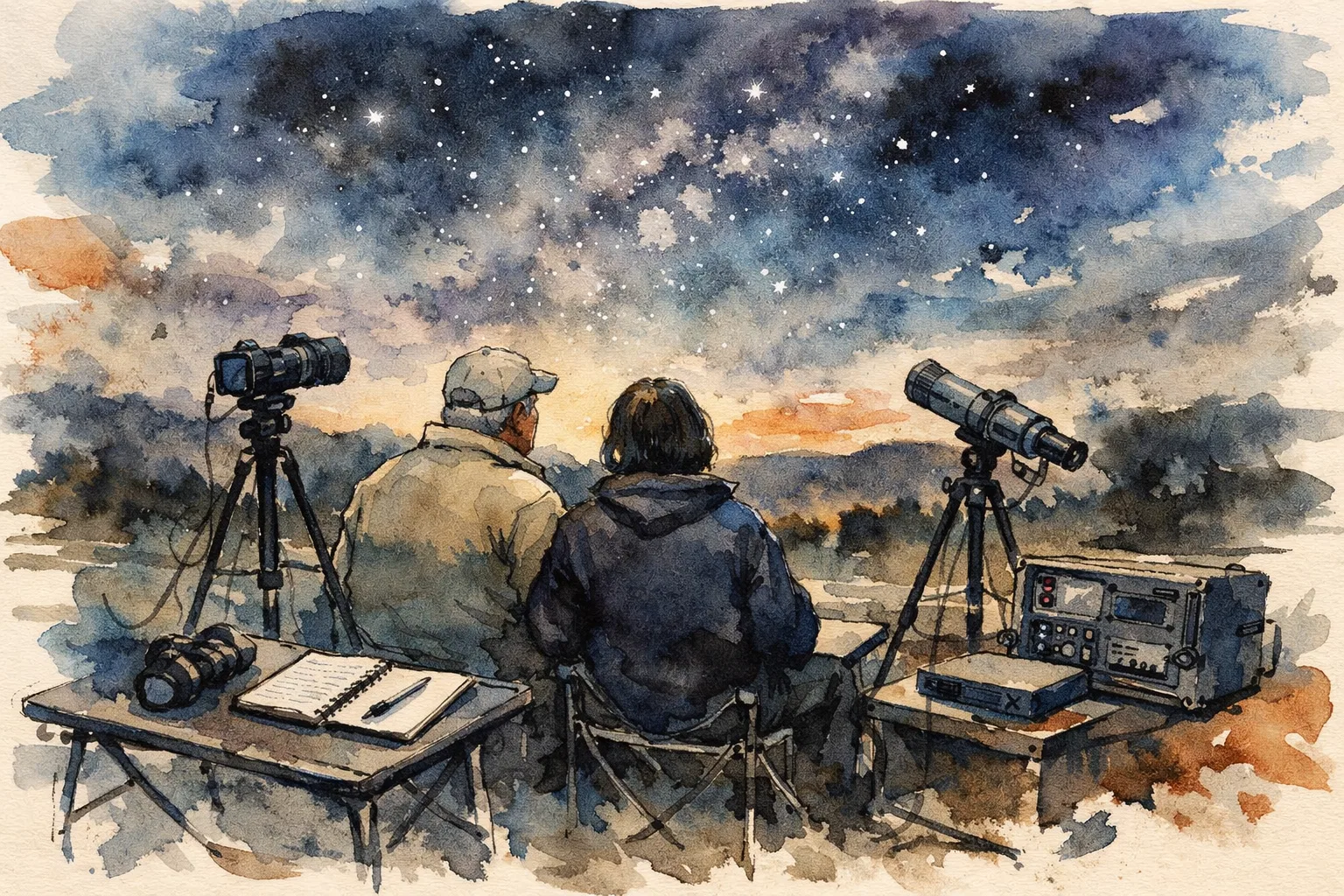
That matters because UFO cases often weaken as they move from witness memory into retelling. Rutledge tried to reverse the usual order. Instead of collecting stories months or years later, he and his observers went into the field while reports were still active, watched the sky, used equipment, and tried to compare what they saw with possible conventional explanations. Google Books’ bibliographic record for Project Identification shows the field character of the study in its indexed terms: aircraft, altitude, cameras, radar, telescopes, photographs, observation stations, Farmington, Fredericktown, Sikeston, Cape Girardeau, Piedmont and Clearwater Lake all appear as recurring topics.[books.google.rw]books.google.rwProject Identification: The First Scientific Field Study of UFO PhenomenaProject Identification: The First Scientific Field Study of UFO Phenomena
The key point for Missouri’s UFO history is not that Rutledge made the case simple. He made it harder to dismiss cheaply. A mass flap can be exaggerated by rumour, media attention and sky-watching expectation, but Rutledge’s work means the Piedmont episode cannot be reduced only to hearsay. It became one of the few state-level UFO episodes where a trained academic team tried to observe and document the phenomenon in real time.
What Project Identification tried to measure
Project Identification was built around a practical idea: if people kept seeing unusual lights in the same broad region, investigators should stop relying only on interviews and try to observe the sky themselves. A modern review of UAP field research describes Rutledge’s campaign as running in the Piedmont area from 1973 to 1981 and says the team used magnetometers, telescopes, optical and radio spectrometers, while also collecting detailed witness reports.[arXiv]arxiv.orgarXiv The New Science of Unidentified Aerospace-Undersea Phenomena (UAParXiv The New Science of Unidentified Aerospace-Undersea Phenomena (UAP
The equipment list matters because it shows what Rutledge was trying to separate. A person seeing a bright light at night may misjudge distance, speed, size and direction. A structured field team can at least try to record where observers were standing, what direction they were looking, whether the object moved against the stars, whether aircraft were nearby, whether a photograph captured anything, and whether any instrument registered an unusual signal. That does not guarantee success, but it improves the quality of the question.
Rutledge’s published book was substantial rather than pamphlet-like. Internet Archive’s catalogue entry lists it as a 1981 Prentice-Hall publication of 265 pages, with plates, bibliography and index. Google Books lists chapters including “Project Identification”, “A Forty-Five Second Transformation” and “Operation Intercept”, and its searchable terms include “Celestron”, “Questar telescope”, “spectrum analyzer”, “radar”, “radio”, “satellite”, “airport”, “runway”, “aircraft” and “pseudostar”. Those terms point to a study concerned not only with mystery, but with the ordinary sky traffic and optical confusion that any serious UFO investigation has to handle.[Internet Archive]archive.orgSource details in endnotes.
In plain terms, the project tried to measure three things:
- Whether the reports were repeatable enough to observe directly. Rutledge’s team did report repeated sightings during field work, which is why the study still attracts attention.
- Whether unknown lights could be distinguished from aircraft, stars, satellites, reflections or atmospheric effects. The book’s own indexed vocabulary shows that conventional aerial and astronomical explanations were part of the working problem, not an afterthought.[books.google.rw]books.google.rwOpen source on google.rw.
- Whether instruments could add anything beyond human testimony. Later UAP researchers have treated Project Identification as an early, imperfect attempt at instrumented monitoring, valuable partly because it exposed how difficult such monitoring is without automated, synchronised systems.[arXiv]arxiv.orgarXiv The New Science of Unidentified Aerospace-Undersea Phenomena (UAParXiv The New Science of Unidentified Aerospace-Undersea Phenomena (UAP
That last point is crucial. Rutledge was not working with today’s cheap digital cameras, GPS time-stamping, automated all-sky systems, networked sensors or machine-learning filters. His project was ambitious for the 1970s, but it was still labour-intensive, observer-dependent and vulnerable to the same night-sky ambiguities that complicate many UFO reports.
What the stronger data proved
The strongest thing Project Identification proved was that the Piedmont-area flap could support organised field observation. That may sound modest, but in UFO history it is a meaningful threshold. Many celebrated cases consist of one event, one set of witnesses and no chance to collect further data. In Missouri, Rutledge believed there was enough continuing activity to justify repeated expeditions, observation stations and technical logging. A later scientific survey of UAP research describes the project as the first instrumented scientific attempt to study these phenomena and says it informed later field-monitoring efforts, even though it lacked the systematic automation researchers would want now.[arXiv]arxiv.orgarXiv The New Science of Unidentified Aerospace-Undersea Phenomena (UAParXiv The New Science of Unidentified Aerospace-Undersea Phenomena (UAP
It also proved that some witnesses were not merely inventing the existence of unusual-looking lights. Rutledge’s team itself reported observations, and the study’s documentation included photographs, diagrams and statistical tables according to contemporary book descriptions and reviews. The point is not that every observed light was extraordinary. The point is that the investigation generated its own observation record, rather than depending entirely on second-hand reports from local residents.[Vatican Observatory]vaticanobservatory.orgSource details in endnotes.
The project further showed that Missouri’s 1973 UFO story was not only a cultural episode, although it certainly became one. The state later formalised Piedmont and Wayne County as the “UFO Capitals of Missouri” for the fiftieth anniversary, partly as a tourism and heritage designation. But Rutledge’s study gives that local identity a harder evidential core: a named academic investigator, a defined project, field teams, equipment and a published record.[sos.mo.gov]sos.mo.govState UFO Capitals of Missouri…
Perhaps most importantly, Project Identification proved the value of asking a disciplined but limited question. “Can we prove what these lights are?” was too large. “Can we observe, record and classify some of what people are reporting?” was more realistic. On that narrower question, Rutledge’s work remains one of the more serious Missouri contributions to UFO research.

What the data did not prove
Project Identification did not prove extraterrestrial visitation. It did not prove a secret military programme. It did not prove that every Piedmont-area report described the same thing. It did not remove the possibility that some sightings were aircraft, stars, planets, satellites, atmospheric effects, misperceptions, local rumour, or a mixture of ordinary and unexplained observations.
This distinction is where many retellings of the case become too strong. The word “unidentified” is not a conclusion about origin. It means the available information did not allow a secure identification. The National Archives’ summary of Project Blue Book is useful here because it shows the same tension at federal scale: out of 12,618 reports collected between 1947 and 1969, 701 remained “Unidentified”, but that did not make them proven spacecraft.[National Archives]cdn.nationalarchives.gov.ukSource details in endnotes.
Rutledge’s field study faces the same evidential boundary. A light that appears to manoeuvre oddly may be genuinely puzzling, but speed and distance are hard to judge without reliable triangulation. A photograph may show a light trail without establishing what produced it. A witness may be sincere and still be mistaken about scale, altitude or motion. An instrument may record a fluctuation without proving that it was caused by the light being watched. These are not dismissive points; they are the ordinary problems of turning field observations into firm conclusions.
The best modern comparison is not to ask whether Rutledge “won” the UFO debate, but to compare his limitations with the standards now proposed for UAP field studies. Recent UAP research discussions emphasise time synchronisation, instrument positioning and diverse sensors because ambiguous evidence can look impressive until the basic measurement chain is tested. The same modern review that praises Project Identification also notes that Rutledge’s team could not build the kind of systematic or automated approach now considered desirable.[arXiv]arxiv.orgarXiv The New Science of Unidentified Aerospace-Undersea Phenomena (UAParXiv The New Science of Unidentified Aerospace-Undersea Phenomena (UAP
That is why the fairest verdict is mixed. Rutledge improved the evidence base for the Missouri flap, but the improvement was not enough to settle the cause.
Why sceptics still had room to object
Sceptical criticism of Project Identification did not have to show that every observation was false. It only had to show that the leap from “unidentified light” to “extraordinary phenomenon” was not fully supported. The Skeptical Inquirer review record preserved by the Center for Inquiry gives a flavour of that debate, noting Rutledge’s high rate of observations in 1973 but also treating the book as something to be challenged rather than accepted at face value.[cdn.centerforinquiry.org]cdn.centerforinquiry.orgSource details in endnotes.
The sceptical concerns are easy to understand. Field teams can be more careful than casual witnesses, but they can also become highly motivated observers. If a team spends night after night looking for unusual lights in an area famous for unusual lights, it may record more ambiguous stimuli than a control group would. Aircraft seen at odd angles, distant landing lights, stars near the horizon, planets, meteors, satellites and local reflections can all become more compelling in a charged setting.
There is also the classification problem. Once an observation enters the “unidentified” category, it can gain a stronger aura than the data deserves. Some UFO literature treats a residue of unexplained cases as if it were positive evidence for one favoured theory. A stricter reading treats that residue as a problem still needing better data. Rutledge’s work sits between those positions: too organised to ignore, too inconclusive to close the case.
The current US government language around UAP illustrates the same caution. AARO describes unidentified anomalous phenomena as objects or events that are not immediately identifiable and says it approaches reports through a scientific, data-driven framework. Its public case material includes examples resolved as balloons, cases closed as not anomalous, and cases still under analysis or unresolved. That structure is a useful model for reading Rutledge: unresolved does not mean meaningless, but resolved and unresolved cases need to be separated carefully.[AARO]aaro.milOpen source on aaro.mil.
What Rutledge changed for later UFO research
Rutledge’s most lasting contribution was methodological. He made the Missouri case a field-observation problem rather than only a folklore problem. Later researchers interested in UAP monitoring have looked back at Project Identification as an early attempt to do what many now argue should be done with better tools: set up sensors, collect continuous data, log conditions, compare sightings against known objects, and avoid relying solely on memory.[arXiv]arxiv.orgarXiv The New Science of Unidentified Aerospace-Undersea Phenomena (UAParXiv The New Science of Unidentified Aerospace-Undersea Phenomena (UAP
That legacy is especially important because UFO research has often suffered from two opposite failures. Believers can over-interpret weak evidence, while sceptics can dismiss witness experience without doing much field work. Rutledge tried to occupy the difficult middle ground: take the reports seriously enough to investigate, but use instruments and repeated observation rather than only stories.
The Missouri setting also gave his work a distinctive character. This was not a military pilot case, a radar case from a secure base, or a single dramatic close encounter. It was a rural flap in the Ozark foothills, linked to Piedmont, Wayne County, Clearwater Lake and surrounding communities. Its value lies in the pattern: many reports, public concern, media attention, no active federal UFO programme, and a local academic team stepping in.[sos.mo.gov]sos.mo.govState UFO Capitals of Missouri…
That makes Project Identification a useful bridge between local history and scientific aspiration. For local memory, it helps explain why Piedmont’s UFO reputation survived long enough to become a formal state designation in 2023. For UFO research, it remains a reminder that better evidence is possible, but also that better evidence may still fall short of proof.[sos.mo.gov]sos.mo.govState UFO Capitals of Missouri…
The balanced verdict
Project Identification proved that the 1973 Missouri UFO flap deserved more careful treatment than ridicule. It proved that trained observers could go into the field, collect repeat observations, use instruments, and produce a substantial written record. It proved that the Piedmont story was not merely an after-dinner legend assembled decades later, because the investigation began while reports were still active and became part of the documented history of the episode.[sos.mo.gov]sos.mo.govState UFO Capitals of Missouri…
But it did not prove what many readers most want to know. It did not identify the lights. It did not establish a single cause. It did not demonstrate extraterrestrial origin. It did not remove the ordinary problems of night observation, uncertain distance, observer expectation and incomplete instrument coverage.
The fairest answer to the page’s central question — did Project Identification solve Missouri’s UFO mystery? — is no, but it changed the quality of the mystery. Before Rutledge, the Piedmont reports could be treated mainly as a local scare, a media flap or a bundle of witness stories. After Rutledge, they also had to be treated as one of the more serious field-study attempts in American UFO history. That is why Harley Rutledge remains central to Missouri’s UFO record: not because he proved the extraordinary, but because he showed how much work was required before anyone could responsibly claim to have done so.
Amazon book picks
Further Reading
Books and field guides related to Did Project Identification Solve Missouri's UFO Mystery?. Use these as the next step if you want deeper reading beyond the article.
The UFO Experience
Explains investigative frameworks relevant to evaluating Rutledge's conclusions.
Project Identification
Directly addresses whether Project Identification explained the sightings.
eBay marketplace picks
Marketplace Samples
Example marketplace items related to this page. Use the search link to explore similar finds on eBay.


Endnotes
1.
Source: sos.mo.gov
Link:https://www.sos.mo.gov/symbol/ufo
Source snippet
State UFO Capitals of Missouri...
2.
Source: books.google.rw
Title: Project Identification: The First Scientific Field Study of UFO Phenomena
Link:https://books.google.rw/books/about/Project_Identification.html?id=T4NTAAAAMAAJ
3.
Source: arxiv.org
Title: arXiv The New Science of Unidentified Aerospace-Undersea Phenomena (UAP)
Link:https://arxiv.org/html/2502.06794v1
4.
Source: archives.gov
Title: National Archives Project BLUE BOOK
Link:https://www.archives.gov/research/military/air-force/ufos
5.
Source: archive.org
Link:https://archive.org/details/projectidentific0000rutl
6.
Source: cdn.centerforinquiry.org
Link:https://cdn.centerforinquiry.org/wp-content/uploads/sites/29/1982/04/22165422/p70.pdf
7.
Source: aaro.mil
Link:https://www.aaro.mil/
8.
Source: aaro.mil
Link:https://www.aaro.mil/UAP-Cases/Official-UAP-Imagery/
9.
Source: archive.org
Link:https://archive.org/stream/412589424-ufos-and-the-extraterrestrial-contact-movement-v-1/412589424-Ufos-and-the-Extraterrestrial-Contact-Movement-v1_djvu.txt
10.
Source: aaro.mil
Title: UNCLASSIFIED FY23 Consolidated Annual Report on UAP Oct 25 2023 1236
Link:https://www.aaro.mil/Portals/136/PDFs/UNCLASSIFIED-FY23_Consolidated_Annual_Report_on_UAP-Oct_25_2023_1236.pdf
11.
Source: aaro.mil
Link:https://www.aaro.mil/Submit-A-Report/
12.
Source: catalog.missouri.edu
Link:https://catalog.missouri.edu/faculty/
13.
Source: archives.gov
Title: project blue book 50th anniversary
Link:https://www.archives.gov/news/articles/project-blue-book-50th-anniversary
14.
Source: books.google.rw
Link:https://books.google.rw/books?id=3claAAAAYAAJ&source=gbs_navlinks_s
15.
Source: cdn.nationalarchives.gov.uk
Link:https://cdn.nationalarchives.gov.uk/documents/briefing-guide-12-07-12.pdf
16.
Source: vaticanobservatory.org
Link:https://www.vaticanobservatory.org/sacred-space-astronomy/mo-ufos-and-miracles/
17.
Source: Wikipedia
Title: Harley Rutledge
Link:https://en.wikipedia.org/wiki/Harley_Rutledge
18.
Source: Wikipedia
Title: Project Blue Book
Link:https://en.wikipedia.org/wiki/Project_Blue_Book
19.
Source: britannica.com
Title: Project Blue Book
Link:https://www.britannica.com/topic/Project-Blue-Book
20.
Source: science.howstuffworks.com
Title: 1973 missouri ufo
Link:https://science.howstuffworks.com/space/aliens-ufos/1973-missouri-ufo.htm
21.
Source: vaticanobservatory.org
Title: ufos in mo
Link:https://www.vaticanobservatory.org/sacred-space-astronomy/ufos-in-mo/
Additional References
22.
Source: youtube.com
Title: Missouri Mysteries, Chapter Two
Link:https://www.youtube.com/watch?v=8MS1s5YlhCM
Source snippet
How Piedmont became the UFO Capitol of Missouri | Living St. Louis...
23.
Source: youtube.com
Title: Harley Rutledge and Project Identification, De-emphasized Documentary Footage
Link:https://www.youtube.com/watch?v=hoOv8b8wA-A
Source snippet
1973 UFO Wave, Broadened Scientific Context and Field Study...
24.
Source: youtube.com
Title: Project Identification, Scientific Field Study of UFOs
Link:https://www.youtube.com/watch?v=FP0bWr_PDb4
Source snippet
Harley Rutledge and Project Identification, De-emphasized Documentary Footage...
25.
Source: youtube.com
Title: How Piedmont became the UFO Capitol of Missouri | Living St. Louis
Link:https://www.youtube.com/watch?v=JDTIqTJMBZ0
Source snippet
Project Identification, Scientific Field Study of UFOs...
26.
Source: nsa.gov
Link:https://www.nsa.gov/portals/75/documents/news-features/declassified-documents/ufo/usaf_fact_sheet_95_03.pdf
27.
Source: war.gov
Title: department of war releases unidentified anomalous phenomena files in historic t
Link:https://www.war.gov/News/Releases/Release/Article/4480582/department-of-war-releases-unidentified-anomalous-phenomena-files-in-historic-t/
28.
Source: facebook.com
Link:https://www.facebook.com/NetflixFansDiaries/posts/20-of-university-scientists-claim-to-have-witnessed-a-ufo-or-are-acquainted-with/689485016556606/
29.
Source: archivesfoundation.org
Link:https://archivesfoundation.org/documents/50-years-ago-government-stops-investigating-ufos/
30.
Source: facebook.com
Link:https://www.facebook.com/groups/1565114127094467/posts/2906047826334417/
31.
Source: instagram.com
Link:https://www.instagram.com/p/DYupr4uxylL/
Topic Tree